Roofing in Milborne St Andrew
Slate and tile repairs, edge work, leadwork and re-covers on the older houses along the village street, priced in writing after a proper survey.
The site visit is free and so is the written itemised quote. Thomas Hannen prices every job himself.
How much of Milborne St Andrew is listed is what complicates a roof here, so the first thing we settle is which side of that line your address falls. There is no conservation area over the village, so on an unlisted house a like for like re-cover needs no application at all.
Most people ring here for one of three reasons. A slate or two has come off and the same slope keeps dropping them. A stain is spreading round a chimney or in a valley on a house that has been added to more than once. Or a roof has got to the point where the owner wants an honest answer rather than another patch.
We get on the roof, look in the loft, photograph what is up there and price it in writing. On an older village house the survey matters more than usual, because what holds the covering on is rarely what you can see from the ground. The site visit and the written quote are both free.
The work
On a listed roof, dry fix is the wrong answer
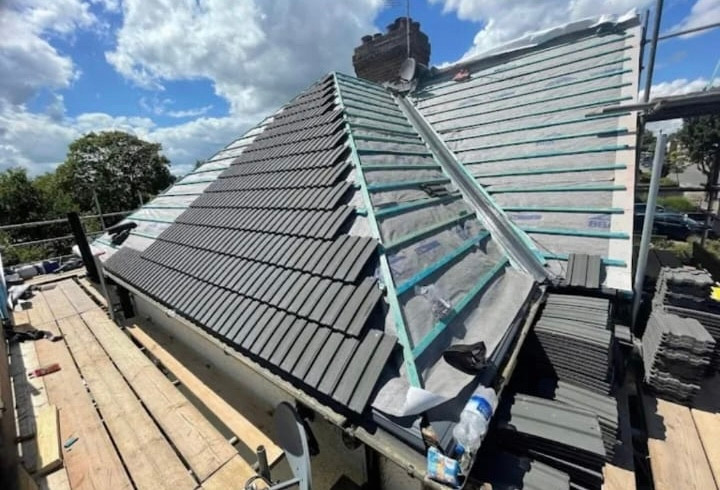
Slate work. There is a good deal of natural slate on the older houses here, and slate almost never fails as slate. The nails go first. Once a slope sheds two or three every winter the fixings are rusting through across the whole of it, and hanging another tingle on each one is money after money.
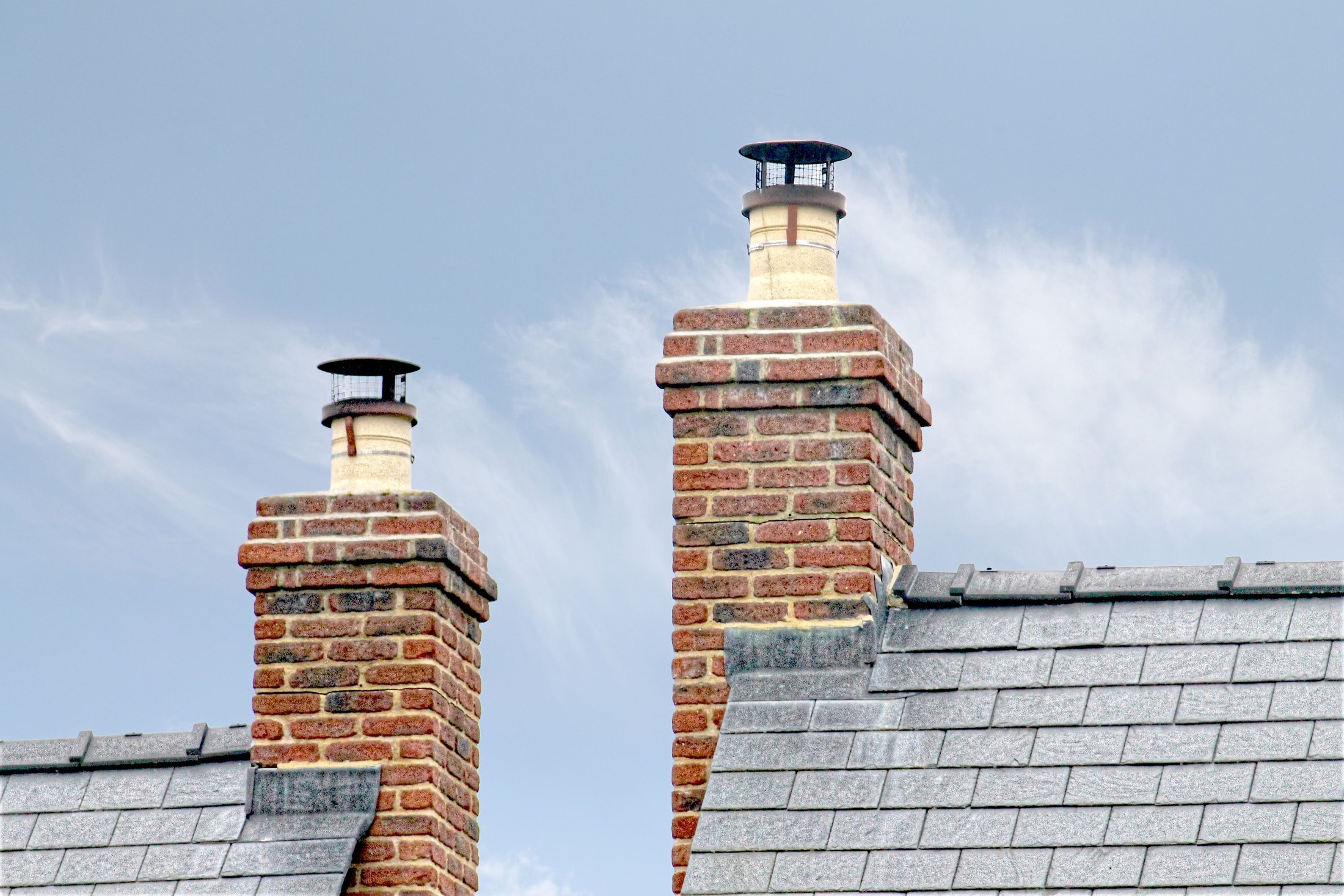
On a listed roof, dry fix is the wrong answer. Mortar bedding cracks, washes out and lets the tiles rock. On an ordinary house we convert to dry ridge and dry verge screwed onto a ventilated roll, the mechanical fixing BS 5534 expects. With around twenty five listed entries in the parish that is often the wrong answer here, so on a listed building we re-bed in a mortar that suits the fabric rather than a hard modern mix that takes the tile with it next time.
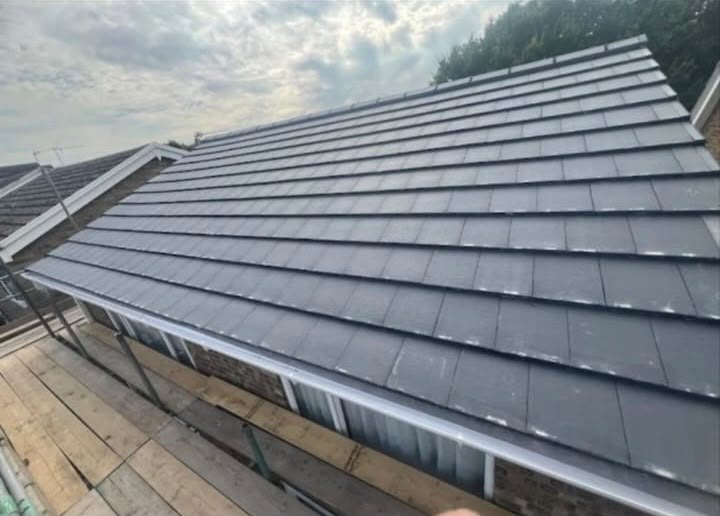
Alongside the slate there is plain tile, clay tile on the older ranges, and concrete tile on the later houses, where the fault is usually a nail or a clip rather than the tile. Stone slate belongs to Purbeck, not this valley. Several of the older cottages are thatched and we do not work on thatch. Where a tiled range adjoins one we work on our side, and that flashing is nearly always the leak.
Older roofs here sit on lath, or on battens with no underlay at all, or on a felt long since perished, and when nails, battens and underlay have gone together the new roof goes back on breathable membrane and treated battens with soft rafter feet cut out first. We would talk you out of a re-roof where the covering has life left and only the edges need doing. Chimney flashings, soakers and valleys in code rated lead. Cast iron rainwater goods here are worth repairing rather than swapping for plastic, and Approved Document L sets the standard a renovated roof is expected to reach.
How it runs
From your call to a written price
Same team throughout, no sub-contracting, and an itemised quote: scaffold, the strip out, battens and membrane, the covering, each junction and disposal on separate lines. Nothing left open overnight and the old material goes with us. There is no conservation area here, so on an unlisted house a like for like re-cover, a repair, new rainwater goods and rooflights sit inside householder permitted development, as long as nothing stands more than 150mm above the roof plane, and Planning Portal guidance sets out the limits. The parish carries around twenty five listed entries, and anything listed needs listed building consent whatever the work, which we check before we price. Dorset Council for both.
Cost
What decides the price of a roof
No rate per square metre. The village is strung along its street, so a good many roofs here can only be reached from the front, and a scaffold that stands over a footway or the highway needs a licence from the council, which is a lead time as well as a line on the quote. This is work at height and the work at height rules are why the platform is a priced line rather than an optional extra. Chimneys, valleys and abutments are priced one at a time. Ask who pays for the skip.
If it is leaking now
Water coming in today
Ring rather than use the form. Anything letting water in comes first, and the first visit makes it safe and watertight. If a ceiling is bulging, put a bucket under it and pierce it once at the lowest point, and keep the loft light off if water is near the wiring. We are eighteen miles out, so you get a straight answer on the phone about when we can be with you.
Worth knowing
A re-roof is simple here. A loft conversion is not
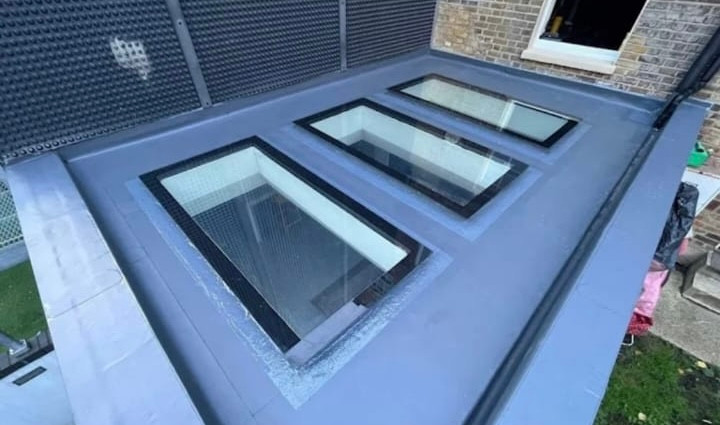
The one thing worth knowing before you plan work on this roof is that Milborne St Andrew drains into the Poole Harbour catchment, and that catchment is under nutrient neutrality rules. They bite on anything that adds overnight accommodation, so they do not touch a re-cover, a repair, a flat roof or new rainwater goods at all.
What they do touch is a loft conversion, because a new bedroom counts. If a conversion is anywhere in your thinking, say so at the survey. It changes what we do now rather than what you pay: rafters, membrane and eaves ventilation can be set up while the covering is off, so the conversion is not undoing work you have just paid for. The planning side takes far longer than the roof does, and the roof is the part you can get on with meanwhile.
Who you are dealing with
A local firm you can check
About eighteen miles from us, covering Milborne St Andrew and the DT11 addresses around it towards Puddletown and Blandford, with Dorset Council for planning and building control. Bournemouth Roofing & Building Ltd, registered in England and Wales, company number 15471719, which you can look up in a minute. Thomas Hannen's business, and he is the one who comes out to price the job, not a salesman. A verified customer's 10 out of 10 on Checkatrade. The visit and the written quote are both free.
Questions
Milborne St Andrew questions we get asked
Does the nutrient rule apply if we add a bedroom?
It does, because Milborne St Andrew drains into the Poole Harbour catchment, and any scheme adding overnight accommodation has to show it is nutrient neutral before Dorset Council will approve it. Re-covering an existing roof adds no bedroom and is not caught by it at all. If a loft room is the real plan, get that application moving early, because the roof work is the quick part and the consent is not.
There are twenty five listed entries here. Does ours count?
Only the address on the list counts, though being physically attached to one can pull you in. The twenty five entries at Milborne St Andrew include the Parish Church of Saint Andrew, and there is no conservation area over the village, so an ordinary house is not caught by either. Where a property is listed, consent from Dorset Council comes before a single tile is moved, not afterwards.
Is a small repair worth your while at this distance?
It is if we can see the whole roof in one trip. You are about eighteen miles out from us, so rather than drive back for each item we come once, look at everything from the ridge to the gully, and put the lot on a single quote. Most calls this far out turn out to be three or four small things rather than the one that prompted the phone call.
Can this wait until spring, or does it need doing now?
It depends what is open. A missing tile with sound felt underneath will see the winter out. A torn valley, an open ridge or bare battens will not, because the water gets into the timber and then it is rafters as well as tiles. We will tell you plainly which of the two you have, and sheet it over in the meantime if it needs holding until the weather turns.
Should the valley be lead, or something more modern?
On an older village property we would keep lead, cut and lapped in short lengths so that it can move. The fibreglass and GRP linings go in quicker, but they sit wider and flatter and they show, which matters on a building standing in a row of older ones. Lead that has split has usually split because somebody laid it in one long piece and left it nowhere to expand to.
Nearby, and next door
Roofing near Milborne St Andrew
Roofing nearby
Our other trades in Milborne St Andrew
Roofing guides
Concrete vs clay roof tiles: which is right? Planning, building regs or listed building consent Storm damage to a roof: the first 24 hoursEverything we do in Blandford Forum Roofing, all areas Every area we cover
Free quote
Get a straight answer on your Milborne St Andrew roof
A free site visit, a look in the loft as well as on the covering, and an itemised written quote you can hold up against anyone else's.