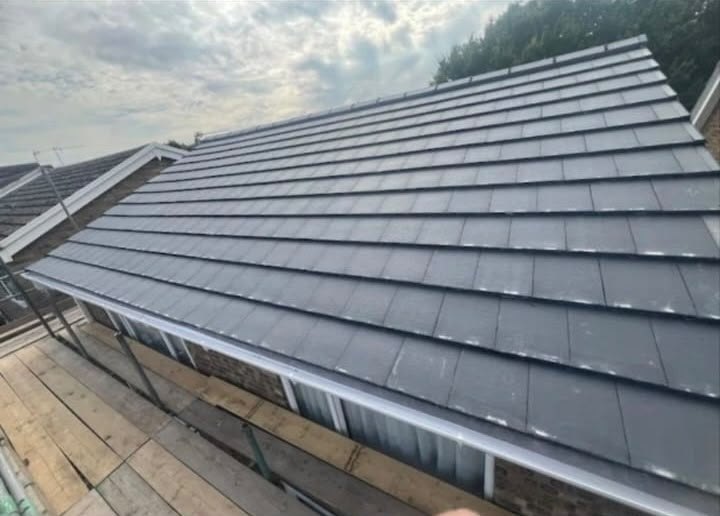
Fascias, soffits and guttering in Milborne St Andrew
Boards off, rafter feet checked, the run re-hung to a fall, and the downpipes followed all the way to where the water actually goes.
The site visit is free and so is the written itemised quote. Thomas Hannen prices every job himself.
We take old rooflines off and put new ones on. Fascias, soffits, bargeboards, capping, gutters, outlets, hoppers and downpipes, repaired where a repair is honest and replaced where it is not.
Out this way the first sign is nearly always on the outside of the building. A dark streak down render or brickwork under one joint. Moss and green growth on the wall below a downpipe that has come off its clips. A bargeboard on the weather gable with the paint lifting off it in sheets.
None of that is worth guessing at from the ground. We come out, lift the gutter to test the fascia behind it, look at the rafter feet and follow the downpipes to see where the water is actually going. Everything gets photographed, and the quote is written and itemised so the boards, the gutter run, the outlets and the downpipes are all priced on their own lines.
The work
Old timber, new plastic, and the bit in between
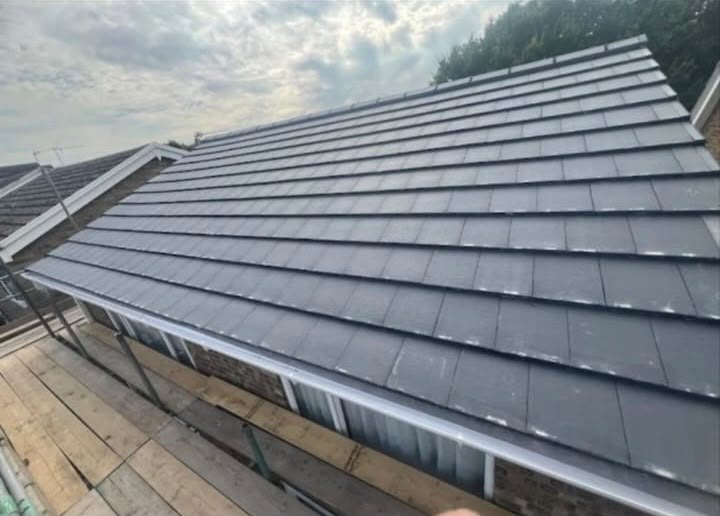
Getting the diagnosis right. Almost everything traces back to the fascia. It is the board across the rafter ends, and every gutter bracket is screwed into it, so a soft fascia means a run that sags, drops and eventually pulls away from the wall. Blown paint is the warning, a screwdriver is the test. Everything else is smaller: a leaking joint at a union, a hopper that has cracked with frost, a downpipe off its clips, a missing shoe at the bottom, an outlet blocked with moss off the tiles. Those are repairs and they should be quoted as repairs.
What we find when the boards come off. With the gutter down and the fascia and soffit away, the rafter feet, the wall plate and the bottom edge of the underlay are all in view. Rot in a rafter end nearly always stops within a few inches and gets cut back and spliced. A felt support tray carries the underlay drip out over the gutter rather than letting it run behind the new board. A tilt fillet lifts the bottom course of tiles so they sit at the right angle over the run. Capping plastic over rotten timber does none of that and hides all of it, which is why the old boards come off. Where the timber is sound, capping over is fair and cheaper and we will say so plainly.
Choosing what goes back. uPVC with vented soffits is the straightforward answer on most houses, in white or in a woodgrain or dark finish where white would look wrong on an older building. Gutter comes in half round, ogee, square and deepflow, and the profile is a real decision: where a big slope drains into one short length, a standard section will spill in heavy rain no matter how clean it is. Timber can be renewed in timber, cast iron on an older building is frequently worth re-bedding and repainting rather than replacing, and aluminium suits a long exposed run.
The fall and the fixings. Brackets at correct spacing, and the run set to fall towards the outlet. Hung level it looks right from the lane and stands with water in it all year, which is what makes it green, heavy and loose. Every outlet, union, hopper, downpipe clip and shoe is renewed or refixed. Older buildings around here often have long low runs on outbuildings that nobody has looked at in years, and those are usually the ones putting water into a wall.
Ventilation, birds and moss. A new soffit gets vents, or an over fascia vent strip where the board is too narrow to take them, so there is a continuous air gap through the eaves into the loft. That is what keeps condensation off the underside of the felt in winter. Birds nest behind a soffit that has lifted, wasps get into a gable end, and moss washed down off the tiles packs the outlets. All three get dealt with while the platform is up.
How it runs
From your call to a written price
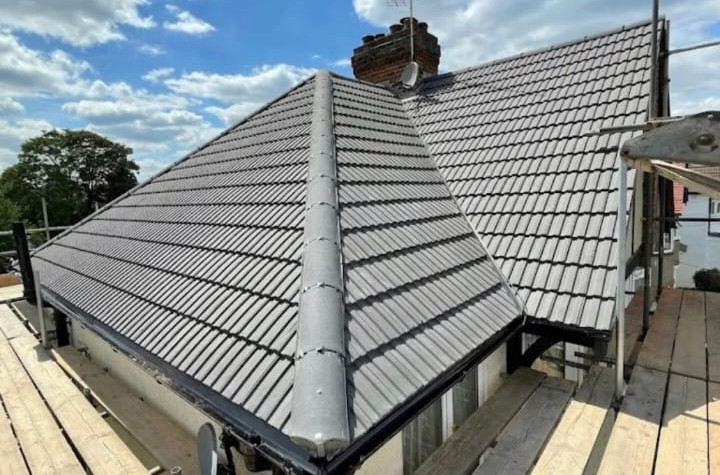
Same team from first visit to last, one person to ring, and no sub-contracting your work out to somebody you have never met. The quote is itemised, not a figure on the back of a card: access, the length of each run, stripping the old boards and gutter, the fascia, soffit and any bargeboard, the gutter, outlets and downpipes, and disposal on separate lines, so you can compare it properly against anyone else's.
Nothing is left open or unusable overnight. The site is swept at the end of each day rather than the end of the job, and what comes out leaves with us. If something turns up once we start that nobody could have seen, you get a photograph and a price before we carry on.
Renewing a roofline like for like is repair, so there is no planning application and nothing for building control. There is no conservation area over Milborne St Andrew, but there are a good number of listed entries in and around the village, and on a listed building the roofline is part of what is protected, so consent comes before the boards move. Dorset Council will tell you whether your address is one of them.
Cost
What decides the price of a roofline
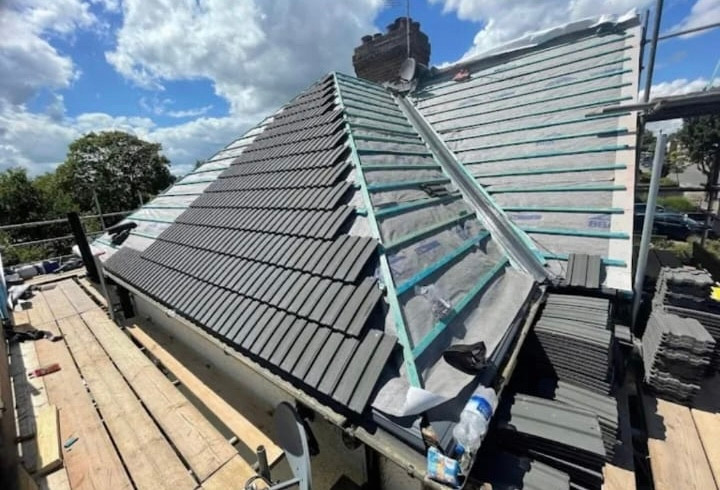
No rate per square metre, because a metre of fascia over a bay is not the same metre as one on a straight gable.
Getting to it. A cottage with the eaves out over a narrow verge, a farmhouse with outbuildings and long low runs, and a modern detached with clear ground all round are three different platforms before a board comes off. A bungalow run comes off a tower, a two or three storey gable wants a scaffold, and a run over a conservatory or a bay window means building the platform around it. The work at height rules are why the access is a priced line rather than something absorbed into a rate.
What is behind the boards. Rotten fascia is a symptom. The question is whether the rafter feet and the wall plate behind it are still sound, and nobody knows until the old board comes off. Capping over with plastic hides that instead of fixing it, which is why we take the old boards off rather than clad them.
The run, not the metre. A straight gable is quick. Bay windows, a conservatory in the way, a corner return, a run that has to be worked around a satellite dish or a service cable, and every outlet, hopper and downpipe are priced one at a time. So is putting the fall back: a gutter hung level looks fine and holds water all year.
Comparing quotes? Ask whether the old boards are coming off or being capped over, what happens if the rafter feet or the wall plate turn out to be rotten, whether the gutter, outlets and downpipes are all being renewed or only the fascia, and whether the scaffold is in the price. Two quotes for the same job are usually two different jobs.
If a section has come away
A gutter hanging off, or a fascia gone through
Ring rather than use the form. A length of gutter pulled off its brackets, a downpipe snapped at the bend or a fascia soft enough to put your hand through goes to the front of the queue, because the next heavy rain runs straight down the wall and into the brickwork. The first visit is about getting it supported and discharging somewhere sensible, and we price the run properly once we can see how far the rot goes. We are a good drive away, so ring rather than message if something is hanging, and tell us if it is over a door or a track people use. The phone is answered 24 hours for emergencies; scheduled work runs Monday to Friday, 8am to 6pm.
Worth knowing
On a village property, the question is where the water ends up
In a town a downpipe drops into a gully and the water is somebody else's problem after that. Out here it usually is not. Roof water on a village property tends to go to a soakaway in the garden, to a ditch on the boundary, or onto the ground through a shoe and nowhere in particular. That last one is more common than people realise, and it is why a wall can stay damp at the base while the gutter above it is perfectly sound.
So when we renew a run we follow it to the bottom rather than stopping at the shoe. A soakaway that has silted up backs water against the footing every time it rains, and no amount of new gutter fixes that. A ditch that has not been cleared holds water at the same level as the outfall. Approved Document H is the reference for how roof water is meant to be taken away, and the practical version is simple: the water has to get far enough from the building and then have somewhere to go. If yours has not, we will say so and price the fix separately rather than hang a new gutter over the same problem.
Who you are dealing with
A local firm you can check
We cover Milborne St Andrew, Puddletown, Dewlish, Bere Regis and the Winterborne villages, broadly DT11, under Dorset Council. You are dealing with Bournemouth Roofing & Building, the trading name of Bournemouth Roofing & Building Ltd, registered in England and Wales, company number 15471719, which you can look up in a minute. Thomas Hannen's business, and he is the one who comes out to price the job, not a salesman. A verified customer's 10 out of 10 on Checkatrade. The visit and the written quote are both free.
Questions
Milborne St Andrew questions we get asked
Do you cover the outbuildings as well as the house?
Yes, and they are worth including. Long runs on a barn, a garage or a stable block are usually simpler than the house and they are often the ones quietly soaking a wall. Each building is a separate line on the quote so you can pick and choose.
The gutter is fine. Can you replace only the fascia?
Yes. The run has to come down to get the board off, but if the gutter is sound and reasonably modern it goes back up on new brackets and a proper fall. You should not be paying for a gutter you do not need.
How do I know whether it is a leak or condensation?
Condensation shows up in cold weather, spreads evenly across the underside of the felt and gets worse in winter. A leak is local, it follows the rain, and it usually stains one spot. If it is condensation, ventilation at the eaves is the fix rather than anything on the roof.
Are you too far away to come out for a small repair?
No. We come out this far regularly and the site visit and the written quote cost nothing. If it is a half day repair we will tell you that rather than talk you into a full run.
Nearby, and next door
Fascias, soffits and guttering near Milborne St Andrew
Fascias, soffits and guttering nearby
Our other trades in Milborne St Andrew
Everything we do in Blandford Forum Fascias, soffits and guttering, all areas Every area we cover
Free quote
Get a price for your Milborne St Andrew roofline
Tell us what the wall is showing and which building it is on. Thomas comes out, tests the board behind the gutter and puts the price in writing.