Exterior cleaning in Milborne St Andrew
Roofs, walls, render, gutters, paths and patios in Milborne St Andrew and DT11. Free site visit, free written itemised quote.
The site visit is free and so is the written itemised quote. Thomas Hannen prices every job himself.
In Milborne St Andrew the surface decides everything. A concrete tiled roof on one of the newer houses can take a scrape and a soft wash. Flint and lime mortar, cob under a limewash, or a thatch cannot take a pressure lance anywhere near them, and one afternoon with the wrong machine will cost you a wall. So the first thing we do here is work out what you have got, and the second is tell you honestly which parts of it we would leave alone.
People ring us for a handful of things. A roof has gone dark and mossy and it is now dropping into the gutter. A patio or a path is green and slippery. The old wall along the front has gone black and mottled. Gutters are overflowing and marking the wall underneath. Or a property is going on the market, or coming back from a let, and everything wants to look cared for by a particular date.
Every surface gets a proper survey on the free site visit, and every surface gets its own line on the written itemised quote with the method next to it, not just a number. If part of the job is better left to a thatcher or a mason, we say that at the visit rather than take the work and make a mess of it.
The work
Cleaning in a chalk valley village

Flint, brick and lime mortar. The older fabric here is banded flint and brick, some cob, and a good deal of it rendered or limewashed with brick dressings around the openings. All of it is bedded in lime mortar, which is deliberately softer than the flint or the brick it holds, so the joint takes the damage instead of the face of the stone. It also means a pressure lance finds the joint first, washes it out to a depth you cannot see from the ground, and drives water into a solid wall with no cavity to drain it. So these get brushed dry, then a biocide at low pressure through a soft wash nozzle, then time. Green film is algae and goes quickly. Black spot is lichen, rooted into the surface, and it dies back over weeks rather than minutes.
Thatch, which we do not clean. There is thatch in the village and it grows moss like everything else. Nobody should be washing it. Water goes into the coat rather than off it, the fixings and netting get disturbed, and a soaked thatch rots from the inside. That is a thatcher's job, and often a sign the coat is holding damp for another reason. We will tell you that for nothing. On the newer houses along the hill the covering is concrete interlocking tile, with clay plain tile and slate on the older properties: the bulk comes off dry with a scrape and a brush, then a soft wash at low pressure and a biocide, working down from the ridge. No jet wash on concrete tile, and none at all on slate. There are mature trees through the village and woodland on the slopes above it, so gutters fill with leaf litter as well as roof moss, and every outlet and downpipe is run through with water to prove it takes it.
How it runs
From your call to a written price
One team from the first visit to the last, one person to ring, and no sub-contracting. The quote is itemised: method for each surface, protection, access and where the water and residue go, each on its own line. If something turns up once we start that nobody could have seen, you get a photograph and a price before we carry on. Cleaning is maintenance, so there is nothing to apply for. There is no conservation area over the village, but there are twenty-five listed entries in and around it, the parish church among them. If the wash shows up joints that need repointing on a listed building, that repair needs listed building consent first. Dorset Council is the authority.
Cost
What decides the price of a clean
No rate per square metre: the same square metre can be twenty minutes or two. A thatched or single storey cottage is hand work off the ground, a two storey house up the hill wants reach poles and sometimes a tower, and a farm range behind a yard means a long hose run before a drop of water moves. The work at height rules decide which. The surface sets the method, and getting it wrong takes the surface off with the dirt. Comparing quotes, ask what method each surface gets, whether a treatment is included or just a rinse, and where the run off goes.
If there is a date
A viewing, a visit or a deadline
Ring rather than use the form. This is not emergency work, but it often has a date on it: a sale, a letting inspection, scaffolding coming down. Milborne St Andrew is the far end of our patch at around eighteen miles, so we group work out this way and will tell you which week we are over. The phone is answered 24 hours for emergencies; scheduled work runs Monday to Friday, 8am to 6pm.
Worth knowing
The Bere Stream runs through it, and that changes the method
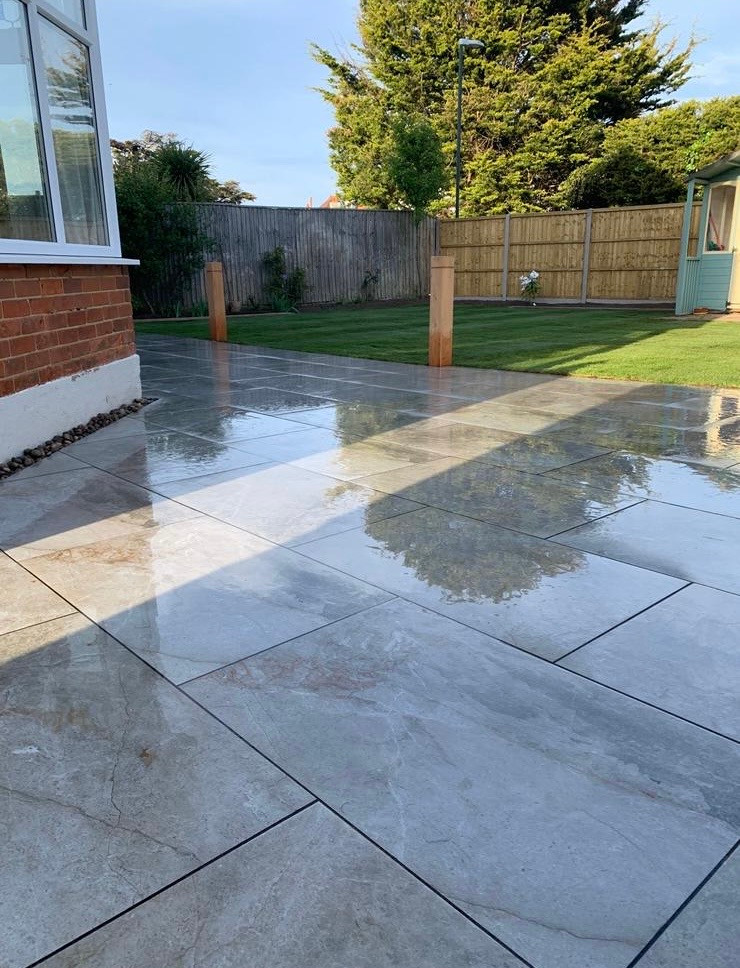
The Bere Stream comes down through the village and a good many gardens, drives and yards here drain towards it, either directly or through the gullies in the road. That is not a planning point, it is a practical one, and it changes how exterior cleaning has to be done on this side of the county.
A chalk stream is fed by groundwater and it is unusually sensitive: the biocides used to kill moss and algae are designed to kill exactly the sort of life a stream like that is full of, and a bucket of dirty rinse water going into a road gully can be in the watercourse within the hour. Nobody sees it happen and nobody comes to check. It is simply whether the firm you hired does the job properly or not.
What that looks like on the ground is straightforward. Products get used at the strength printed on the label rather than mixed strong to save an hour, which is what the HSE guidance on biocides is about and is also why the treatment works. Gullies and drains near the work are covered before anything is mixed, planting and banks are sheeted and watered down first, and the run off is collected or steered onto ground where it will soak away rather than allowed to sheet across hard surfacing into a drain.
Close to the water we brush a product on rather than spray it, and we do not spray at all on a windy day, because drift carries a good deal further than people think. The pollution prevention guidance sets the standard and it applies to a domestic job as much as to a commercial one. If you are comparing prices, ask each firm the same question: where is the run off going. It is a fair question and the answer tells you a lot.
Who you are dealing with
A local firm you can check
We cover Milborne St Andrew and the villages along the valley on DT11, out to Bere Regis, Puddletown and Blandford Forum, and Dorset Council is the planning authority for this address. Bournemouth Roofing & Building Ltd, registered in England and Wales, company number 15471719, which you can look up in a minute. Thomas Hannen's business, and he is the one who comes out to price the job, not a salesman. A verified customer's 10 out of 10 on Checkatrade. The visit and the written quote are both free.
Questions
Milborne St Andrew questions we get asked
There is moss all over the thatch. Can you clear it?
Thatch is not something we wash. Water and biocide pushed into a coat shorten its life, and moss on thatch is usually a sign the coat has gone soft rather than a cleaning problem. That is a thatcher's work and we will say so. What we do at Milborne St Andrew is the gutters, the render, the walls and the hard standing, and we tell you plainly which part of the roof is not ours.
Our flint and brick wall has gone green. Is jetting safe?
No. Flint is bedded in lime and the lime is softer than the stone, so a lance cuts the joints out and leaves the flints sitting proud with holes behind them. On the flint walls through Milborne St Andrew we brush off the loose growth, apply a biocide at low pressure and let it fade over the weeks after. Slower on the day, and it does not leave you needing a repoint.
Does the Poole Harbour catchment change what you can spray here?
The nutrient rules for Poole Harbour are a planning matter and they only apply where a scheme adds a bedroom or a holiday let, so they have nothing to say about a house wash. The wider point still stands. Milborne St Andrew drains freely, and whatever soaks in here carries on down through that catchment, so product goes on at the diluted rate and no surplus is poured away on site.
There are listed cottages here. What changes on those?
The method changes, not the permission. Twenty five entries in the parish are listed, the Parish Church of Saint Andrew among them, and buildings of that age have lime mortar, soft brick and old joinery that will not stand a jet. Cleaning itself is maintenance and needs no consent. Anything that alters the face of the building, a coating or a sealer, goes to Dorset Council before we touch it.
You are eighteen miles out. Will you actually come this far?
Eighteen miles is further out than most of our work and we still come. What we ask for is a bit of notice, because a run to Milborne St Andrew is worth setting up as a full day rather than an hour on the doorstep. Thomas Hannen prices it himself while he is there, on paper and line by line, and there is no charge for the visit or the written quote.
Nearby, and next door
Exterior cleaning near Milborne St Andrew
Exterior cleaning nearby
Our other trades in Milborne St Andrew
Everything we do in Blandford Forum Exterior cleaning, all areas Every area we cover
Free quote
Get a price for cleaning in Milborne St Andrew
Tell us the address and what the surface is. We come out, look at it and put an itemised price in writing. No charge for either.