Exterior cleaning in Tolpuddle
Roof moss, green render, blocked cast iron gutters and slippery paths cleaned along the village street, at a pressure old walls can take.
The site visit is free and so is the written itemised quote. Thomas Hannen prices every job himself.
Nearly everything along the street in Tolpuddle is old: lime render over cob or rubble, brick and flint, clay tile, thatch, and mortar that was mixed to be softer than what it holds together. Cleaning it is a treatment and a soft wash, done in stages. There is very little here we would put a pressure washer anywhere near.
Two problems bring most of the calls. The first is green low down on a wall, in a band from the ground up to about waist height, which is rain hitting the path or the road and coming straight back at the wall. The second is a roof that has gone dark on the shaded side and is dropping moss into a gutter that is already full. After those comes the path or the yard that is slippery enough to be a worry for anyone unsteady.
The right order is almost always rainwater first, wall second, and the ground last. Clearing an outlet costs little and stops the thing that is making the wall wet. The site visit is free and the written quote prices each elevation and each surface separately, so you can do the roof this year and the walls next if that suits you better, and we would rather tell you that than take the lot in one go.
The work
What a street of old buildings actually needs doing

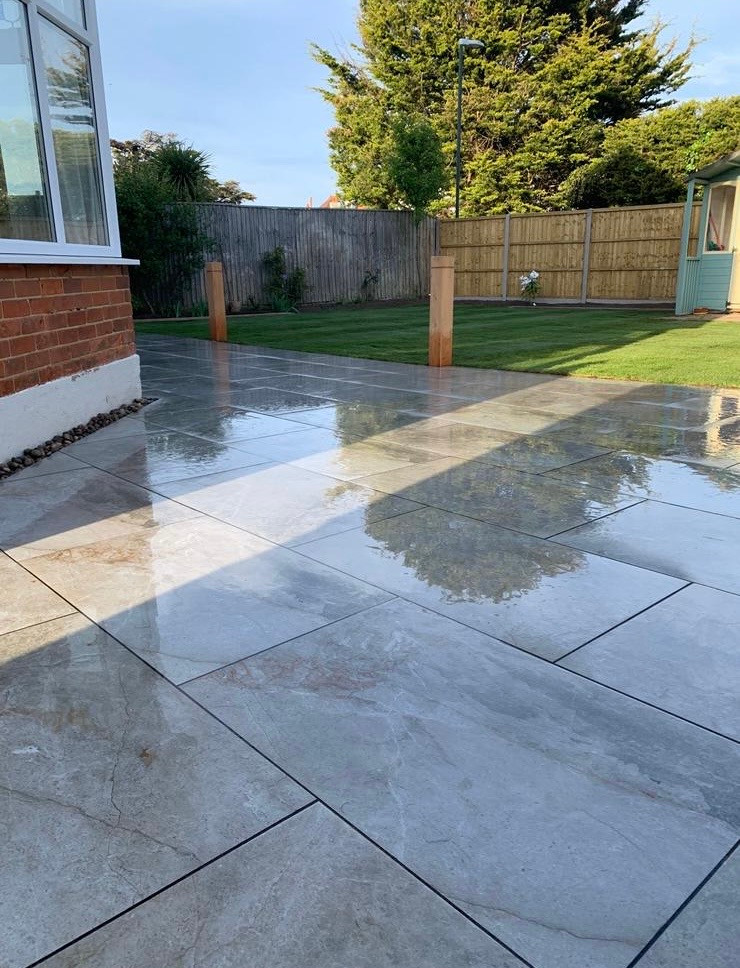
WORK Sacrificial coats: lime render, limewash and cob. These are meant to weather and be renewed, and they are only held on with what the wall could take. A lance goes straight through them and there is no putting that back cheaply. So it is a treatment, low pressure through a wide nozzle, and a rinse. If the render is already blown or hollow behind, the honest advice is to get it repaired before anything is washed, because a clean will find every loose edge. Thatch is a thatcher's job. Where a roof is thatched we do not touch it and no treatment of ours goes near it. We sheet it if there is any chance of overspray and deal with the tiled ranges and the rainwater goods around it. On the clay plain tile and slate along the street, much of it old enough that a proportion will be cracked before we start and lichen has crusted into the surface, moss comes off dry, scraped out of the lap and off the ridge, and an approved biocide follows to kill the spore and slow the regrowth. We never jet wash old clay, because the fired face is the waterproof part of the tile and a lance takes it off. Cast iron half round sits low and reachable on plenty of the older buildings, and clearing the runs, the outlets and the valleys and checking the fall is the cheapest useful thing you can have done to a building like this. Where a range has no gutter at all, and some do not, rain lands on the path and comes back up the wall, and no amount of cleaning fixes that. Sorting the ground or adding a rainwater goods run is the real answer, and we will say so. On the brick paths and stone flags, where black spot and algae make the surface slick underfoot, we start at the doorway, because that is where somebody slips, and any brick paving jointed in sand is re-sanded once it has dried.
How it runs
From your call to a written price
RUNS One team from first visit to last, one person to ring, and a written quote itemised by surface: method, protection, access, and where the water and residue go on separate lines, since run off into a village stream is a pollution question. We check the address with Dorset Council before quoting rather than afterwards, because in a village like this the chance that a building is listed or sits in the Tolpuddle conservation area is high, with twenty seven listed entries in and around the parish and the Martyrs' Cottages among them. That does not change the clean, which needs nobody's consent. It changes what we would recommend doing next, and it is better to know that before you have a price in your hand.
Cost
What decides the price of a clean
No rate per square metre, because what is on the surface decides the time. Along this street it is getting to it that varies: a cottage sitting straight on the pavement, a rendered house behind a garden wall you have to get a hose over, and a farm building on the edge of the village are three different problems before any water is turned on. work at height rules decide what needs more than a pole. Soft old fabric adds time as well, since the gentlest method that will work is slower than the quickest one that would.
If there is a date
A viewing, a visit or a deadline
Ring rather than use the form. We are eighteen miles out, so a Tolpuddle job is planned around one visit to look and one to do it, and a date set for a sale or a survey wants a fortnight rather than a phone call on the Friday. Tell us the date on the call. Outside Monday to Friday, 8am to 6pm, by arrangement.
Worth knowing
Cleaning is maintenance. Changing how it looks is not.
There is a conservation area over the village and twenty seven listed entries in and around it, which is a great deal for a place this size. None of that stops you having a wall washed, a roof cleared of moss or a gutter emptied. Cleaning is maintenance and no consent is involved, on a listed building just as much as on a modern one. Where it bites is the step after the clean, and that is where people get caught out.
Painting a wall that has never been painted, spraying a coating onto an old tiled roof, replacing a lime render with a cement one, or sealing an old stone path all change the appearance of the building, and on a listed building or inside a conservation area that can need listed building consent even when the work itself looks small.
So there is one thing worth doing before you accept any quote in this village: have the clean and anything that follows it priced as separate lines, so you can say yes to one and think about the other. A firm that will only give you a single figure for cleaning and coating is asking you to commit to the part that needs checking in order to get the part that does not.
The other reason to keep them apart is that on old fabric the reversible choice is nearly always the better one anyway. A wall that has been washed and treated can be washed and treated again in five years. A wall that has been sealed, painted or rendered in cement has been changed, usually in a way that traps damp in a building designed to let it out, and getting back from there is a far bigger job than the one you started with.
Who you are dealing with
A local firm you can check
We cover Tolpuddle, Affpuddle and the DT2 villages along the Piddle, across to Puddletown, Milborne St Andrew, Bere Regis and Dorchester. Bournemouth Roofing & Building Ltd, registered in England and Wales, company number 15471719, which you can look up in a minute. Thomas Hannen's business, and he is the one who comes out to price the job, not a salesman. A verified customer's 10 out of 10 on Checkatrade. The visit and the written quote are both free.
Questions
Tolpuddle questions we get asked
Which parts of the village need consent before cleaning?
None of it for a straight wash. The Tolpuddle Conservation Area controls appearance, and cleaning does not change appearance, it uncovers it. The 27 listed entries here are a different matter, and they take in the Martyrs' Cottages and the former Methodist chapel to the east of them, where the fabric is old enough that the method needs agreeing with Dorset Council beforehand. We check an address against the list at quoting stage, not afterwards.
What causes the dark band along the base of the wall?
Rain hitting the path and bouncing back up. The bottom course gets wetted twice, once falling and once splashing, and on the older buildings in Tolpuddle that band is also where lime render runs thinnest and softest. Washing it hard takes the render away with the growth. We treat it, drop the pressure to almost nothing, and where the render has already blown we say so and leave it, because a wash would finish it off.
Does anything limit which treatment you can use here?
The drainage does. Tolpuddle sits in the Poole Harbour catchment and the ground here sheds water quickly, so nothing treated goes towards a ditch, a field drain or an open watercourse. We bund and collect, use a foul gully where the property has one, and carry the rest away. The nutrient rules people mention only bite on schemes adding overnight accommodation, so they have no bearing on a house being cleaned.
What would you not clean on a building of this age?
Exposed timber, lime render that has already blown, and anything with an open joint water can get behind. On the older buildings through Tolpuddle those three come up constantly, and a contractor who cleans them regardless leaves you with a repair instead of a clean wall. We list what is being treated and what is being left, with the reason, on the written quote, so nobody finds out afterwards.
The gutters overflow at the back but not the front. Why?
Usually because the back is where the trees are. In Tolpuddle the rear elevations tend to look onto gardens and a tree line, so leaf litter loads that run while the front stays clear for years. An overflow also points at a fall running the wrong way or an outlet blocked at the bend, so we check both while we are up there instead of scooping the run out and coming back next year.
Nearby, and next door
Exterior cleaning near Tolpuddle
Exterior cleaning nearby
Our other trades in Tolpuddle
Everything we do in Wareham Exterior cleaning, all areas Every area we cover
Free quote
Get a written price for your Tolpuddle clean
Send the postcode and tell us what needs doing. We come out, look at the roof, the walls, the rainwater goods and the paths, and put the price in writing.