
Driveways in Tolpuddle
Gravel entrances that hold their stone, old brick and flag paving lifted and relaid, and patios set at a level an old wall can live with, across Tolpuddle and DT2.
The site visit is free and so is the written itemised quote. Thomas Hannen prices every job himself.
Last updated
In Tolpuddle the question is almost never which surface. It is how much ground you are allowed to make hard, where the water is going to go afterwards, and what height the paving is allowed to finish at where it meets an old wall. Settle those three at the survey and the rest, whether it is gravel, block paving, stone, porcelain, resin or tarmac, is ordinary work.
The problems here are a short list. A gravel entrance off the street that has worn through to bare ground and now sheds stone onto the road. A path or a small courtyard of old brick and flag that has sunk into a set of trips. And a patio behind the cottage that has been topped up and re-laid over the years until it is sitting far too high against the wall, with a damp patch inside to match.
We come out and look before anybody talks about materials. That visit is free, the written itemised quote is free, and where a repair will genuinely do, that is what we quote.
The work
Entrances, courtyards and the ground behind the cottages
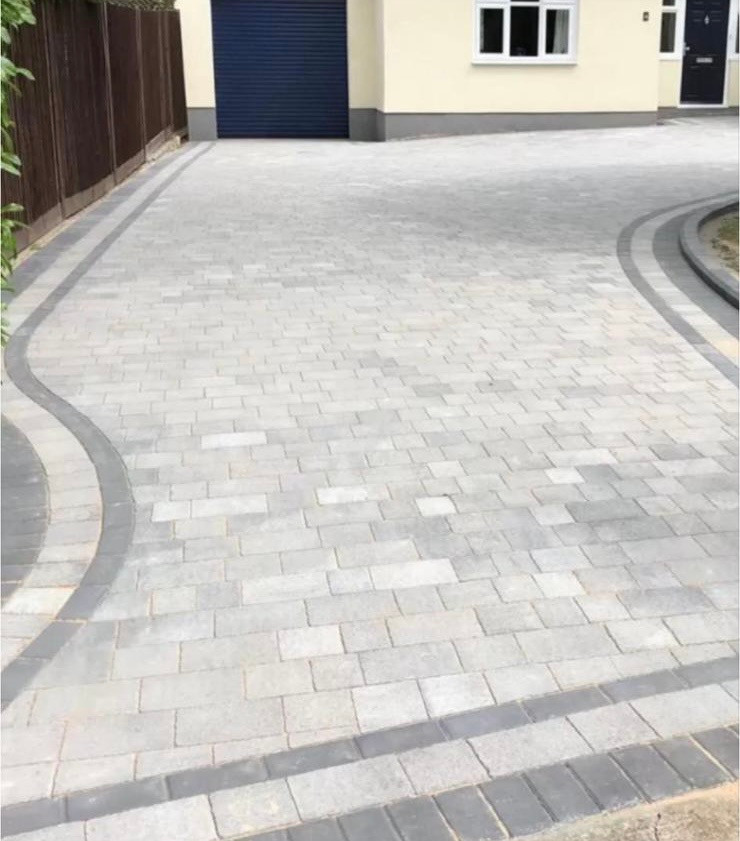
Entrances off the village street. Most of the older properties in Tolpuddle were not built with a car in mind, so the parking is a later addition through a gap in a wall or a hedge, and that means an opening, a standing and a crossing.
The opening itself, which may mean taking down a length of wall and rebuilding a clean return and pier in the same brick or stone. The standing behind it, dug to a firm formation with a geotextile membrane and a compacted sub-base so it does not start rutting and ponding in winter. And the crossing to the carriageway, which is a dropped kerb application to Dorset Council as highway authority. We build the first two or three metres in something bound, because that is where the turning happens and where loose stone escapes onto the road.
Rounded shingle rolls, and on any sort of fall it ends up in the gutter and the gully. Angular gravel locks, a grid holds it in cells, and a resin bound finish fixes it altogether while still draining. Any of them fails without an edge restraint, so a haunched kerb or a brick border along the boundary is part of the job, not a nicety. Where there is old paviour or stone worth keeping, it comes up carefully and is stacked, the ground beneath is corrected, and it goes back down with the odd replacement let in, which is slower than laying new and the only version that still looks like it belongs. It goes back on a full mortar bed with the jointing pointed, not filled with a kiln dried sand that washes out and lets weed and green staining in.
Steps get a deep tread and a nosing you can pick out in the dark, because garden levels here step down towards the Piddle rather than run flat, and the paving is set with a positive fall away from the building.
How it runs
Laying a new drive at a village property, stage by stage
Thomas comes out to look at the ground, the levels, where the water runs now and where the lorry can stand. The quote itemises excavation, muck away, the sub-base, edgings, the surface, and drainage, each on a separate line. Digging, laying and finishing then follow in order.
Paving your front garden is normally permitted development, and the condition is the water, not the size: over five square metres the surface has to be permeable or drain to a lawn, a border or a soakaway inside your own boundary, as the front garden paving rules set out. Run it onto the road and you need planning permission. Materials at the front can matter more in a village, and the village is in the Tolpuddle Conservation Area, so it is worth checking with Dorset Council before choosing. New gates, piers and walls have limits, lower beside a highway, set out in the limits on new walls and gates.
Spoil goes away with us each day, the road and paths are kept clear, and if the dig turns up an old drain or soft ground, we stop, show you a picture of it and price it before digging on.
Cost
What decides the cost of a new driveway
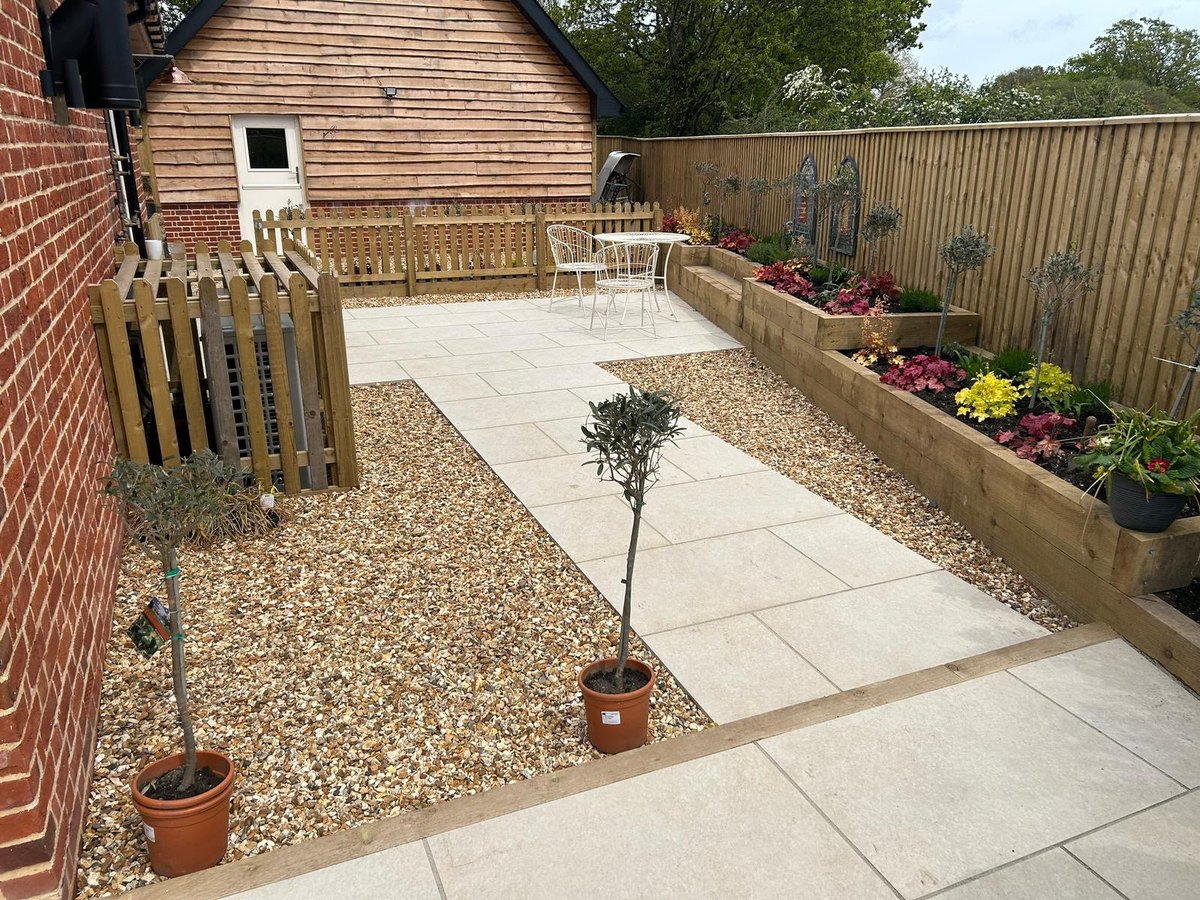
The surface you choose is only part of the price. What goes under it decides most of the rest. The dig. The depth of excavation, the ground conditions and the amount of spoil going away are the real variables. On older plots you can find a buried wall, an old cobbled yard or soft made ground, and each changes the job.
Getting in and out. A property with room for a grab lorry on its own ground is the easy case. Where the lorry has to stand on the road, or everything goes by barrow through a narrow gate, it takes longer and costs more.
The sub-base. A drive that carries a car needs a deeper, better compacted sub-base than a path. Skimping here is why drives rut and sink.
The water. Surface water has to stay on your land: permeable blocks, gravel, a channel to a soakaway, or a fall to a border. The drainage is often a bigger line than the surface.
The edges. Haunched edgings hold the surface in. Leave them out and it spreads.
Ask anyone else quoting how deep they dig, what sub-base goes in and how thick, and where the water will go.
If it is urgent
A lifted slab or a drive holding water
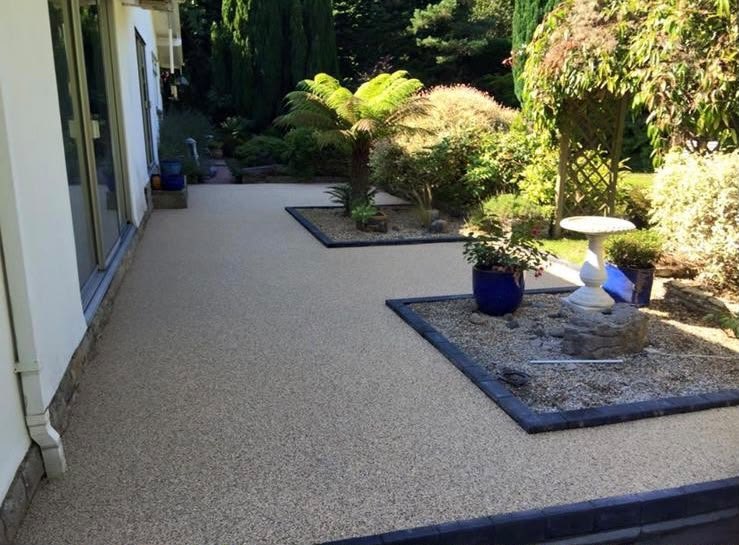
Ring rather than using the form. A lifted slab, a sunken patch by a doorway or a gully that has stopped taking water should not wait, because somebody trips or water ends up against the house.
Tell us whether a step has cracked or moved enough to catch a foot, or whether water is reaching a door threshold. On the first visit we make it safe, lifting or bedding the worst of it, and price the proper repair after. Scheduled paving work runs Monday to Friday, 8am to 6pm. If your call goes unanswered, we ring back as soon as we are free.
Worth knowing
Height against an old wall is the decision that matters here
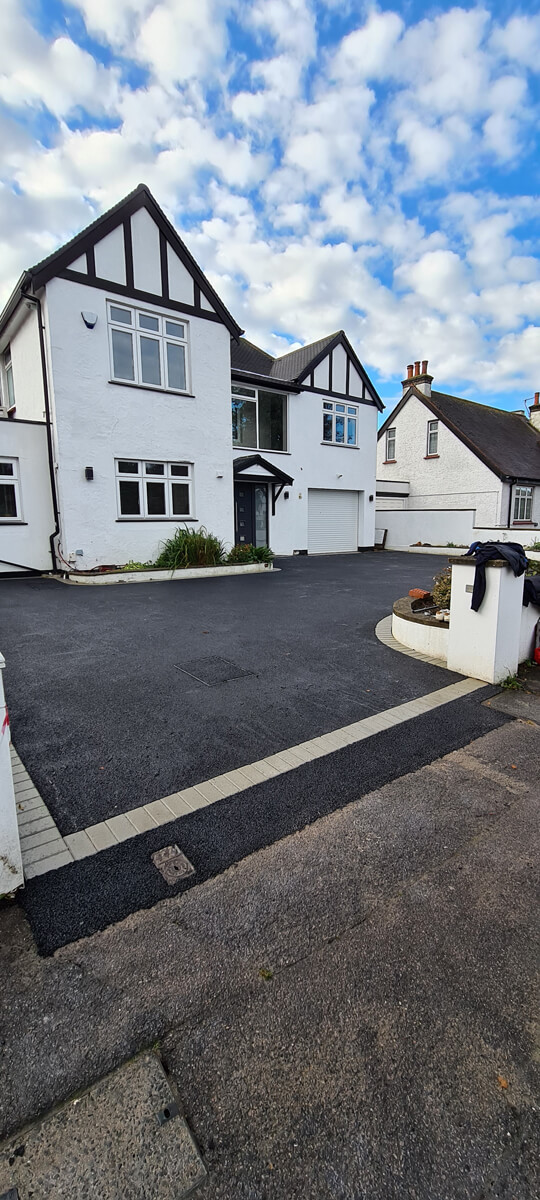
Tolpuddle is a conservation area with more than two dozen listed entries in it, which is a planning fact with a very practical consequence: a lot of the walls you would be paving up against were built solid, without the damp proof course a modern house has. On a wall like that the ground level outside is not a detail, it is the thing that keeps the inside dry.
Every time a patio or a path is topped up rather than taken up, the finished level creeps a course or two higher, and eventually the paving is above the internal floor. Then rain that lands on the paving has nowhere to go but sideways into the wall, and the damp patch that appears in the room beyond gets blamed on everything except the paving that caused it. Paving behind an old cottage can be three layers deep because nobody ever removed the old one. For a terrace, see patios in Tolpuddle.
So on an old wall we take the level down, never up. The paving finishes well below the internal floor with a clear fall away from the house, and where a door sits low the answer is a channel drain and a step, not raising the ground. A gravel margin or a narrow drainage channel along the base of the wall lets it dry out and keeps splashback off the brickwork, and we avoid sealing a hard cement edge tight against old masonry, because a solid wall has to be able to breathe.
One more thing to check before anything is ordered: where a cottage is listed, the walls, outbuildings and boundary structures that go with it can be covered by the same listing, so raising ground against the building or opening up a frontage may need listed building consent in its own right. We flag whatever applies at the survey and it goes into the written quote.
Who you are dealing with
Who prices your drive
We cover Tolpuddle, Puddletown, Milborne St Andrew, Bere Regis and the DT2 villages along the Piddle. The drive out from Boscombe is about twenty miles, and Dorset Council is the planning and building control authority. Send the postcode if you want to be sure.
Company number 15471719 belongs to Bournemouth Roofing & Building Ltd, registered in England and Wales. Thomas Hannen runs the firm, and he measures up and prices your drive in person. Look us up on Checkatrade and you will find a verified customer's 10 out of 10. The visit and the written itemised quote are both without charge. Before you book a visit in Tolpuddle, you can read our customers' Google reviews, word for word, on our reviews page.
Planning at a glance
Do you need planning permission in Tolpuddle?
Most repairs in Tolpuddle need no application at all. What decides whether a change to the outside of your house does is who the council is, whether a conservation area or a listing applies, and whether the place sits in a protected landscape.
| Question | In Tolpuddle |
|---|---|
| Who decides | Dorset Council is the planning authority for Tolpuddle. Dorset Council's heritage pages set out what it controls. |
| Conservation area | Yes: Tolpuddle Conservation Area. Check whether your street is inside the boundary before changing anything visible. |
| Listed buildings | Yes, there are listed buildings in and around Tolpuddle. If yours is one, work can need listed building consent. |
| Protected landscape | No National Park or National Landscape covers Tolpuddle. |
Questions
Questions about driveways in Tolpuddle
The kitchen floor is barely above the patio. Is that the damp?
Yes, paving that close to the kitchen floor is the likeliest cause of the damp. Once an outside surface finishes level with or above the internal floor, rain landing on it has nowhere to go but sideways into the wall, and on the old cottages at Tolpuddle there is often nothing in that wall to stop it. The cure is to take the paving down, hold it off the wall with a drained margin and fall it away.
Work on the inside face will not hold while the levels are wrong.
What surfaces sit right in the middle of the village?
Gravel, hoggin and a reclaimed or muted brick, as a rule. The Tolpuddle Conservation Area brings appearance into play whenever the material changes, and a wide area of black tarmac in front of a cottage is the change that gets queried. There are more than two dozen listed entries here as well, so a fair number of frontages are constrained by more than the conservation area alone. Dorset will give you a steer before anything is ordered.
Can we hard surface the front without applying for anything?
Under five square metres, or in a porous build that drains onto your own ground, generally yes. Go over that with a surface that sheds water to the road and it needs an application. In a village like Tolpuddle the sensible move is to build it porous regardless, because the road drainage in front of these cottages was never sized to swallow another roof's worth of run off. Dorset will confirm the position for your frontage.
Somebody mentioned nutrient neutrality. Does that apply to paving?
Not to a patio or a drive. Tolpuddle drains to the Poole Harbour catchment and the nutrient rules bite where a scheme creates new overnight accommodation, so they catch an annexe or a conversion adding a bedroom and leave hard landscaping alone. If the project also includes a garden room somebody intends to sleep in, that becomes a different conversation and Dorset will want it settled before consent.
The brick path has sunk in the middle. Relay or replace?
Relay, provided the bricks are sound. Old path bricks are softer than modern pavers but they are what makes the frontage look right, so they come up, get cleaned off and go back on a fresh bed once the ground beneath is corrected. Broken ones move to the least visible run. At Tolpuddle that is nearly always the better route, because new machine made brick next to an old wall shows from the lane.
Nearby, and next door
Driveways near Tolpuddle
Nearby places we also cover for driveways, with straight-line distances from Tolpuddle, and the other trades we offer in Tolpuddle itself.
Driveways nearby
Our other trades in Tolpuddle
Driveways and patios guides
Driveway planning permission and where water goes Sunken or ponding driveway: base or drainage Indian sandstone vs porcelain paving: an honest comparisonEverything we do in Wareham Driveways, all areas Every area we cover
Free quote
Get a written price for your Tolpuddle drive or patio
Send the postcode and tell us what you are dealing with. We come out, look at the ground and the levels, and put the price in writing with the days it will take.