
Driveways and patios in Winterborne Kingston
Drives, parking and patios in the village, built from the ground up and drained properly for wet winter ground.
The site visit is free and so is the written itemised quote. Thomas Hannen prices every job himself.
In Winterborne Kingston the drive is the easy half. The hard half is deciding where the rain that lands on it is allowed to go, because the ground here is wet for a good part of the year and it will not always take it.
The jobs we get called to in the village are usually one of three. A drive that has broken up at the entrance, where every vehicle turns off the street and the edge has nothing holding it. A bay or a path that ponds after a downpour and stays wet for days. Or a house with parking on the verge and nothing made, where the owner wants somewhere proper to leave a car.
What we do first is look, and look at the right things. We open a hole to see what stone is under the existing surface, check the fall of the ground from the house to the boundary, and find out where the surface water goes today. Then the price comes back written and itemised, with the excavation, the muck away, the sub-base, the edgings, the surface and the drainage each on their own line, so nothing important is hiding inside a single figure.
The work
What we are usually asked to do in the village
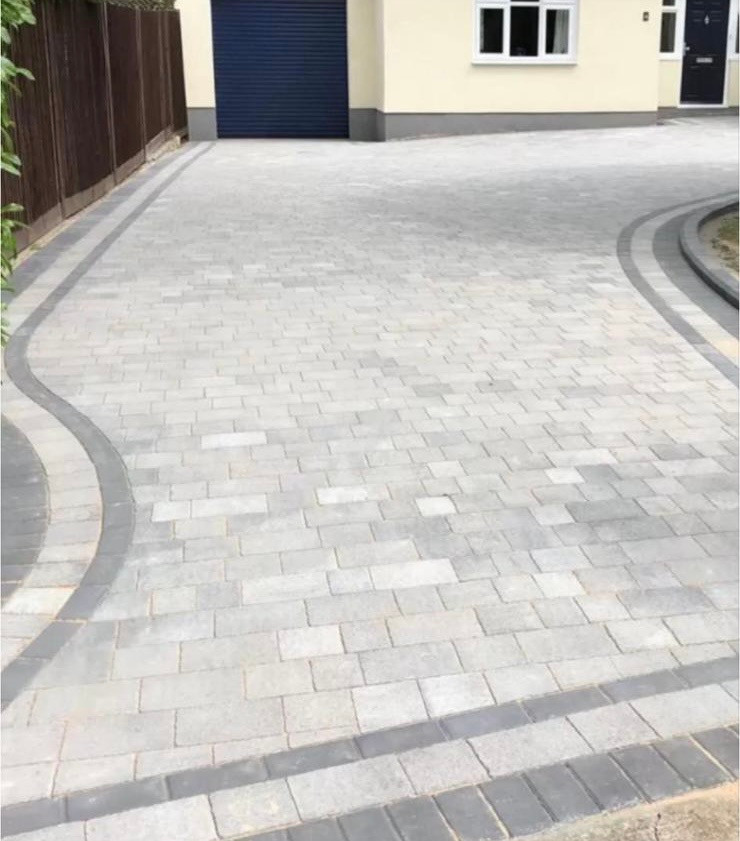
The entrance, which is where most drives fail. A lot of houses here come straight off the street across a verge, with no kerb line and nothing to stop the surface spreading. That is why the first two metres break up first: the edges have no restraint and the base was never built for a vehicle turning on it. We take that end out properly, put in a haunched edge or a kerb, build the depth back up and finish with a bound apron so nothing loose ends up on the carriageway. Where an access is being made or widened, that also means a crossing over the verge, and Planning Portal guidance on dropped kerbs covers how a dropped kerb is applied for.
Concrete poured straight onto soft ground cracks in the middle, lifts at the joints and eventually rocks under a wheel. Small cracks can be cut out and filled and left alone; once a slab is moving, the honest answer is to break it out, get the depth and compaction right underneath, and lay something that can be lifted and put back later. On the block paving and tarmac at the newer houses, sinking is nearly always the base rather than the blocks, so we lift the affected area, correct the sub-base, re-compact and relay the same units, then re-sand with kiln dried sand. The ground here is wet, the North Winterbourne runs close by and the village lies in flood zones 2 and 3, so a soakaway is sized from a percolation test rather than assumed and sometimes needs a positive outfall. Gravel wants a membrane, a compacted sub-base and a real edge, plus a bound stretch downhill of a gate. Out the back, flags go on a full mortar bed with the falls away from the wall and the finished level kept well below the damp proof course.
How it runs
From your call to a written price
Behind the house, a patio at ground level is permitted development. At the front it turns on where the water goes: a permeable build-up, or a fall into a border, a lawn or a soakaway on your own land, keeps you clear, while a sealed surface over five square metres draining to the road does not. Planning Portal guidance on paving your front garden sets out that test. Dorset Council is the planning authority. No conservation area covers the village, though seven entries in it are listed, the parish church among them, and on a listed house the council can want listed building consent for paving laid against the walls.
Cost
What decides the price of a driveway
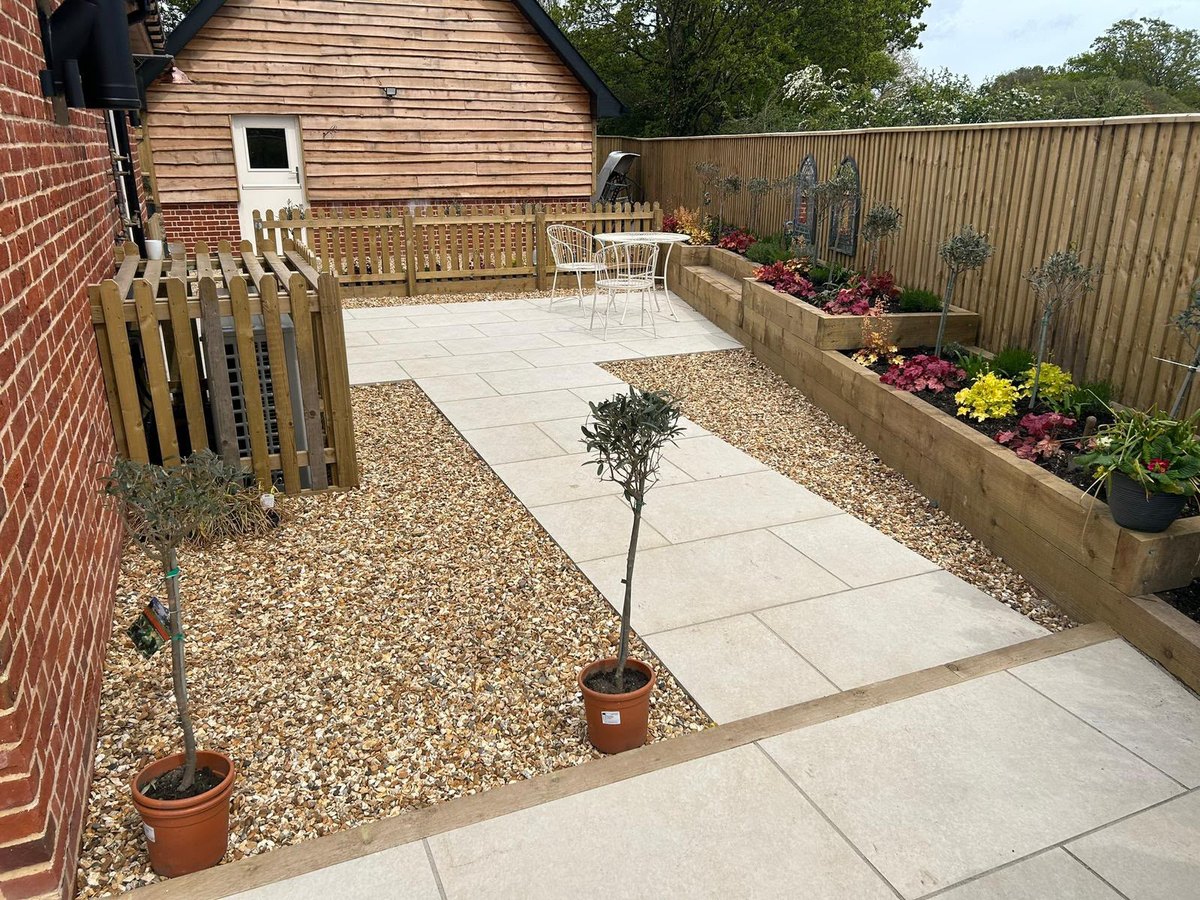
Two quotes for the same drive are usually two different jobs. A cottage on the street with a verge in front of it, a bungalow behind a hedge and a farmhouse at the end of a long track are priced apart before any stone is ordered, because access sets how the stone arrives and how the spoil leaves. Depth of dig and volume of muck are what move the figure, and on wet ground so does the drainage. Worth asking a rival quote whether the edgings are haunched or simply bedded.
If it is urgent
A trip hazard, or a drive that floods
Ring for these; the form is for the rest. A gully that has silted up and put water at a doorway, or a slab by the front step that has dropped, gets dealt with on the first visit. We make it safe, get the water moving, and price the permanent work once the ground can be opened up. Say which one it is when you ring and we bring what is needed.
Worth knowing
A winterbourne village, and why a soakaway here is a question not an assumption
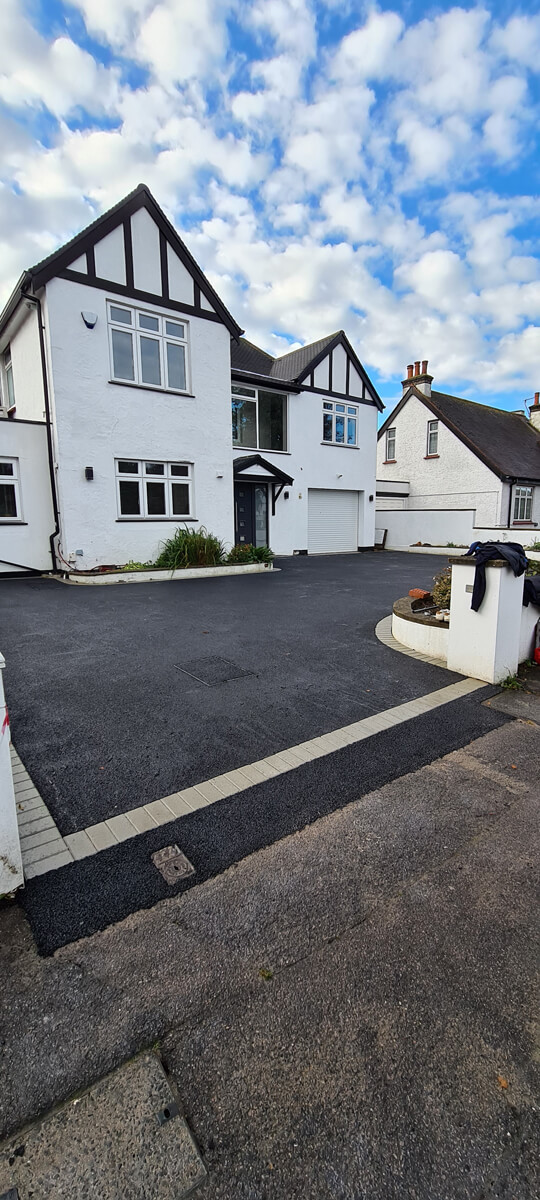
A winterbourne is a stream that runs through the winter and dries back in summer, and that tells you most of what you need to know about the ground under your drive. For a good part of the year the water table sits high, and the mapped surface water risk through parts of the village is not small. On ground like that, digging a hole and calling it a soakaway is a guess.
It wants a percolation test, done properly and ideally not in the middle of a dry August, and Approved Document H is the document that sets out how surface water should be dealt with in order of preference. Where the ground will not take it, the answer is a positive outfall to a ditch or an existing surface water drain, agreed before the job starts rather than discovered halfway through.
The rest is design you get for nothing if you ask for it early. Keep the surface permeable so most of the rain never becomes runoff in the first place, which is the sustainable drainage approach, SuDS in the jargon, and the reason a permeable drive also sidesteps the planning question at the front.
Put a channel drain across the entrance so water off the street does not run down to the house. Never let surface water into a foul drain. And accept that a wet dig costs more: the spoil comes out heavy, a soft formation has to come out deeper, and stone has to be brought back up to make a base worth laying on.
Who you are dealing with
A local firm you can check
We cover Winterborne Kingston, Bere Regis, Milborne St Andrew, Winterborne Whitechurch and the villages along the Winterborne valley, and DT11 generally. Bournemouth Roofing & Building Ltd, registered in England and Wales, company number 15471719, which you can look up in a minute. Thomas Hannen's business, and he is the one who comes out to price the job, not a salesman. A verified customer's 10 out of 10 on Checkatrade. The visit and the written quote are both free.
Questions
Winterborne Kingston questions we get asked
Can the flooding be fixed without lifting the whole drive?
Sometimes. If the surface is sound and water is merely arriving faster than it leaves, cutting a channel drain across the low point and piping it to a pit clear of the house solves it without disturbing the rest. If the water is standing because the base is saturated and has slumped, no drain will hold it. The surface water rating at Winterborne Kingston is high, so we test which one you have first.
The winterbourne runs a few doors away. Does that matter?
For where you send the water, yes. The North Winterbourne channel passes around seventy metres from parts of Winterborne Kingston, and the village lies in flood zones 2 and 3, so the drainage design has to keep run off on your own land and out of the channel. It also means the water table climbs through winter, which is how a deep pit fills from below and stops working precisely when you need it.
Can a lorry and a machine get in?
Usually, though the approach wants looking at first. The lanes through Winterborne Kingston are narrow with soft verges and there is frequently only one spot where a grab lorry can stand. We check the turning point, the overhead wires and the width of the entrance on the visit, and where a large lorry cannot get in we work with a smaller machine and more loads. That affects the days, not the specification.
How deep should the base go on wet ground?
Deeper than a standard drive, and the trial hole decides by how much. Ground around Winterborne Kingston is naturally wet, so the subgrade often has very little bearing strength and a thin layer of stone is simply pushed down into it. We lay a geotextile separator to stop stone migrating into the soft material, then build up in compacted layers. That detail is the difference between a drive that ruts and one that does not.
Do you have to break out the old concrete?
Not in every case. Concrete that is unbroken and does not rock underfoot can stay as a base beneath block paving or resin, which saves a full excavation and a great deal of muck away. Concrete that has heaved at the joints or lifted where a root has run under it comes out, because anything laid on top follows the same lines within a couple of winters. We break a test section to see.
Nearby, and next door
Driveways and patios near Winterborne Kingston
Driveways and patios nearby
Our other trades in Winterborne Kingston
Everything we do in Blandford Forum Driveways and patios, all areas Every area we cover
Free quote
Free quote for a drive or patio in Winterborne Kingston
Ring or send a photograph and we will come and look properly. The visit and the written itemised quote are free.