Driveways and patios in Lytchett Matravers
Drives, patios and paths in the village and out along the lanes, priced from what is under them rather than from what goes on top.
The site visit is free and so is the written itemised quote. Thomas Hannen prices every job himself.
Most drives here do not fail at the surface. If yours is rutting where the cars turn, ponding by the front door or dropping away at the garage, it is the sub-base under your Lytchett Matravers drive that has gone, and another skim of tarmac over the top will not hold it. We dig a trial hole first and tell you which of the two you have.
Three calls come out of the village more than any others. The drive that went down with the house has finally given up, usually at the point where the wheels turn in. The back patio has started rocking, one slab sits proud of the next, and somebody has caught a foot on it. Or there is a second and third car in the family now, the single-width drive is not enough, and half the front garden is up for discussion.
All three want looking at before anyone quotes. We come out, survey the fall of the ground with you, dig a trial hole at the worst spot to see what depth of stone is actually down there, and find out where your rainwater goes at the moment. Then you get it in writing with the excavation, the sub-base, the edgings, the surface and the drainage on separate lines.
The work
The drives and patios we are asked for in the village
Rebuilding a drive that has run out. Much of the village went up in the post-war decades, the biggest single share of it in the 1970s and early 1980s, and the drives went in with the houses: a strip of concrete, or a thin skim of tarmac over whatever came out of the trench. Cars got heavier, which is why you get rutting and ponding rather than a neat crack. A rebuild is a dig to formation, compaction, a geotextile membrane where the ground is soft, then a real depth of sub-base before anything decorative goes near it.
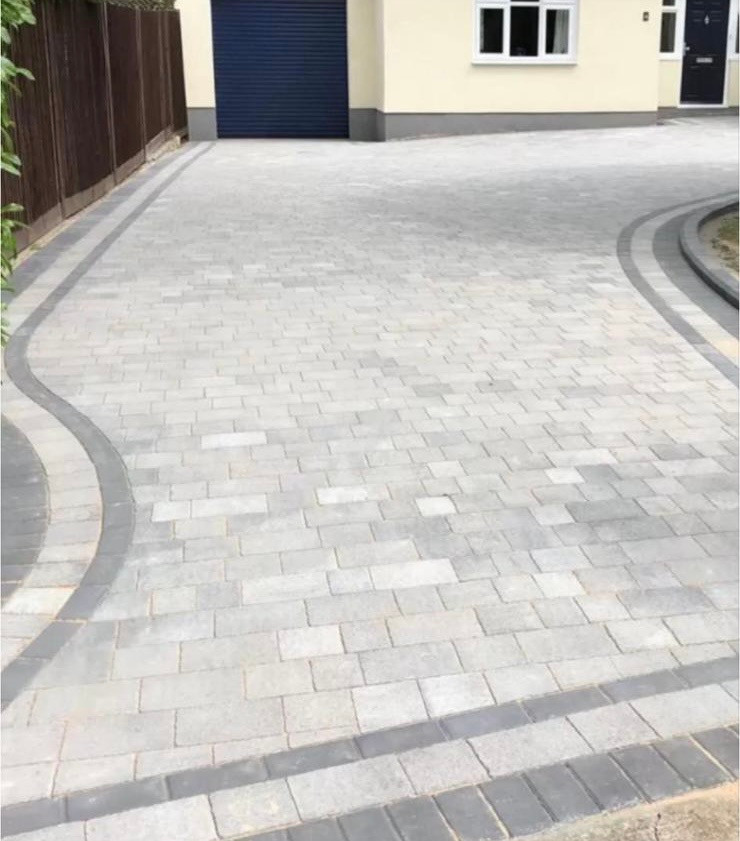
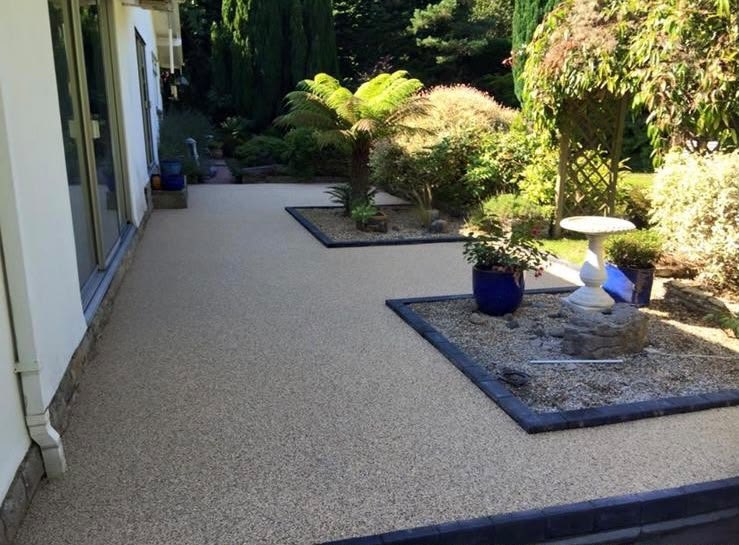
Block paving is still the surface most people here ask for, and it earns that where cars turn, because a sunken bay can be lifted and relaid rather than patched. It wants an edge restraint haunched in concrete all the way round and kiln dried sand brushed into the joints. If yours has gone wavy the edge has let go; if weeds are coming up it needs a re-sand, not a new drive. Resin bound goes over a sound concrete or tarmac base, tarmac suits the longer runs, and concrete carries weight but always shows its repairs.
Where the water goes is the local part. The ground under the village drains slowly, so a soakaway here wants a percolation test rather than an assumption, and where the test fails the run off needs a positive outfall instead. Plenty of plots fall away behind the house, so a patio arrives with a step, a retaining edge and a decision about levels: finished well below the damp proof course, or a channel drain across the doorway if you want to come out level from patio doors. Out on the lanes gravel ruts as soon as an oil tanker has been on it, and a cellular grid with a bound strip at the entrance keeps the stone off the road.
How it runs
From your call to a written price
Same team start to finish, one person to ring, nothing sub-contracted out. The quote is itemised: excavation, muck away, sub base, edgings, surface and drainage on separate lines, and the spoil leaves with us.
On permission. At the front, more than five square metres of new hard surface needs planning permission unless it is permeable or the water goes to a border, a lawn or a soakaway on your own land, which is how we build them; Planning Portal guidance on paving your front garden sets it out plainly. A patio at ground level behind the house is permitted development. Dorset is the authority, and with fifteen listed entries around the village, work tight against a listed frontage can want listed building consent.
Cost
What decides the price of a driveway
No rate per square metre, because what is under a drive decides more of the cost than what goes on top. A bungalow with a straight run in off the road, a detached house on a plot that falls away behind, and a cottage where the only route to the back is a side gate are three different jobs before a spade goes in. On ground that drains this slowly the dig is usually deeper than people expect. Ask any quote how deep the dig is, what sub base is going in, where the surface water ends up, and who takes the spoil away.
If it is urgent
A trip hazard, or a drive that floods
Ring rather than use the form. A lifted slab, a sunken bay by a doorway or a gully that has stopped taking water will not wait: somebody falls, or water ends up against the house. If a slab has lifted on a path someone uses in the dark, say so and we will get it flat or out of the way first. The phone is answered 24 hours for emergencies; scheduled work runs Monday to Friday, 8am to 6pm.
Worth knowing
Where the water ends up matters more here than the surface does
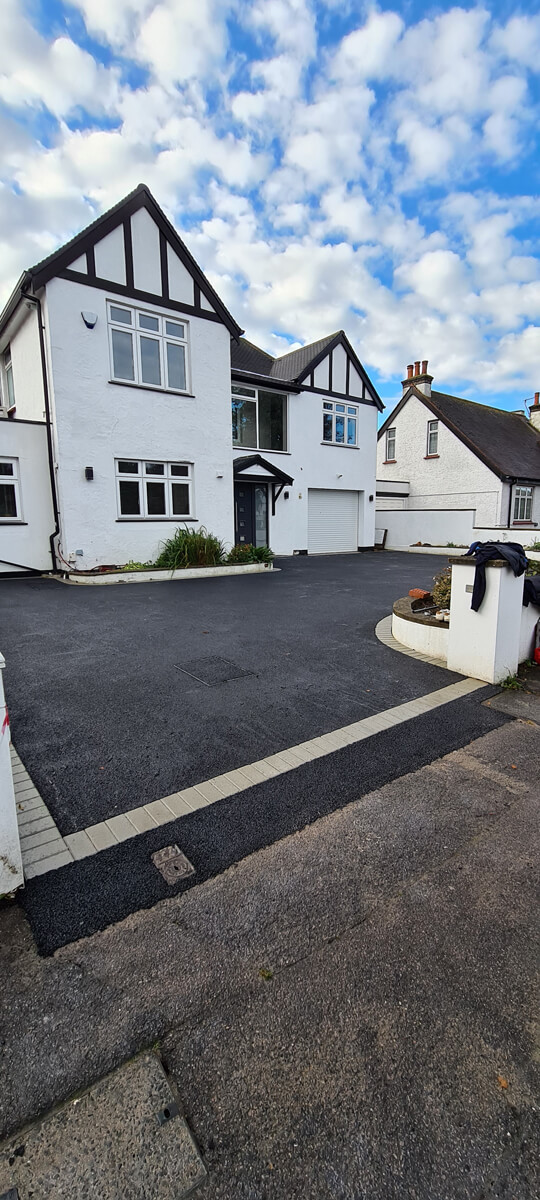
The ground under the village holds water and moves with it, swelling when it is wet and shrinking back when it dries. That has two consequences for a drive.
The first is that a soakaway is not the automatic answer: it needs a percolation test rather than an assumption, and plenty of holes dug around here fill up and stay full. Approved Document H sets out the order you are meant to work through, and where infiltration will not do it the answer is a positive outfall, or a permeable build-up with enough open stone under it to hold a downpour and let it go slowly.
The second is about the house rather than the drive. Ground that shrinks and swells reacts to how wet it is kept, so tipping the water off a roof and a whole drive into one spot a metre from a wall is not a damp problem, it is a movement problem.
When we set the falls we run water away from the house, keep any outfall clear of the foundations, and if there is nowhere sensible for it to go we will tell you on the first visit rather than after the dig. If a neighbour has just built a drive that now sends water your way, raise it before you build yours.
Who you are dealing with
A local firm you can check
We work across Lytchett Matravers, Lytchett Minster, Upton, Organford and Holton Heath, and BH16 generally. Bournemouth Roofing & Building Ltd, registered in England and Wales, company number 15471719, which you can look up in a minute. Thomas Hannen's business, and he is the one who comes out to price the job, not a salesman. A verified customer's 10 out of 10 on Checkatrade. The visit and the written quote are both free.
Questions
Lytchett Matravers questions we get asked
Will a soakaway actually work in the clay up here?
Not automatically. The ground under most of Lytchett Matravers is slightly impeded drainage, loamy over clay, so water sits in a hole rather than sinking out of it. We dig a test pit and time how fast it empties before anyone commits to a soakaway. If it drains too slowly the surface water goes to a positive outfall instead, or falls onto lawn and a border. Assuming infiltration is how a drive ends up under water in February.
Do the listed buildings in the village affect our drive?
Only if yours is one of them or sits within its curtilage. Fifteen entries are listed around Lytchett Matravers, the Parish Church of St Mary The Virgin among them, and there is no conservation area over the settlement. For an ordinary house that means the surface is your choice and the real constraint is where water goes. If your deeds mention listing, say so at the visit and we confirm it before pricing anything.
Why does the patio have to fall away from the house?
Because the ground across Lytchett Matravers shrinks and swells with a significant rating, and where rainwater lands beside a footing is a structural question rather than only a damp one. Soaking and drying the same spot next to a foundation moves it over time. So the paving is laid falling away from the building, the finished level stays down at the threshold, and the run of water finishes somewhere it can spread out instead of ponding on brickwork.
Who signs off the dropped kerb, you or the council?
Dorset Council does, as highway authority, and that side is separate from anything happening on your own land. They handle the application for the footway crossing and they inspect it. We price the drive up to the boundary line and keep the crossing as its own item on the written quote, so you can see which part is ours. Get the council side moving early, because the paving is the quick half of the job.
Is permeable block paving the only sensible option on this ground?
No. Permeable blocks only work where water can get away underneath, and with impeded ground under much of the village that is not a given. The alternative is a sealed surface laid to a definite fall with a channel drain and somewhere real for it to discharge. Either way the sub base gets built up properly, because a thin base over loamy clay ruts under a car within two winters and then the blocks rock.
Nearby, and next door
Driveways and patios near Lytchett Matravers
Driveways and patios nearby
Our other trades in Lytchett Matravers
Everything we do in Corfe Mullen Driveways and patios, all areas Every area we cover
Free quote
Free quote for your drive or patio in Lytchett Matravers
Tell us what it is doing now and we will come and look. The visit and the written itemised quote are both free.