
Driveways in Corfe Mullen
Drive widening, block paving, resin bound surfaces and patios across Corfe Mullen. We rebuild what is under the surface, not just what you can see.
The site visit is free and so is the written itemised quote. Thomas Hannen prices every job himself.
Last updated
A thin layer of tarmac laid for one small car is what most Corfe Mullen drives were built as. If yours is cracking, sinking or simply too narrow for two vehicles, the fix is a proper dig and a real sub-base, and that is a job of days rather than weeks.
The jobs come in three shapes. Somebody is fed up reversing off the verge because the drive only takes one car. An original concrete or tarmac surface has broken up at the edges and weeds have taken the cracks. Or a rear patio of old flags has sunk towards the house and now holds water against the wall.
We come out, measure what you have got, look under the surface where we can, and give you an itemised written price. Where the existing base is genuinely sound we will say so and quote the smaller job, because covering good ground twice is the easiest money in this trade and we would rather have the recommendation.
The work
Drives built in the seventies, and what they need now
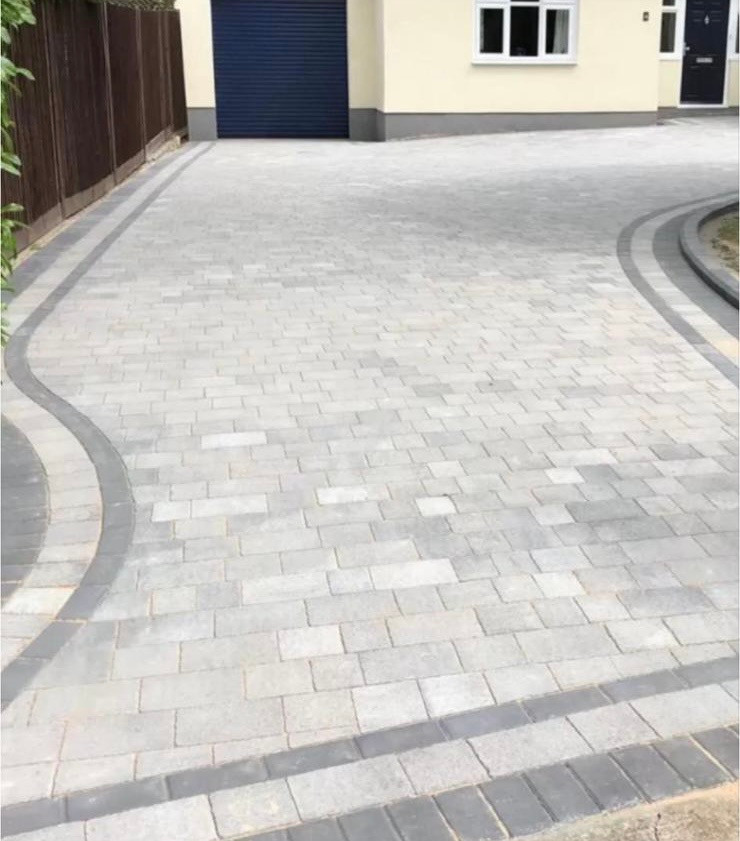
Widening a drive that was never wide enough. Nearly two thirds of the village went up between 1945 and 1982, and a third of the whole place in the 1970s and early eighties, when one car per house was the assumption.
Widening means excavating the extra strip to formation, laying a geotextile membrane and a compacted sub-base at the same depth as the rest, then tying the new surface into the old so there is no seam to fail along. Usually the sensible answer is to take the whole frontage up and lay it as one, because a patched half never quite matches and the join is the first thing to crack.
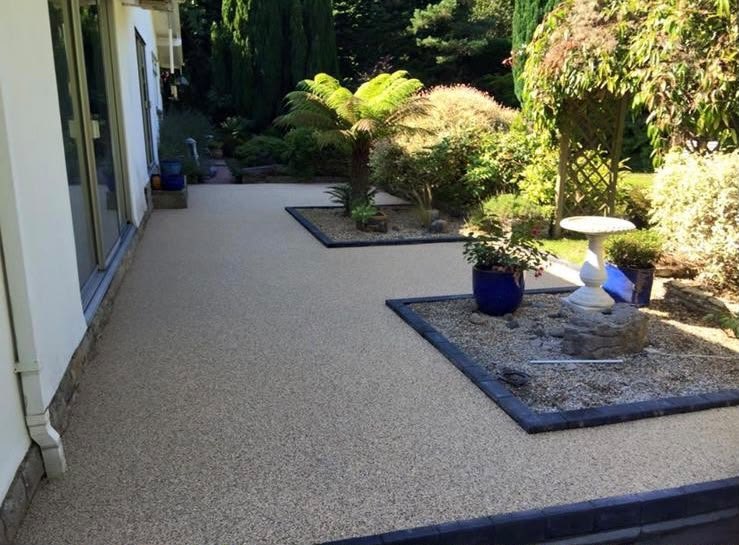
Original drives in Corfe Mullen were often laid thin, straight onto whatever was there, and once the edges have crumbled and the middle is cracked an overlay just follows the fault up. We break it out, take the spoil away, and rebuild in block paving, resin bound stone or fresh tarmac depending on what you want to look at. Broken concrete is heavy and the disposal is a real line on the price, which is why it belongs on the quote in writing rather than as a surprise.
Bungalow side accesses. A third of the houses in Corfe Mullen are bungalows and a lot of them have a long narrow run down the side to a garage at the back. Those strips take the same loading as the front drive but rarely got the same base, so they rut and dish first. They also collect water, with the house on one side and a fence on the other, and this ground drains poorly, so a channel drain or a defined fall to a gully matters more than the paving does.
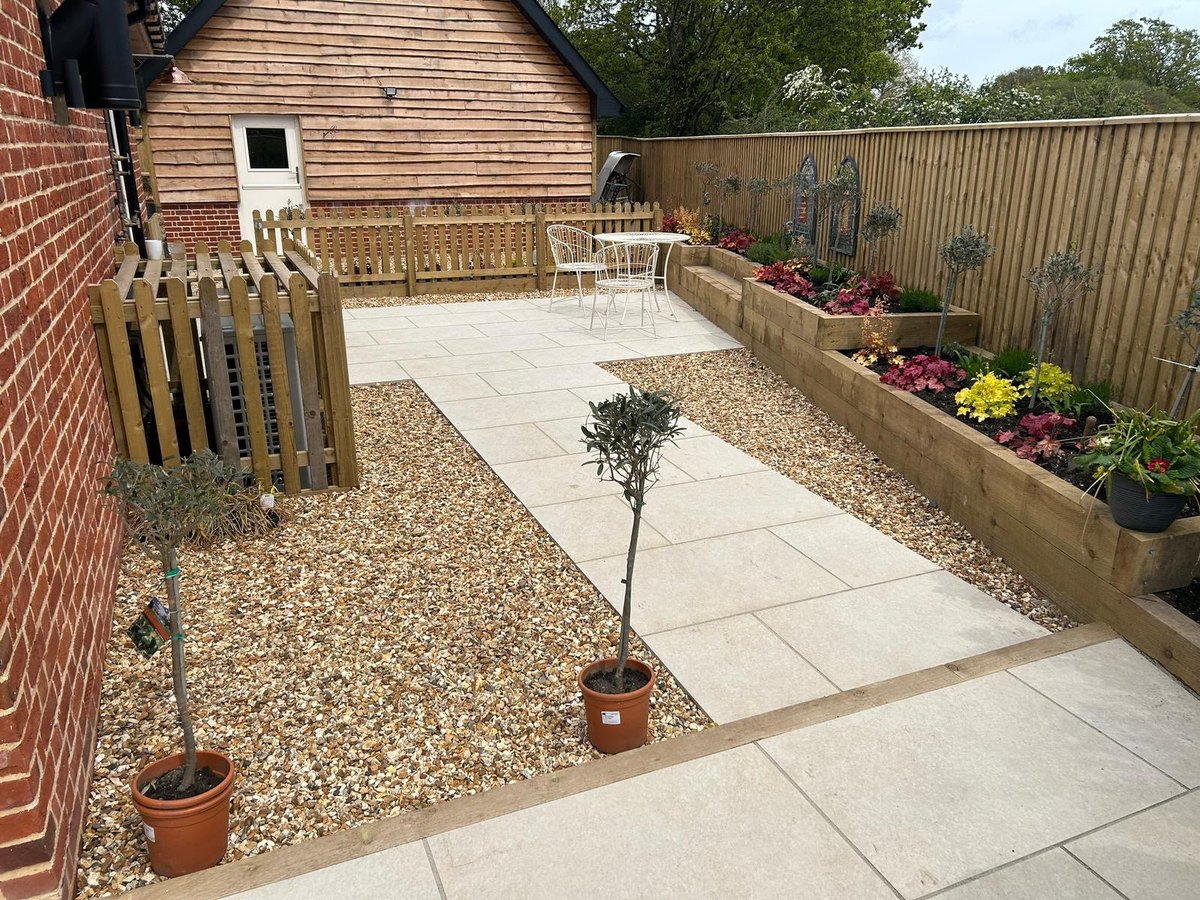
Where a block drive has settled we lift, correct the sub-base, reset to a true fall and re-sand with kiln dried jointing sand. Where the edge restraint was never haunched properly the whole edge has usually crept, and that goes back on concrete so it stops. Rear gardens here are generally decent sized and the original patio is often a small square of concrete flags: porcelain or natural stone on a full mortar bed, laid to fall away from the house, with the finished level kept below the damp proof course and a step down from the threshold where it needs one. For that side of the job, see patios in Corfe Mullen.
How it runs
A new drive on clay: from the dig to handing it over
Thomas comes out and prices the drive himself, and he looks first at where the water will go, because the ground here is clay that drains slowly and moves as it wets and dries. On the quote, the digging out, the muck away, the sub-base, the edgings, the surface and the drainage are all separate lines. The dig, the base and the surface are then done in that order.
Most houses in Corfe Mullen have a frontage, so the digger and grab lorry work from the road and the skip sits on the drive. Where the parking is round the back of a terrace, the route in is agreed first. The road and footway are swept each day, and the spoil leaves with us. If we find an old soakaway, a service pipe lying too shallow or soft ground under the old concrete, work on that part stops while you look at a photo and a price.
Under the rules for paving a front garden, a permeable surface, or one that drains to a lawn or border instead of the road, is normally permitted development. More than five square metres of solid surface draining to the road needs planning permission. A new or widened dropped kerb is a separate application to Dorset Council as highway authority. Unless your frontage is inside the conservation area around Brogg Street and Sleight Lane, or is one of the parish's listed buildings, the material and colour are yours to pick.
Cost
Sub-base, edgings and drainage on slow-draining ground
Be wary of a rate per square metre. The ground work under a drive costs more than the blocks on top.
The dig and the sub-base. On clay, a drive needs a proper depth of compacted crushed stone, with soft spots dug out, or it will rut and sink. The depth is the first line to compare.
Where the water goes. Permeable block paving only works if the water under it has somewhere to go, and on clay a soakaway may not drain. A channel drain to a border, or an outlet to a proper drain, has to be designed in, and Approved Document H covers it.
Access and layout. A detached house with an open frontage onto the road, a bungalow with a narrow side run to a back garage, and a terrace where parking is round the rear ask for quite different work before anything is measured.
Edgings. Block paving is held in by its edgings. Haunched in concrete, they last; laid loose, the drive spreads.
Ask each firm what depth they dig, which sub-base and how thick, whether the edgings are haunched, where the water goes, and who takes the spoil.
If it is urgent
A drive sinking towards the house, or water at the door
Call rather than using the form. A raised slab or a dip by a doorway will not wait, because somebody trips or water ends up against the house. A drive that has settled back towards the house, so rain that used to run to the road now arrives at the front door, is worth looking at before winter.
The first visit makes it safe and finds the cause. Drive work is booked Monday to Friday, 8am to 6pm. Miss us, and we call you back.
The one local thing
A village of drives that all reached the same age together
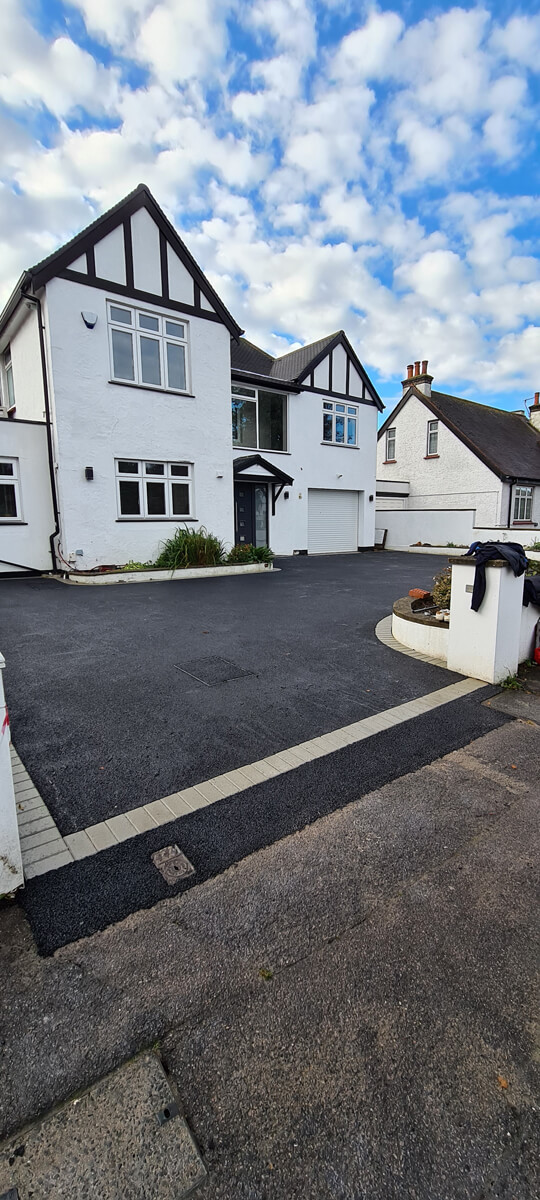
Around six in ten homes in Corfe Mullen were built between 1945 and 1982, and the peak was the 1970s and early 1980s. That matters for a practical reason. When a whole estate goes down inside a few years, the drives on it wear out inside a few years of each other too, which is why one street can suddenly be full of broken tarmac and lifted edges.
It also means the original specification is fairly predictable: a shallow base, a thin surface, an edge that was never restrained, and a width sized for a car noticeably smaller than the one on it now.
So the question here is usually not repair or replace, it is how far out to go while the machine is on site. Widening the drive is far cheaper done in the same visit than as a second job two years later, and the same is true of moving a soakaway, putting a duct in for a car charger, or taking the paving round to a bin store.
The one thing you cannot decide on your own is the entrance: making a crossover wider means crossing the verge and the kerb, and that is applied for from the council rather than settled with us. Get that in motion early and the rest follows easily.
Who you are dealing with
Who lays your drive, and how to check them
We lay drives in Corfe Mullen, Broadstone, Lytchett Matravers and the BH21 villages either side of Wimborne, about eight and a half miles out from our Bournemouth base in Boscombe. Dorset Council handles planning and dropped kerbs.
Thomas Hannen owns the company and comes out to measure and price the drive himself. It is Bournemouth Roofing & Building Ltd, registered in England and Wales, company number 15471719. Checkatrade shows a verified customer's 10 out of 10. You pay nothing for the survey or the written quote, and every line of it is itemised. Before you book a visit in Corfe Mullen, you can read our customers' Google reviews, word for word, on our reviews page.
Planning at a glance
Do you need planning permission in Corfe Mullen?
Most repairs in Corfe Mullen need no application at all. What decides whether a change to the outside of your house does is who the council is, whether a conservation area or a listing applies, and whether the place sits in a protected landscape.
| Question | In Corfe Mullen |
|---|---|
| Who decides | Dorset Council is the planning authority for Corfe Mullen. Dorset Council's heritage pages set out what it controls. |
| Conservation area | Yes: Brogg Street / Sleight Lane Conservation Area. Check whether your street is inside the boundary before changing anything visible. |
| Listed buildings | Yes, there are listed buildings in and around Corfe Mullen. If yours is one, work can need listed building consent. |
| Protected landscape | No National Park or National Landscape covers Corfe Mullen. |
Questions
Questions about driveways in Corfe Mullen
Does anything in Corfe Mullen restrict how a drive looks?
Very little on appearance, for most addresses. The Brogg Street and Sleight Lane Conservation Area covers only a small part of the parish, so unless your house is inside it or is one of the parish's listed buildings, such as the Church of St Hubert or Court House, nobody will tell you what colour a drive should be.
Dorset Council is the planning authority and its interest is in drainage and in the crossing over the footway. That puts the whole argument onto the ground underneath, not onto the look of the surface.
The estate went up in the seventies. Is our drive due?
Probably at much the same time as the neighbours'. 62.1% of Corfe Mullen was built between 1945 and 1982, with 34.5% of it landing in the 1970s and early 1980s, so the original drives went down within a few years of each other and reach the end together. That is why a road suddenly looks tired all over. It is also why we price what has actually failed rather than assuming everything comes up.
The lawn stays soft all year. Where does the drive drain?
Not onto the lawn, which is the usual mistake here. Corfe Mullen has impeded drainage, so grass already soft in July will not absorb a winter of run off from a paved area on top of the rain falling on it. Water needs a defined route: a channel at the low end, a piped run, and an outfall that keeps working when everything is wet. Any soakaway gets a timed pit test first.
A third of homes here are bungalows. Does the layout change?
It changes what a frontage has to do. Bungalows are 33.6% of Corfe Mullen and their plots tend to be wide and shallow, so the drive handles turning, parking and a level route to the front door in the same space. That means working out where a car actually swings, keeping the fall away from a low threshold, and finding width for two cars without leaving a strip of grass nobody can use.
Is widening worth doing while the machine is on site?
It is the sensible moment, because excavation, compaction and edge restraint are the same operations whether a drive is one car wide or two. Doing it afterwards means breaking the new edge out again. What is not automatic is the road side: if widening needs a wider crossing over the footway, that is a Dorset Council application on their timetable. It sits on the quote as its own item so it can be decided separately.
Nearby, and next door
Driveways near Corfe Mullen
Nearby places we also cover for driveways, with straight-line distances from Corfe Mullen, and the other trades we offer in Corfe Mullen itself.
Driveways nearby
Our other trades in Corfe Mullen
Driveways and patios guides
Driveway planning permission and where water goes Sunken or ponding driveway: base or drainage Indian sandstone vs porcelain paving: an honest comparisonEverything we do in Corfe Mullen Driveways, all areas Every area we cover
Free quote
Get a written price for your drive
Free site visit in Corfe Mullen, a free itemised quote, and a straight answer on whether widening is worth doing now.