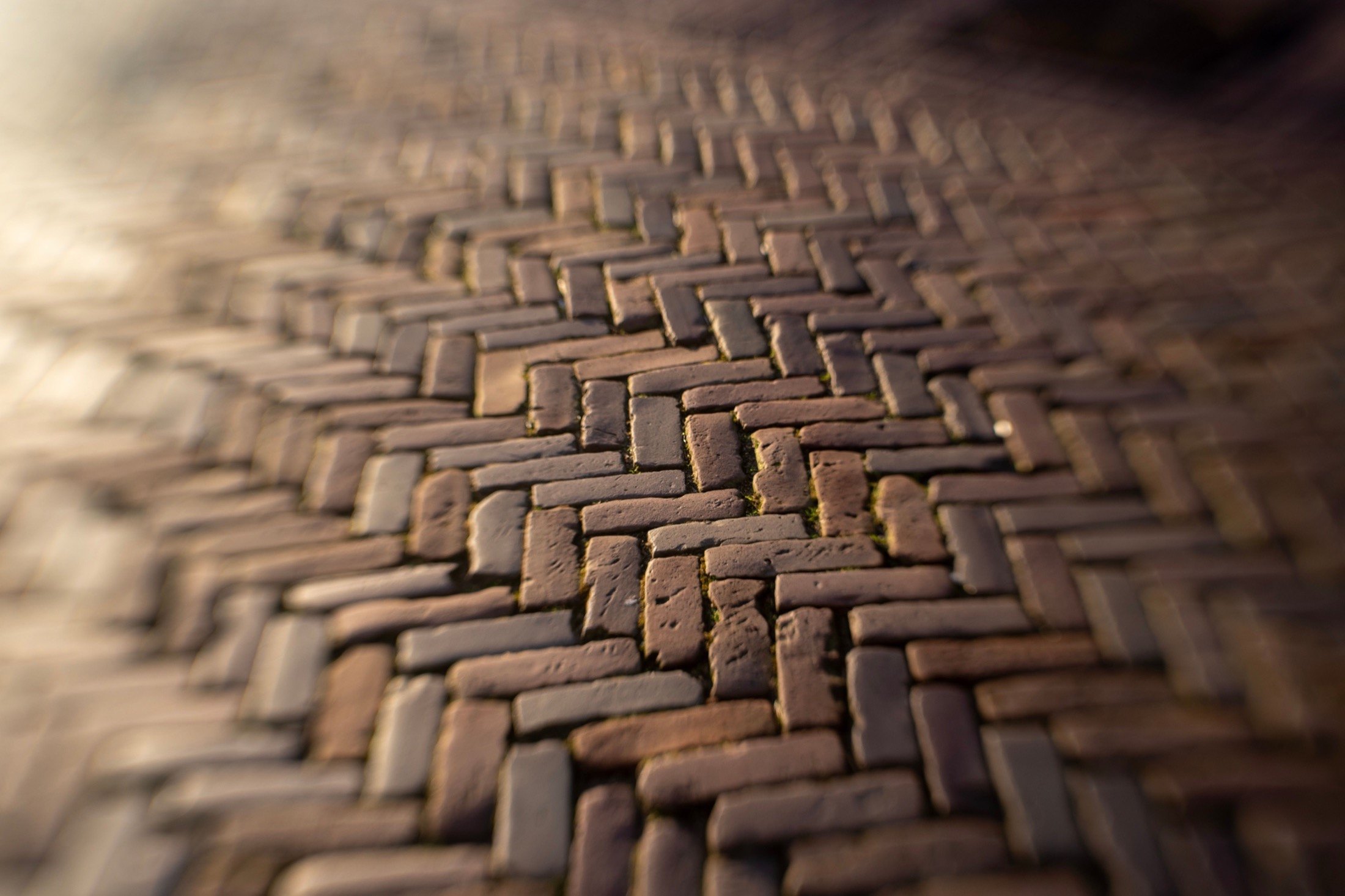
Driveways and patios in Stone
Sunken block paving lifted and relaid, rutted tarmac, patios that pond against the house and drives widened for a second car, across Stone and the BH21 lanes.
The site visit is free and so is the written itemised quote. Thomas Hannen prices every job himself.
Nearly every drive we are asked to look at around Stone has failed from underneath rather than on top. The blocks or the slabs themselves are usually still sound. What has gone is the sub-base under them, laid too thin on ground that swells in winter and shrinks back in summer, so the wheel tracks sink and the rest stays put. Lifting the surface, digging down to a firm formation and rebuilding the base is the honest answer here far more often than a brand new surface is.
Three things bring people to the phone here. A dip where the car stands, deep enough that water sits in it and finds the front door. A patio that has settled the wrong way over the years, so rain now runs back towards the wall of the house instead of away from it. And a single width drive that has to take a second car, with a hedge on one side and no obvious place for the water to go once the front garden is hard.
All three are ordinary work and none of them needs to start with a demolition. We come out, dig a small hole in the corner of the drive to see what is actually under it, and tell you whether you are buying a repair, a relay or a rebuild. The site visit and the written itemised quote both cost nothing.
The work
What we get called to on the closes and lanes around Stone
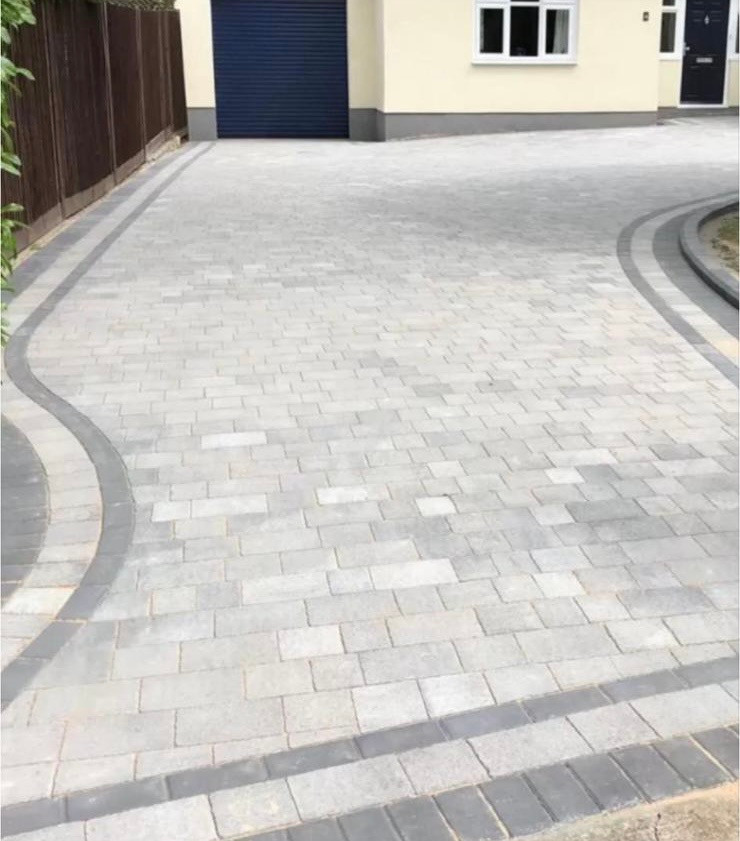
Block paving that has sunk in the wheel tracks. The bread and butter job here. Drives that went down with the brick estates are thirty and forty years old, and most were built with a shallow layer of stone straight onto clay. We lift the blocks by hand and stack them, because the same blocks nearly always go back down. The dig goes to a proper formation, a geotextile membrane goes between the ground and the stone so the two cannot pump into one another, and the sub-base goes back in layers, each one compacted before the next. If the pattern has spread over the years it is the edge restraint that gave way, so the edgings are reset and haunched in concrete before anything else goes back.
Concrete and tarmac from the same era. Concrete cracks along the day joints and lifts where a root has got under it; tarmac goes brittle at the unsupported edges, then ruts where the car turns. An overlay is sometimes a fair answer and sometimes throwing money away, and the test is simple. If the base is still firm and only the surface has tired, an overlay works. If the panel rocks when you stand on the edge of it, covering it just moves the problem up by forty millimetres. We will say which one you have got before you have paid for anything.
Widening for a second car is the commonest new work here: taking out a length of border and low wall, matching the surface across the new bay, and deciding where the extra water goes. On clay that is not a free move, so it is a permeable build up, a channel drain into a soakaway, or a gravel border that takes the run off. A vehicle crossing over the footway is a dropped kerb application to the county highways team.
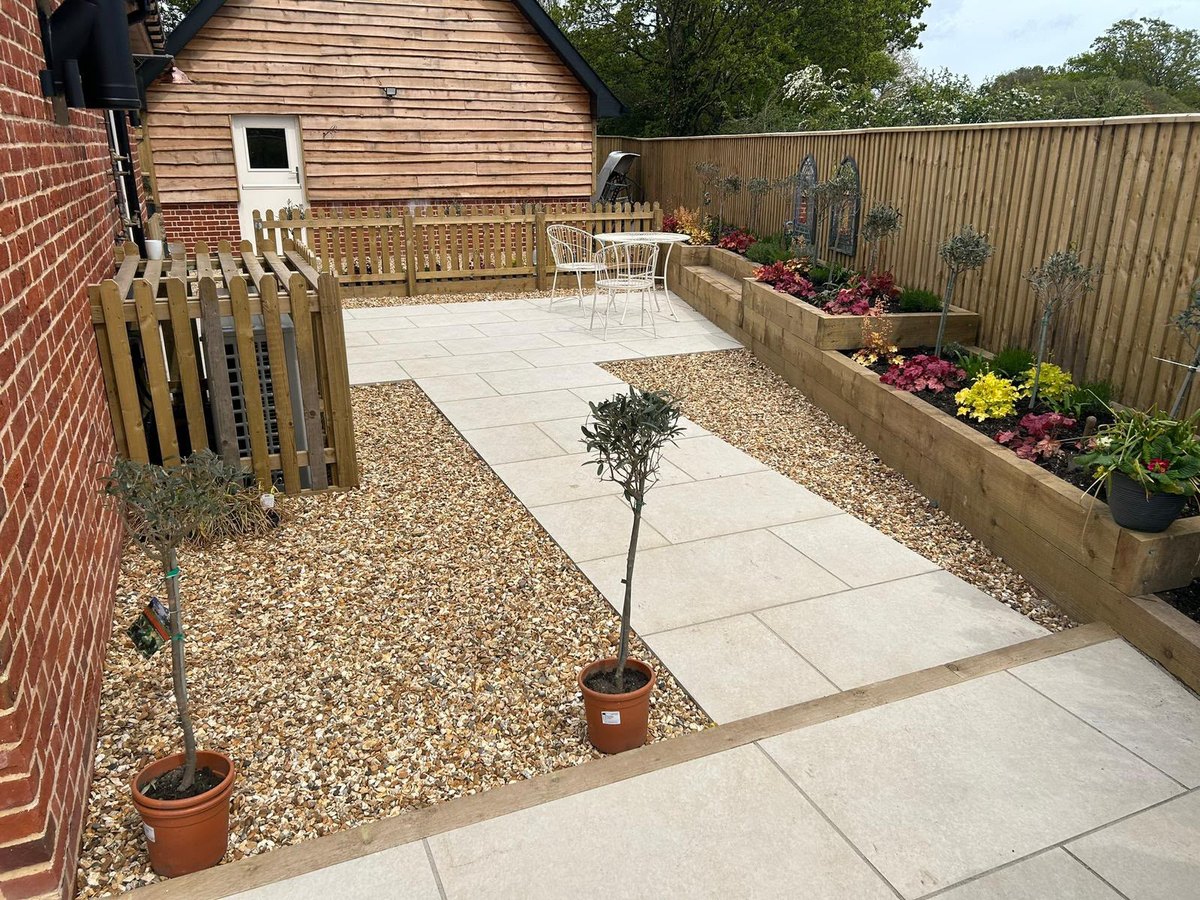
Parking courts and shared hardstanding. A third of the homes in this corner of BH21 are flats and their parking is communal, which changes how the job runs rather than how it is built. We phase it so nobody loses their space for more than a day, and where the bill falls on leaseholders your managing agent will need to run the consultation that section 20 of the Landlord and Tenant Act 1985 requires, so the quote is written to suit that from the start. Patios go on the same rules as the drive: a full mortar bed, the fall away from the building, and the level clear of the damp proof course.
How it runs
From your call to a written price
One person to ring, and an itemised quote. Paving your own front garden is normally permitted development, and the trigger is surface water rather than area: hard surfacing over five square metres has to be permeable or drain to a border, lawn or soakaway inside your own boundary, and the front garden paving rules set that out plainly. Push it into the road and you need permission. Crossing the verge goes to Dorset Council as highway authority. There are 91 listed entries in this stretch of the Stour valley and a good few are boundary walls and gate piers rather than houses, so if your frontage is old we check whether listed building consent applies first.
Cost
What decides the price of a driveway
No rate per square metre, because what is under it decides more than what goes on top. A house off one of the lanes where a grab lorry can pull onto the frontage, a terrace on a close where the machine works from the road, and a flat whose parking court has to stay half open are three different jobs. Ground conditions, the depth of the dig and how much muck goes away are the real variables. On clay, where the water is sent is a design decision with a cost. Ask the depth of dig, the sub base, the drainage and who takes the spoil.
If it is urgent
A trip hazard, or a drive that floods
Ring rather than use the form. A lifted slab, a sunken bay by a doorway or a gully that has stopped taking water will not wait, because somebody falls or water ends up against the house. We are eight miles away, so if water is running back at the house we will cut a temporary channel on the first visit. The phone is answered 24 hours for emergencies; scheduled work runs Monday to Friday, 8am to 6pm.
Worth knowing
The ground here moves, and it takes your drive with it
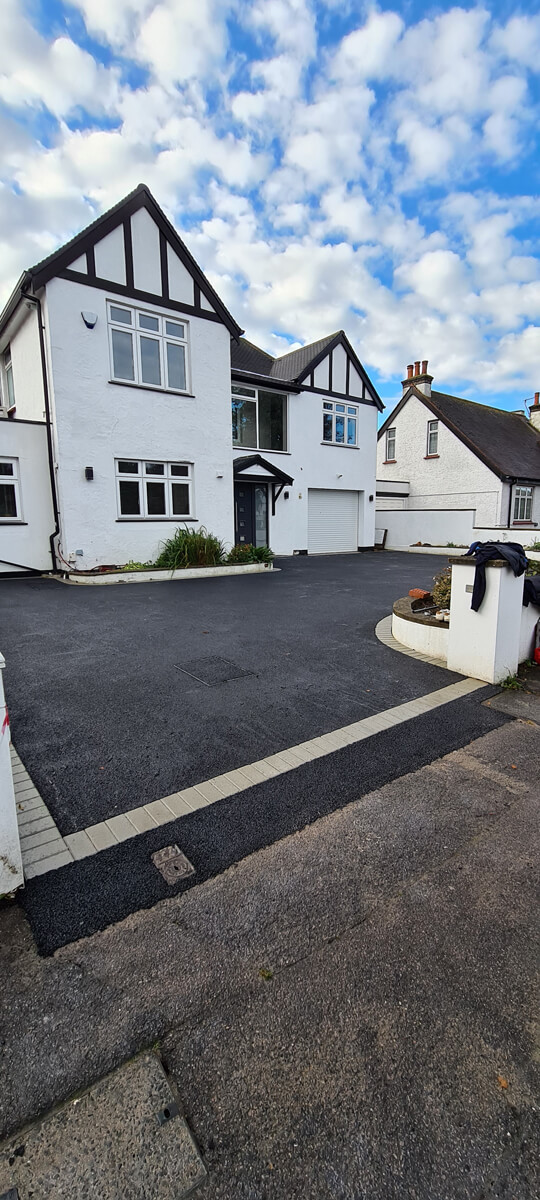
The ground around Stone is cohesive and has a real shrink and swell rating, which is a dry way of saying it gets smaller in a hot summer and bigger again through the winter. Under a lawn that does not matter. Under a drive it decides everything. A surface laid on a token scraping of stone rides up and down with the clay and cracks or dips within a few seasons, which is exactly what we find when we open up a failed drive here.
It is why the depth of the dig, the geotextile membrane between clay and stone, and compacting the sub-base in layers rather than all in one go are not upsell items on this ground. They are the job. Ask anybody quoting you how deep they are digging and what is going back in, and if the answer is vague, that is your answer.
The second half of it is where the water ends up. Clay does not take water away, so a soakaway that would work perfectly on sand can fill up and stay full here, and a hole that stays full next to a wall is a foundation problem rather than a puddle. Anything infiltrating should be proved with a percolation test rather than assumed, kept well away from the house, and sized properly. Approved Document H is the standard that sits behind all of that, and it is why we will sometimes tell you the honest answer is a positive outfall to an existing surface water drain instead.
If there are mature trees near the frontage, be careful in both directions: do not send new run off at their roots, and do not seal the ground over them completely either. Changing how much water reaches clay near a house is the one decision on a driveway that can cost more than the driveway.
Who you are dealing with
A local firm you can check
We cover Stone, Pamphill, Wimborne Minster, Sturminster Marshall and the BH21 addresses along the Stour, with Dorset Council for planning and building control. Send the postcode if you want to be certain. Bournemouth Roofing & Building Ltd, registered in England and Wales, company number 15471719, which you can look up in a minute. Thomas Hannen's business, and he is the one who comes out to price the job, not a salesman. A verified customer's 10 out of 10 on Checkatrade. The visit and the written quote are both free.
Questions
Stone questions we get asked
The drive has dropped where the car stands. Why there?
That is where the load is, and the ground around Stone shrinks and swells with the seasons, so the wheel positions consolidate first. Lifting that patch and packing it up buys you a flat drive until the next dry summer, because the material under it is still too shallow. The repair that holds is to take the bay out, dig deeper, rebuild in compacted layers and relay the same blocks on top of it.
Where do residents park while the parking area is dug up?
In sections, so nobody loses a space for the whole job. Around a third of the homes at Stone are flats and the parking usually sits in one bay serving all of them, so it gets taken in halves: dig, base and surface one side, open it up, then cross over. That adds a day or two to the programme. The alternative is finding somewhere else for everyone to leave a car for a week, which never works.
Is resin the wrong choice on ground that moves?
It is the least forgiving of the options. Resin is a continuous surface bonded to a base, so when the ground beneath shifts the surface has to crack somewhere instead of moving at a joint. Block is jointed, which means it absorbs small movement without showing it, and a failed patch lifts and relays with the same blocks. On the ground at Stone that flexibility is worth more than the neater finish.
What do you actually check on the site visit?
Levels first, with a laser: where water goes now, where the thresholds sit and how much fall there is to the road. Then a hole through the existing surface, because a drive at Stone laid in the eighties can have six inches of stone under it or none at all. Then access, turning space and where a lorry can stand. Thomas does all of that himself and the figures come off it.
The edges have spread and blocks are loose. Fix or relay?
Edges are usually a repair. Blocks work loose because the edge restraint has moved, and once the restraint goes the whole field creeps towards it and every joint opens. Resetting the kerb or edging on a concrete haunch and re-sanding pulls the lot back tight again. If the field has dipped as well, that is a separate job, and the two get set out as separate items so one can be done now.
Nearby, and next door
Driveways and patios near Stone
Driveways and patios nearby
Our other trades in Stone
Everything we do in Corfe Mullen Driveways and patios, all areas Every area we cover
Free quote
Get a written price for your Stone driveway or patio
Send the postcode and tell us what the drive is doing. We come out, open a hole to see what is under it, and put the price in writing with the days it will take.