
Driveways and patios in Wimborne Minster
Courtyards, frontages, block paved and resin drives and stone patios across Wimborne Minster and BH21. Free site visit and free written itemised quote.
The site visit is free and so is the written itemised quote. Thomas Hannen prices every job himself.
New paving on an older Wimborne Minster house must not finish above the damp proof course, because that is how a tidy courtyard turns into a wet wall. In the town centre there is a second question: the material and the finish are part of the planning decision, not just a matter of taste.
The calls split by where you are. From the old streets it is a small frontage or a back courtyard where the brick paving and the flags have sunk, weeded and started holding water against the house. From the converted houses and blocks it is shared parking that has broken up and nobody is certain who instructs the work. From the newer roads round the edge of the town it is a tarmac or concrete drive from decades ago that wants replacing with block paving or resin.
All of them start the same way. A free site visit, a level taken against the wall of the house, a trial hole or a lifted block to see what the sub-base is doing, and an honest answer about whether this is a re-lay, a rebuild, or a drainage problem wearing a surface. Then a written itemised quote with the method beside each line.
The work
Paving in the old streets, and out on the newer roads
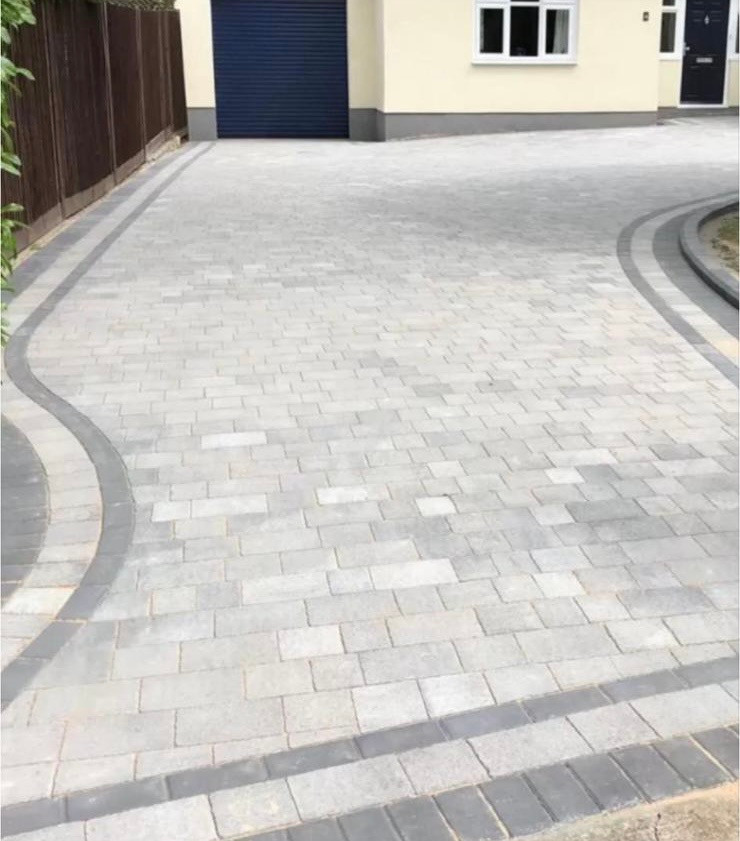
Frontages and courtyards behind the old houses. Getting on for a fifth of the houses in Wimborne are pre-1919 and the largest single group is pre-1900, so much of this work is small areas with awkward access and often no way in except through the house or a side gate. Everything moves by barrow and the machine that would take a day off the job simply will not fit. We lift old clay paviours and stone flags by hand, keep and clean what is sound, rebuild the base, and re-lay with the pattern and the pointing that was there. Sawn natural stone, clay pavers and granite setts all sit comfortably on these streets. Concrete block on a period frontage rarely does.
Ground levels against an old wall. This is the one that costs people money in Wimborne. On the oldest houses the damp proof course is a slate course low down, or there is none at all, and generations of paving laid over paving have quietly raised the ground until it bridges the wall and wet tracks inside. The fix is to reduce the level rather than add to it, and where that is impossible, a drained gravel margin or a channel drain along the wall with a proper outfall. We check it with a level before quoting, because it changes the whole design of a courtyard.
Shared parking at converted houses and blocks. A third of the town's homes are flats, and a lot of that parking sits behind converted buildings, in courts never built for the number of cars now on them. The bays by the entrance go first and the falls are usually flat enough that water stands and stains. We will survey one for a managing agent or a residents' group and price it in sections so the whole court is never closed, set out plainly enough for leaseholders to read. Where the cost triggers a formal consultation, section 20 of the Landlord and Tenant Act 1985 is the process the agent has to follow.
Out from the centre it is the familiar work: tarmac gone grey and open, concrete cracked into rocking panels, block paving dished by the garage and short of jointing sand. We lift and re-lay block by hand on a corrected sub-base, overlay a sound base in tarmac or resin bound, or excavate to formation, lay a geotextile membrane and build a compacted sub-base to the depth a parked car needs. Patios come up off their five dabs of mortar and go back on a full mortar bed with the fall running away from the house, and the finished level is set from the threshold rather than from the old paving.
Room for a soakaway is scarce in a town garden and the ground shrinks and swells, so the drainage is often a permeable build-up, a channel drain to an existing surface water outfall, or a silted gully dug out and re-connected. Approved Document H is the standard the design answers to. On a narrow street there is frequently nowhere to stand a skip, so the muck away is planned around a timed grab lorry and everything leaves with us.
How it runs
From your call to a written price
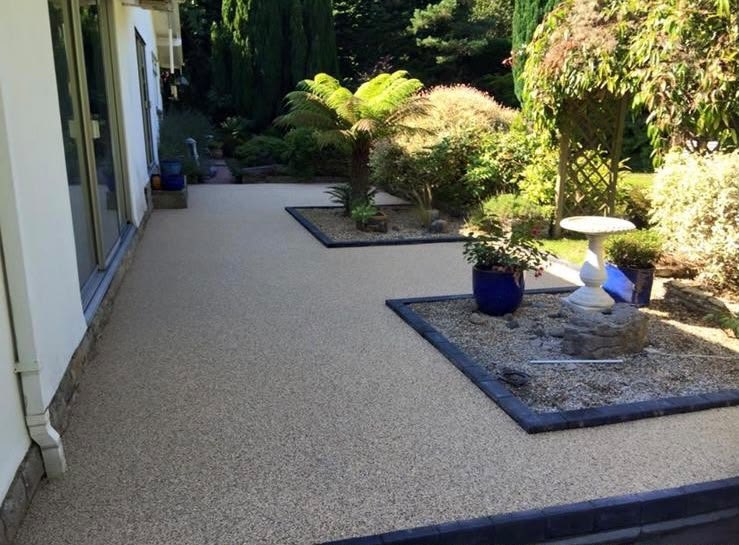
One person to ring, the same team throughout, and the quote itemised: excavation, muck away, sub base, edgings, surface and drainage on separate lines. The town centre sits inside the Wimborne Minster Conservation Area and a number of buildings in and around it are listed, the Church of St Michael and All Angels and Old Manor Farmhouse among them. Paving is still normally permitted development, but appearance carries weight in a conservation area, and where a building is listed listed building consent can cover the ground and the boundary as well. The front garden rule applies wherever you are, per Planning Portal guidance on front gardens. Dorset Council is the authority here.
Cost
What decides the price of a driveway
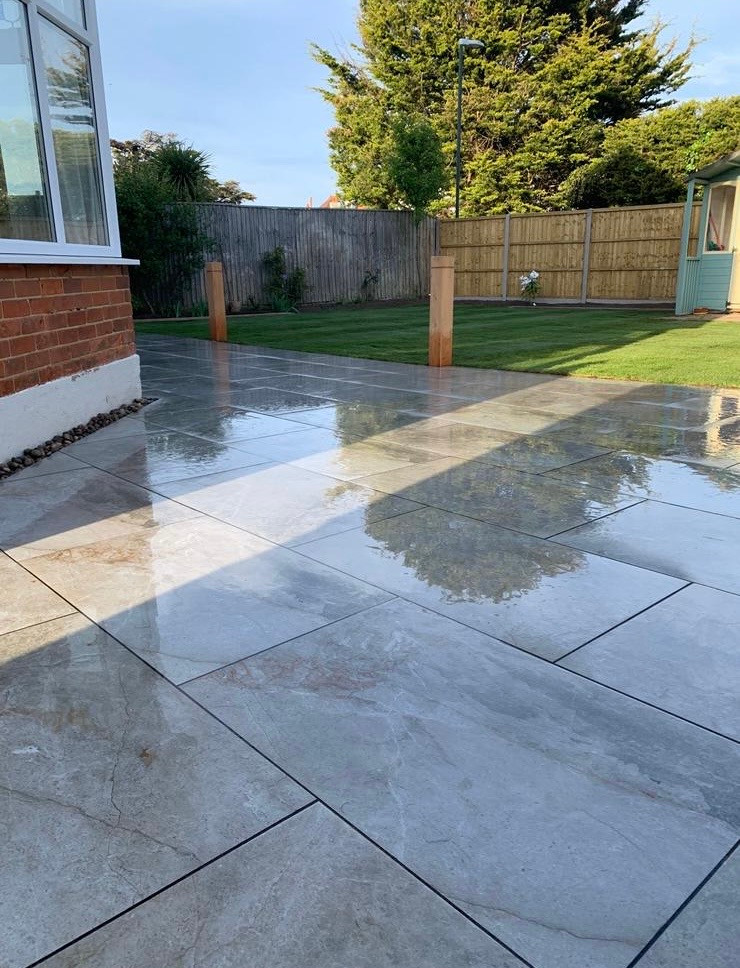
No rate per square metre. What is under it decides more of the cost than what goes on top. A town centre terrace where every barrow comes through the house, a courtyard behind a shop with one gated entrance and a semi on the edge of town with a drive you can park a van on are three jobs before a spade goes in. After that it is the depth of the dig, how much muck goes away and where the surface water is allowed to go. Ask the dig depth, the sub base, the drainage and who takes the spoil.
If it is urgent
A trip hazard, or a drive that floods
Ring rather than use the form. A lifted slab, a sunken bay by a doorway or a gully that has stopped taking water will not wait: somebody falls, or the water ends up against the house. In the town it is usually an old flag tipped on a frontage right beside the pavement, or a courtyard gully backing up against a wall. We make it safe first, then price the permanent work.
Worth knowing
What the conservation area actually changes about your paving
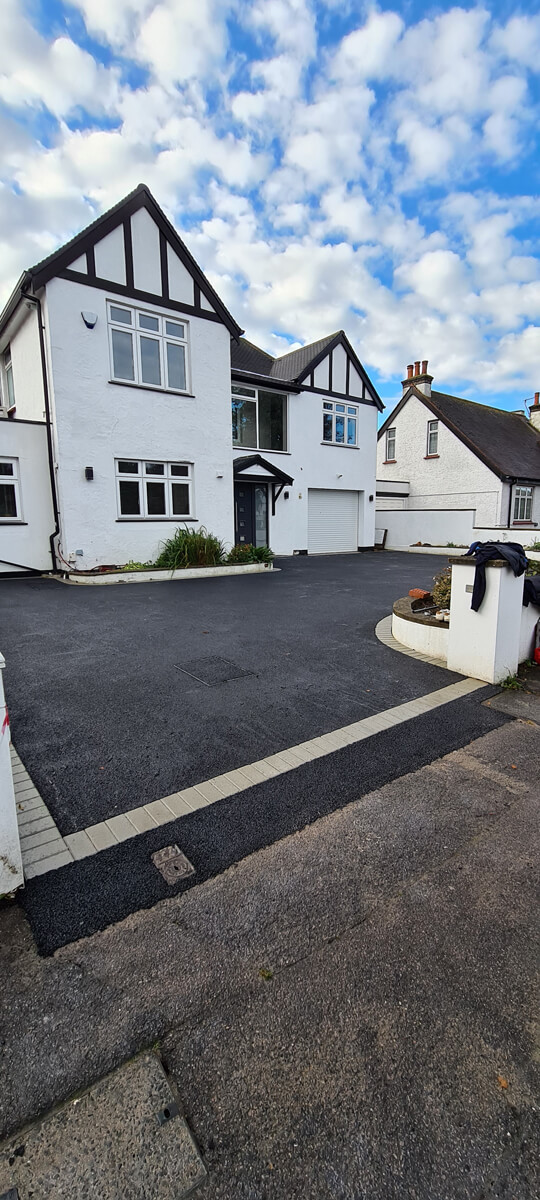
It does not stop you paving, and it does not mean an application for every slab. What it removes is the assumption that any surface will do. Inside the conservation area the look of a frontage is a planning consideration, so the paving that draws an objection is the one that reads as suburban on a street of brick, stone and gravel.
The council keeps the boundary, and it is worth checking whether your address is inside it before you order anything, because the line runs down the middle of some streets rather than round the edge of the town. Where the house itself is listed, take advice first: the council sets out what needs consent, and on a listed building that can extend to the ground and the walls around it, not just the front door.
In practice the useful rule is to let the street choose the material. Clay pavers, sawn or riven natural stone, stone setts and gravel over a bound base all belong here and all can be built to take a car. If you want the practicality of block paving, ask for a clay paver or a stone sett rather than a bright concrete block, and keep the borders and the edgings in the same family.
Two more small things save real trouble: a pre-application conversation with the conservation officer costs only time and settles the material question before you buy it, and a new crossing over a footway in the centre is a highway decision that can be refused on visibility whatever the planners think of the paving. Ask about both before you take a deposit off anybody's quote.
Who you are dealing with
A local firm you can check
We cover Wimborne Minster, Colehill, Merley, Furzehill, Pamphill and out to Corfe Mullen and Broadstone across the BH21 postcodes, and Dorset Council is the planning and building control authority for this address. Bournemouth Roofing & Building Ltd, registered in England and Wales, company number 15471719, which you can look up in a minute. Thomas Hannen's business, and he is the one who comes out to price the job, not a salesman. A verified customer's 10 out of 10 on Checkatrade. The visit and the written quote are both free.
Questions
Wimborne Minster questions we get asked
Do I need consent to repave a courtyard in the conservation area?
For the paving alone, usually not, but the Wimborne Minster Conservation Area controls appearance so the choice of material carries weight. Reclaimed stock brick, stone setts and gravel are accepted; large format concrete slabs behind a period frontage often are not. Anything touching a wall, railing or gate at the street edge is a separate application to Dorset Council, and where the building is listed the level of paving against it is examined too.
There is no vehicle access to our yard. Is that fatal?
It is a labour question, not a fatal one. Behind the Wimborne Minster frontages the yards are reached through a passage or a side gate, so material moves in and out by barrow, or by dumper where a metre wide opening exists. We board the passage floor to protect it, keep bagged material on the pavement for as short a time as the council permits, and work in smaller loads.
Should paving be kept lower against an old house?
Yes, and by more than looks comfortable. 18.9% of Wimborne Minster predates 1919, and a solid wall with no cavity relies on drying out through its face, so paving carried up to internal floor level traps that moisture inside. Where the levels leave no room, we form a recessed gravel channel with a perforated pipe along the base of the wall, so the paving can sit high while the wall keeps an open face.
Can new paving be matched to the old brick?
Closely, not identically, and that is usually the better result anyway. Old stock bricks and clay pavers vary in colour across a single batch, which is why a reclaimed match blends in where a modern pressed brick shouts. In Wimborne Minster we source reclaimed clay pavers where they can be found, and lay any new brick as a defined border rather than a patch dropped into the middle of an old floor.
How quickly can someone come and look?
Wimborne Minster is under seven miles from where we are based, so a look at a lifted slab or a sunken drive is a short run and often happens within a few days. Thomas Hannen comes out himself and prices the job, and both the visit and the written itemised quote are free. If the yard sits behind a locked passage, we do need somebody there with a key.
Nearby, and next door
Driveways and patios near Wimborne Minster
Driveways and patios nearby
Our other trades in Wimborne Minster
Everything we do in Wimborne Driveways and patios, all areas Every area we cover
Free quote
Get a written price for paving in Wimborne Minster
A free site visit, a level taken against your wall, and an itemised written quote with the base, the surface and the drainage priced separately.