Driveways and patios in Beacon Hill
Drives and patios that stay flat, because the dig, the sub-base and the drainage are done before the surface goes anywhere near them.
The site visit is free and so is the written itemised quote. Thomas Hannen prices every job himself.
The ground underneath is what gives way when a Beacon Hill drive dips where you park. The blocks or the concrete on top are almost never the problem. So the ground is the part we dig into and the part we price.
Three things bring people here to the phone. Water standing in the same spot for two days after rain. Two sunken wheel tracks where the car sits, with the blocks tipping in towards them. Or a patio nobody uses any more because it is uneven, green and one slab rocks every time you walk on it.
We come out, look at the falls and the levels, and lift a corner or dig a small hole so we can see what is under there. That takes half an hour and it settles the argument, because the same symptom can be a morning's work or a full rebuild and you cannot tell from a photograph. You get told which, and why, before anyone talks about a price.
The work
Wide frontages, long drives and 1970s concrete
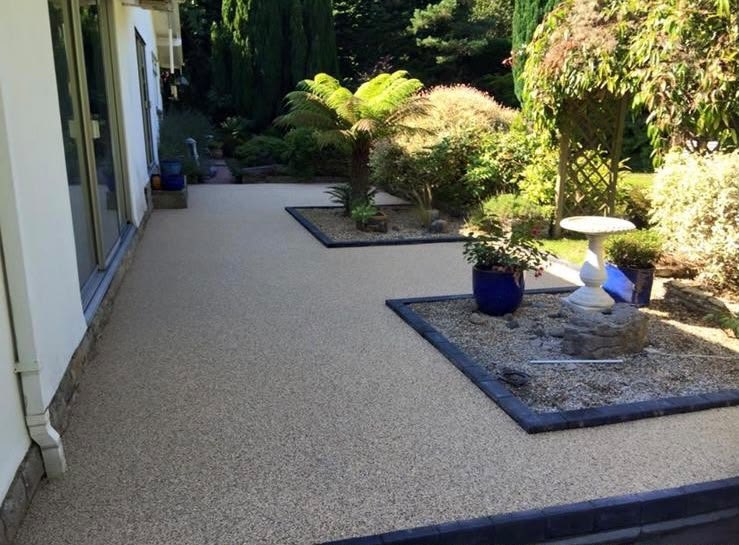
Worn out concrete drives. Most of the housing up here went up between the late 1960s and the early 1980s, and a poured concrete drive came with a lot of it. Fifty years on they crack along the bay joints, lift where a conifer root has got under them, and carry a spread of staining by the garage door. Two honest options: break it out, dig down and start again, which means a machine and a real disposal cost, or, where the slab is still flat and firmly bedded, repair the cracks and lay resin bound gravel over it. We will talk you out of the second if the concrete moves underfoot.
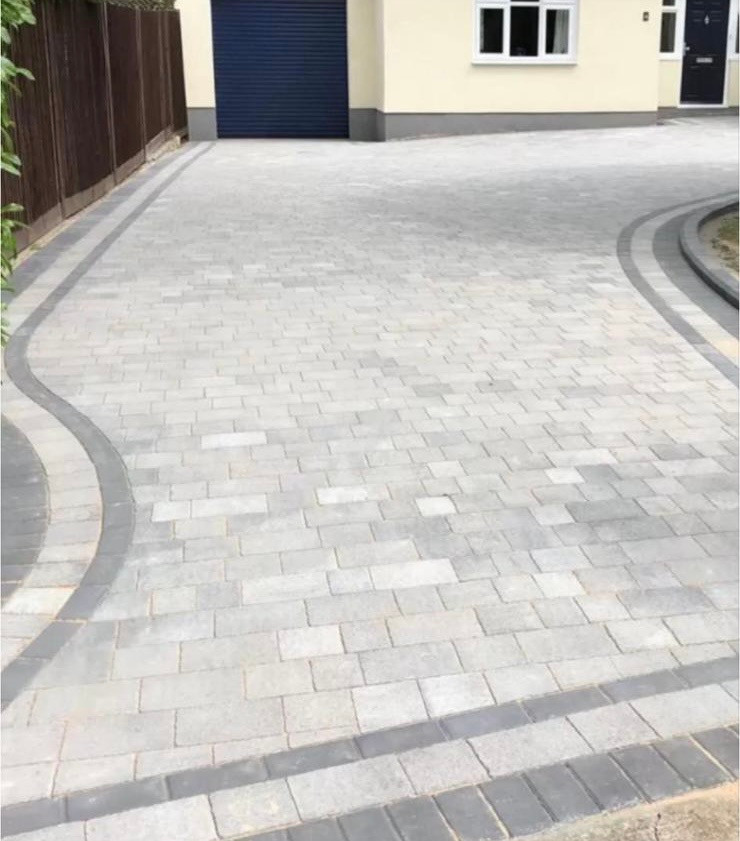
Block paving that has rutted is a base problem every time. We lift the blocks, keep what is worth keeping, take the failed material out to proper formation, put a geotextile membrane down and rebuild the sub-base in compacted layers. Where a drive has only lost its sand and grown weed in the joints, that is a clean and a re-sand rather than a rebuild, and we will say so.
Bungalow thresholds, and the second car. Around a quarter of the homes here are bungalows, which means patio doors opening straight onto the garden and a damp proof course two courses above the ground. Every time a new patio has gone on top of the old one the level has crept up, and eventually the wall inside goes damp. The fix is to bring the finished level back down, or run a channel drain and a gravel margin across the threshold. The detached houses were given single width drives, so taking in a strip of lawn is the other common job, and the part people miss is the edge: paving pushed against soft ground creeps out within a couple of winters unless the new side is kerbed and haunched.
How it runs
From your call to a written price
One team from the first visit to the last, and the quote itemised so excavation, muck away, sub base, edgings, surface and drainage each stand on their own line. Paving in front of the house stays permitted development as long as the water stays on your land, through a permeable surface or a fall into a soakaway, a border or a gravel margin. More than five square metres of hard surfacing draining out onto the road needs planning permission, and the front garden rules set it out plainly. Dorset Council are the planning and the highway authority here, so if you also need a vehicle crossing built, a dropped kerb is a separate application, not something we can grant you.
Cost
What decides the price of a driveway
Beacon Hill plots are mostly open at the front, which helps: everything arrives and everything leaves by the same route, and a drive a lorry can back onto costs less to build than one where every barrow goes through a side gate. The ground is the variable that moves the price. It holds water rather than draining it away, so the depth of the dig and where the surface water is allowed to go get decided on site rather than assumed. Ask any quote how deep the dig is, what sub base is going in, where the water goes and who takes the spoil away.
If it is urgent
A trip hazard, or a drive that floods
A lifted slab, a bay sunk by a doorway, or a gully that has given up are the ones to ring about rather than the form. We make it safe and get the water moving first, then price the permanent work. If it is ponding against the house, photograph it while the water is still there, because that tells us far more than a dry drive does. We are eight miles away.
The one local thing
Nothing here is listed, and that changes your choice
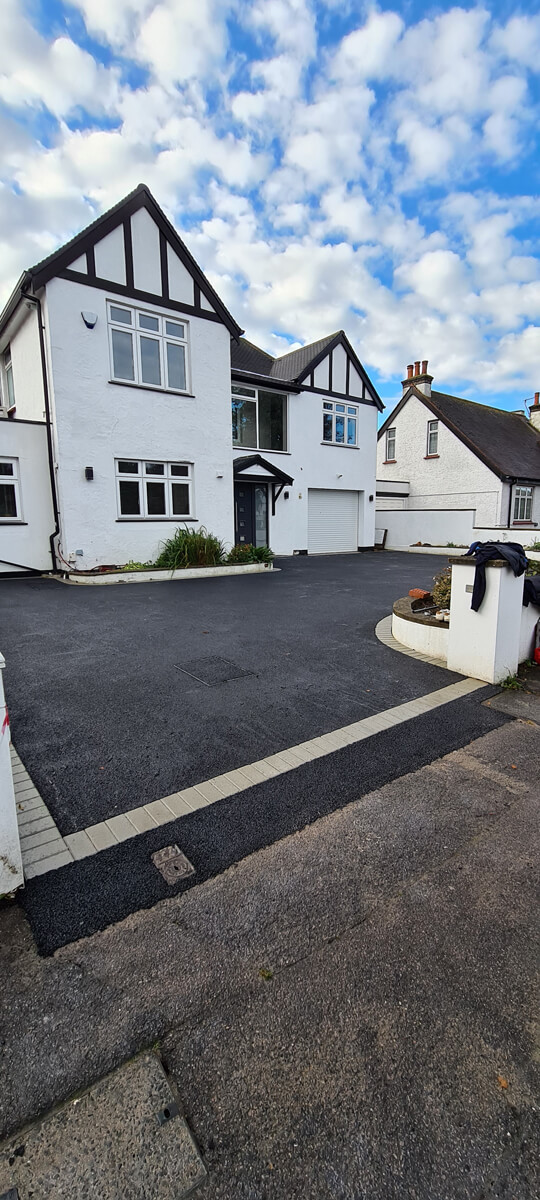
There is no conservation area over Beacon Hill and there are no listed entries in it. On this side of Dorset that is unusual, and it is worth knowing before you start ringing round. It means nobody has a say in what your drive or patio looks like. No consent for changing from concrete to block paving, no argument about whether grey porcelain is in keeping with anything, no material you have to match. The look of it is entirely your decision, and any contractor telling you otherwise here is wrong.
So the decision moves onto ground and use instead, and the ground is the awkward part. Water is slow to get away in this pocket, which is exactly the condition where a soakaway that looked fine on paper fills up in January and stays full. That is why we dig a hole and fill it before we design the drainage rather than after, which is the test Approved Document H expects.
Where the ground will not take it, the water needs a positive outfall to a surface water drain instead, or the surface itself has to be the drainage: permeable block paving over an open graded sub-base holds the rain and lets it go slowly, which is the whole idea behind SuDS. You are free to choose the surface. You are not free to choose the ground, so let the ground pick first.
Who you are dealing with
A local firm you can check
We work Beacon Hill and the BH16 lanes around it, out through Upton, Lytchett Matravers and across to Corfe Mullen, about eight miles from us. Bournemouth Roofing & Building Ltd, registered in England and Wales, company number 15471719, which you can look up in a minute. Thomas Hannen's business, and he is the one who comes out to price the job, not a salesman. A verified customer's 10 out of 10 on Checkatrade. The visit and the written quote are both free.
Questions
Beacon Hill questions we get asked
Beacon Hill has no conservation area. Can we pave what we like?
Within the ordinary rules, largely yes. There is no conservation area at Beacon Hill and nothing listed in it, so Dorset Council will not be arguing about the colour of a block or the finish of a slab. What still bites is surface water. Hard surface a front garden and send the run off onto the road rather than into your own ground and that needs an application. A permeable build keeps the job out of the planning system.
Our garden lies wet until March. Will a soakaway empty?
Not necessarily, and it is worth settling before stone is ordered. The ground around Beacon Hill is naturally wet, so infiltration gets proved rather than assumed: a hole in the right spot, filled twice, with the drop timed. Slow ground pushes the design towards a positive outfall, or towards a storage layer under the drive with a restricted outlet. That changes what the job costs, which is why it belongs on the quote and not in a conversation halfway through.
Why does the drive crack along the same line each summer?
Because the ground under Beacon Hill is cohesive and shrinks as it dries out. A long dry spell pulls moisture from it, the ground drops, and a rigid concrete or mortar bedded surface breaks along its weakest line, then closes again over winter. Flexible surfaces ride it out because the joints move. If a drive here keeps failing in the same place, the answer is a jointed surface over a deeper stone base, not another repair.
Only the wheel tracks have sunk. Can that be patched?
Sometimes, and the test is what sits under them. We lift a square metre in the rut and look at the bedding sand and the stone below. If the stone is intact and the sand has simply washed into a soft spot, that area gets rebuilt and relaid and the rest of the Beacon Hill drive is left alone. If the stone has punched down into wet ground, patching buys a year. The decision is made with the ground open.
Is gravel a sensible surface on ground that moves?
It copes better than most, because there is no rigid surface to crack. On shrinking and swelling Beacon Hill ground a loose surface simply resettles, which is why old drives here outlast the concrete ones. The problem is containment: with no proper edge and no stable bound base underneath, stone migrates into the road and ruts where the wheels run. Bound gravel or a cellular grid over a full base keeps the advantage without the sweeping up.
Nearby, and next door
Driveways and patios near Beacon Hill
Driveways and patios nearby
Our other trades in Beacon Hill
Everything we do in Corfe Mullen Driveways and patios, all areas Every area we cover
Free quote
Get a written price for your drive or patio
A free site visit in Beacon Hill, a proper look at the ground, and an itemised quote you can compare against anyone else's.