Roofing in Beacon Hill
Roof repairs, re-covering, flat roofs and leadwork across Beacon Hill and the BH16 addresses around Sturminster Marshall and Lytchett Minster.
The site visit is free and so is the written itemised quote. Thomas Hannen prices every job himself.
If water is getting into a Beacon Hill roof, look at the junctions before you look at the tiles. On the estate roofs here the covering routinely outlives the mortar at the ridge and verge, the felt at the eaves and the nails holding the lot down.
People ring us for three things. A stain has come through a bedroom ceiling after a wet week. A ridge tile or a verge cap has ended up on the drive. Or the roof has reached the age where you want somebody to say honestly whether it has years left or is on borrowed time.
Beacon Hill is about eight miles from us off the A350, so we can usually get a look the same week. The site visit is free and it is a proper survey rather than a glance from the pavement: on the roof where it is safe to be, a head into the loft, and photographs of what we find.
The work
A wet fascia and a dry loft is the eaves felt
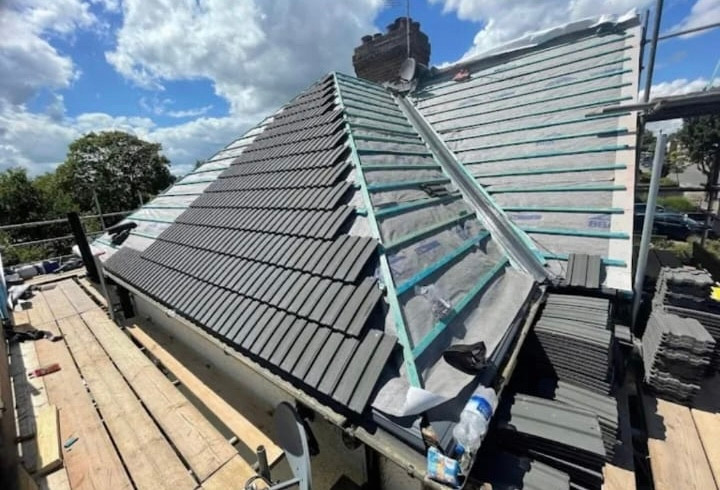
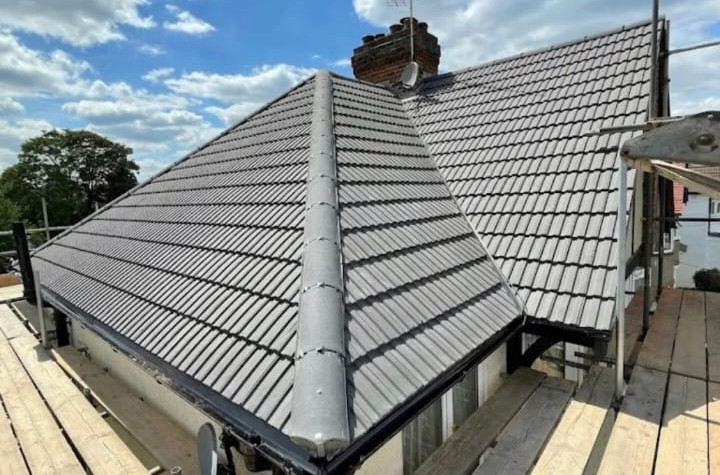
Ridge, hips and verges. Most of Beacon Hill went up between the late 1960s and the early 1980s, and those roofs carry concrete interlocking tile with the ridge, hips and gable verges bedded in sand and cement. Mortar bedding has a working life and forty odd years is about it: it cracks, water runs down the back of the ridge tile, and eventually a cap lifts in a gale. We take it off and convert to a dry fix system screwed and clipped over a ventilated roll, the mechanical fixing BS 5534 expects, which vents the roof space along the ridge while it is at it.
The eaves course of underlay. The bitumen felt laid under those roofs is brittle now. It tears first where it laps into the gutter, the one place it has to be sound, so water runs behind the fascia instead of into it. A wet fascia and soffit with a dry loft is nearly always this, and eaves protection trays and a new felt support put it right without stripping the slope.
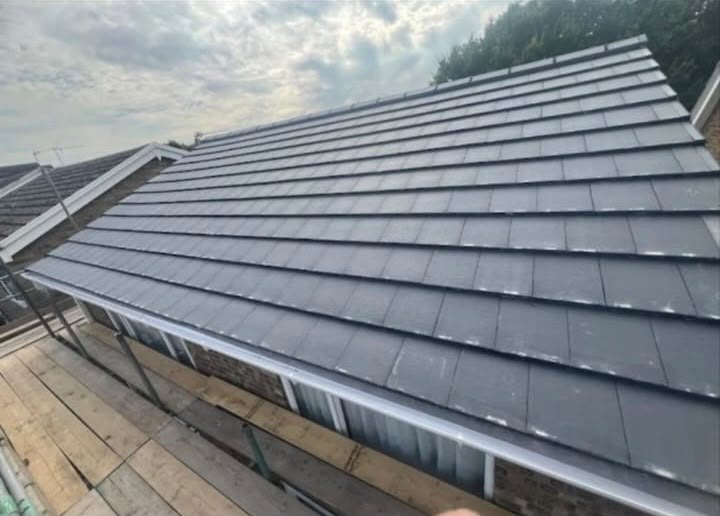
Repairs are slipped, cracked and missing tiles, storm damage, and leaks traced to where water genuinely enters. When the nails, battens and underlay have perished together the covering comes off, soft rafter feet are replaced, and it goes back on breathable membrane and treated battens with a matched tile.
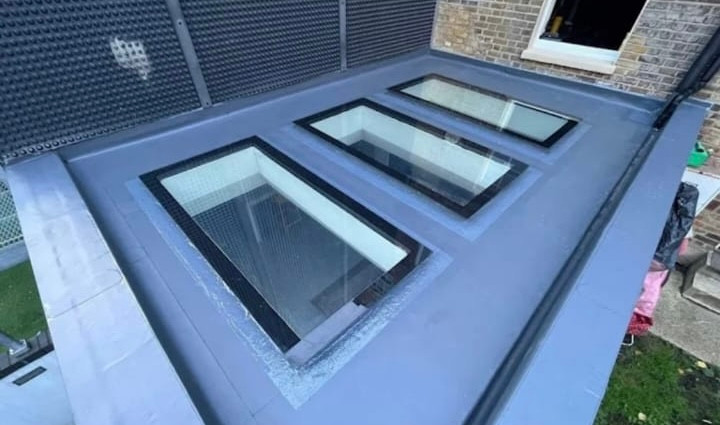
Flat roofs over the integral garages, extensions and porches are inspected deck first, and those abutments are often sealed up with mastic by somebody in a hurry, which is a leak with a date on it. A fair share of the leaks we attend are a gutter running over or a downpipe discharging into thin air, and on ground that shrinks and swells where that water goes matters. With the roof open, insulation and eaves ventilation are cheap, and Approved Document L sets the standard a renovated roof must reach.
How it runs
From your call to a written price
One team from first visit to last, and an itemised written price: scaffold, strip out, battens and membrane, the covering, each junction and disposal on separate lines.
On permission the answer here is short. No conservation area over Beacon Hill and nothing listed, so a repair, a like for like re-cover, new rainwater goods and rooflights all sit inside ordinary householder permitted development within the limits Planning Portal guidance sets out, with no planning permission and no application. Building control comes into it once you re-cover a large part of a slope, when Approved Document L asks you to look at the loft insulation at the same time. Dorset Council if anything bigger comes up.
Cost
What decides the price of a roof
No rate per square metre: the area is the easiest thing to measure and the least useful thing to know. Bungalows and chalets here often come off a tower, and the two storey estate houses want a scaffold, which is usually straightforward because the drives are wide. How long it stands matters as much as its size, and the work at height rules are why the platform is a priced line.
Chimneys, valleys and abutments are priced one at a time. Ask whether the scaffold is in the price, whether battens and membrane are renewed or covered over, and who pays for the skip.
If it is leaking now
Water coming in today
Ring rather than use the form. Anything letting water in goes to the front of the queue, and the first visit makes it safe rather than prices it. Look along the ridge line and the gable verges from the ground and check the drive for mortar crumbs or a broken cap. Do not go up a ladder. The phone is answered 24 hours for emergencies; scheduled work runs Monday to Friday, 8am to 6pm.
Worth knowing
Where the roof water ends up matters here
The ground under Beacon Hill is cohesive and it shrinks and swells with the weather. That turns rainwater into a structural question rather than only a damp one, and it changes what we do at the bottom of a downpipe rather than at the top of the roof. A downpipe emptying onto a border, a gully that has silted up, or a soakaway sitting too close to the wall all put repeated wetting and drying into the ground beside a foundation, and that is the one thing this ground does not take well.
So when we price roofing work here we follow every downpipe to see where it actually goes, and we say so if the answer is nowhere. Approved Document H is the standard for getting roof water clear of a building. It is cheap to put right while the scaffold is up and expensive to leave.
Who you are dealing with
A local firm you can check
About eight miles from us, covering Beacon Hill and the surrounding BH16 addresses in Sturminster Marshall parish and out towards Lytchett Minster and Upton. Dorset Council for planning and building control. Bournemouth Roofing & Building Ltd, registered in England and Wales, company number 15471719, which you can look up in a minute. Thomas Hannen's business, and he is the one who comes out to price the job, not a salesman. A verified customer's 10 out of 10 on Checkatrade. The visit and the written quote are both free.
Questions
Beacon Hill questions we get asked
Nothing at Beacon Hill is listed. Does that simplify things?
It removes one whole layer. There is no conservation area covering Beacon Hill and no listed entries here, so a re-covering is permitted development and nobody at Dorset Council has a view on whether you use slate, clay or concrete. Weight is the practical constraint: swapping a light covering for a heavy one on 1970s rafters is a question for the structure, not for planning.
We are in the Green Belt. Does that stop a new garage roof?
Green Belt does nothing to a repair or a re-covering on the house. Where it bites at Beacon Hill is a new outbuilding or an extension, because that adds volume in open countryside and Dorset Council looks at it differently from the same job in a town. Re-roofing an existing garage, even down to new rafters, is replacing what is already there rather than adding anything.
Half the houses here are older than 1983. What fails?
Battens and nails, on most of them. Close to six in ten homes at Beacon Hill were built before 1983, and the 1970s and early 1980s were the busiest years, so the typical roof here is concrete tile on softwood battens with sarking felt underneath. The tiles are barely halfway through their life. The felt has gone brittle at the eaves and the nails have rusted where the tile laps sit wet.
The gully by the back wall floods every winter. Serious?
Worth dealing with. The subsoil at Beacon Hill holds water and moves with it, shrinking in a dry summer and swelling again in winter, so a gully that overflows against a wall keeps one corner of the building on ground that never settles. The roof end of the fix is usually simple: gutter falls, a blocked outlet, or a downpipe shedding straight onto the path. We price that with the roof rather than separately.
Who actually turns up and works out the price?
Thomas Hannen, and he owns the firm. There is no estimator on commission and no sales visit. He gets up on the roof at Beacon Hill, looks in the loft, and writes an itemised quote that separates strip and disposal, battens, membrane, fixings, ridge and verge, gutters and access, so you can see what comes out if you change the scope. Bournemouth Roofing and Building Ltd is registered in England and Wales, company number 15471719.
Nearby, and next door
Roofing near Beacon Hill
Roofing nearby
Our other trades in Beacon Hill
Roofing guides
Concrete vs clay roof tiles: which is right? Planning, building regs or listed building consent Storm damage to a roof: the first 24 hoursEverything we do in Corfe Mullen Roofing, all areas Every area we cover
Free quote
Get a straight answer on your Beacon Hill roof
A free site visit, photographs of what we found, and a free written itemised quote you can compare properly.