Roofing in Broadstone
Roof repairs, re-roofs, dry ridge and verge, flat roofs, leadwork and guttering across Broadstone, Dunyeats, Clayford and out towards Corfe Mullen.
The site visit is free and so is the written itemised quote. Thomas Hannen prices every job himself.
Most Broadstone roofs are older than the houses look. Nearly two thirds of the town went up between 1945 and 1982, with the peak in the late 1950s and early 1960s, and the concrete tiles from that era are now well past the life they were sold with.
What that usually means is not a new roof. It means the fixings and the edges have gone while the tiles themselves are still sound, and the honest job is the one that deals with that rather than the one that strips the lot. We get up there, put our head in the loft and photograph what we find before anyone talks about price. Six miles from us, the site visit is free, and a typical repair here is two or three working days.
The work
Galvanised nails rust from the head down
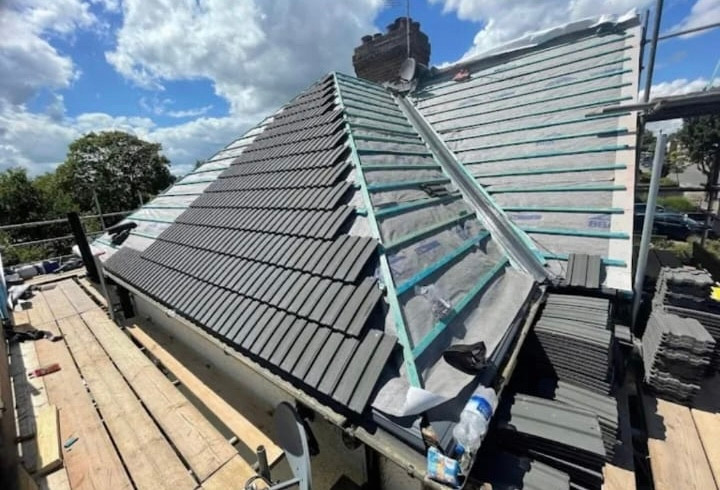
Nail sickness on the 1950s and 1960s stock. Nearly two thirds of Broadstone went up between 1945 and 1982, a quarter of the town in the late 1950s and early 1960s alone. Those concrete tile roofs were nailed with galvanised nails that rust from the head down. The tile is still fine; the nail holding it is not, which is why a whole slope starts letting go within a year or two of the first one moving. Where the battens and underlay are sound the answer is re-fixing rather than re-covering, and we will tell you which of the two you have. BS 5534 sets out how a covering should be mechanically fixed for its exposure.
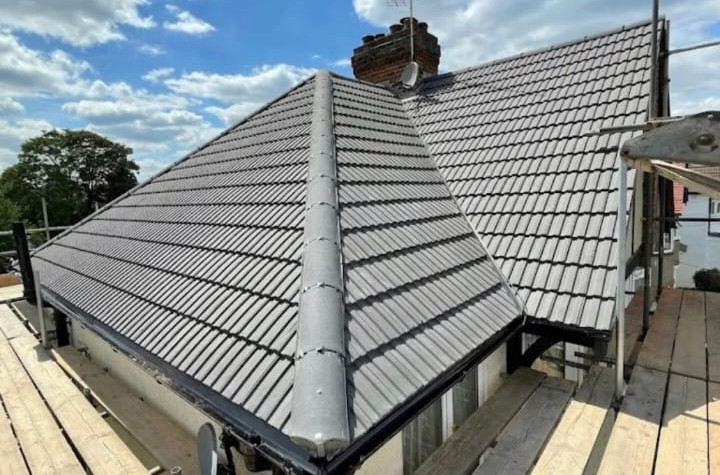
Ridge, hip and verge, which is most of a bungalow roof. Two in five homes here are bungalows, and a bungalow has roughly twice the roof of a house with the same floor area, most of it edge. Hipped ends mean long hip runs, and every one of them is mortar bedding that cracks, washes out and drops. We convert to a dry fix system: a dry ridge screwed to a ventilated roll, dry verge units closing the gables, and hips mechanically fixed. It is the single most useful thing you can do to a roof of this age here.
A lot of the post-war building here sits at a shallow pitch, and pitch decides what covering is allowed. Some tiles cannot be laid below their minimum, and a plain tile will not go on a roof designed for an interlocking concrete tile. Where someone has already done it, water tracks back under the laps in driving rain and the leak looks like it comes from nowhere. On a strip we check the batten gauge against the tile, the underlay at the laps and eaves, and any rafter that has been taking water quietly.
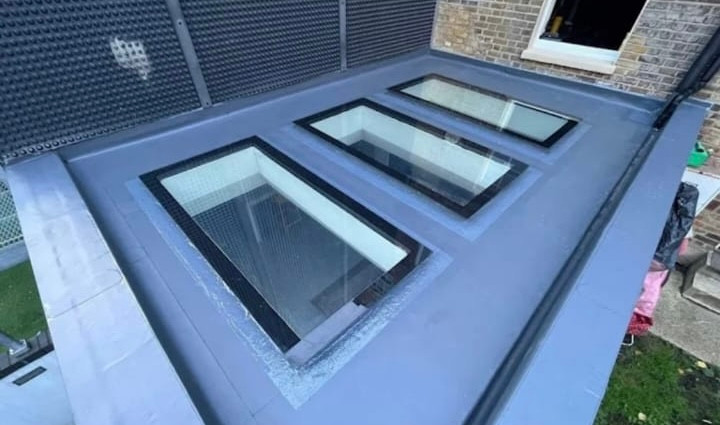
Sixty years of rear additions, garages, porches and dormers, most of them flat and on their second or third covering. Felt, GRP fibreglass and EPDM rubber all last where the deck is sound and the falls and upstands are right. Chimney flashings, soakers, valleys and abutments go back in code rated lead. Then the rainwater side: clearing moss and debris, correcting a fall that has dropped, and renewing split gutters and downpipes. On ground that shrinks and swells, a downpipe emptying beside a foundation is a structural question rather than just a damp one. With 42% of the town in bungalows the loft is large, easy to get at and the best value insulation job we do, and Approved Document L sets what a renovated roof is expected to reach.
How it runs
From your call to a written price
Same team from first visit to last, one person to ring, and no sub-contracting your roof out. The quote is itemised: scaffold, strip out, battens and membrane, covering, each junction and disposal on separate lines. The site is swept daily, the old tiles leave with us, and anything found on the strip gets a photograph and a price before we carry on. Re-covering in the same materials is permitted development, so no planning application and no building control, and Planning Portal guidance sets out where that stops: changing the appearance from the street. Broadstone has no conservation area of its own. The council keeps the list of conservation areas in BCP, and we check the address before anything is ordered.
Cost
What decides the price of a roof
No rate per square metre. A 1960s hipped bungalow, a semi on a corner plot and a 1980s detached house are three different jobs before a tile moves, and the platform changes on each. Some roofs come off a tower, most want a scaffold, and how long it stands matters as much as its size, which is why the work at height rules make it a priced line and not an optional extra. Chimneys, valleys and abutments are priced one at a time. Ask any quote whether scaffold is in, whether battens and membrane are renewed or covered over, and who pays for the skip.
If it is leaking now
Water coming in today
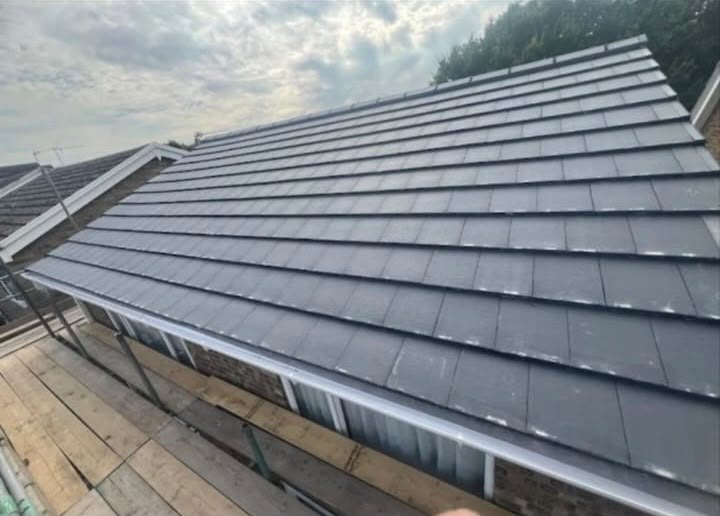
Ring rather than use the form. Anything letting water in goes to the front of the queue, and the first visit is about making it safe while you decide. A bungalow is quicker to make safe than a two storey house, so a temporary cover here usually goes on the same day. The phone is answered 24 hours for emergencies; scheduled work runs Monday to Friday, 8am to 6pm.
Worth knowing
The ground here shrinks and swells
Broadstone sits on cohesive ground with a significant shrink-swell rating. Clay-rich soil of that kind takes up water and expands, then dries out and contracts, and it does it seasonally. Where that happens right beside a foundation, the movement is a structural question rather than just a damp one, which is why cracked render, sticking doors and stepped cracking in brickwork are more common around here than the age of the houses would suggest.
A roof contributes to that more than people realise. A blocked gutter, a split downpipe or a shoe discharging onto the soil next to a wall puts a concentrated, seasonal volume of water into exactly the ground that reacts to it.
On a bungalow, with twice the roof area per household draining through the same number of downpipes, the volumes are not small. So when we look at guttering here we are not only thinking about the wall getting wet. We check where the water actually ends up, and whether it is being delivered into the ground beside the house or taken away from it.
Who you are dealing with
A local firm you can check
We cover Broadstone, Dunyeats, Clayford, Merley Park and out towards Corfe Mullen and Canford Magna, broadly BH18, under BCP Council. Bournemouth Roofing & Building Ltd, registered in England and Wales, company number 15471719, which you can look up in a minute. Thomas Hannen's business, and he is the one who comes out to price the job, not a salesman. A verified customer's 10 out of 10 on Checkatrade. The visit and the written quote are both free.
Questions
Broadstone questions we get asked
Why does a Broadstone bungalow have so much ridge and verge?
Because the floor area sits under roughly twice the roof of a two storey house. Bungalows are 42.0 per cent of the dwellings in Broadstone, and that shape puts far more ridge, hip and verge on every property. Edges are where roofs fail, so the wind is given more to work on. The compensation is a lower scaffold and easy access to the loft while the covering is off.
My neighbours are all having their roof edges done. Why?
Because your street went up together. Sixty three per cent of Broadstone homes were built between 1945 and 1982, and the single biggest group went on in the late 1950s and early 1960s. Roofs bedded within a few years of each other reach the end of their mortar and their nail life within a few years of each other too. Round here that means edge work far more often than a full strip.
Broadstone has no conservation area. Does that change anything?
For a like for like re-cover it means the appearance controls that catch some Dorset villages do not apply to you. Broadstone sits under Bournemouth, Christchurch and Poole as the planning authority, and only four entries in the whole settlement are listed. Unless yours is one of them, the tile profile and colour are your decision rather than an application. Building regulations still cover how the work is done.
Where does the rainwater off my roof actually end up?
Down the gutters and into whatever the house was built with, which on this ground matters more than people expect. Broadstone sits on cohesive soil that shrinks and swells significantly with the seasons, and the surface water flood band here is high. A downpipe discharging beside a wall instead of into a drain becomes a foundation problem, not just a damp patch on the plaster. We check the outfalls while pricing the roof.
What can I see from the garden before ringing you?
Stand back at the far end of the plot and sight along the ridge line. A dip in it, daylight showing at a gable, or a verge tile sitting out of line tells you the bedding has let go. On a single storey roof you can read almost the whole slope from ground level, which is a genuine advantage in Broadstone. Send a photograph over and we can often say before anyone climbs anything.
Nearby, and next door
Roofing near Broadstone
Roofing nearby
Our other trades in Broadstone
Roofing guides
Concrete vs clay roof tiles: which is right? Planning, building regs or listed building consent Storm damage to a roof: the first 24 hoursEverything we do in Broadstone Roofing, all areas Every area we cover
Free quote
Get a price for your Broadstone roof
Tell us the address and what you have noticed. We will tell you whether it is a re-fix or a re-cover, and put an itemised price in writing.