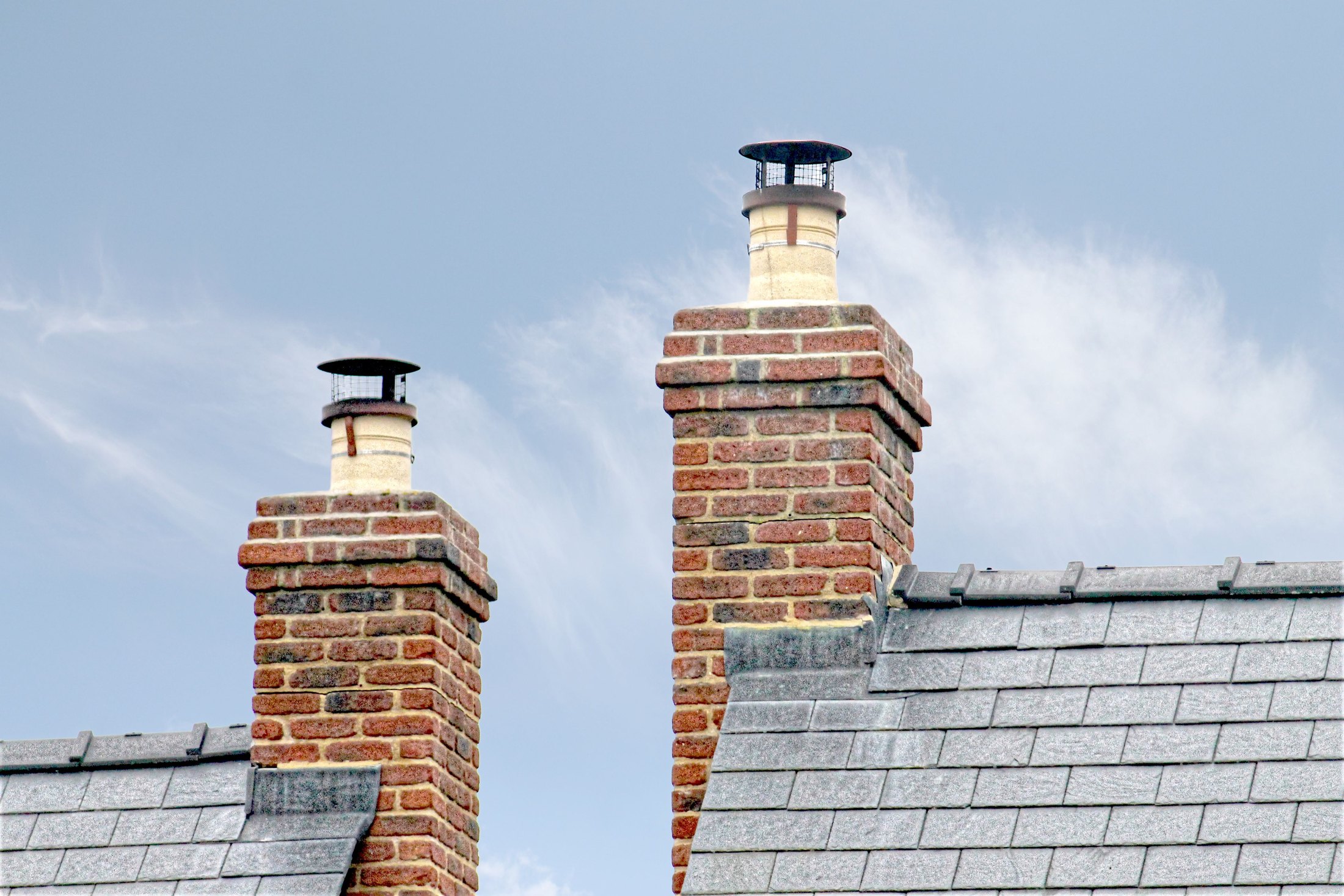
Roofing in Corfe Mullen
Dry ridge and verge, eaves and underlay repairs, re-covers, flat roofs, leadwork and guttering across Corfe Mullen, old village and plateau alike.
The site visit is free and so is the written itemised quote. Thomas Hannen prices every job himself.
Last updated
Most of Corfe Mullen went up between the war and the early 1980s, so the roofs reach the end of their fixings together, not one at a time. On the majority of addresses the honest answer is edge work, not a re-cover.
The signs are usually that something came off in the wind, a ceiling has stained, or the roof has begun to look tired. We come out, get on the roof, put our head in the loft and photograph what we find, so you are looking at the same thing we are. If rain is already coming through a bungalow ceiling in Corfe Mullen, ring 07435 839745 first and the form can wait. About eight and a half miles away, and the visit costs you nothing.
The work
Sixties mortar bedding, and a lot of it per house
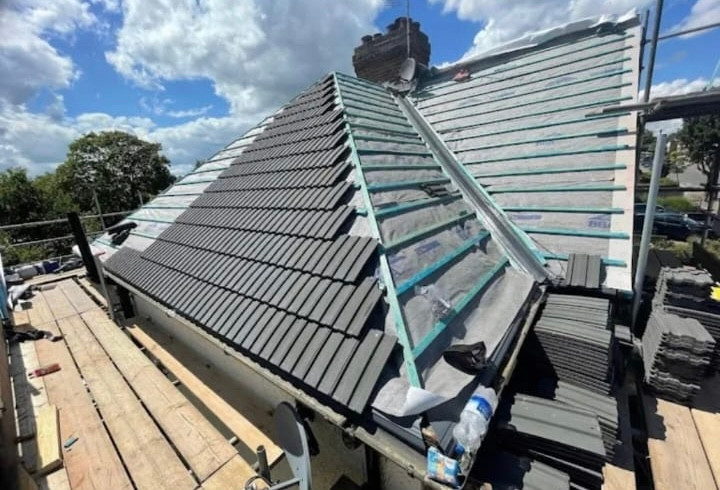
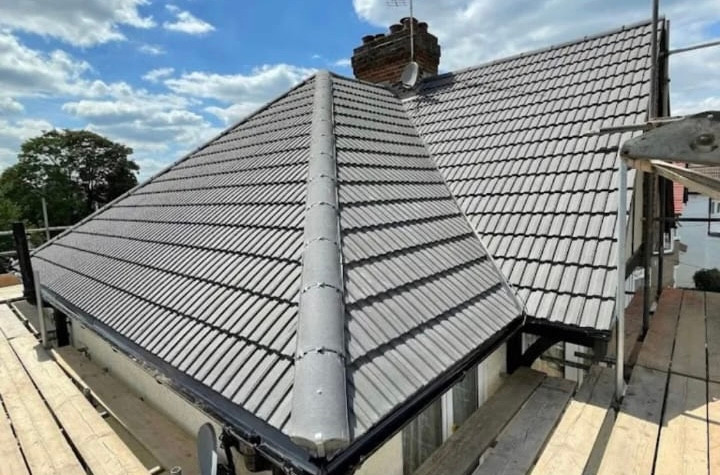
Ridge and verge are the weak point on roofs in Corfe Mullen. Mortar bedding from the 1960s and 1970s cracks, washes out and lets wind under the edge of the covering. We replace it with a mechanically fixed system screwed onto a ventilated roll, which is what BS 5534 expects and vents the roof space along the ridge.
Nearly two thirds of the housing here went up between 1945 and 1982, with a third of the whole village in the 1970s and early 1980s alone, so those edges are reaching the same age at the same time. A third of the homes are bungalows, which means a lot of metres of edge for the size of house.
Repairs run to slipped, cracked and missing tiles, rocking hip and ridge tiles, storm damage, and leaks traced back to where the water genuinely enters. Most of the housing carries concrete interlocking tile. In the old village there is plain clay tile and natural slate, plus the odd cob and thatch property we will point you elsewhere for. Sarking felt of this generation sags and tears where it laps into the gutter, which is the one place it must be sound, and that is the usual cause of a wet fascia. Underneath sit the battens and rafter feet, checked from inside before we recommend anything.
When nails, battens and membrane have gone together, the covering comes off, soft timber is replaced, and it goes back on breathable membrane and treated battens with a matched tile. We will tell you plainly when a covering has years left, which on this stock it usually does.
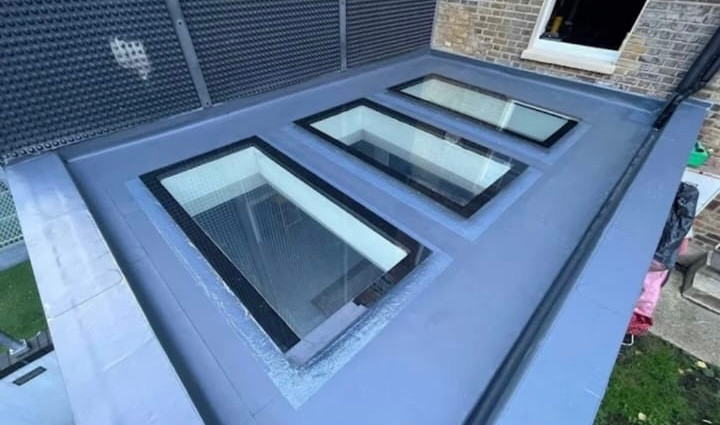
Garages, rear extensions and porches come in felt, GRP fibreglass or EPDM rubber, deck first then falls, upstands and outlet, with chimney flashings, soakers, valleys and abutments in code rated lead. Gutters and downpipes are worth more attention here than most places: on ground that shrinks and swells, a downpipe discharging beside a foundation is wetting and drying the ground next to the house, which is a structural nuisance rather than just a damp one. While the covering is off, insulation, eaves ventilation and condensation are far cheaper to deal with, and Approved Document L sets the standard a renovated roof is expected to reach.
How it runs
Repairing or re-covering an estate roof, step by step
Most roofs in Corfe Mullen went on in the seventies and early eighties, so Thomas usually starts at the edges: the ridge, the hips, the verges and the felt at the eaves. He gets up to look, checks the loft and prices it himself. The quote breaks out access, the strip, battens and membrane, the covering, each junction, any dry ridge or verge work, and disposal. One firm is accountable for the whole job.
On the plateau along Wareham Road and around Lambs Green, drives are wide and the scaffold and skip usually stand on your own ground. In the old village frontages are tighter, so where they go is agreed with you, and with a neighbour if needed, before a start date is set. Old tiles and battens come down a chute into the skip, never over the edge, and the drive is swept each evening. A rotten rafter foot or a split valley board found on the way is photographed and priced before anyone touches it.
Putting back the same covering is permitted development, so no planning application, but re-covering over a quarter of the roof is still notifiable to building control, and Planning Portal guidance marks where that ends. Corfe Mullen does have a conservation area, around Brogg Street and Sleight Lane, and a change of covering inside it should be raised with Dorset Council first. There is one listed entry in the parish, where listed building consent applies. BH21 straddles the council boundary and some parish addresses are BH18, so we go by the address, not the postcode. If it is one loose hip tile or a single leak on an otherwise sound roof, our page on roof repairs in Corfe Mullen covers that job on its own.
Cost
Dry ridge, new verges or a full re-cover: what sets the price
Corfe Mullen roofs are not priced at a rate per square metre. On a roof of this age the first question is repair or re-cover, and the honest answer is often repair.
Edges first. Mortar-bedded ridges and verges from that period crack and let go, often long before the concrete interlocking tiles wear out. Dry fixing the ridge and verge is priced by the length of edge and costs a fraction of a re-cover. BS 5534 now expects ridge and hip tiles to be mechanically fixed, so re-bedding in mortar alone falls short.
The underlay. Felt of that era often sags and rots at the eaves where it drops into the gutter. If the rest of the felt is sound, eaves carrier trays fix that without stripping the roof.
When it is a re-cover. If the tiles have gone porous or the battens are soft, stripping to the rafters, new battens and a breathable membrane, then re-covering, is the right call. Changing to a lighter or heavier tile alters the load on the trusses, so that is checked first.
Which house. A bungalow has more edge for its size but a cheaper platform; a two storey detached is the reverse. The work at height rules make the scaffold its own line, and on the plateau a lorry pulls up close, while in the old village it may not.
Ask any other roofer whether the ridge and verges are being dry fixed or re-bedded, whether the felt is being renewed or just patched at the eaves, and whether the scaffold and skip are included.
If it is leaking now
A ridge tile down, or water coming through today
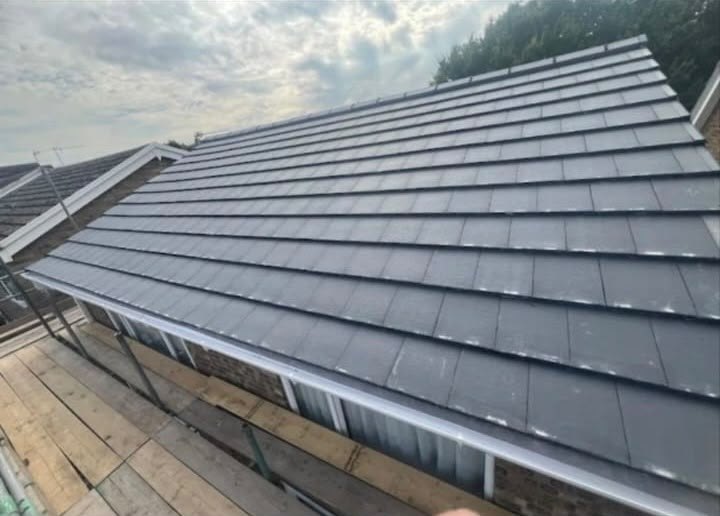
Phone us rather than sending the form. Anything letting water in is dealt with ahead of planned work, and the first visit makes it safe with a temporary cover or by refixing what has slipped.
While you wait, look at the ridge line and the gable verges from across the road, and check the drive for fallen mortar, because on roofs of this age that is where trouble starts. Do not go up a ladder yourself. Planned roofing runs Monday to Friday, 8am to 6pm. If we miss you, we call back.
Worth knowing
The old village and the plateau are two different jobs
Corfe Mullen is two places that grew separately and still sit on different ground, about forty five metres apart vertically. The old village sits low on the river terrace near the Stour; the larger newer part sits on the plateau above it along Wareham Road.
That decides almost everything else. On the plateau it is post-war and 1970s estate housing, concrete tile, no designation, and the job is usually edge work. In the old village there is genuinely old fabric, a conservation area over it, and a matched repair in clay tile or slate with careful stripping. Same trade, two conversations, settled by the street name. The postcode will not tell you.
Who you are dealing with
Who is pricing your roof in Corfe Mullen
Our base in Boscombe is about eight and a half miles away. We work across the old village, the plateau along Wareham Road, Lambs Green, Broadmoor Road and out towards Corfe Lodge Road, and Dorset Council is the planning and building control authority.
Thomas Hannen owns the business, gets up to look at the roof and sets the price himself. Bournemouth Roofing & Building Ltd is registered in England and Wales, company number 15471719, so you can check us before you ring. A verified customer gave us 10 out of 10 on Checkatrade. The visit costs nothing, and neither does the itemised written quote. Before you book a visit in Corfe Mullen, you can read our customers' Google reviews, word for word, on our reviews page.
Planning at a glance
Do you need planning permission in Corfe Mullen?
Most repairs in Corfe Mullen need no application at all. What decides whether a change to the outside of your house does is who the council is, whether a conservation area or a listing applies, and whether the place sits in a protected landscape.
| Question | In Corfe Mullen |
|---|---|
| Who decides | Dorset Council is the planning authority for Corfe Mullen. Dorset Council's heritage pages set out what it controls. |
| Conservation area | Yes: Brogg Street / Sleight Lane Conservation Area. Check whether your street is inside the boundary before changing anything visible. |
| Listed buildings | Yes, there are listed buildings in and around Corfe Mullen. If yours is one, work can need listed building consent. |
| Protected landscape | No National Park or National Landscape covers Corfe Mullen. |
Questions
Questions about roofing in Corfe Mullen
Poole is next door. Which council handles Corfe Mullen?
Dorset Council handles it. Corfe Mullen sits in the Dorset local planning authority area, not Bournemouth, Christchurch and Poole, which is easy to get wrong because the BH21 and BH18 postcodes cross the boundary.
It decides who you ask about a skip permit or whether a change of covering needs an application. There is a single listed entry in the whole settlement, and the Brogg Street and Sleight Lane Conservation Area covers a small part of Corfe Mullen. A like for like re-cover is permitted development inside that conservation area as well as outside it; a change of covering inside it is a question for the council first.
Whole streets here went up in the seventies. Do they all need doing?
Not all at once, but they do come round together. Six homes in ten in Corfe Mullen date from between 1945 and 1982, and more than a third of the entire settlement went up in the 1970s and early 1980s. Roofs of one age reach the end of their bedding and their nail life at the same time, which is why one road suddenly sprouts scaffolding. It is normally edge work rather than a strip.
Can the loft be insulated while the tiles are off?
That is the sensible moment for it, and on a Corfe Mullen bungalow it earns its place because a third of homes here are single storey with the whole floor area under the roof. With the covering off we can reach the eaves properly instead of crawling to them from a hatch. It sits on the quote as its own line, so it can be dropped without changing the rest.
Mortar keeps appearing on my path. How urgent is that?
Not an emergency, but it is a countdown. That material came off the ridge or the verge bedding, and once enough of it has gone the tile is held by friction and nothing else. On the 1970s stock that dominates Corfe Mullen the ridges were bedded solid along their whole length, so they crack, shed, then lift in one go during a gale. A dry fixed ridge and verge is the usual answer.
How much of the roof do you strip in a day?
Only what can be dried in before we leave. On a typical Corfe Mullen bungalow that is generally a whole slope, felted, battened and loaded out the same day. On a two storey semi it is one elevation at a time. Nothing gets opened on a Friday afternoon that cannot be closed, and the forecast decides which slope we take first rather than convenience.
Nearby, and next door
Roofing near Corfe Mullen
Nearby places we also cover for roofing, with straight-line distances from Corfe Mullen, and the other trades we offer in Corfe Mullen itself.
Roofing nearby
Our other trades in Corfe Mullen
Roofing guides
Concrete vs clay roof tiles: which is right? Planning, building regs or listed building consent Storm damage to a roof: the first 24 hoursEverything we do in Corfe Mullen Roofing, all areas Every area we cover
Free quote
Get a price for your Corfe Mullen roof
Tell us the street and what you have noticed. We will come out, get in the loft, and put an itemised price in writing. No charge for either.