
Bricklaying and repointing in Corfe Mullen
Repointing, wall tie repairs, lintels, garden walls and new brickwork across Corfe Mullen and the BH21 villages around it.
The site visit is free and so is the written itemised quote. Thomas Hannen prices every job himself.
Bricklaying and repointing
Brickwork in Corfe Mullen: what we do and what it costs you to ignore
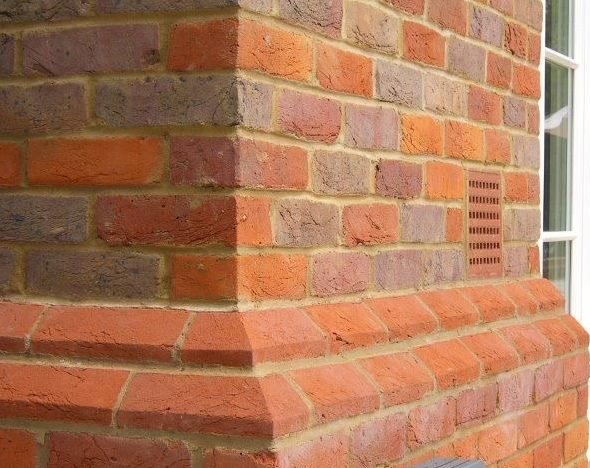
Corfe Mullen is a postwar village of cavity walls, so the brickwork faults here are cavity wall faults. Failing pointing on an exposed gable, rusting wall ties, a dropped lintel over a garage opening and garden walls with no damp proof course account for most of what we are called out to, and all four are repairs rather than rebuilds if they are caught early.
Typically people ring us because something has become visible. A line of cracking that runs horizontally along the mortar and does not look like normal settlement. Joints on the weather side that have gone back far enough to see daylight in. A garden wall leaning into next door. Or a step crack above a window or a garage door that has widened enough to notice from the pavement.
We come out, look at the whole property rather than the one wall you have spotted, and tell you which of those it actually is, because the repairs are very different and so are the prices. If it is nothing yet, we will say so. The site visit and the itemised written quote cost you nothing either way.
The work
The brickwork jobs we do around Corfe Mullen
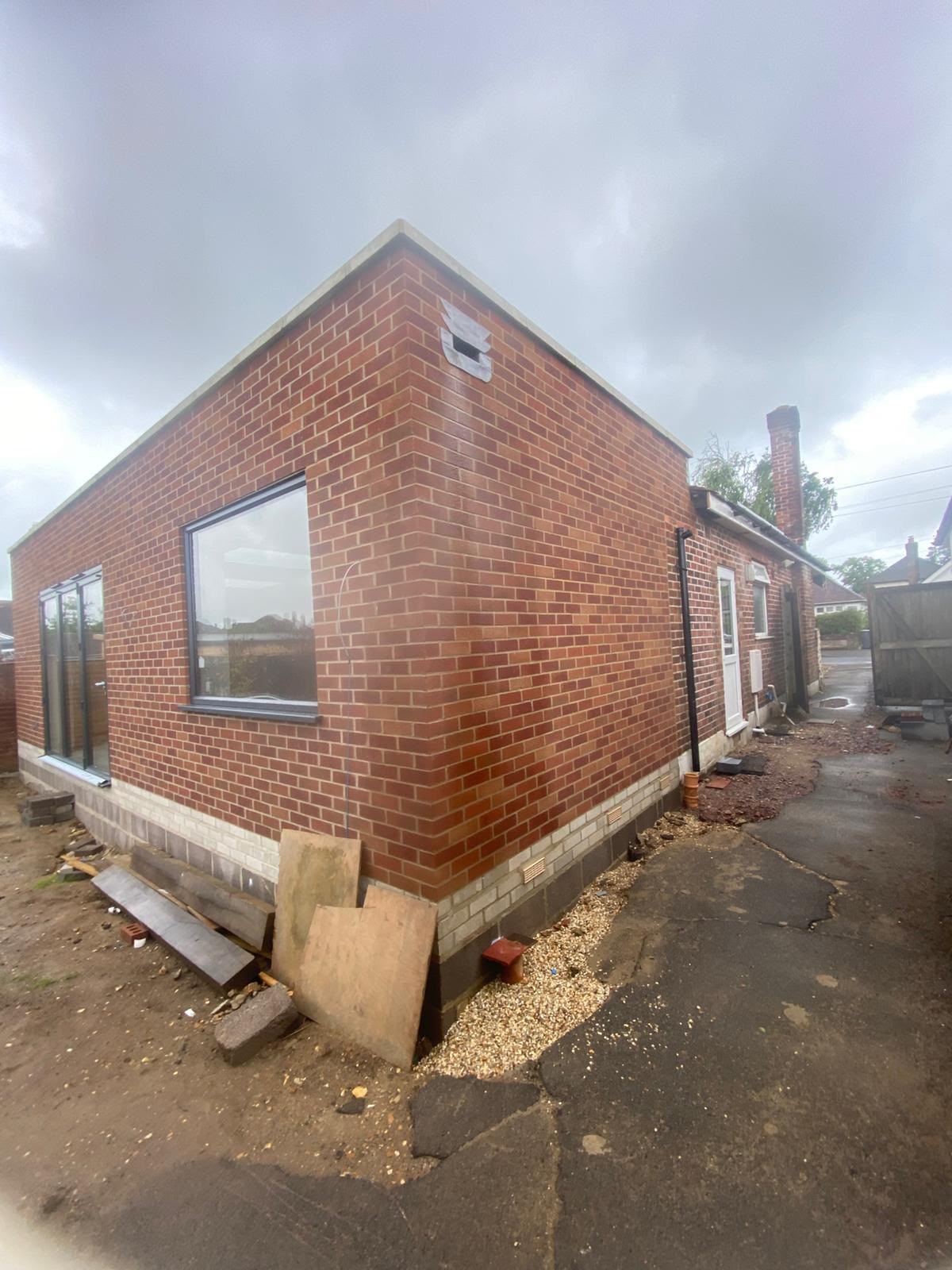
Cavity walls of one generation. Close to two thirds of the houses here went up between 1945 and 1982, with the peak in the 1970s and early 1980s, built as a brick outer skin with blockwork behind and a cavity between. That brickwork was pointed in cement with a thin joint, and it does not fail evenly: it goes on the exposed gable and along the top course under the verge while the sheltered elevations are still fine. We rake back to sound mortar, match the mix and the sand for colour, and put the profile back as bucket handle or weather struck to suit the wall. On the handful of older properties in the village the same job is done in a soft NHL lime instead, because a solid wall has to stay breathable.
Ties and lintels. The pair of skins is only a wall while the ties across the cavity are doing their job. On houses of this age they are galvanised steel, and when they corrode they swell, which lifts the outer skin a fraction at every tie. That is the horizontal cracking at regular course intervals people describe as a stripe up the gable. Remedial ties go in from outside without taking the wall down, and the holes are made good in matched mortar. Garage openings, patio doors and wide picture windows of this period were built off steel lintels, and a corroding lintel expands and cracks the brickwork it carries: prop the opening, cut out the courses, replace the lintel, rebuild over it. Anything structural like that goes through building control.
The commonest single job in the village is still the garden wall. Estate plots are divided by long low brick walls, most built with no damp proof course, so they draw water up and the bottom courses turn soft and blow, and on ground that shrinks and swells a shallow footing does the rest. We rebuild bowed lengths on a proper footing, put in a DPC, reset the coping, and rebuild driveway gate piers bonded into something instead of standing on their own. Where faces have spalled after a frost we cut out and replace, and the awkward part in Corfe Mullen is the match, because the facing bricks used across these estates are largely out of production: that means reclaimed stock, a sample taken off the wall and a trial panel. New work is extension skins, porches, retaining walls between split level plots and new piers, off a dug foundation with weep holes where they belong.
How it runs
From your call to a written price
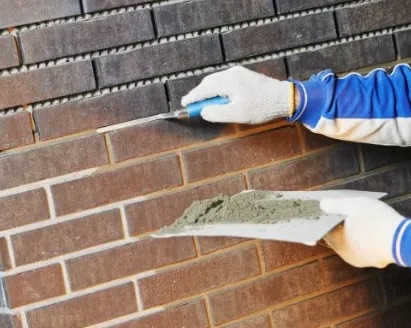
Thomas prices it himself, and the quote itemises access, raking out, the mix, each elevation and any brick replacement. Corfe Mullen is Dorset Council, one of the easier places on our patch for consents. There is no conservation area in the village and only a single listed entry in the parish, so for almost everyone here repointing and brick repair is maintenance with no application at all. You can confirm your address against the council's listed building consent pages if you are unsure. New or raised garden walls do have height limits, which Planning Portal guidance on fences, gates and garden walls sets out, and if a wall is shared with a neighbour then the Party Wall etc. Act 1996 applies.
Cost
What decides the price of a brickwork job
No rate per square metre: the metre of wall tells you nothing until you know what the joints are like. A single storey bungalow, a two storey detached with a stack on the gable and a garage wall tight on the boundary are three different set ups. The platform is a priced line rather than a favour, under work at height rules. Depth of rake and the state of the brick faces decide the hours, not the square metres. Comparing quotes, ask the rake depth, hand or disc, the mix, the brick count and the scaffold.
If something has moved
Loose brickwork, or a wall that has shifted
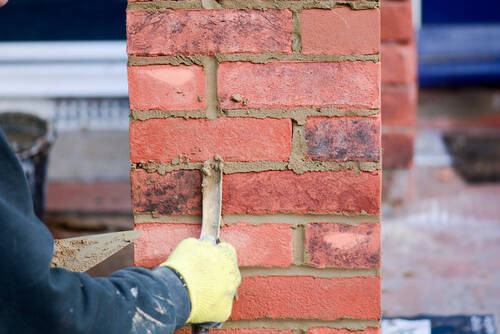
Ring rather than use the form. Anything overhead or leaning jumps the queue: a chimney that has moved, a parapet, a garden wall pushed out by roots or a vehicle. Round here it is most often a boundary wall gone over between two plots, or brickwork dropping off the head of a garage opening. The phone is answered 24 hours for emergencies; scheduled work runs Monday to Friday, 8am to 6pm.
The one local thing
The whole village was built at once, so it is wearing out at once
Roughly two thirds of Corfe Mullen went up between 1945 and 1982, and the single biggest burst of it was in the 1970s and the very early 1980s. That is unusual enough to be worth saying out loud, because it means the cavity walls on a whole street were built within a few years of each other, out of the same bricks, with the same mortar and the same galvanised wall ties.
They do not wear out one house at a time. They come to the end of their life together, and the first sign is usually a neighbour having scaffolding up for something nobody can quite explain.
What to do with that. If a house near you has had remedial ties fitted, it is worth having yours looked at, because yours will be the same age and the same specification. The check itself is quick: a small hole in a mortar joint and a borescope tells you what condition the ties are in without taking anything apart, and it is far cheaper than waiting for the outer skin to bow.
The same logic runs the other way too. If your neighbour has just had a full repoint and yours looks similar, do not assume you need one. Walls on the same street weather at very different rates depending on which way they face and what shelters them, and we will happily tell you that yours has a good ten years left in it rather than sell you a job you do not need yet.
Who you are dealing with
A local firm you can check
We are about seven miles from Corfe Mullen and out this way constantly, covering the BH21 side from Broadstone and Merley through to Wimborne, Colehill and Lytchett Matravers. Bournemouth Roofing & Building Ltd, registered in England and Wales, company number 15471719, which you can look up in a minute. Thomas Hannen's business, and he is the one who comes out to price the job, not a salesman. A verified customer's 10 out of 10 on Checkatrade. The visit and the written quote are both free.
Questions
Corfe Mullen questions we get asked
Is the mortar colour our choice in Corfe Mullen?
It is. Corfe Mullen has no conservation area and one listed entry in the whole settlement, so unless yours is that building nobody at Dorset Council has a view on what colour your joints end up. We still match the existing mortar as closely as the sand allows, because a patch reading lighter or darker than the wall around it announces itself from the pavement and is harder to live with than the original fault.
Why is 1970s brickwork failing before Victorian brickwork?
Because it was built quickly and pointed thin. Corfe Mullen is 62.1% post-war stock with its largest cohort in the 1970s and early 1980s, and that generation used a strong sandy mortar struck to a shallow bucket handle. Once the outer skin of the joint carbonates, sand washes out of the top few millimetres and the joint goes hollow. Victorian lime keeps working because it absorbs small movement and closes itself up again.
Do you rebuild the low front walls on these estates?
Regularly. The front walls on the Corfe Mullen estates went up with the houses in the 1970s and early 1980s, usually a single skin on a shallow footing under a coping that does not throw water clear, so they take water in at the top and frost pushes the courses apart. Rebuilding from the damp course up with a proper coping and a movement joint stops that cycle. Sound bricks get reused.
How do you decide between patching and doing the whole elevation?
By how deep the failure runs, not by how it looks. Where a rake test finds sound mortar behind a weathered face over most of a wall, patching the hollow bands around the openings and the corners is the sensible job. Where sand runs out dry across whole panels, patching only moves the problem along. On the post-war stock here it is normally the edges rather than the field of the wall.
Does the radon mapping here affect a brick extension?
Only work that makes new floor area. Corfe Mullen falls in a radon affected area in the 3 to 5% band, which calls for basic radon protection in new construction, so an extension or a garage conversion has the membrane detailed into it. Repointing, rebuilding a garden wall or repairing a chimney does not come into it at all, because none of those puts a new floor over the ground.
Nearby, and next door
Bricklaying and repointing near Corfe Mullen
Bricklaying and repointing nearby
Our other trades in Corfe Mullen
Everything we do in Corfe Mullen Bricklaying and repointing, all areas Every area we cover
Free quote
Find out what that crack actually is
We will come and look at the whole property, tell you whether it is pointing, ties or ground, and put a written itemised price in front of you.