
Driveways and patios in Post Green
Sunken drives, level thresholds and patios that drain properly, priced in writing after a free visit.
The site visit is free and so is the written itemised quote. Thomas Hannen prices every job himself.
We build drives, parking and patios in Post Green and the BH16 lanes around it. On this side of the harbour the ground lets water go slowly, so the drainage design is the first decision on the job and the surface is close to the last.
Calls here tend to be one of three. A drive that has sunk in two dips where the wheels always sit, so the middle stands proud and the water finds the low bit. A patio that was built up to meet a back door and now sits wet against the wall every winter. Or a wide frontage with a bit of old concrete and a lot of gravel, which the owners want turned into somewhere two cars can sit and turn without reversing out.
We come, dig a trial hole, take levels off the house and watch where water actually runs before anything is priced. Then it is one written quote with the dig, the muck away, the sub-base, the edgings, the surface and the drainage separated out, so you can hold it against anyone else's.
The work
Bungalow thresholds, wide frontages and drives from the estate years
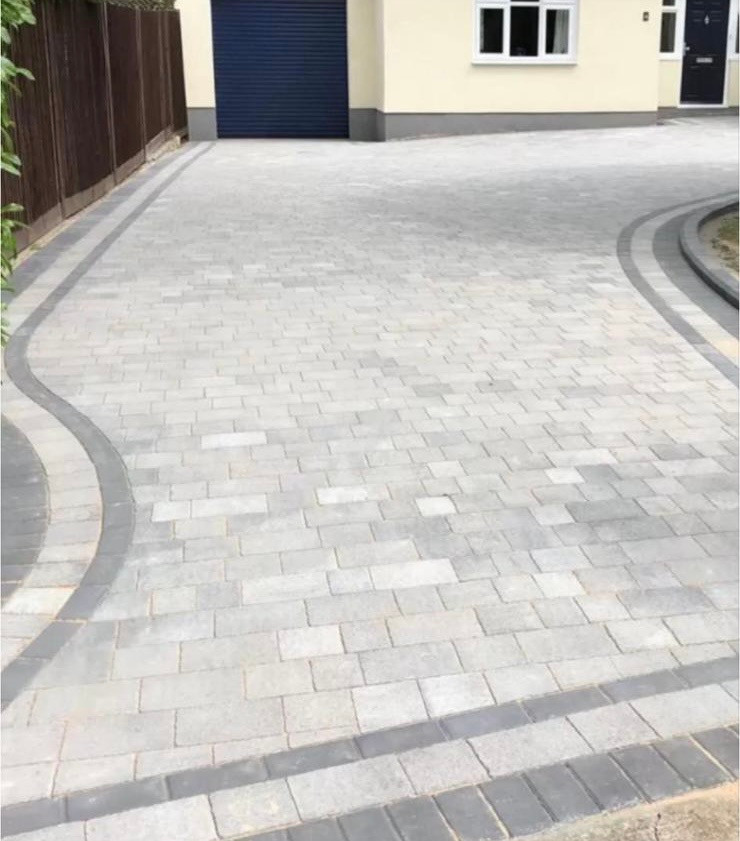
Level access at a bungalow door. Close to a third of the housing round here is single storey, and a bungalow puts its threshold low, often only a course or two above the outside ground. That is where most of the damp we get shown starts: a patio or a path built up over the years until it bridges the damp proof course. The fix is not more paving. It is taking the level back down, keeping the finished surface clear of the damp proof course, falling it away from the wall, and running a channel drain across the doorway with somewhere real for the water to go. Where the threshold has to stay flush for a wheelchair or a frame, that channel and its outfall are the whole design.
Frontages that could hold two cars. Plots here are wide and shallow, and a lot of them still have the original single strip up to a garage with grass or gravel either side. Widening one is mostly groundwork: excavate to a firm formation, geotextile membrane, sub-base compacted in layers to a depth the trial hole sets, then a haunched kerb or edge restraint so nothing spreads. Getting turning space in matters more than squeezing in a third bay, because coming out forwards stops the verge being churned every time somebody visits.
Most of this housing went up between the late 1960s and the early 1980s, and the drives are of their time: bay concrete with joints that have opened, thin tarmac that ruts, or block paving that has dropped at the crossover. Sound concrete can take resin bound straight over it, which skips the dig entirely. Anything moving underfoot comes up and is rebuilt properly, and the spoil leaves on a grab lorry the same day rather than sitting in a skip on the verge for a fortnight. The ground drains slowly here, so a soakaway wants a percolation test rather than an assumption.
Patios go on a full mortar bed in porcelain, natural stone or block paving you can lift and relay later, with steps that have matched risers and a jointing mortar that stays put instead of brushed sand that washes into the border. On its own we also do the small stuff: one sunken bay, a rocking slab, cracked pointing, a silted gully, or a re-sand and re-level of paving that has dipped. That is often the honest answer.
How it runs
From your call to a written price
Same team from first visit to last, one person to ring, and an itemised quote: excavation, muck away, sub base, edgings, surface and drainage on separate lines.
Dorset Council is the planning authority, and the Lytchett Minster conservation area covers part of the older village, where appearance is controlled and listed building consent matters if you are working at one of the eighteen listed frontages. Paving at the front stays permitted development while the rain stays on your ground, and more than five square metres of sealed surface draining to the road needs planning permission, which is the front garden rules. Where the access has to be formed or widened, a dropped kerb is applied for separately from the highway authority.
Cost
What decides the price of a driveway
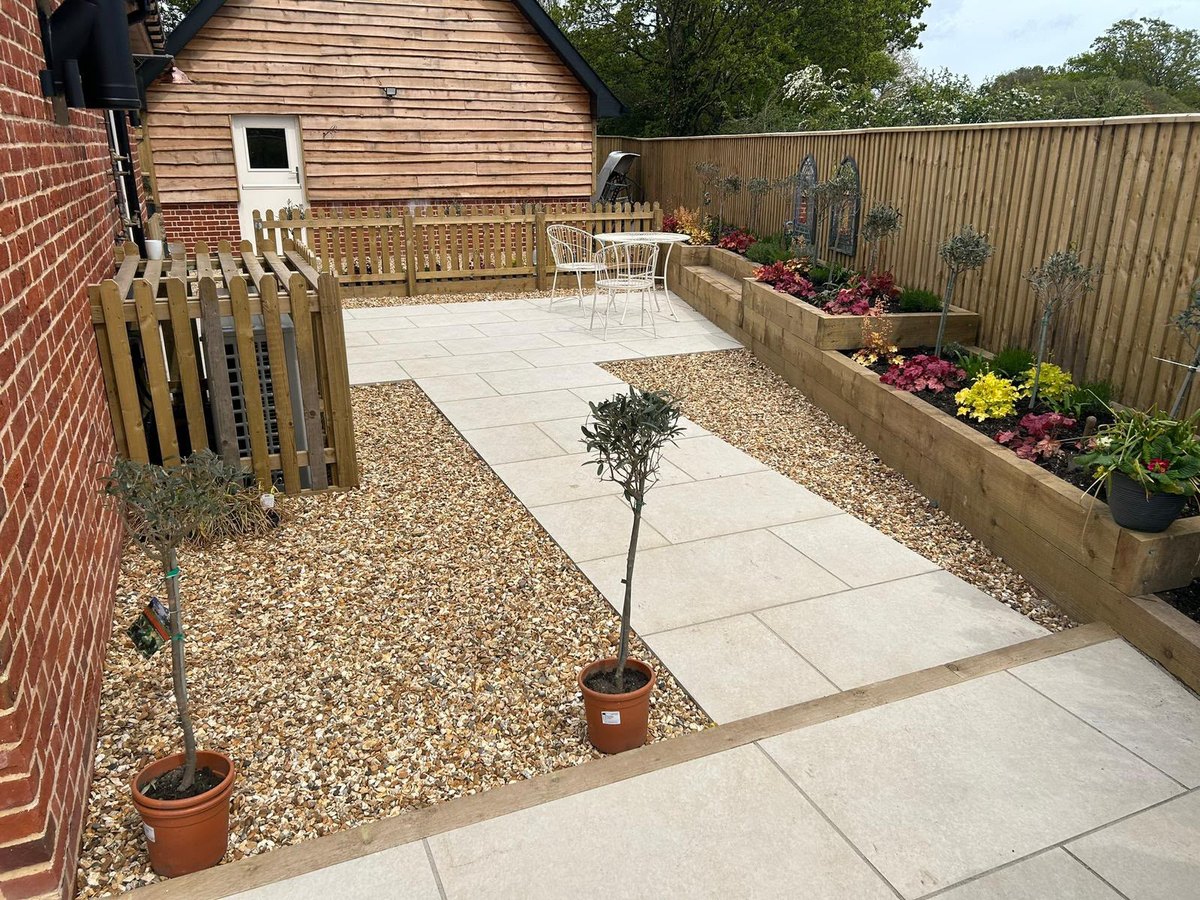
Levels do more to the figure here than the surface does, because at a low bungalow threshold the drainage is the design and not a detail. A bungalow with a wide open frontage, a house behind a shared gravel access and a semi with a narrow gate at the side are three different jobs before a machine turns a wheel. Slow draining ground usually means a deeper dig and more muck away. When you compare quotes, ask the dig depth, the sub base, where the water is being taken and whether the edgings are haunched.
If it is urgent
A trip hazard, or a drive that floods
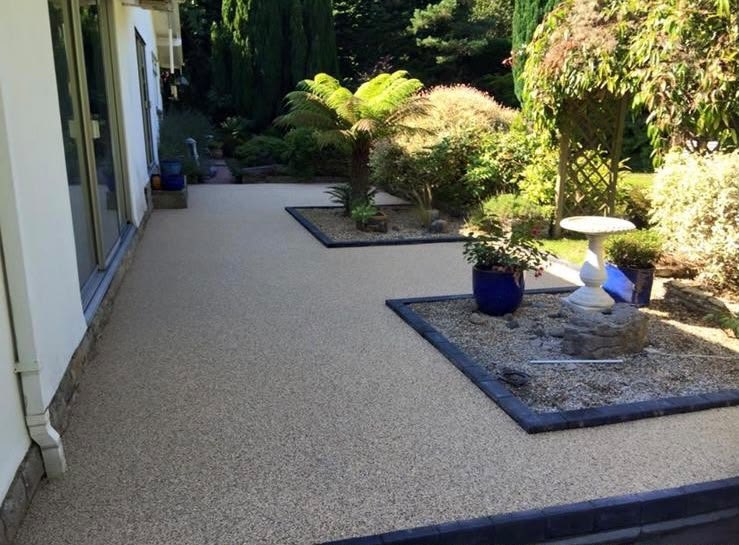
Ring rather than use the form. A lifted slab, a sunken bay by a doorway or a gully that has given up will not wait, because somebody falls or water ends up against the house. If water is standing against a low threshold, send a photograph while it is still there, because where it sits tells us more than a dry survey will. Anything outside Monday to Friday, 8am to 6pm, is by arrangement.
The one local thing
Slow ground, and the rule that water stays on your plot
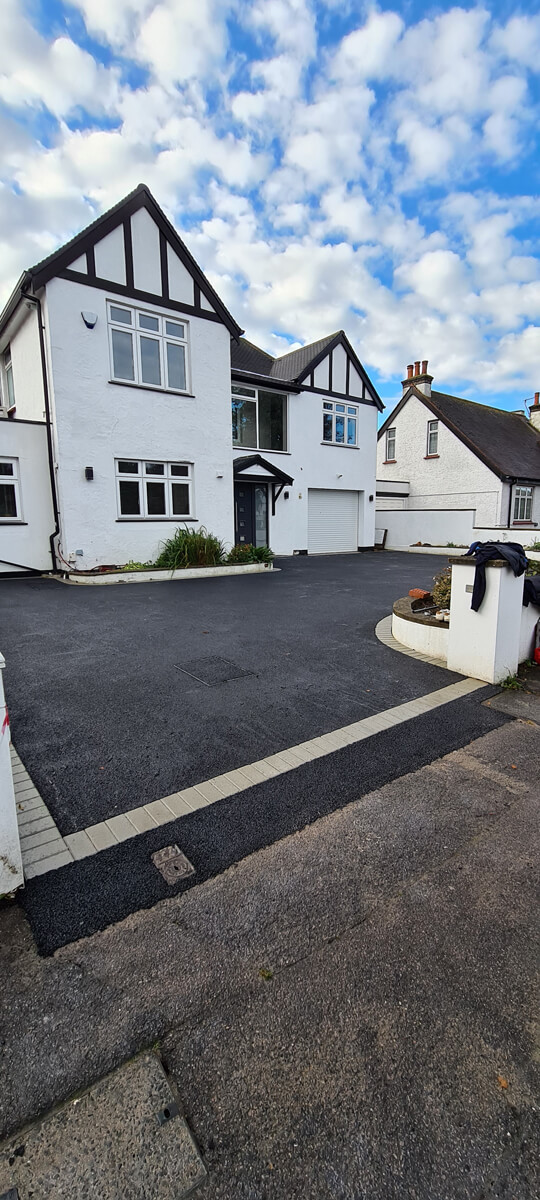
Everything here drains towards the harbour, and the ground in between is slow to take water. That has two practical consequences for a drive. The first is that a soakaway cannot be assumed. It has to be sized on a percolation test done at the depth the crates will really sit and in conditions that reflect a wet winter, which is what Approved Document H sets out.
A hole dug in August in ground that looks fine can be sitting full of groundwater in January before a drop of your roof or drive water gets near it. Where the test says the ground will not take it, we design a positive outfall instead and agree it with whoever owns the ditch, rather than building a soakaway that works for one summer.
The second is that a drive gully must never be joined to the foul drain, and the water must not simply be pushed out to the road for someone else to deal with. That is what permeable paving is for, and on ground like this it is usually the cleanest answer: an open graded sub-base under the blocks holds the rain in the stone and releases it slowly, which is the whole idea behind SuDS, and it keeps the whole thing inside your boundary.
It costs a little more in stone and it saves the drainage runs, so the two usually meet in the middle. If your garden already puddles in the same place every winter, tell us where. That spot is the best survey information on the property.
Who you are dealing with
A local firm you can check
We work across Post Green, Lytchett Minster, Upton, Holton Heath and out to Lytchett Matravers, eight miles from us in BH16. Bournemouth Roofing & Building Ltd, registered in England and Wales, company number 15471719, which you can look up in a minute. Thomas Hannen's business, and he is the one who comes out to price the job, not a salesman. A verified customer's 10 out of 10 on Checkatrade. The visit and the written quote are both free.
Questions
Post Green questions we get asked
Is our house inside the Lytchett Minster conservation area?
Part of Post Green is and part is not, and the boundary line matters more than the postcode. Inside it, a change of material or colour on a frontage is looked at while replacing what is already there is treated as maintenance, and Dorset Council decide. Post Green House is one of eighteen listed entries around here. We check the address against the conservation area map before quoting, so the surface you are offered is one you can have.
The trench sides collapse when we dig. Normal here?
Yes, and around Post Green the running sand rating is significant, which is why long open trenches are a bad idea. The sides slump into the bottom, stone put in vanishes into the slump, and the level compacted yesterday has gone by morning. So drainage runs are dug and backfilled the same day in short sections, and anything that must stay open gets supported. It is a sequencing problem far more than a materials one.
Can the patio finish level with the back door?
Only with a drainage detail across the front of it. A threshold level surface needs a channel at the door and a fall away from the building, or water runs back over the sill in a downpour. The ground here is slightly impeded, so the channel has to discharge into something that will accept it rather than a soakaway a couple of metres from the wall. On a bungalow, and 30.6% here are bungalows, the doors already sit low.
Do you do small repairs, or only whole drives?
Small repairs too. A sunken bay, a cracked step, a silted channel, an edge clipped by a wheel: those are half day jobs and worth doing before they spread across the rest. On the 1945 to 1982 stock that makes up 54.3% of Post Green, the usual finding is one bad patch on an otherwise sound drive. Thomas Hannen looks at it and tells you whether it is a repair or the beginning of a rebuild.
Where can the water from a new drive legally go?
Onto your own ground, and it has to stay there. Post Green sits around four kilometres from Poole Harbour and surface water leaving a site here heads that way, so pushing run off onto a lane or into somebody's ditch without agreement is not an option. We size the drainage to hold what the drive sheds, keep the discharge point clear of the footings, and write on the quote exactly where it goes.
Nearby, and next door
Driveways and patios near Post Green
Driveways and patios nearby
Our other trades in Post Green
Everything we do in Corfe Mullen Driveways and patios, all areas Every area we cover
Free quote
Want a straight price for the drive or the patio?
Tell us where the water sits after heavy rain and we will come and look. Free visit, free itemised written quote, no salesman.