
Driveways and patios in Wool
Drives, garage aprons and patios in the village, rebuilt from the sub-base up rather than resurfaced over the old one.
The site visit is free and so is the written itemised quote. Thomas Hannen prices every job himself.
The base under a Wool drive usually has to be rebuilt before anything new goes on top, and the surface itself is the part you are free to change. Most of them went down when the houses did, which for a lot of the village means the 1970s, so they are reaching the end together.
The three calls we get most often here. A concrete drive that has cracked across a bay and now rocks when a wheel goes over it. Water standing at a garage door or a front step after a downpour, on ground that was already slow to drain. And a household that has gone from one car to two, on a frontage that was laid out when one was the assumption.
What we do first is open a hole in the existing surface, check the depth and the state of the sub-base, and follow the fall of the ground from the house out to the boundary. Then we look at the practical side: how a machine gets in, where a lorry can stand, and whether there is anywhere for surface water to go. The quote comes back itemised, with the excavation, the muck away, the sub-base, the edgings, the surface and the drainage on their own lines.
The work
Estate drives, garage aprons and back gardens in Wool
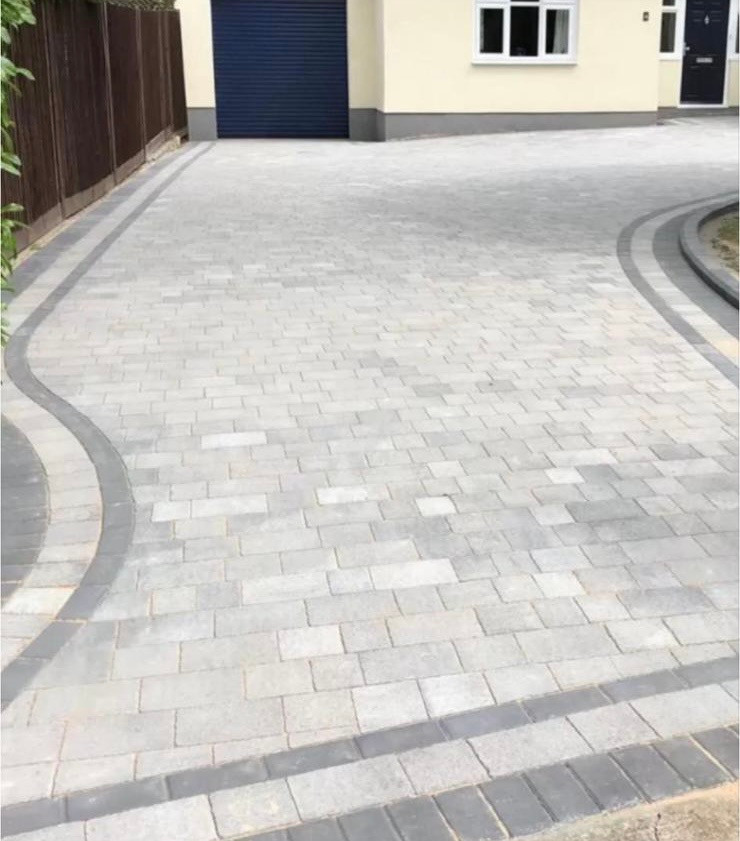
Concrete laid in bays. This is the classic Wool drive: a slab poured in panels with joints between them, thin, and laid on whatever was there at the time. Over half the housing here went up between 1945 and 1982, so a lot of it is the same age and fails in the same order. A corner drops, a joint opens, the panel rocks, then water gets underneath and takes the fines out from below. Small cracks can be cut out and filled and left alone. Once a panel is moving, filling it is throwing money at a symptom, and the job is to break it out, dig to a proper formation, lay a geotextile membrane and compact a real sub-base before anything goes back on top.
Garage doors and front steps that take the water. A lot of these drives fall gently towards the house, which nobody notices until the surface has been resurfaced once or twice and the level has crept up. Then the garage floods and the doorstep sits in a puddle. The answer is a channel drain across the opening running into a gully with a real outfall, the falls reset away from the building, and the finished level dropped back below the damp proof course. Surface water goes to a soakaway, a border or a surface water drain, never into a foul drain, and on ground this wet the soakaway is sized from a percolation test rather than assumed.
On the terraces and semis the frontage is narrow, so a parking bay has to be worked out properly: an edge restraint or a haunched kerb to hold the surface, a build-up that carries a vehicle rather than a footpath, and enough room to get in and out without three point turns into the road. Crossing the footway means a dropped kerb, and Planning Portal guidance on dropped kerbs covers how that crossing is applied for. Where a wall or a hedge line has to be opened we rebuild the ends properly rather than leaving them raw. Plenty of the drives here were block paved over the original base rather than a new one, so they show wheel tracks, ponding by the garage and weeds through the joints; blocks are made to be lifted, so we take up the affected area, correct the depth, re-compact and relay the same units, then re-sand the whole drive with kiln dried sand. Out the back, flags go on a full mortar bed with the falls running away from the wall, and on slow ground we would rather build in a permeable margin than send everything to one gully, because in a wet winter the one gully is what gives up first. Where the way in is a narrow lane or a parking court behind a terrace, the access decides the method, and that is time on the quote rather than a surprise.
How it runs
From your call to a written price
Dorset Council is the planning authority, the older part of the village sits in the Wool Conservation Area, and there are nine listed entries, so on one of those the council can want listed building consent for hard landscaping against the building. At the front, a new hard surface of more than five square metres needs planning permission unless it is permeable or drains to a lawn, a border or a soakaway inside your own boundary, and that test is set out in Planning Portal guidance on paving your front garden. A patio at ground level round the back is permitted development. The quote splits the dig, the disposal, the sub-base, the edgings, the surface and the drainage.
Cost
What decides the price of a driveway
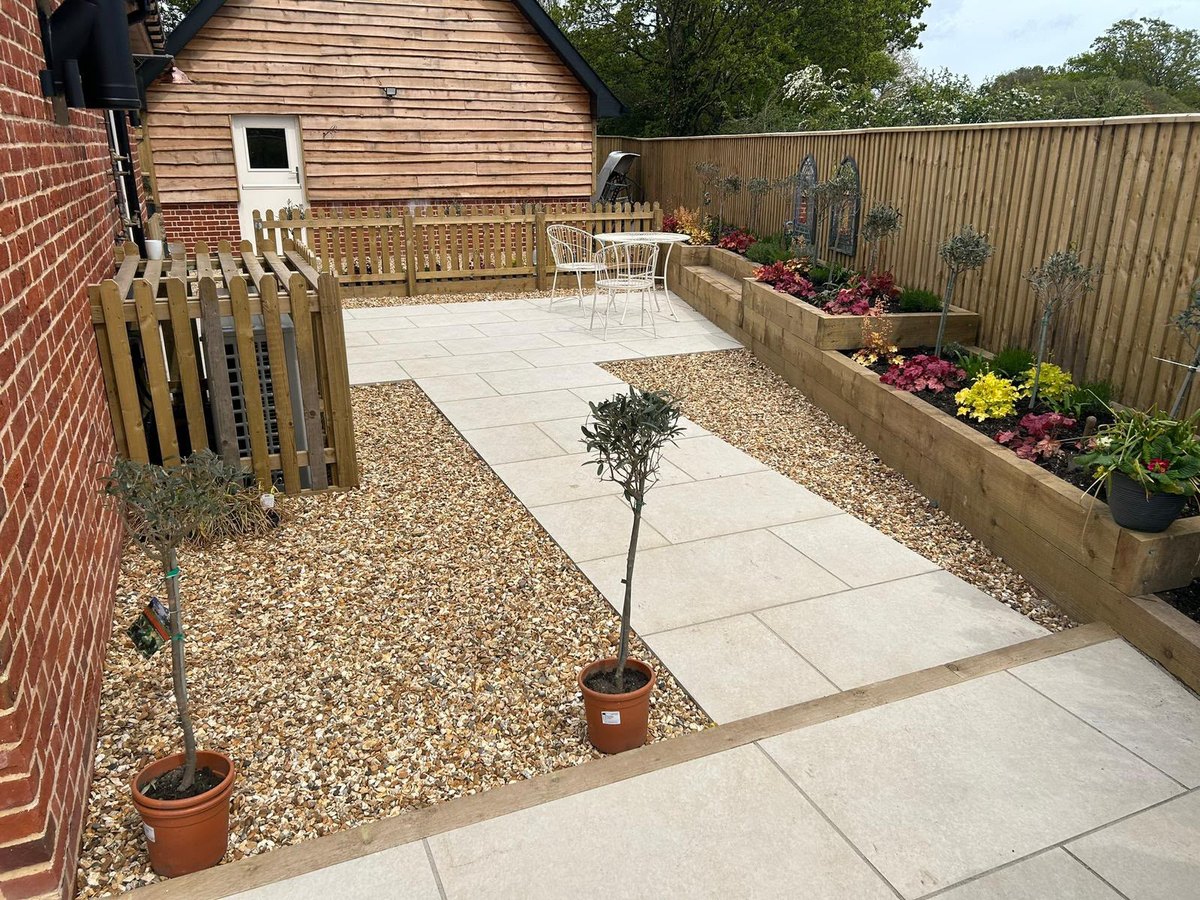
What is underneath settles this, not the surface you pick. A terrace with a footway across the front, a semi where a side gate is the only route to the back garden and a bungalow with a wide open drive are three different jobs before a shovel goes in, because one takes a machine and another takes a barrow. On slow ground the drainage design is its own line rather than a detail. Ask whether the edgings are haunched and who is carting the spoil.
If it is urgent
A trip hazard, or a drive that floods
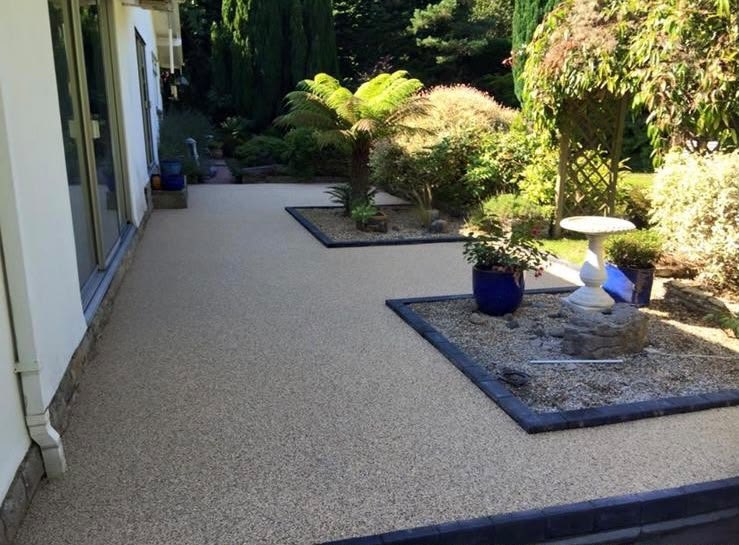
Ring rather than use the form. Water getting into a garage or standing at a doorway, and a slab that has dropped where somebody walks, are the two that will not wait. We make it safe and get the water moving on the first visit, then price the permanent work once the ground can be opened up. Tell us which it is when you ring.
Worth knowing
A village whose drives were all built in the same few years
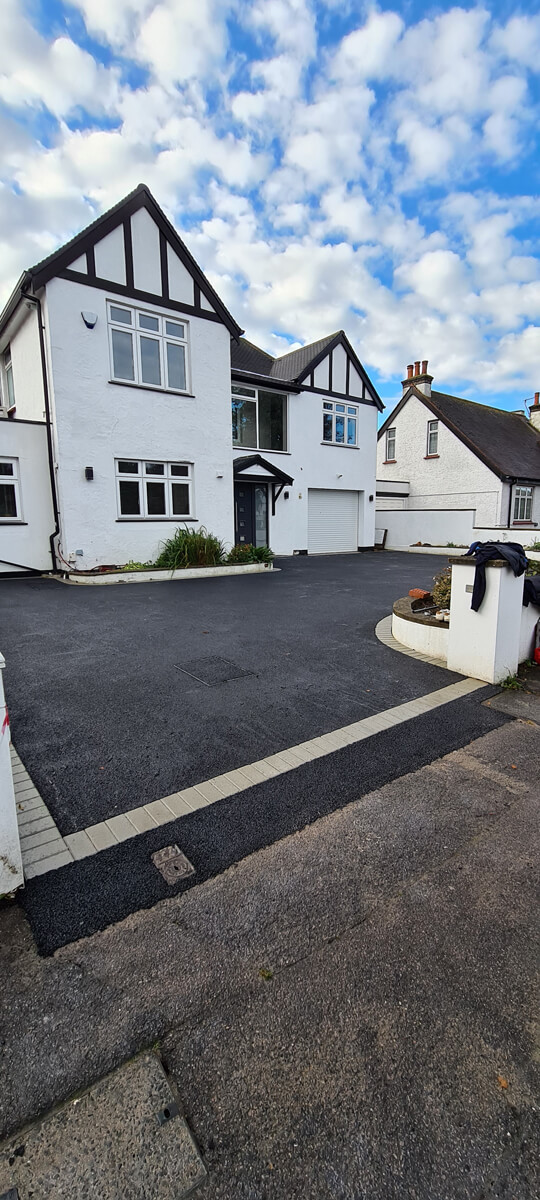
More than half the housing in Wool went up between the war and the early 1980s, and the biggest single push was the 1970s. That has an odd effect that people notice without quite naming it: the drives fail in waves. A whole road built at the same time was laid to the same detail, the same thickness and the same base, and it reaches the end of its life at the same time.
If your neighbour's concrete has started cracking and yours looks like it is holding, you are probably a couple of winters behind, not built better. The same goes for the pressed concrete edgings, the garage aprons and the original gullies, all of which came from one specification and give up on roughly one timetable.
Two practical things follow, and both save money. First, do the whole width and the whole depth once rather than half of it twice. The temptation on an estate drive is to resurface, and a resurface is exactly what raises the level towards the damp proof course and towards the garage door. If the base is thirty odd years past its best, taking it out and rebuilding it is the cheaper decade.
Second, talk to the neighbours. Where two or three houses on a run all need doing, one dig, one machine, one lorry and one lot of disposal covers all of them, and the saving is real because most of the fixed cost of a drive is getting the plant and the spoil in and out. We are happy to price two adjoining drives together and show you both, itemised, so nobody is guessing at who is paying for what.
Who you are dealing with
A local firm you can check
We cover Wool, East Burton, Bovington, Winfrith Newburgh, Wareham and the villages along the Frome, and BH20 generally. Bournemouth Roofing & Building Ltd, registered in England and Wales, company number 15471719, which you can look up in a minute. Thomas Hannen's business, and he is the one who comes out to price the job, not a salesman. A verified customer's 10 out of 10 on Checkatrade. The visit and the written quote are both free.
Questions
Wool questions we get asked
Water gets into the garage every downpour. Fixable on its own?
Usually, and without lifting the whole drive. Water reaching a garage normally comes off a drive falling towards it with nothing to intercept, so a threshold channel across the opening piped away takes it out. Ground at Wool is naturally wet, so whatever that channel discharges into has to be sized and sited on a test rather than guessed at. If the drive falls the wrong way, the last couple of metres get relaid.
Does the conservation area cover the newer part of Wool?
It covers the older core rather than the whole village. The Wool Conservation Area boundary matters if you fall inside it, because a change of front surface is judged on appearance and like for like counts as maintenance. On the estates built between 1945 and 1982, which is 55.0% of the housing here, no such control applies and the only planning question left is the front garden drainage rule.
Who approves a new opening across the pavement?
Dorset Council's highways team, and it is a separate application from anything concerning the drive itself. They set the width, the construction depth under the footway and how the utility covers get dealt with, and the work in the highway must be done by an approved contractor. We build up to the boundary and leave the crossing detail ready, so the two pieces meet at the right level afterwards.
Can a patio sit on ground that stays wet?
Yes, but not on a bed of sand over soft soil. On the wet ground around Wool a terrace needs a compacted stone base thick enough to spread the load, a full mortar bed instead of five dabs under each slab, and a fall of about one in eighty away from the house. Slabs bedded on dabs over wet ground rock within a season, because water gets underneath and the soil shifts.
Why has one end broken up and not the other?
Because load and water both concentrate there. The turning end, where wheels scrub and the car stands overnight, takes far more punishment than the run in, and it is generally the low end where water gathers as well. Around Wool the ground holds moisture, so a saturated base under the standing area fails while the rest still looks sound. We price the failed section and the drainage instead of relaying everything.
Nearby, and next door
Driveways and patios near Wool
Driveways and patios nearby
Our other trades in Wool
Everything we do in Wareham Driveways and patios, all areas Every area we cover
Free quote
Free quote for a drive or patio in Wool
Ring or send a photograph and we will come and look properly. The visit and the written itemised quote are free.