Plastering in Wool
Skimming, ceilings, patch repairs and external render across Wool, Bovington and the BH20 villages. We find what wet it before we price the repair.
The site visit is free and so is the written itemised quote. Thomas Hannen prices every job himself.
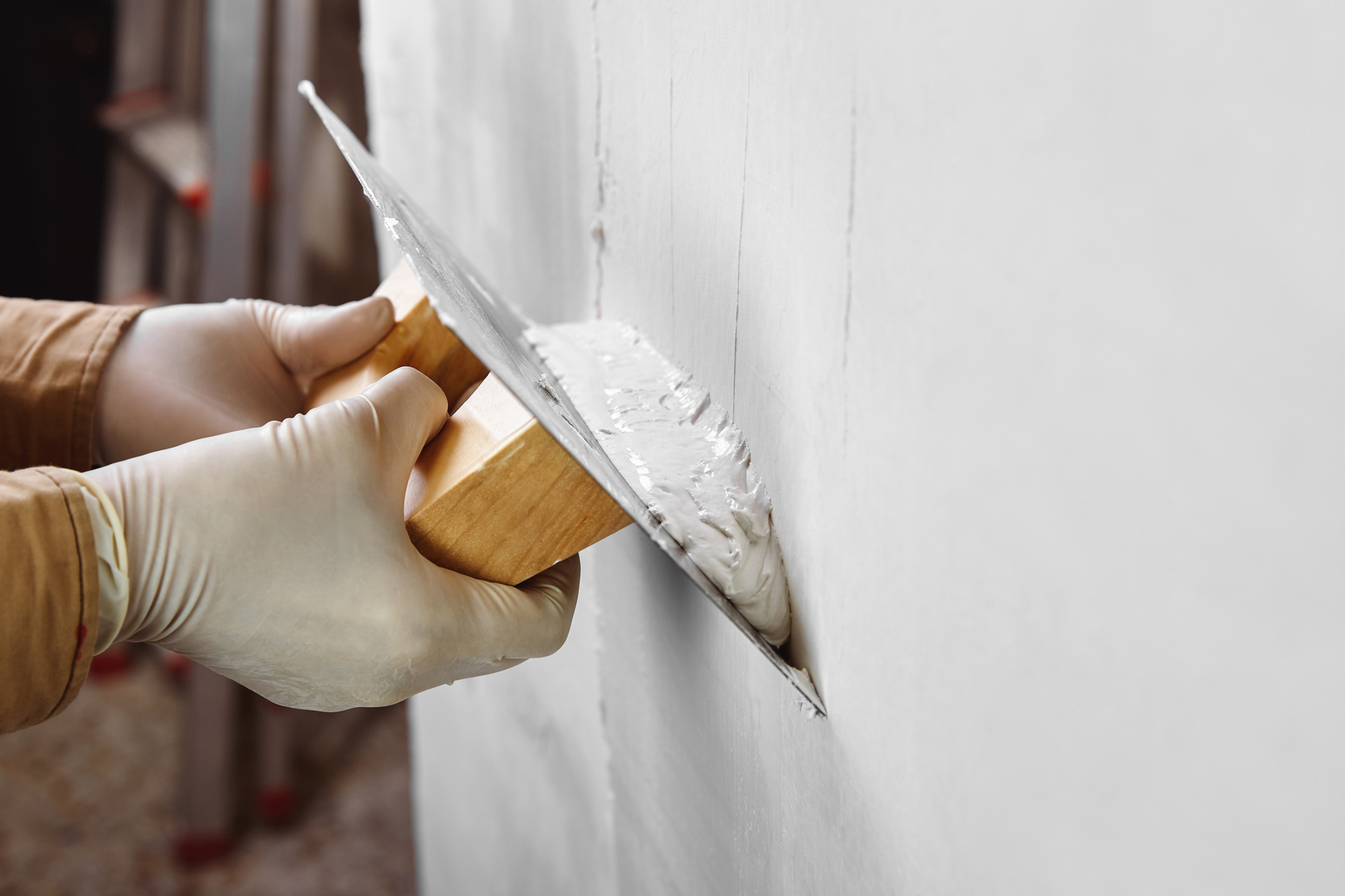
If a patch of wall in a Wool house has gone soft or hollow, the first job is finding where the water came from, not replastering it. We trace it, let the wall dry, then hack out the blown area, put a backing coat on and skim it flush with what is around it so the repair does not show.
Most calls from Wool are one of three things. A wall that has blown in one patch, usually behind a kitchen unit, under a window or on the wall shared with next door. A ceiling that has cracked along the board joints or gone soft after a bath overflowed upstairs. Or a whole house that has just changed hands and wants skimming flat before the decorator starts.
We come out, sound every wall and ceiling in the rooms concerned rather than the one you rang about, find out what wet it in the first place, and give you a written price with the jobs on separate lines. If a skim will do the job we will tell you, rather than quoting a strip out.
The work
The difference between a repair and a scar
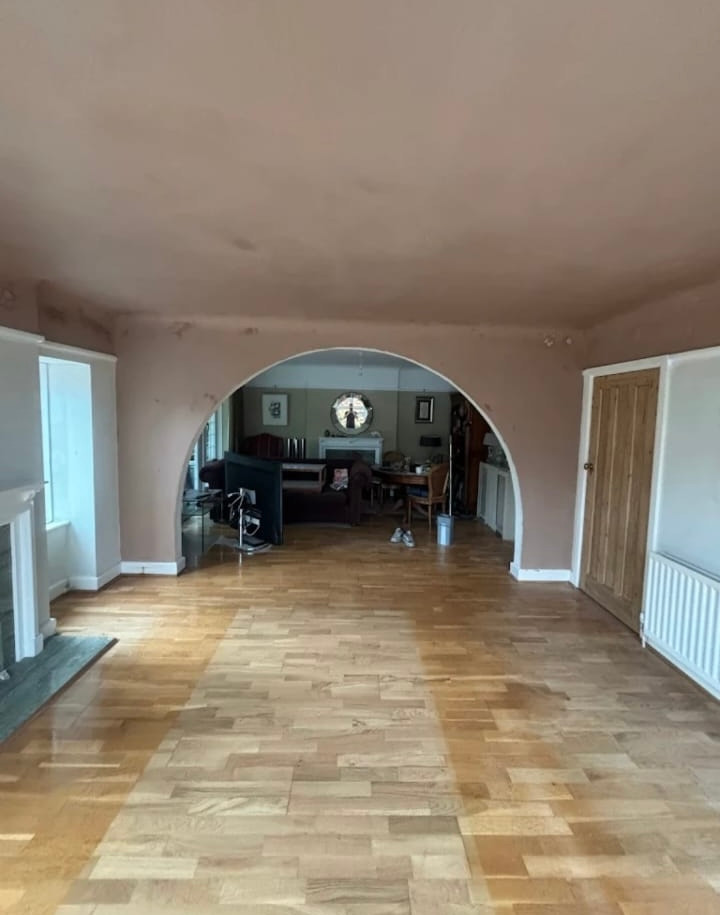
Skimming and making good. The bulk of the housing here went up between the war and the early eighties, most of it through the seventies, and it is thin gypsum plaster on brick or on the lightweight block that came in around then. That plaster is usually still sound, so the job is a skim rather than a strip: covers down, floors under dust sheets, a clean, a coat of PVA where the background is dusty, then two passes of finish coat off the trowel. One room is a day. A whole three bedroom house before decorating is most of a week.
Patch repairs after other trades. A quiet third of our work in this village is making good after somebody else: chased walls after a rewire, holes where a boiler or a radiator moved, the strip of bare block behind a kitchen that came out, a doorway blocked up. Cutting the patch back square, bonding it out to the right depth and feathering the finish in so you cannot find it under paint takes longer than people expect, and it is the difference between a repair and a scar.
Ceilings here are plasterboard nailed to the joists with scrim tape over the joints, which is why the crack you can see runs straight across the room, and why the nails show as a row of small dimples. Both come right with a skim. A ceiling that has been soaked from above is different: it gets taken down, the boards go in the van, and we will not put a finish on until the joists are dry. Artex from the seventies skims over well once cleaned and stabilised, and we never sand or scrape a textured coating, because anything that old can contain asbestos.
Dry lining goes on dabs where the blockwork is flat and dry, stud where it is not, tape and joint or a full skim over the board, with angle bead on every external corner and stop bead where the plaster stops at a reveal. In a loft conversion the sloping ceilings and the little vertical walls at the eaves are where boards want cutting properly rather than filling, and it shows in the light from a Velux. Half the village is terraces and semis, so a good deal of this happens on a wall that belongs to two houses, and we come off one of those in sections rather than swinging at it.
Down near the river the fabric is older: solid walls with no cavity, lath ceilings, and lime plaster that has to stay breathable, so those get a haired lime backing coat rather than gypsum hardwall. Outside, the dry dash and pebbledash on the estate housing cracks and goes hollow around the openings first, and with the exposed elevation facing south west and the coast five miles off that is the wall that gets the driven rain. We cut back to sound material, mesh reinforce the repair and match the topcoat, and on modern blockwork it is a primer, a mesh reinforced basecoat and a silicone thin coat, off a bell cast bead clear of the damp course.
How it runs
From your call to a written price
Permission, plainly. The quote is itemised: protection, hacking off, boarding, the backing coat, beads, finish and disposal on separate lines. Plaster inside is your business and nobody else's, and patching render like for like is repair. Two things change that. The older core of the village is the Wool conservation area, where adding render to a bare brick or stone elevation, or stripping it off, counts as a change of appearance rather than a repair, and there are nine listed entries here where listed building consent can reach the internal plaster as well as the front wall. And if you re-render most of an elevation instead of patching it, Approved Document L brings building control in. Dorset Council handles both.
Cost
What decides the price
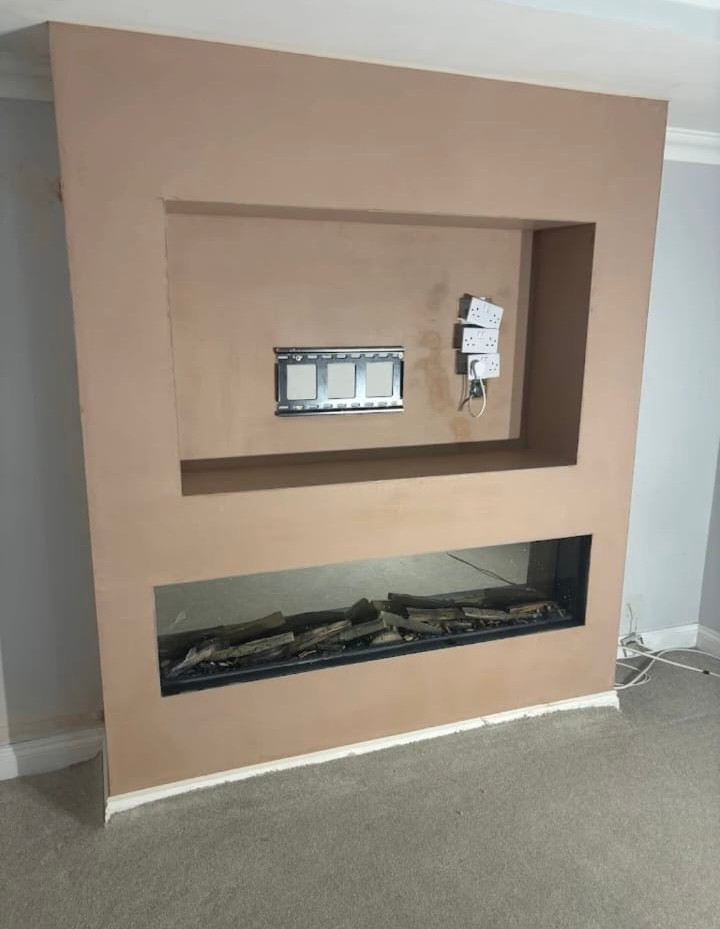
There is no useful rate per square metre: the square metres are the easiest thing to measure and the least useful thing to know. A seventies wall of lightweight block with a thin coat of plaster, a party wall in an older terrace, and a solid brick wall down by the river that has only ever had lime on it are three different prices. Access matters as much: a terrace with the front door on the pavement, a semi with a side gate too narrow for a barrow, and a bungalow with a drive. Ask what backing coat is going on and why.
If it has just gone
A ceiling down, or a wall that has gone soft
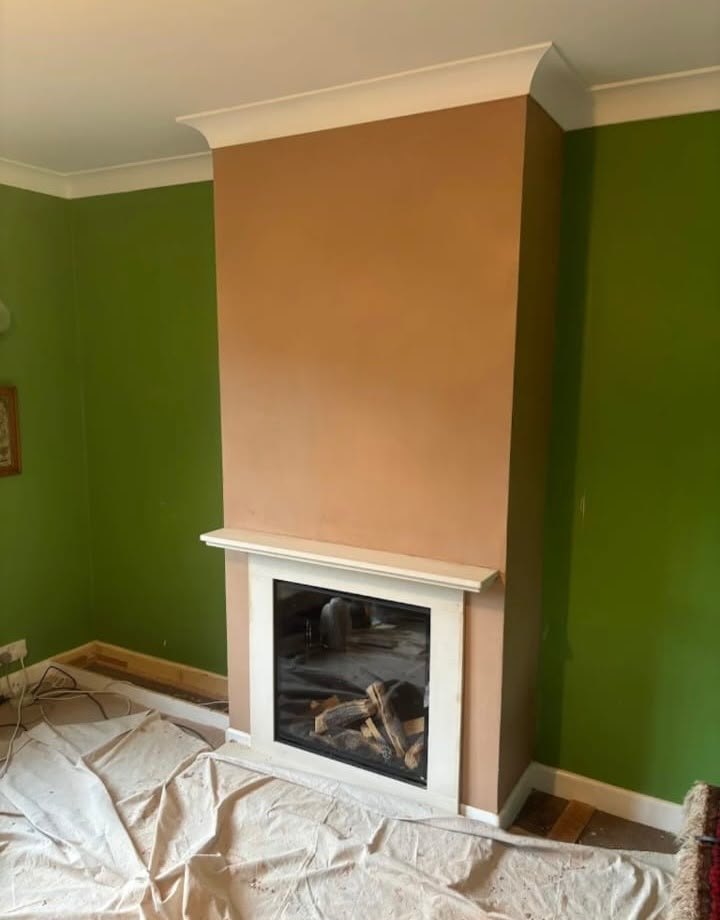
Ring rather than use the form. A ceiling that has cracked and dropped, plaster off a wall after a leak, or render that has come away from a gable goes to the front of the queue. We are about sixteen miles out along the A352, so we will normally have someone with you inside a day, and the same day when it is unsafe.
Worth knowing
Plastering in a house that is joined to another one
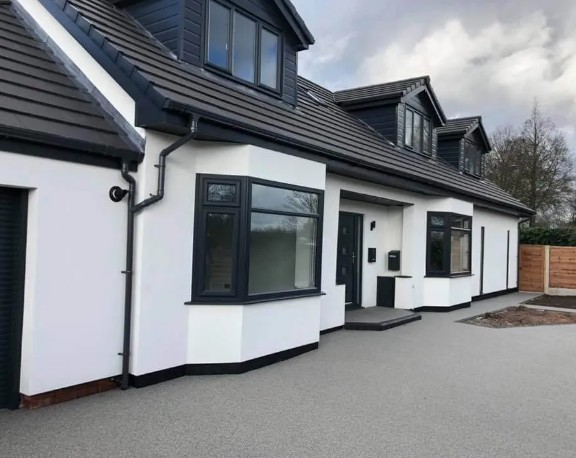
Half the homes in Wool are terraced or semi-detached, and the wall you share is the one that behaves differently from all the others. In most of the housing here it is a single leaf of masonry with plaster straight onto it, and that plaster is doing more than looking flat: the mass of the wall and the coat on it are part of what keeps next door's television out of your living room. Hacking it off is noisy for them as well as for you, and the vibration can crack the plaster on their side of it, so we tell the neighbours before we start rather than afterwards.
It also changes what we recommend. Dry lining a party wall on dot and dab sounds like an upgrade and often makes airborne sound worse, because you have built a drum with an air gap in the middle of it. On a party wall the safe answer is usually to repair and skim what is there, and if sound is the real problem, to say so and price a proper independent lining rather than let you pay for a board that makes it worse.
The other thing about an attached house is where the water comes from. A soft patch on your side of a shared wall, or a stain that appears high up in a bedroom, often starts in the house next door, and it can travel a long way sideways before it shows.
We would rather spend the first half hour finding it than replaster over it, because a skim on a wall that is still being fed will blow again inside the year and you will have paid twice. If it does turn out to come from next door, you get photographs of what we found, so you have something to show rather than an argument on the doorstep.
Who you are dealing with
A local firm you can check
We cover Wool and the BH20 villages, Bovington, East Burton, East Stoke, Coombe Keynes and Winfrith Newburgh, and east along the A352 into Wareham. Bournemouth Roofing & Building Ltd, registered in England and Wales, company number 15471719, which you can look up in a minute. Thomas Hannen's business, and he is the one who comes out to price the job, not a salesman. A verified customer's 10 out of 10 on Checkatrade. The visit and the written quote are both free.
Questions
Wool questions we get asked
Next door's leak wet our party wall. What now?
The wall has to dry before anything goes back on it, and the leak has to be stopped first. Over half of Wool is terraced or semi detached, 25.8% and 24.7%, so shared walls are the norm here and water crossing between properties is common. We can strip the blown plaster back to brick to help it dry out and return to rebuild the coat later. Who pays for what is between you and the neighbour.
Is our street inside the Wool conservation area?
Dorset Council holds the boundary map and it is worth checking, because the designation covers part of the village rather than all of it. Inside the boundary, the external appearance of a building is controlled, so a change of render material or finish needs an application while like for like repair does not. Nine listed entries also sit in this parish, and those carry tighter control that reaches the internal plaster as well.
What is typical in the 1970s houses in Wool?
Plasterboard on timber for the ceilings and a backing coat on block for the walls. 55.0% of Wool was built between 1945 and 1982 and the peak fell in the 1970s and early 1980s, so most houses here are that build. What turns up is joint cracking overhead, a textured coating applied later that has to come off or be covered, and blown plaster low down on external walls.
Should we use sand and cement or a modern render?
On the south west face here, a mesh reinforced silicone system. That is the exposed elevation, roughly eight kilometres in from the coast, and it takes repeated wetting right through winter. Sand and cement is rigid, so it cracks with movement and then holds water behind the crack, which is what pushes it off the wall. A flexible system on mesh moves and sheds. On sheltered elevations sand and cement is still fine.
How many days for a pair of ceilings and one wall?
A day to sheet up and get the old surface off, a day to board and set, then drying time before decoration, so most people are back in the room inside a week. Water damaged ceilings add to that, because the joists have to dry before new board goes up. In an occupied house we work one room at a time so the rest of the property stays usable throughout.
Nearby, and next door
Plastering and rendering near Wool
Plastering and rendering nearby
Our other trades in Wool
Everything we do in Wareham Plastering and rendering, all areas Every area we cover
Free quote
Get a price for plastering in Wool
Tell us the address and what you have noticed. We will come out, sound the walls, and put an itemised price in writing. No charge, and no obligation.