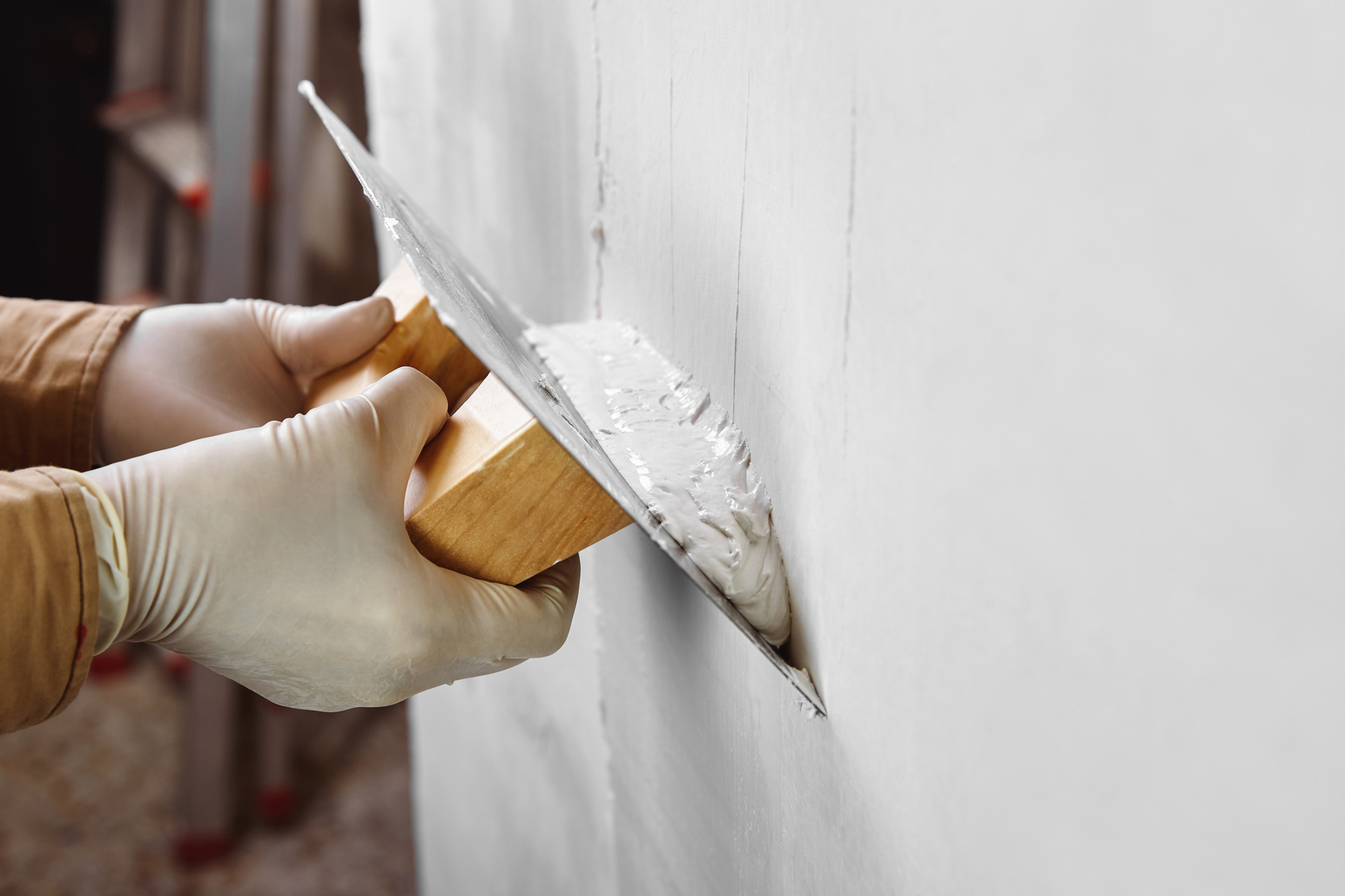
Plastering and rendering in West Lulworth
Render repair and renewal, lime plaster, lath ceilings, skimming and dry lining across West Lulworth and BH20. Free site visit, free itemised quote.
The site visit is free and so is the written itemised quote. Thomas Hannen prices every job himself.
More of what we are called to in West Lulworth is render than rooms: a patch blown off a seaward wall, or a hairline crack that has quietly started letting water behind. We can cut out and match, or take the elevation back and rebuild it properly, and the free visit is where you find out which of those your wall actually needs.
The village asks a lot of a wall. It sits less than a mile from open water with its weather arriving from the south west, so a surface here spends the winter wet, dries out, and gets wet again before it has finished. That is why render fails at the corners and the base rather than in the middle, and why a repair that would last twenty years two valleys inland can be back in five.
Inside, the work splits neatly. The old cottages are stone rubble under render, with lime plaster and lath ceilings, low headroom and walls that were never flat and should not be made flat. The newer houses up the lanes are plasterboard, taped joints, dot and dab and artex.
Both are ordinary work when the method matches the wall, and both go wrong when it does not. We survey the room, sound every wall and ceiling in it, and put an itemised written price in front of you with the method on it as well as the number.
The work
Cement on a cob wall seals the rain inside
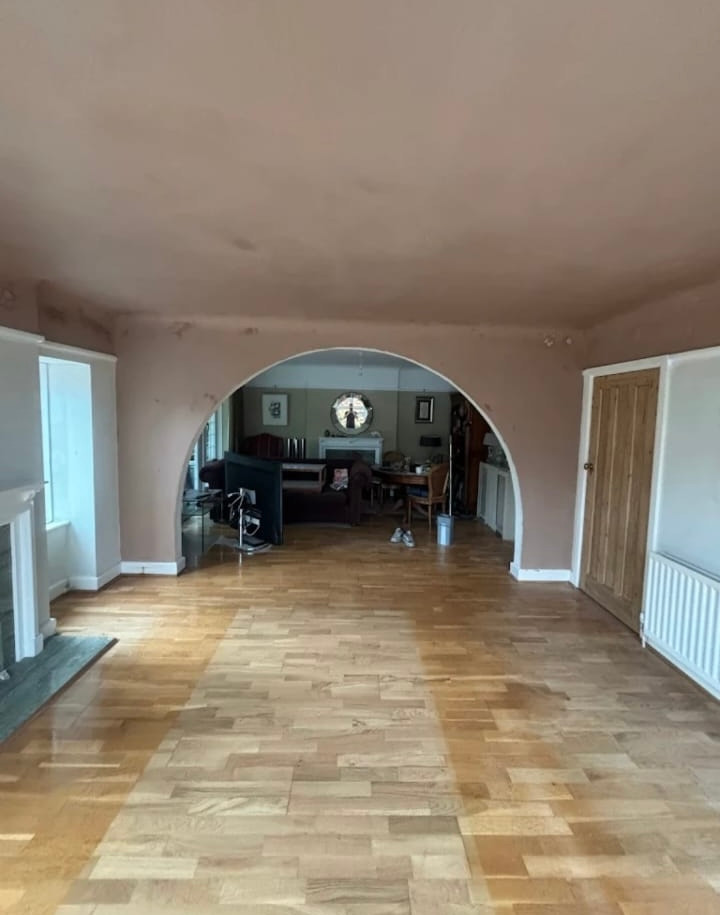
Render repair and renewal. The biggest part of our work in the village. A blown patch is cut out square, the edges keyed, a render coat brought back level and the texture matched so the repair does not read as a repair. Where an elevation drums over most of its face, patching is money you will spend twice, so it comes back to the stone and goes on properly: a scratch coat to key it, a basecoat with mesh bedded through it, a primer, then a silicone thin coat, a monocouche or a K render topcoat, with a bell cast bead at the bottom so water drips clear instead of tracking down into the wall. The cove is under a mile from here and the exposed elevation faces south west, so a wall on that side is wet and salted again before it has dried out, and a rigid sand and cement skin cracks under that where a mesh reinforced system copes.
Lime render and limewash on the old stone. A stone rubble or cob wall is solid, with no cavity behind it, and it gets rid of rain by drying out again, so it wants a breathable lime render and a breathable paint over it. A rigid sand and cement skin on a wall like that seals the water in and it comes out somewhere else, usually as a damp patch on the inside face or a section of render falling away in one piece. Lime is slower and wants longer between coats, and on the right wall you pay for it once.
In the cottages the ceilings are lime pushed through riven lath, and the question is never the crack. It is whether the keys curled over the backs of the laths have snapped off, which we check from the loft or the room above. Keys gone, the ceiling has to come down. Keys holding, scrim, a patch and a skim is honest work and a great deal cheaper. Up the lanes it is board work instead: plasterboard on stud, dabs on the outside walls, taped joints and artexed ceilings, and where a wall sounds hollow that piece has let go and comes off for a backing coat of browning, bonding or hardwall first.
A good many houses here earn their keep between changeovers, and the constraint is the calendar rather than the wall. Tell us the free week and we will tell you what fits in it. A skim and a mist coat will. A hacked-off and floated wall will not, because the water in a backing coat leaves on its own timetable.
How it runs
From your call to a written price
The quote is itemised: protection, hacking off, board, the backing coat, beads, the finish coat, making good and disposal each on its own line. Replastering inside is repair, and so is repairing render like for like. Changing the look of an elevation is different here, because the village has its own West Lulworth conservation area and something over forty listed entries, Little Bindon among them, and listed building consent can reach internal plaster and lath ceilings as well as the outside. Rendering a wall that is bare stone today is worth checking against Planning Portal guidance on external walls first. Re-render a whole elevation rather than patch it and Approved Document L treats it as renovating a thermal element.
Cost
What decides the price
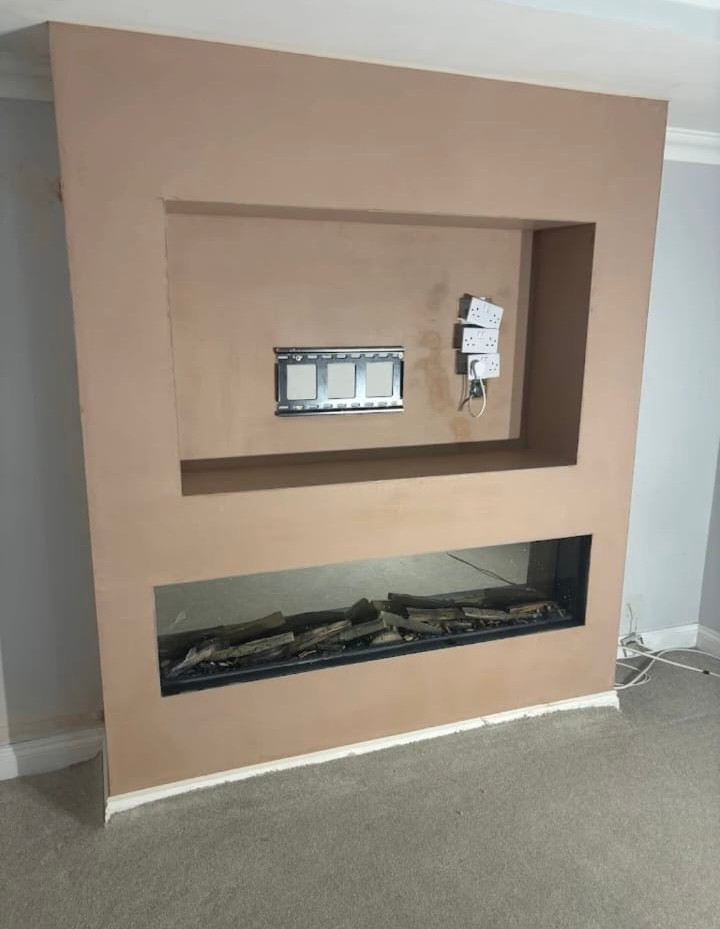
No rate per square metre. Every wall and ceiling is sounded with a knuckle first, because the split between what is skimmed and what comes off back to the stone moves the price further than the size of the room does. A cottage down near the cove with nowhere to park and a room that cannot be emptied, a rendered gable that needs a scaffold rather than a tower, and a modern house up the hill with a drive to work off are three different jobs. Scaffold is a priced line, because work at height rules decide the platform rather than the budget.
If it has come down
Render blown off a wall, or a ceiling coming down
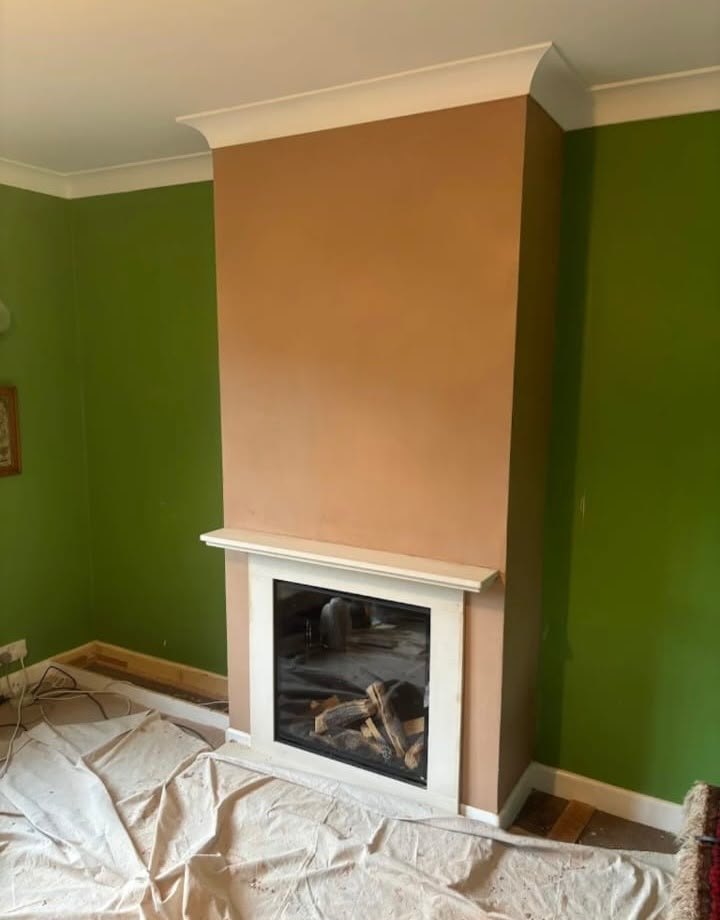
Ring rather than use the form. A ceiling pulling away from the joists, or render coming off a wall in sheets, goes to the front of the queue. West Lulworth is the far end of the patch for us, out past Wool, so you get a straight answer on the phone about which day we can be there rather than a promised hour we would miss.
Worth knowing
Salt gets at the beads before it gets at the render
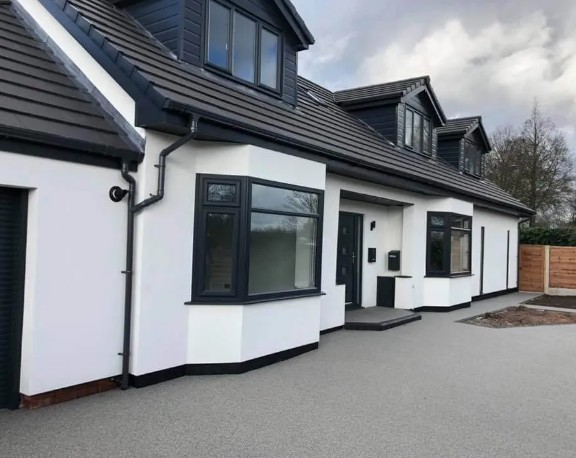
Salt is the thing that makes this village different to work in, and it does its damage where you cannot see it. Air off the Channel keeps a seaward wall damp between showers so it never fully dries, and that slow wetness gets at the metal buried in the render.
Ordinary galvanised angle bead and stop bead rust from the cut ends inwards, swell, and push the render off the corner from behind. That is why on this coast the corners and the reveals go first while the middle of the wall looks perfectly sound, and why a patch repair on the corner alone comes straight back.
So on any elevation facing the weather we use stainless beads and stainless fixings for the mesh, and we say so on the quote, because it is a line most quotes do not carry and it costs very little against having the job twice. The same thinking runs through the rest of the specification.
A rigid sand and cement render on a wall that moves will hairline crack, and every crack here is a door for driven rain, so a mesh reinforced basecoat under a silicone topcoat is the safer build. The paint matters as much as the render: a plastic masonry paint on an old stone wall seals the water in, while a mineral or breathable paint lets the wall carry on drying. Ask anyone quoting whether the beads are stainless, and what the topcoat is meant to do.
Who you are dealing with
A local firm you can check
We cover West Lulworth, East Lulworth and the coast road villages, out to Winfrith Newburgh, Wool and Wareham on BH20, and Dorset Council is the planning and building control authority for this address. Bournemouth Roofing & Building Ltd, registered in England and Wales, company number 15471719, which you can look up in a minute. Thomas Hannen's business, and he is the one who comes out to price the job, not a salesman. A verified customer's 10 out of 10 on Checkatrade. The site visit and the written itemised quote are both free.
Questions
West Lulworth questions we get asked
The whole village is a conservation area. What does that stop?
It controls appearance rather than repair. West Lulworth has its own conservation area covering the village, so putting back what is already there, in the same material and the same finish, counts as maintenance. Swapping a lime or sand and cement render for a different system, or changing the colour so the front reads differently from the lane, is a change the council will want to look at. Dorset Council is the authority. We price both routes.
Does being this close to the sea change the render?
At seven hundred metres in from the water it changes the detail more than the mix. Salt carries in on the wind, settles on the surface and holds damp between showers, so a wall here rarely dries out fully across winter. Metal in the wall suffers first: bead, mesh, lintels and any fixing corrode from the edge inwards and push the coat off in a line. Stainless or non ferrous beads go on the seaward elevation.
Is there a time of year you will not render here?
We avoid the depths of winter on exposed walls. Render needs to stay above a few degrees while it sets and needs a stretch of hours without driving rain, and the seaward side of a West Lulworth house gets neither reliably between November and February. Sheeting a scaffold helps with the rain but not with the cold. Spring through early autumn is the window. Internal plastering carries on all year regardless of what the weather does.
Is a stone cottage here likely to be listed?
Quite possibly. There are 43 listed entries in this parish, Little Bindon among them, which is a lot for a village of this size, so an older cottage is worth checking against the national list before any work is planned. Where a building is listed, consent reaches internal plaster as well as the elevations, and lime rather than gypsum is normally what the conservation officer expects to see specified.
Do you scaffold the whole house or just one wall?
Whichever the work actually needs. On a coastal house the seaward elevation is usually the one that has gone, so standing scaffold on that side alone is normal and it keeps the job smaller. Scaffold appears as its own line rather than being buried inside a rate for the walls, so you can see what dropping an elevation takes out. Where it has to stand on a lane or a verge, the council is told first.
Nearby, and next door
Plastering and rendering near West Lulworth
Plastering and rendering nearby
Our other trades in West Lulworth
Everything we do in Wareham Plastering and rendering, all areas Every area we cover
Free quote
Get a price for plastering or rendering in West Lulworth
Tell us the address and what the wall is doing. We come out, sound it and put an itemised price in writing. No charge for either.