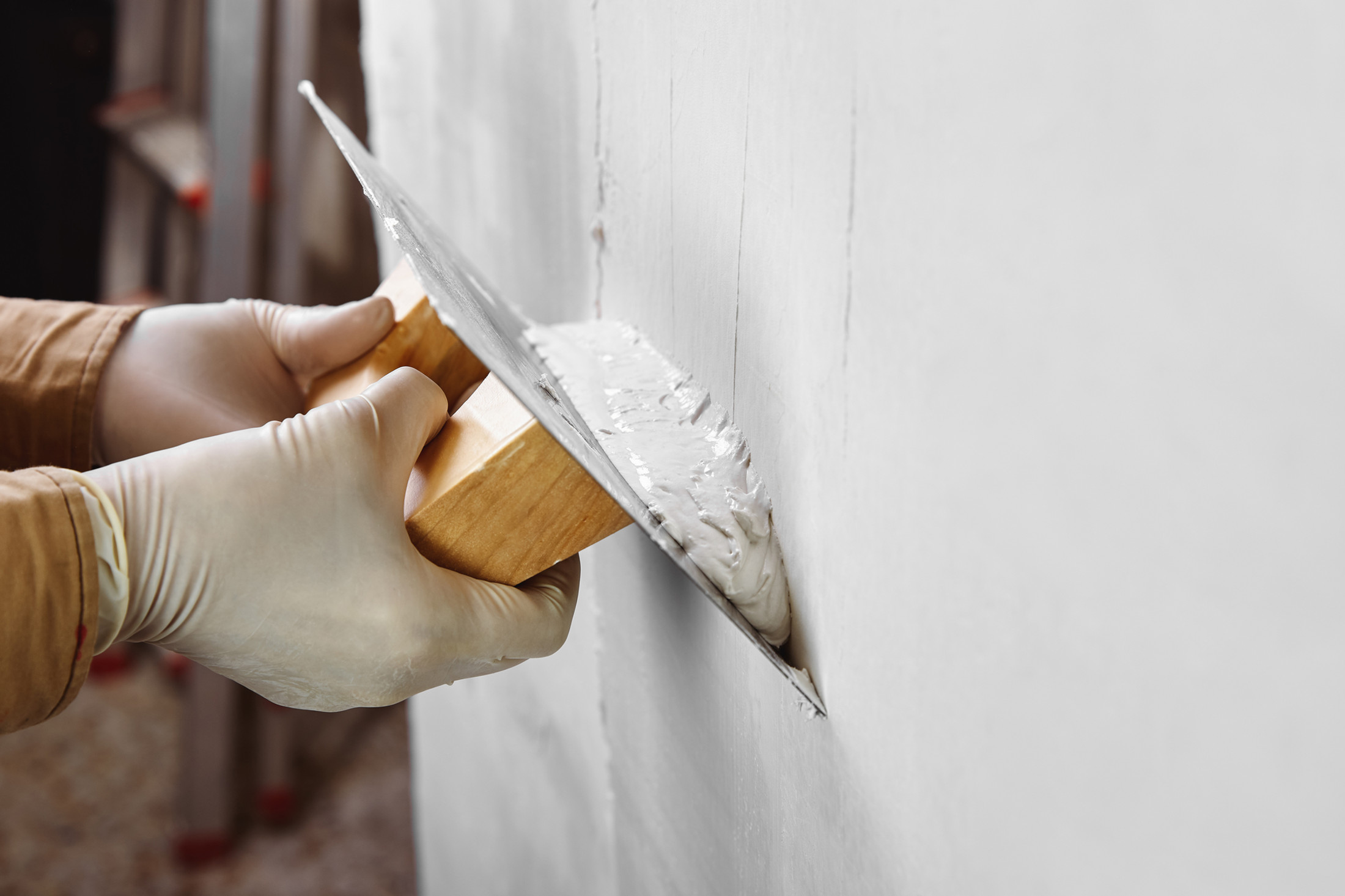
Plastering in Wareham
Skimming, re-plastering, lath ceilings, lime on solid walls, dry lining and external render across Wareham and BH20. Free site visit, free itemised quote.
The site visit is free and so is the written itemised quote. Thomas Hannen prices every job himself.
Last updated
Find the water first. On a Wareham wall that is wet as well as loose, replastering comes last on the list, not first, so we work out where the water is getting in, let the wall dry, then put back a finish that will stay put. On a dry wall it is far simpler: we sound it, skim what is solid and hack off what is not.
Plaster in Wareham warns you with a bowing ceiling, a soft wall near the skirting, rough making good or crazed gable render. A hall ceiling has cracked and one edge is starting to bow. A downstairs wall has gone soft and powdery a foot up from the skirting. A room has been left rough after a rewire, a new window or a stud partition coming out. Or the render on a gable has crazed and greened and nobody can tell you whether it matters.
Wareham has to be read before any of that can be priced, because the town is two kinds of building in one postcode. Inside the old streets it is solid brick, lime plaster and lath ceilings. Out on the edges it is post-war and seventies housing, plasterboard, taped joints and artex. The method that suits one will fail on the other, so we survey the room, sound every wall and ceiling in it, and give you a written itemised price with the method on it as well as the number.
The work
Hall ceilings crack because everyone walks over them
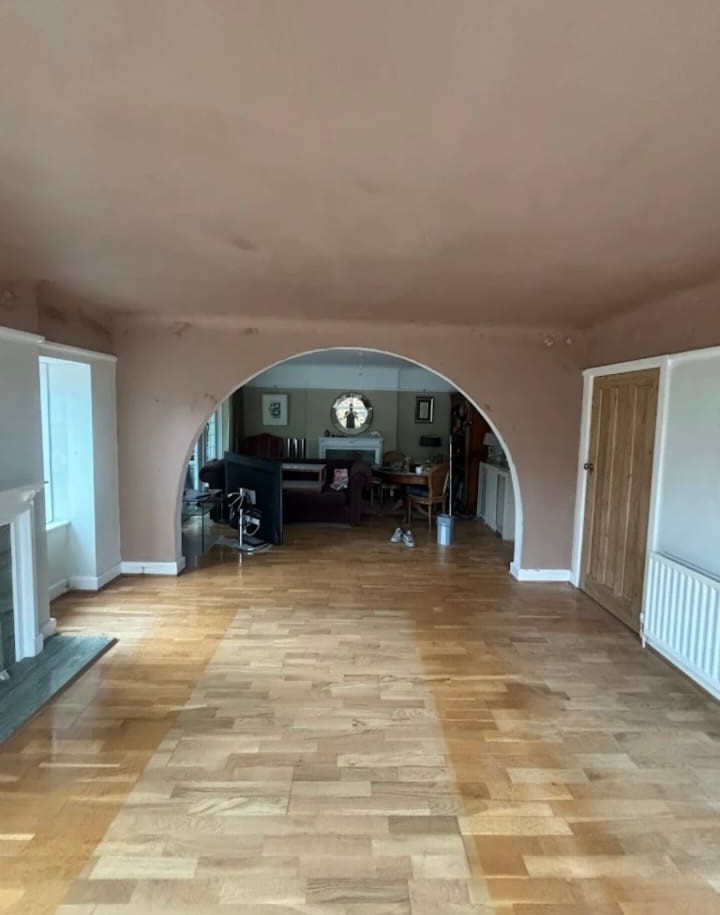
Lath and lime in the old streets. The brick houses along North Street, West Street and South Street carry lime plaster on solid walls with lath ceilings overhead, and about one home in six in the town predates 1919. The crack you can see is rarely the problem.
What matters is whether the plaster keys that curl over the backs of the laths have snapped off, and that is a job for a look from the loft or the floor above. Keys gone, the ceiling comes down and goes back on lime or on board. Keys holding, scrim and a skim will see you out.
Where old plaster has parted company with the brick, it comes off back to a clean background and a backing coat goes on first. On these walls that usually means lime, not gypsum, because a solid wall has to keep breathing, and a hard modern finish over one still carrying water simply blows again. Where the wall is genuinely dry, browning or hardwall and a gypsum finish are honest and cheaper.
Skimming in the post-war and seventies housing. Half the town went up between the war and the early eighties, most of it around the turn of the seventies, and the estates off Sandford Road and Worgret Road are the other half of the town: plasterboard on stud, taped joints, artexed ceilings and, in the newer ones, dabs on the outside walls. Where the background is sound we prepare and prime the surface, thinned PVA or a bonding primer depending what is already on it, and run two passes of finish coat off the trowel. A bedroom is a day.
Close to three in ten homes in Wareham are terraced, and the same three jobs come round: the scar where a chimney breast has been taken out, a party wall dry lined at some point and now hollow in patches, and hallway ceilings that crack because everything upstairs walks over them. Angle bead on every rebuilt corner and stop bead at each reveal, or the new work chips within a year. A fifth of the town is bungalows, which means wide ceilings with nothing but a cold loft above them, and they show every crack.
Outside there are gable ends, porches and the odd wholly rendered house. Older walls here carry sand and cement, often pebbledash; newer work is a thin coat silicone, a monocouche or a K render system. New render goes on as a scratch coat or basecoat with mesh bedded through it, then a primer and the topcoat, with a bell cast bead at the bottom so water drips clear and does not run down into the wall. The exposed elevation faces south west, and a hairline crack in render on that side is not a blemish. It is a door for water. For the outside walls, see rendering in Wareham.
How it runs
Replastering rooms in Wareham's older houses
Thomas comes out, sounds every wall and ceiling with a knuckle, and prices it himself. The quote lists protection, hacking off, board, the backing coat, beads, the finish coat, making good and disposal, each on its own line. The whole job sits with one company.
Furniture goes to the middle of the room under sheets, doorways are sealed against dust, and the old plaster leaves in bags as it comes down. In a terrace in the old streets, sheets of plasterboard often cannot turn up a narrow stair, so they are cut to size downstairs. For a flat above a shop, we agree times so the stairs stay clear. If a wall turns out to be hollow further than it sounded, or the laths behind a ceiling are rotten, Thomas shows you a photo, prices the extra, and we carry on only when you are happy.
Replastering inside is repair, and so is patching render like for like. What matters most in Wareham is listing. There are getting on for two hundred listed entries, most in the streets inside the old walls, and listed building consent reaches inside as well as out, so taking down a lath and plaster ceiling or stripping historic lime plaster can need it. Re-render a whole elevation rather than patch it and Approved Document L treats that as renovating a thermal element. Dorset Council handles both. Much of the old town is also the Wareham Conservation Area, so even on an unlisted house there, putting new render on a brick front or changing its finish needs checking with the council first, while replastering indoors is untouched by it.
Cost
Lath and lime or board and skim: what sets a plastering price
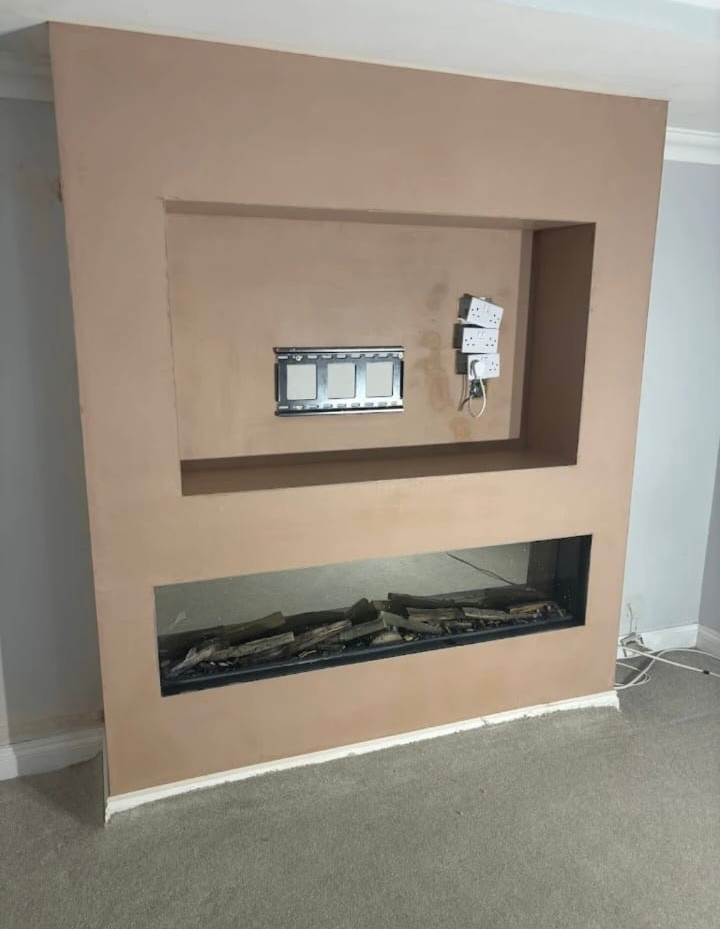
We do not set plastering prices per square metre. The split between what can be skimmed and what has to come off back to the brick moves the price far more than the size of the room.
What the walls are. In the older houses of Wareham the walls are solid brick with lime plaster, and the ceilings are often lath and plaster. Patching those needs lime, applied in coats, and slow drying. Gypsum on a solid wall that needs to breathe holds damp and blows. The houses of the late sixties and early seventies usually have plasterboard ceilings and gypsum walls, and a skim over sound board is quick.
How much is loose. A ceiling that has sagged away from its laths has to come down, and the dust and bagging is a day in itself before any board goes up.
Getting materials in. A Georgian town house on West Street with nowhere to park, a terrace near the quay where the van stops at the corner, and a bungalow with a drive take different amounts of carrying. Anything above a porch wants a scaffold on its own line, because work at height rules decide the platform.
Ask each quote which walls are being hacked off and which skimmed, whether lime or gypsum is going on the solid walls, and how the ceiling will be dealt with.
If it has come down
A ceiling sagging or plaster coming off in sheets
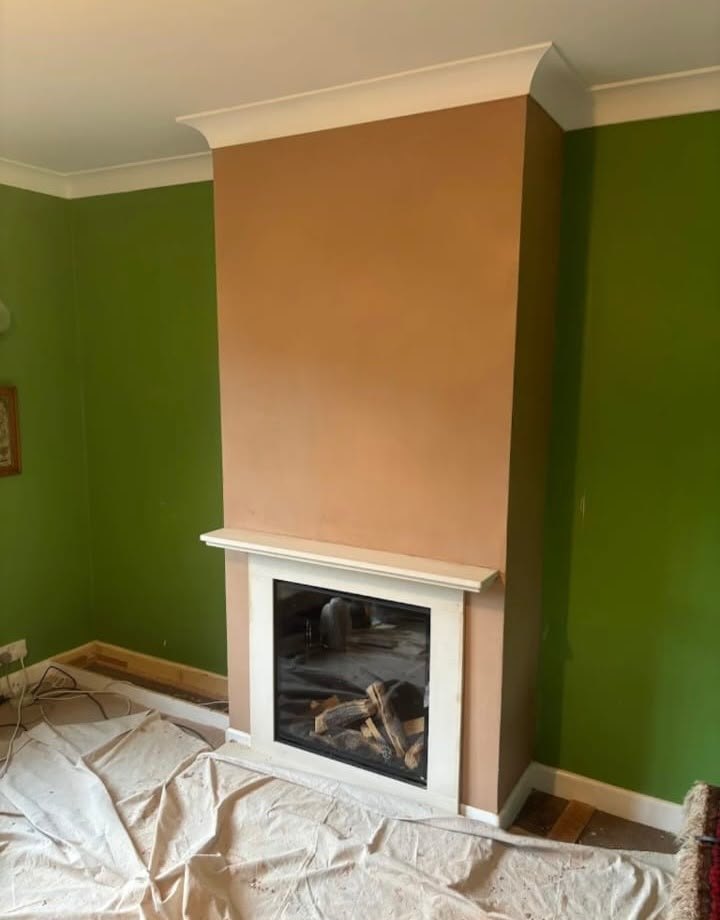
If a ceiling is pulling away from the joists, or plaster is coming off a wall in sheets, clear the room below and ring us rather than using the form. Do not push a bulging ceiling back up.
If water is in it, the source has to be found and stopped before anyone replasters, whether that is a roof, a pipe or a bath above. On the first visit we make it safe, propping the ceiling or taking down what is loose, and then price the repair. Booked plastering runs Monday to Friday, 8am to 6pm. If you cannot get through, we call back as soon as we can.
Worth knowing
A wall that has had water up it needs the jobs in the right order
Parts of Wareham sit in flood zones two and three, with the Frome on one side and the Piddle on the other, and that changes the plastering more than anything else about the town. Water that has been up a wall does not simply dry off. Gypsum plaster turns to mush and stays wet, salts come out of the brick and push through any new finish, and the wall behind loses roughly an inch of moisture a month.
You can check what your own address is in on the government flood risk service in under a minute, and it is worth knowing before you commit to a finish.
So the order matters. Loose plaster comes off early, to about half a metre above the line the water reached, and then the wall is left open to dry with ventilation rather than a heater aimed at it. Only then does anything go back. On a solid wall that means a lime backing coat and a lime finish, which lets the wall carry on drying through the surface instead of trapping the damp behind it.
On a modern wall it means keeping the bottom of the boards clear of the floor. Ask anyone who quotes for a wet wall what moisture reading they took and what the backing coat is. If neither answer is a real one, the same repair will be back within two winters.
Who you are dealing with
Plasterers for Wareham, Northport and the Purbeck villages
We plaster in Wareham town, Northport and Stoborough, and out to Sandford, Ridge, Wool and the Purbeck villages on BH20. Dorset Council decides planning and building control questions here, and Wareham is 12.5 miles from our base in Boscombe.
You deal with Bournemouth Roofing & Building Ltd, a company registered in England and Wales with the number 15471719. It is Thomas Hannen's business, and Thomas is the one who sounds the walls and prices the job himself. A verified Checkatrade customer scored us 10 out of 10. The site visit and the written quote, itemised, are both free. Before you book a visit in Wareham, you can read our customers' Google reviews, word for word, on our reviews page.
Planning at a glance
Do you need planning permission in Wareham?
Most repairs in Wareham need no application at all. What decides whether a change to the outside of your house does is who the council is, whether a conservation area or a listing applies, and whether the place sits in a protected landscape.
| Question | In Wareham |
|---|---|
| Who decides | Dorset Council is the planning authority for Wareham. Dorset Council's heritage pages set out what it controls. |
| Conservation area | Yes: Wareham Conservation Area. Check whether your street is inside the boundary before changing anything visible. |
| Listed buildings | Yes, there are listed buildings in and around Wareham. If yours is one, work can need listed building consent. |
| Protected landscape | No National Park or National Landscape covers Wareham. |
Questions
Questions about plastering in Wareham
How soon after a flood can a wall be replastered?
Not until the wall itself is dry, and on solid construction that takes months, not weeks. Wareham sits in flood zones 2 and 3 with the Piddle running close to the town, so this comes up here far more than it does inland. A meter reading taken through the depth of the wall decides it, not how the surface looks. Laying a fresh coat on a wall that still holds water just buries the problem behind it.
The old town is full of listed houses. What changes inside?
Consent covers the interior too. Wareham carries 196 listed entries, including houses along West Street, so a good part of the older centre sits inside listed control. In a listed house we cannot strip a historic ceiling, take out a cornice or cover a lime plastered wall with gypsum without agreement first. Dorset Council decides what is acceptable and we price the work around that, which usually means lime repair rather than a modern set.
We are in a terrace. Will the neighbour feel the hacking off?
They will hear it, and probably feel it. Terraced housing is the single biggest type in Wareham at 29.5% of dwellings, so a lot of plastering here happens either side of a shared wall. Hacking off carries straight through the brickwork and old backing comes away noisily. We tell the neighbours which days are the loud ones and keep heavy work to normal hours. Stripping plaster is not notifiable, but cutting into the party wall itself can be.
What do the post war houses in town usually need?
Re-skimming tired surfaces and dealing with the joints behind them. 52.0% of Wareham was built between 1945 and 1982, peaking in the late 1960s and early 1970s, so those houses have plaster on block or early plasterboard now carrying layers of paper and textured coating. On those it is mainly preparation, with very little new plaster. What you end up with is only ever as good as what sits underneath it.
What does the itemised quote actually list?
Each element on its own line: how much wall is being hacked off, how much is being set, boarding, beading, scaffold or towers where there is external work, waste removal and making good afterwards. It comes in writing once Thomas has been round, and both the visit and the quote are free. Splitting it that way lets you drop a room or defer an elevation and see exactly what that takes out.
Nearby, and next door
Plastering near Wareham
Nearby places we also cover for plastering, with straight-line distances from Wareham, and the other trades we offer in Wareham itself.
Plastering nearby
Our other trades in Wareham
Plastering and rendering guides
Silicone, cement or lime: which render? Cracked render: which cracks matter Hollow-sounding wall: blown plaster or dot and dabEverything we do in Wareham Plastering, all areas Every area we cover
Free quote
Get a price for plastering in Wareham
Tell us the address and what the wall or ceiling is doing. We come out, sound it and put an itemised price in writing. No charge for either.