Plastering in Crossways
Dry lining, ceiling skims, cracked taped joints, solid wall replastering out towards Moreton, and external render across Crossways, priced in writing after a free visit.
The site visit is free and so is the written itemised quote. Thomas Hannen prices every job himself.
If the walls in your Crossways house sound hollow when you knock them, nothing is wrong. Most of the village is dry lined, which means the plasterboard is stuck to the blockwork on dabs with a gap behind it, and that gap is what you can hear. It changes how we fix things to the wall and how a new opening gets formed, but it is not a fault and it is not a reason to replaster anything.
Two sorts of call come out of Crossways. Newer houses where the finish is sound but tired: hairline cracks along the taped joints, a ceiling that wants flattening, a wall opened up for a new door and never properly made good. And the older properties out towards Moreton and Woodsford, where the plaster has blown off a solid wall and needs taking back and rebuilding in coats.
Both are our work. It is a fair run out past Dorchester from us so it is booked rather than passing trade, but the site visit is free, the written itemised quote is free, and we would rather tell you a wall needs filling and painting than sell you a room of new plaster.
The work
Let the house shrink first, then skim it once
Dry lining, and living with a hollow wall. Most of the housing here is plasterboard on dot and dab or board on stud rather than plaster laid straight onto brick, nearly three in ten of it built between 1983 and 2008. Day to day that only matters when you want to fix something heavy to a wall or cut a new opening through one, because there is a void behind the board and a fixing has to reach past it. When we make good round a new door or a moved radiator, the board is packed and dabbed back properly first, then taped, so the repair does not telegraph through the paint a year later. Angle bead and stop bead go on every external corner and window reveal, because there is nothing solid behind the board to hold an edge on its own.
Taped joints and the first two winters. Newer ceilings here are taped and jointed rather than skimmed, which is quick and flat when it is new and shows every joint once the timbers have dried out and shrunk. Hairline cracks in straight lines along a board joint or above a door are shrinkage rather than damage, and the right answer is to let the house settle through a couple of heating seasons and then skim the whole ceiling in one go.
Out towards Moreton and Woodsford there are brick houses and cottages plastered straight onto the wall. Where the surface is sound we prepare it, seal it and put two coats of finish plaster on with a trowel. Where a patch sounds hollow it comes off and a backing coat of bonding, browning or hardwall goes back first, floated out and ruled level, and the finish coat wants a few days before a mist coat and decorating. Where a wall is genuinely old and has no damp proof course we use lime rather than gypsum, because it has to dry through its own face.
Extensions, garage conversions and loft rooms are the commonest new work: boarding out, tape and joint or a full skim, and the insulation behind the board decided before the boards are ordered rather than after they are up. Outside, gables and full elevations in sand and cement or pebbledash go rigid and craze; a hollow panel or two is cut out and patched back in a scratch coat and a render coat, and a wall that rings hollow all over comes off and goes back as a thin coat system with a bell cast bead at the base.
How it runs
From your call to a written price
The quote is itemised rather than one figure: what comes off, how each background is prepared, the beads, the backing coat, the finish coat, the making good and the waste on separate lines. Nothing we do inside needs planning permission, and outside the position in Crossways is unusually simple: no conservation area over the village and nothing listed in it at all. Building control is what actually applies here. An extension or a loft room is building work, and the insulation behind the plasterboard has to be inspected while it can still be seen, not after it is boarded over. Dorset Council for both.
Cost
What decides the price of a plastering job
No rate per square metre. What sits behind the finish decides it: sound plaster takes a skim, a hollow wall comes off and needs a backing coat. A newer detached house with a wide side gate, a bungalow on one of the closes with a garage to mix in, and a terraced house where everything comes through the front door are three different jobs. Outside, render brings a tower or a scaffold into the price, with a tower on a bungalow gable and a scaffold on anything two storeys up, and the work at height rules are why that is its own line. A full re-render counts as renovating a thermal element, so Approved Document L and building control take an interest.
If it has started to come down
A sagging ceiling, or plaster off the wall
Ring rather than use the form. A ceiling that has begun to bow, or plaster coming off a wall in sheets, goes to the front of the queue. We are the best part of twenty miles away, out past Dorchester, so we will tell you on the phone when we can be with you; clear the room underneath, and if water has come through, switch that lighting circuit off.
Worth knowing
Nothing in Crossways is listed, and that is worth money
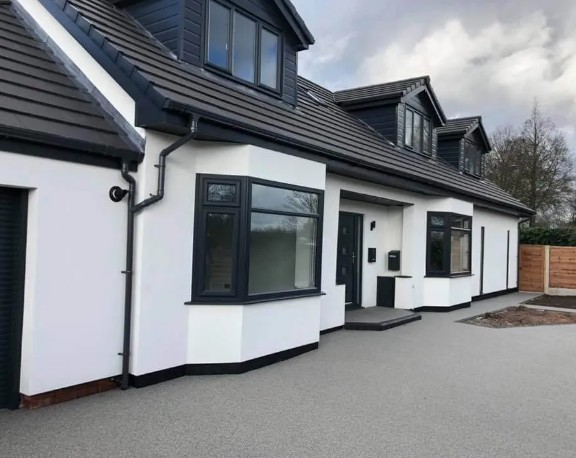
This is rare on our patch and genuinely useful. Crossways has no conservation area, and there is nothing in the village on the list of listed buildings. In most places round here that sentence comes with a condition attached. Here it does not, and the practical result is that the outside of your house is your own decision.
Take a tired pebbledash off and put a through coloured render on in a completely different shade, change the texture, change the colour, and normally nobody has to be asked, which Planning Portal guidance on external walls confirms is the usual position where no designation applies. Two villages away the same job is an application and a wait.
Use that to choose on performance instead of paperwork. Nothing is forcing a like for like match, so pick the system for the wall: a mesh reinforced silicone thin coat over blockwork where the elevation takes driven rain, a monocouche if you would rather never repaint it, and sand and cement only where you are patching into an existing one.
The single thing that can still catch you is a planning condition on one of the newer estates, because some developments have permitted development rights removed by condition, which does the same job as a conservation area without being called one. Check your own planning permission or your deeds before you order anything. It takes ten minutes and it is the only paperwork in it.
Who you are dealing with
A local firm you can check
We cover Crossways, Moreton, Woodsford, Warmwell and the DT2 addresses east of Dorchester, with Dorset Council for planning and building control. Send the postcode if you are not sure whether we come out that far. Bournemouth Roofing & Building Ltd, registered in England and Wales, company number 15471719, which you can look up in a minute. Thomas Hannen's business, and he is the one who comes out to price the job, not a salesman. A verified customer's 10 out of 10 on Checkatrade. The visit and the written quote are both free.
Questions
Crossways questions we get asked
Nothing in Crossways is listed. Are we free to re-render?
On appearance, you are. Crossways has no conservation area and not one listed entry, which is unusual on this patch, so the render system, the texture and the colour are your choice, and permitted development covers the ordinary case. Dorset Council still has a say if you are thickening a wall out past a boundary or altering the structure. For recovering a wall that is already rendered, nobody needs asking.
Why do the cracks follow the board joints upstairs?
Because the joint is the weak line and the timber behind it is still moving. Around 28.9% of Crossways homes went up between 1983 and 2008, built with dry lining and taped joints rather than a wet backing coat, and a taped joint a couple of millimetres thick cannot bridge much. A full skim across the whole wall spreads that movement over a continuous surface instead of concentrating it on the tape.
Does the Poole Harbour nutrient rule affect a loft conversion here?
It can, and that is the one place it touches us. Those rules only engage where a project adds somewhere new to sleep, so a loft or a garage turned into a bedroom is caught while replastering a room you already have is not. Dorset Council deals with it at the application stage, long before anyone is boarding out. Plain plastering work in Crossways does not trigger it at all.
Will you plaster through the winter, or wait for spring?
Inside work carries on all year as long as the heating is on low and steady; what changes is the drying, so a January skim wants a couple more days before paint goes near it. Rendering outside stops in a frost. A cold clear night after a wet day is the combination that ruins a fresh coat, so we watch the forecast for the week ahead rather than the calendar.
A few older cottages here are pre 1919. Do you do those?
We do, and they need a different approach. About one home in seven in Crossways predates 1919, so the village is mostly modern with a handful of solid walled buildings mixed through it. On the older ones we use a lime backing coat so the wall can still dry through; on the estate housing next door it is board and skim. The mistake is treating both the same because they share a postcode.
Nearby, and next door
Plastering and rendering near Crossways
Plastering and rendering nearby
Our other trades in Crossways
Everything we do in Wareham Plastering and rendering, all areas Every area we cover
Free quote
Get a written price for your Crossways plastering
Send the postcode and tell us which rooms, or which elevation outside. We come out, tap the walls, and put the price in writing with the days it will take.