Driveways and patios in Crossways
Block paving, resin bound drives, concrete taken out and patios across Crossways and the DT2 villages. We build the base for the ground you have got.
The site visit is free and so is the written itemised quote. Thomas Hannen prices every job himself.
If a Crossways drive is cracking in the same lines every year, the surface is not the problem. Ground that moves with the seasons needs a deeper compacted base and a surface that can flex with it, and that is a different job from laying something new over the top.
Most people here ring us about one of three things. An old concrete drive that has cracked at the joints and now rocks under a wheel. A frontage that is open lawn and needs to become somewhere to park a second car. Or a patio that has sunk at one corner, holds standing water and has gone slippery in the shade.
We come out, take levels, dig a trial hole to see what base is actually there, and put a written itemised quote in front of you with excavation, sub-base, drainage and surface priced separately. If we think the existing surface can be kept, we will tell you, and quote you the cheaper repair instead.
The work
Estate drives, open frontages and big back gardens
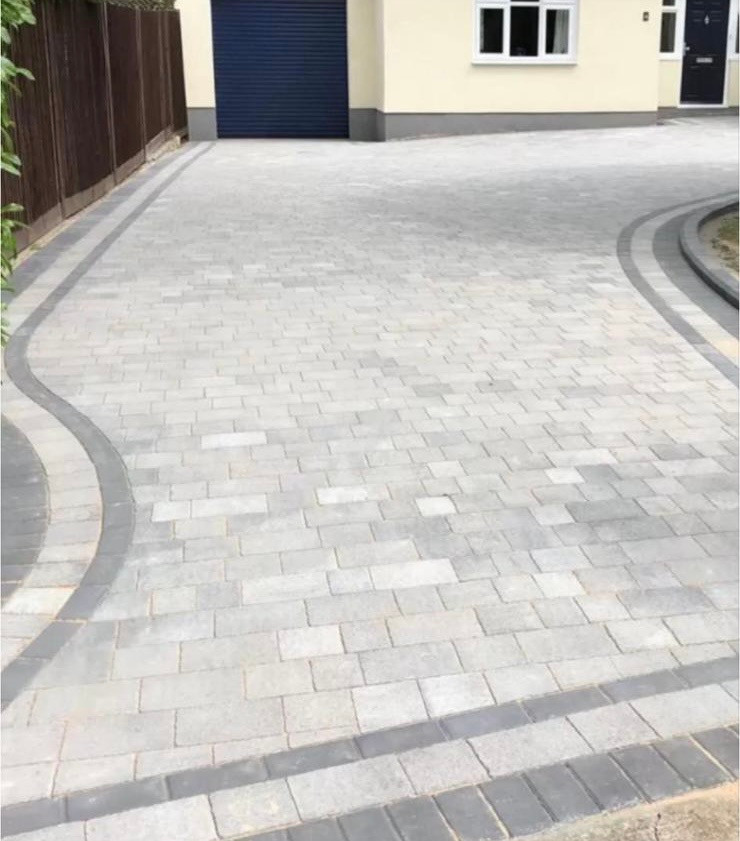
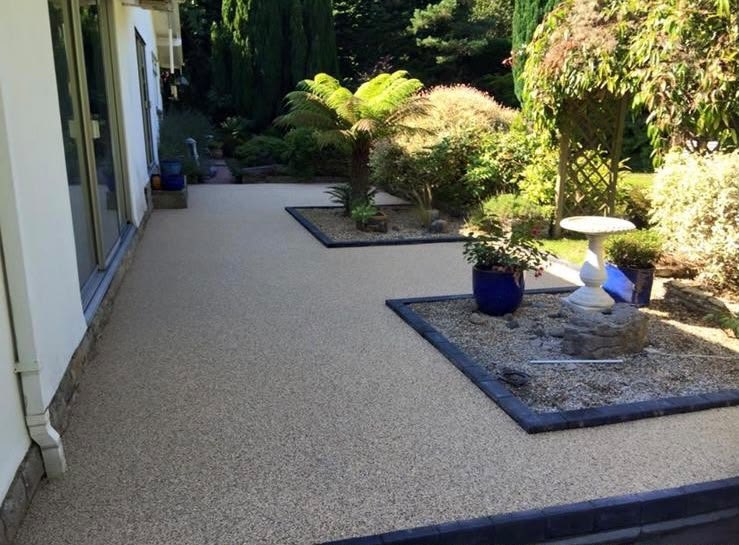
Old concrete taken out, or covered. A lot of the original drives in the village are concrete, and concrete does not fail gradually: it holds up for years, then cracks at the bays and starts to see-saw. Where the slab is still flat and unbroken it will take resin bound stone or new paving straight over the top, which saves the whole cost of breaking it out. Where it is cracked across its width we take it up, and the disposal goes out by grab lorry or skip with the price for it on the quote in advance.
Open frontages that need defining. Plenty of houses here have no wall or hedge at the front, just lawn running to the pavement, so the parking area has to define itself and there is nothing holding the edge in. We set a haunched edge restraint or a kerb line to give it a clean border, dig the extra area to formation, and lay membrane and a compacted sub-base at the depth the ground needs. Done properly you get a drive that looks deliberate rather than a strip of paving that has crept across a lawn.
The strip in front of a garage door is the part that fails first and matters most, because if the fall runs the wrong way you get water inside. We reset the levels so the surface drops away from the threshold, put a channel drain across the front where the ground is flat, and take that water to a gully or a soakaway rather than letting it lie against the door. The ground here shrinks and swells, so where rainwater ends up beside a foundation is a structural question and not only a damp one.
On the newer parts of the village the block paving itself is usually fine and the base under it has settled. We lift the affected bays, re-compact and correct the sub-base, reset to a true fall and re-sand with kiln dried jointing sand, and that takes the weeds and the staining with it, because both come from open joints and standing water. Gardens here are generous, so the patio does not have to be a strip against the back wall, and a second seating area further down the garden is often less work than extending the first, because it needs no drainage work against the building.
How it runs
From your call to a written price
The written quote splits excavation, muck away, the sub base, edgings, the surface and the drainage onto separate lines. Paving a front garden is normally permitted development where the surface is permeable or the run-off is directed to a lawn or a border, and planning permission only comes in over five square metres of solid surface draining onto the highway. A dropped kerb is a separate highway approval from Dorset Council. There is no conservation area over Crossways and nothing at all on the national list in the village, so unlike most places on our patch the material and the colour really are your decision and nobody else's.
Cost
What decides the price of a driveway
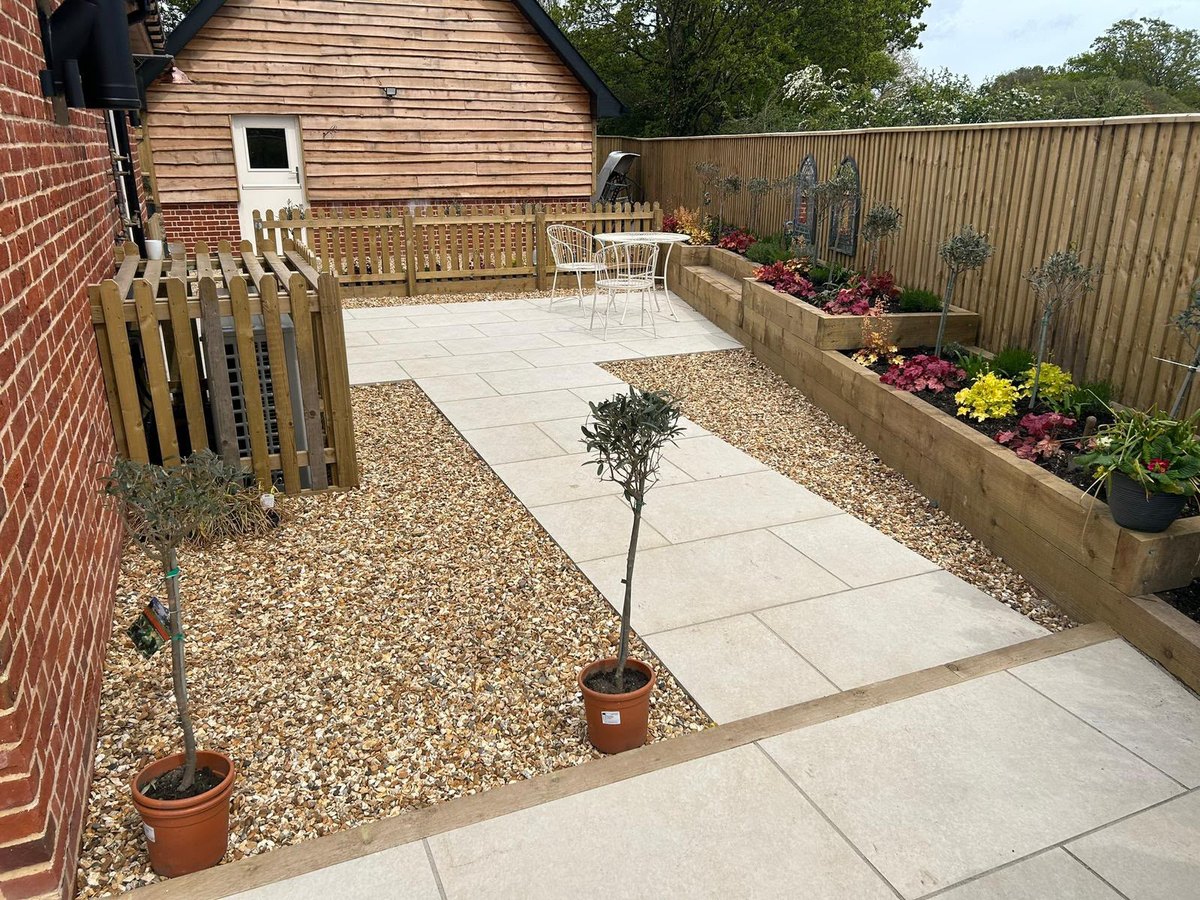
We do not price by the square metre, because what is under the surface decides more of the cost than what goes on top. A house with an open frontage straight off the estate road, a bungalow with a run down the side to a garage, and a property on the edge of the village with a long approach are three different jobs at the same square metres. Ground conditions and the depth of the dig are the real variables. Ask what sub base is going in, where the water goes, and who takes the spoil.
If it is urgent
A trip hazard, or a drive that floods
Ring rather than use the form. A slab that has lifted or a gully that has stopped taking water will not wait. The two we get called out to here are water standing in front of a garage door and a slab that has tipped enough to catch a foot on the way to the bins. Outside Monday to Friday, 8am to 6pm is by arrangement.
The one local thing
Ground that moves with the seasons, and what to build on it
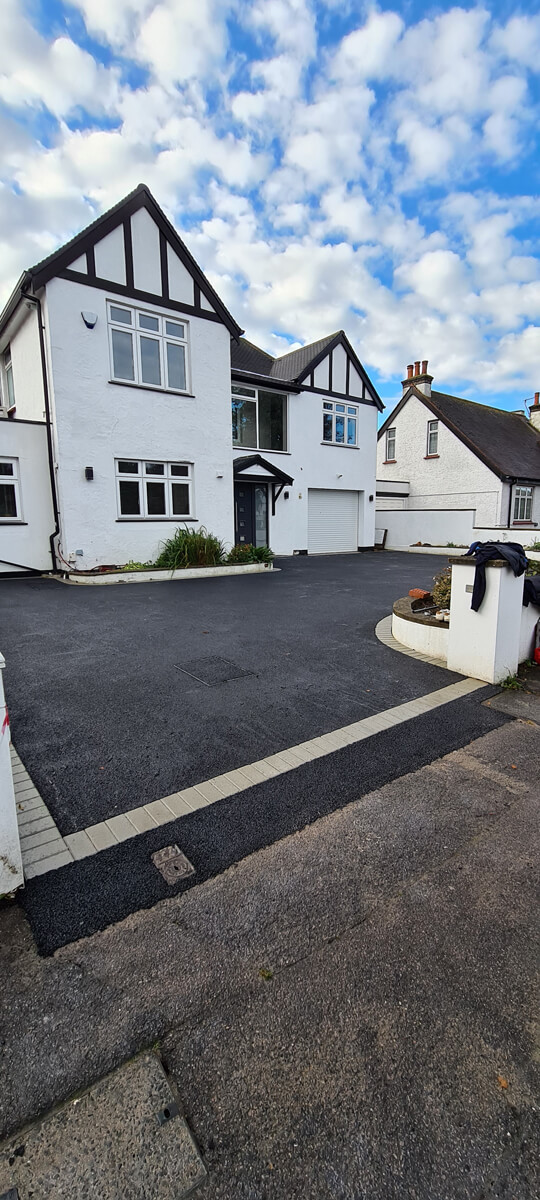
The ground around Crossways is cohesive, and cohesive ground shrinks in a dry summer and swells again over winter. Nothing you lay on it is immune to that. It is why a rigid concrete slab on a thin base cracks in the same places year after year while a flexible surface on a deep, properly compacted sub-base rides the movement out.
Block paving and resin bound stone over a good depth of crushed stone are far more forgiving here than a big continuous pour, and where a patio has to be rigid we get the base right and put the movement joints where they belong rather than waiting for the ground to choose.
The other half of it is where the water ends up. On ground that shrinks and swells, water arriving beside a foundation is a structural question rather than just a damp one, and that makes soakaway position a real design decision. Approved Document H expects a soakaway to sit well clear of the building, five metres being the usual figure, and there is no point putting one where the ground will not accept water anyway, which is what a percolation test is for.
Mature trees complicate it further: they dry the ground out around them in summer, and their roots will lift a surface that has been laid straight over them. We would rather design the drive around the tree, or bridge the roots on a deeper base, than lay something that will be uneven within two years.
Who you are dealing with
A local firm you can check
We cover Crossways, Moreton, Woodsford and the DT2 villages east of Dorchester, travelling out from a Bournemouth base, and the site visit and quote are both free. Bournemouth Roofing & Building Ltd, registered in England and Wales, company number 15471719, which you can look up in a minute. Thomas Hannen's business, and he is the one who comes out to price the job, not a salesman. A verified customer's 10 out of 10 on Checkatrade. The visit and the written quote are both free.
Questions
Crossways questions we get asked
Crossways has nothing listed at all. Is the surface our choice?
It is. No conservation area covers Crossways and there are no listed entries in the settlement, so nobody is judging the look of a frontage and the ordinary permitted development position applies. Dorset Council's interest is the drainage, and the crossing over the footway if a new one is being formed. That is not the case everywhere round here, and it turns the decision into a practical one about wear and water.
Cracks open in the garden every dry summer. Will paving crack too?
Rigid surfaces will. Ground at Crossways carries a significant shrink and swell rating, so it lifts and drops with the seasons, and a concrete slab or rigidly bedded stone terrace telegraphs that movement straight into its joints. Block paving and gravel ride it out because they are made of small pieces over a flexible base. Where a seamless finish is wanted, the base goes deeper and the falls stop water standing in one place.
Does fast draining ground still need a test hole?
It does, because a garden is not a geology map. Crossways ground is freely draining, so infiltration is usually the right answer, but the top metre of any plot is whatever the builder left behind, and made ground can hold water when the ground beside it does not. A pit dug and timed on the day settles which of the two you have, and it decides the entire drainage design.
Crossways is a fair way west. Do you work out there?
Regularly. It is around twenty miles from base, far enough that the job is planned as full days rather than short visits, so materials arrive in one delivery and the dig, the base and the surface run on consecutive days. It also means the survey and the pricing happen on one trip. Thomas Hannen comes out, measures, digs the check hole and writes the quote from what he finds.
Is winter a problem for laying on ground that drains?
Less of one than on heavy ground. Freely draining ground at Crossways means a dig does not turn to soup after a wet night, so excavation and base building carry on through the colder months. What weather does control is the finish: bound and resin surfaces want dry, warmer conditions to cure, and mortar bedding will not go down into a frost. So the base goes in and the top waits for a window.
Nearby, and next door
Driveways and patios near Crossways
Driveways and patios nearby
Our other trades in Crossways
Everything we do in Wareham Driveways and patios, all areas Every area we cover
Free quote
Get a written price for your drive or patio
Free site visit in Crossways, a free itemised quote, and a trial hole dug before anyone tells you what your drive needs.