Flat roofing in Crossways
Garage, porch and extension roofs across Crossways and the DT2 villages, looked at from the roof and priced in writing.
The site visit is free and so is the written itemised quote. Thomas Hannen prices every job himself.
Last updated
There is no conservation area in Crossways, so unless your own house is on the Historic England list, what goes on your flat roof is your decision. The only body with a say is building control, and only when the covering is renewed over most of the roof.
Most of Crossways went up between the seventies and the nineties, which means the garages, porches and back extensions all carry flat roofs of roughly the same age. The signs are a ceiling stain under one of them or felt gone grey and splitting along the laps, and when a neighbour has just had theirs done it is worth knowing where yours stands.
We come out, get on it, lift a corner where it is safe, look at the deck and check where the water is supposed to go. Then you get a written price rather than a guess. If water is getting through one of those ceilings now, ring 07435 839745 and say it is coming in.
The work
Garages, porches and the roof over the back kitchen
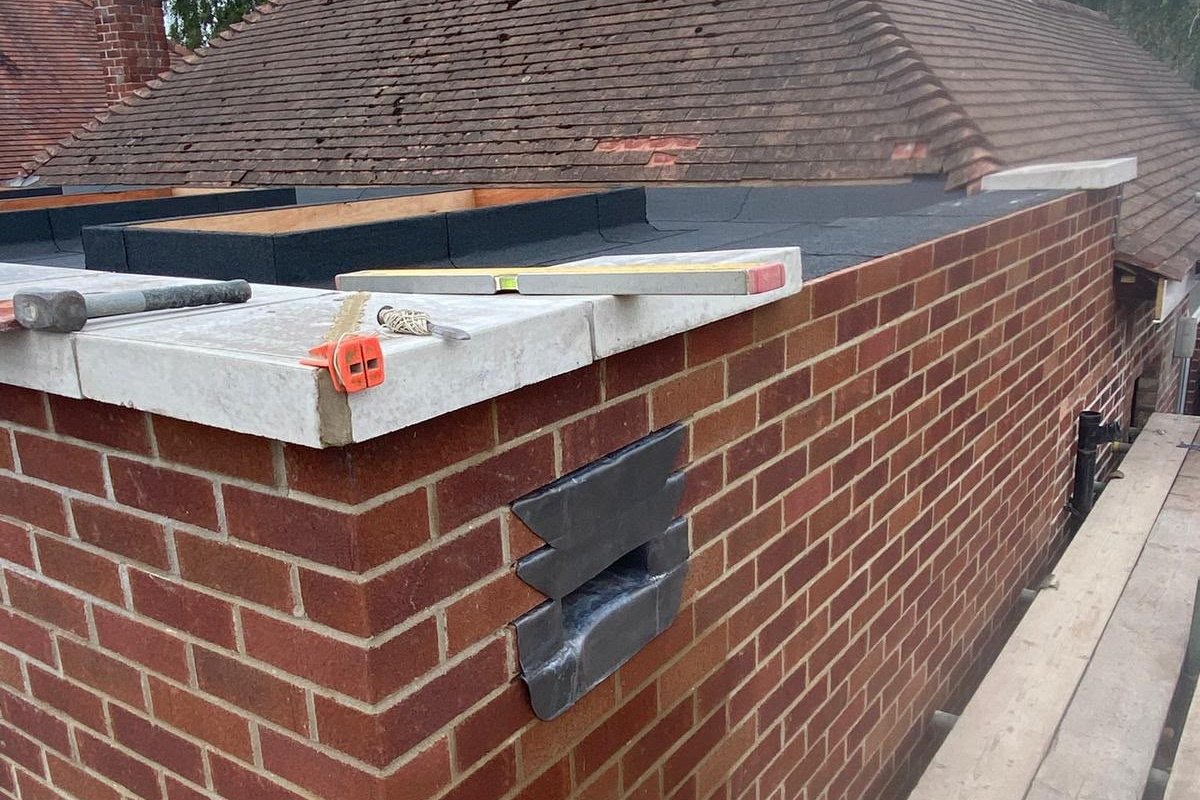
The garage roof comes first. The commonest flat roof in Crossways, and most are felt laid when the estate went up. What fails is a lap that has split, a blister lifted off the deck, a seam gone between two sheets, or a trim whose fixings have pulled.
On a Crossways garage, any of those is cut out, primed and welded back under a fresh cap sheet in a morning. What decides whether that is worth doing is the deck: chipboard swells the moment water reaches it and never flattens again, so a garage roof that dips in the middle is a board problem wearing a covering problem's clothes.
The porch and the bay top. Small roofs, awkward shapes, usually the ones with a kerb, an outlet and something to work round. GRP fibreglass is laid wet onto the deck, so it takes a shape rather than being cut to one, and that is why it suits these. A crack along a joint grinds out and re-laminates. On a plain rectangle we would rather use EPDM rubber, because it goes on as one sheet with no joints across the field and there is nothing in the middle of it to fail.
The roof over the back kitchen. Bigger, usually over a room in daily use, and the one where the build up decides how happy you are in five years. A built up three layer torch on felt system is still a proper roof and single ply belongs on the wider spans. What we will not do is re-cover a room roof cold when it is already running with condensation. PIR insulation above the deck, with the vapour control layer under it, keeps the dew point outside the timber and stops the interstitial damp people mistake for a leak. BS 6229 covers the build up.
Falls, and where the water is meant to go. Crossways roofs of this era were often laid dead level. Firrings over the joists put a slope back, or tapered insulation does the same work inside a warm roof, so water reaches the rainwater outlet rather than pooling. Ponding will not come through a sound covering by itself, but it holds grit and moss on the surface all winter and it is where the first split appears. Standing water underfoot that moves like a bubble is water in the deck.
The junctions, which is where the hours are. The upstand against the house wall, the abutment with a lead cover flashing set into a chase, the drip and apron at the front edge, the kerb round a rooflight, and the outlet itself. A parapet, a coping and a cavity tray get formed, not sealed. A skylight, a lantern, a Velux, a hatch, a soil pipe or a vent pipe each need a collar. And before any of it, we check the gutter, the hopper and the downpipe. A garage is a day, a back extension with a new deck two or three working days.
How it runs
Replacing the felt on a garage or extension roof
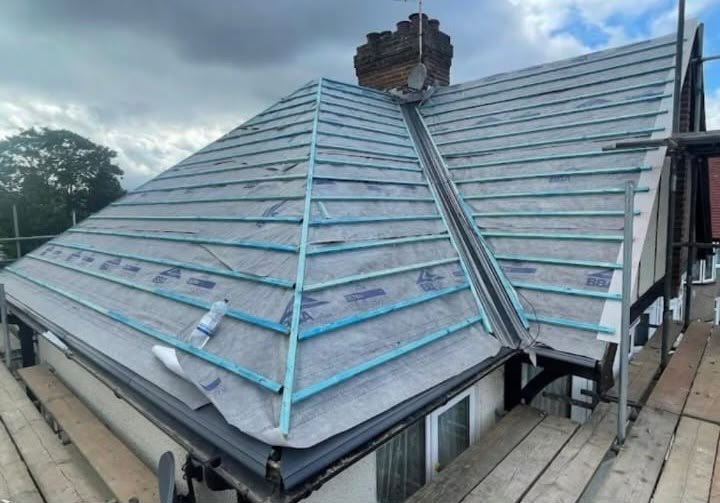
Thomas comes out, gets up on the flat roof, walks it to feel for soft spots in the deck, and looks at the ceiling below. He prices it himself on the visit. On the quote you will see separate lines for access, taking off the old covering, new decking or firrings where needed, insulation, membrane, every upstand, outlet and edge trim, and the skip. The roof is then stripped and laid under that one quote.
In Crossways flat roofs are mostly on garages built with the houses in the seventies and eighties, on single storey rear extensions, and over porches and dormers. Many still have their original felt, and plenty have been patched more than once. Access is usually easy off the drive, so a tower goes up beside the garage and the skip sits on the drive. No deck is left exposed at night. We sweep up before leaving each day and cart the old felt away ourselves. Where the rot has spread further than the lifted corner showed, we photograph it and agree a figure with you first.
A re-cover raises no planning question on an ordinary unlisted house in Crossways, since there is no conservation area, though the Planning Portal sets out where that stops if the shape or height changes. A full re-cover makes the roof a controlled thermal element under Approved Document L, so the insulation is improved and Dorset Council is told on a building notice or full plans. We handle that.
Cost
What is under the felt decides the flat roof price
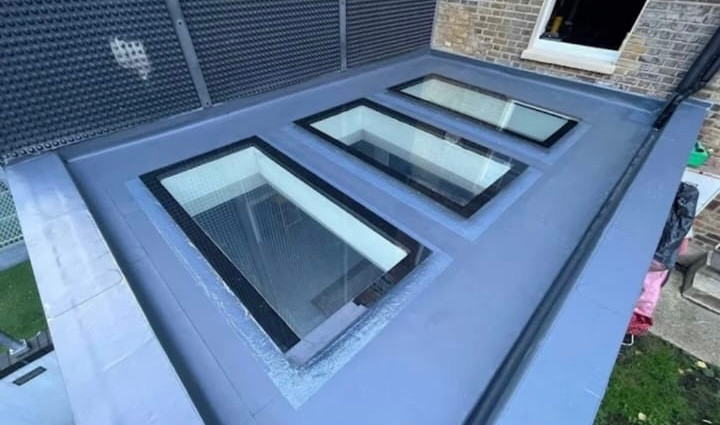
We do not price Crossways roofs by the square metre. The covering goes on quickly. What is underneath it sets the job. The deck. Garage roofs from this era were often decked in chipboard, which swells and goes soft once water gets in through a split. Ply that bounces when you walk on it has to come off too. Thomas lifts an edge before he quotes, because a new deck is the biggest single change in the price.
The falls. Many of these roofs were laid nearly flat, or drain towards a corner with no proper outlet, so water sits on them. Adding firrings to set a fall is more work than laying the membrane, and it is what stops the next roof ponding. Each upstand against the house wall, each edge trim and all the outlets are priced one by one.
Reaching it. A single Crossways garage beside the drive comes off a tower. An extension roof under an upstairs window needs a scaffold that stays up while the deck is open. The work at height rules set which of the two it is, and the skip is listed separately.
The system. Torch on felt, EPDM rubber and fibreglass all price differently. Unless the house is listed, the choice is yours and comes down to the roof.
Put these to any rival roofer: the system and number of layers, whether the deck is replaced or overlaid, and whether firrings are being added to correct the falls.
If it is coming through
Water through a garage or extension ceiling
Move anything that will spoil and get a bucket under the drip. A split, a burst blister or felt that has lifted at the upstand against the house wall lets water straight onto the ceiling below, and the deck carries on rotting after the rain stops.
On a garage, check stored boxes and anything electrical. First we make it watertight with a patch or a sheet held down with weights, then we check how much of the deck is wet. The permanent job is priced after that. Planned flat roofing runs Monday to Friday, 8am to 6pm. With water coming in, call instead of filling in the form. A missed call gets a call back from us as soon as possible.
Worth knowing
No conservation area, so the covering is your call
Crossways leaves the covering to you, which is worth saying plainly because on most of the villages around here it is not true. There is no conservation area over Crossways, and unless the Historic England list names your address, the house is not listed either.
Nobody has to approve the colour, the sheen or the material of your flat roof, and you are not obliged to put felt back just because felt is what is there. If EPDM or fibreglass suits the roof better, you can have it.
That leaves one real gate, and it is a technical one rather than an aesthetic one. Renew the covering over most of a roof and the regulations treat it as a controlled thermal element, which means the insulation has to be brought up to standard at the same time. In practice that turns a cold roof into a warm roof with PIR above the deck, and it is why a quote that mentions nothing about insulation is not comparing like with like. Ask any quote you get whether the work is being notified and what insulation is going in.
Who you are dealing with
Who prices your flat roof
We travel 21.8 miles from our base in Boscombe to Crossways, and we cover flat roofs in the village, Woodsford, Warmwell, Moreton and the DT2 villages round them, with Dorset Council for building control. Your contract is with Bournemouth Roofing & Building Ltd, registered in England and Wales, number 15471719. Before you book a visit in Crossways, you can read our customers' Google reviews, word for word, on our reviews page.
Thomas Hannen owns the firm, and he walks the roof and writes your price himself. On Checkatrade, a verified customer scored us 10 out of 10. We do not charge for the visit, and the written quote with each part itemised is free too.
Planning at a glance
Do you need planning permission in Crossways?
Most repairs in Crossways need no application at all. What decides whether a change to the outside of your house does is who the council is, whether a conservation area or a listing applies, and whether the place sits in a protected landscape.
| Question | In Crossways |
|---|---|
| Who decides | Dorset Council is the planning authority for Crossways. Dorset Council's heritage pages set out what it controls. |
| Conservation area | None covers Crossways, so a like-for-like repair is ordinary maintenance. |
| Listed buildings | Nothing in Crossways is on the statutory list, so listed building consent does not come into it. |
| Protected landscape | No National Park or National Landscape covers Crossways. |
Questions
Questions about flat roofs in Crossways
Do I have to put the same covering back on?
No, you do not have to. There is no conservation area in Crossways, so unless your house is listed, the covering is your choice. We will tell you which system suits the shape, the openings and the traffic the roof takes, and put the reasoning in writing rather than just naming a product.
Is a repair worth it, or should the whole roof come off?
If the covering still bends and the failure is at a lap, a seam or an upstand, a repair is honest value. If it cracks when lifted, or the deck gives underfoot, a patch is sitting on something that moves and you will be paying twice.
How long does a flat roof take?
A garage is normally a day. A rear extension with a new deck, firrings to correct the falls and a rooflight to form round is two or three working days. We will not strip a deck we cannot make watertight again by the end of the day.
Why is there water standing on my roof after the rain stops?
Because the fall has gone flat or the outlet is blocked. Pooling on its own will not come through a sound covering, but ponding holds grit and moss against it and it is where a split starts. Firrings or tapered insulation put the fall back.
Nearby, and next door
Flat roofing near Crossways
Nearby places we also cover for flat roofing, with straight-line distances from Crossways, and the other trades we offer in Crossways itself.
Flat roofing nearby
Our other trades in Crossways
Flat roofing guides
GRP, EPDM or felt: which flat roof covering? Snow on a flat roof or a conservatory Warm roof or cold roof: which do you need?Everything we do in Wareham Flat roofing, all areas Every area we cover
Free quote
Get a price for your Crossways flat roof
Tell us the address and what you have noticed. We will get up and look, check where the water goes, and put an itemised price in writing. No charge, and no obligation.