Flat Roofing in Tolpuddle
Flat roof repairs, re-covering in EPDM, GRP fibreglass and felt, new decks, falls and outlets on garages, cottages and extensions around Tolpuddle.
The site visit is free and so is the written itemised quote. Thomas Hannen prices every job himself.
In Tolpuddle the flat roof is nearly always the newest thing on the building and the wall it leans against is the oldest. Almost every leak we find here is at that meeting point rather than out in the middle of the covering, and that is a repair job rather than a replacement.
The usual story
A modern roof fixed onto an old building
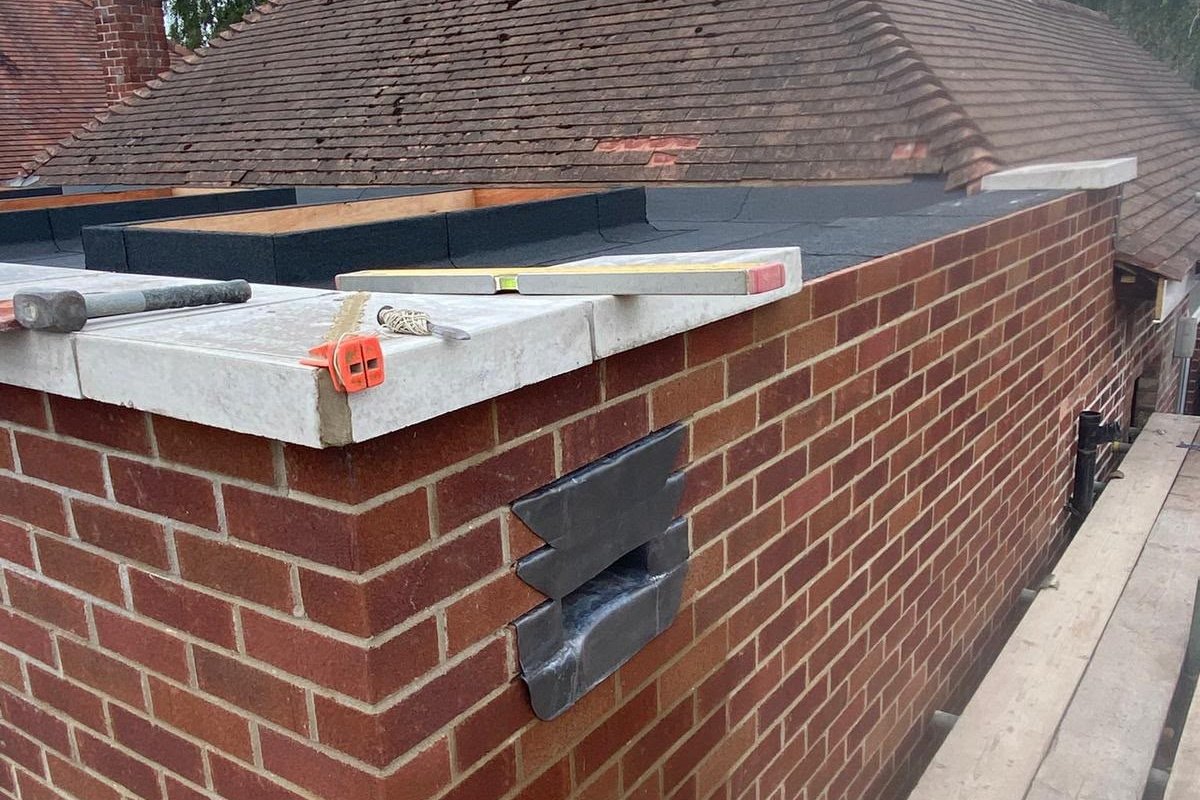
The village is old and the flat roofs are not. A kitchen extension, a bathroom over a scullery, a garage, a store: modern decks and modern coverings fixed onto walls of soft brick, rubble or cob under render. Two materials that behave nothing like each other, joined by a detail somebody had to improvise on the day.
So that is where we look first. We walk the roof, press the covering to see whether it has any give left, and pay most of our attention to the upstand, the flashing and the edge where new work meets old. A small area of covering comes up so we can see the boarding, and it all gets photographed before it goes back down. If the wall itself is soft or the render has blown, we will say so, because there is no sense dressing a beautiful flashing into something that will not hold it. The visit and the written price cost you nothing.
New on old
Making a modern covering sit properly on old fabric
The chase is the first problem. Textbook detailing says cut a chase into the brickwork and dress a cover flashing into it. In a soft handmade brick, or in rubble, cutting a chase can do more damage than the leak ever did. So we work with what is there instead: lead dressed over an apron and secured into a raked out bed joint, pointed back in a mortar that suits the wall rather than a hard cement that will take the face off it in the first frost.
Movement is the second. Old walls shift with the seasons and a rigid covering does not enjoy being told to shift with them. It is one reason EPDM does well here: a single sheet of rubber, bonded cold, no joints out in the field of the roof and enough give at the upstand to live with a wall that moves. GRP, brushed on wet over fresh plywood and cured as one fibreglass skin, is superb over a stable deck and unforgiving over one that flexes. We choose by the building rather than by what is easiest to fit.
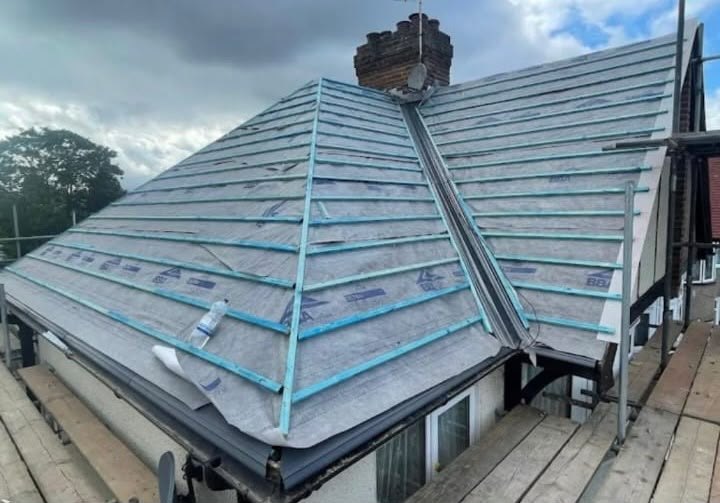
Fire is the third, and it decides more than people realise. Torching a built up felt roof means an open flame against old timber, dry ivy in a wall, or thatch on the roof next door. Where that is the situation we will not torch it. Three layer built up felt is a fine covering and we still fit it, but it goes down cold bonded or self adhesive under the mineral cap sheet. Single ply, hot air welded at the laps, is another way round the same problem on a wider span.
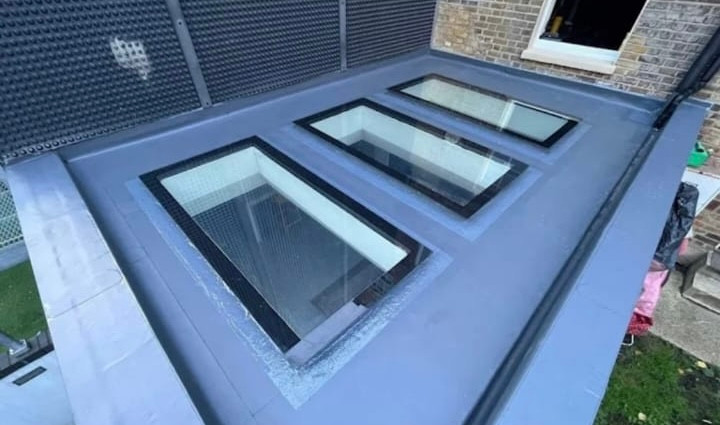
Then the ordinary work, which is the same here as anywhere. The boarding comes up if it is soft, chipboard being the usual culprit, and OSB goes back over joists we have checked. The fall is re-cut with firrings or tapered insulation so water reaches an outlet instead of sitting in a hollow. Parapets, of which this village has plenty, get their coping re-bedded with a cavity tray behind. Every open edge takes a trim with a drip on it. Rooflights and lanterns go back onto kerbs we build up so the skylight stands clear of standing water, and Velux units, hatches, soil pipes and vent pipes each take a collar. The outlet, hopper, gutter and downpipe are cleared before we price a covering. Blisters, bubbles, splits and seams that have lifted are all repairable: back to sound material, a new piece bonded or welded in, edge dressed down.
Insulation is the one place where an old building wants some thought. A warm roof, with PIR over the deck and the vapour control layer beneath it, keeps the dew point out of the timber and is what building control will expect on a renewed covering. On a building with solid walls and no damp course, though, it is worth asking where the moisture in the fabric is going once you seal the top of it. BS 5250 covers moisture in buildings and Approved Document L the thermal standard. We would sooner have that conversation before the boards go down than after the plaster starts to bloom.
How it runs
From your call to a written price
Same team from first visit to last, one person to ring, and no sub-contracting your work out to somebody you have never met. The quote is itemised, not a figure on the back of a card: access, stripping the old covering, any new deck or firrings, the insulation, the membrane and each upstand, outlet and edge trim, and disposal on separate lines, so you can compare it properly against anyone else's.
Nothing is left open or unusable overnight. The site is swept at the end of each day rather than the end of the job, and what comes out leaves with us. If something turns up once we start that nobody could have seen, you get a photograph and a price before we carry on.
Putting the same covering back is maintenance rather than development, and Planning Portal guidance marks where that stops and planning permission starts. Tolpuddle is a conservation area with listed buildings through it, and Dorset Council handles that alongside building control and listed building consent.
Cost
What decides the price of a flat roof
No rate per square metre, because the square metres are the easy part and what is under the covering is what decides the job.
Getting to it. A garage on a village plot, a flat roof over a rear kitchen and a porch on a cottage frontage are three different jobs before any covering comes off the van. A garage or a single storey extension will often come off a tower, anything above a two storey wall wants a scaffold, and the platform has to stand while the deck is open rather than for an afternoon. The work at height rules are why it is a priced line rather than something folded into a rate.
The deck under the covering. A sound deck can be re-covered. Chipboard that has been wet for years, or ply that gives underfoot, has to come off and be replaced, and you cannot tell which you have from the ground or from a photograph. We lift a corner before quoting, because the deck is the single biggest swing in the price.
The falls, and where the water is meant to go. Most flat roofs that fail were never laid to a fall, or the fall runs at an outlet that has since been blocked or built over. Correcting it with firrings is more work than laying a membrane and it is the difference between a roof that lasts and one that ponds. Upstands, edge trims and each outlet are priced one at a time, because that is where the hours and the leaks both are.
Comparing quotes? Ask which system is being quoted and how many layers, whether the deck is being renewed or covered over, whether the falls are being corrected with firrings, how the upstands, outlets and edge trims are detailed, and whether the scaffold and the skip are in the price. Two quotes for the same job are usually two different jobs.
If it is coming through
Water through a flat roof
Ring rather than use the form. A flat roof that has split, blistered or lifted at an upstand puts water straight onto a ceiling, and once the deck is wet the damage carries on after the rain stops. The first visit is about getting it covered and dry, and we price the permanent job once we can see how much of the deck has gone. Put a bucket under it and pierce a bulging ceiling in one spot over the bucket rather than waiting for it to give way. An emergency cover to keep the deck dry is arranged as soon as we can get across. The phone is answered 24 hours for emergencies; scheduled work runs Monday to Friday, 8am to 6pm.
Sequence
Ask the council before you order, not after
The whole village is a conservation area and there are twenty seven listed entries in the parish, which is a great many for its size. Neither of those stops you having a dry roof, and neither applies to a like for like re-cover, which counts as maintenance. What they do is put a step in front of anything that changes how the roof looks or puts something new up through it.
The mistake is taking that step last. People agree a system, take a delivery, get the access up, and only then find out that a change of material or a new rooflight wanted asking about, by which time all the pressure is running one way. Do it the other way round. One call to Dorset Council at the start costs nothing and usually comes back as yes with a condition. If the building itself is listed, that consent is separate again, and a listing does not stop at the back door of the house. We will price the job either way and we will wait for the answer before anything comes off the van.
Who you are dealing with
A local firm you can check
We cover Tolpuddle, Puddletown, Affpuddle, Briantspuddle and Milborne St Andrew across DT2, working out from Bournemouth. You are dealing with Bournemouth Roofing & Building, the trading name of Bournemouth Roofing & Building Ltd, registered in England and Wales, company number 15471719, which you can look up in a minute. Thomas Hannen's business, and he is the one who comes out to price the job, not a salesman. A verified customer's 10 out of 10 on Checkatrade. The visit and the written quote are both free.
Questions
Tolpuddle questions
Will you use a naked flame near thatch?
No. Where there is thatch nearby, or old dry timber in the wall, we fit the covering cold bonded or self adhesive, or we use rubber instead. It is not worth the risk to save an hour on the roll.
The wall is cob under render. Can you still flash into it?
Not with a cut chase, and we would not try. We work lead over an apron and take it into a raked out joint, or form a proper upstand and cover it, then point back in a mortar that matches what is already there.
Does a conservation area stop me putting in a rooflight?
Rarely, but it does mean asking first, particularly where the roof is visible from a public view. The council will usually say yes with something to say about size or position. Ask before you order, not after.
Can you match how the old roof looked?
Usually. A mineral cap sheet comes in more than one colour, and rubber and single ply come in greys and darks that sit quietly on a village roof. If matching matters, we will bring a sample to the visit.
Nearby, and next door
Flat roofing near Tolpuddle
Flat roofing nearby
Our other trades in Tolpuddle
Everything we do in Wareham Flat roofing, all areas Every area we cover
Free quote
Get a written price for your Tolpuddle flat roof
A free site visit, the deck opened and checked, and an itemised quote you can compare.