Patios in Wool, the estate concrete question
Half the back gardens in the village have a 1970s concrete apron or paving on dabs, and they are all failing at about the same time.
The site visit is free and so is the written itemised quote. Thomas Hannen prices every job himself.
Over half the houses in Wool went up between 1945 and the early eighties, and most of them got the same back garden treatment: a concrete slab or a set of grey paving squares laid straight onto the ground. Those patios are all reaching the end together, and the real question is whether the concrete comes out or gets used.
Three calls keep coming. A concrete apron cracked across and tilting back towards the house. Paving squares that rock, ring hollow and have moss growing out of every joint. And somebody who wants porcelain and has been told, correctly or not, that the old slab has to be dug out first.
We come and find out which it is. If the existing concrete is sound and at a level we can work with, laying over it saves a dig, a skip and several days. If not, it comes out. Either way you get a written itemised quote with the dig, the muck away, the base, the edgings, the slabs, the drainage and the jointing on separate lines, free of charge.
The work in the village
Over the old concrete, or out and start again
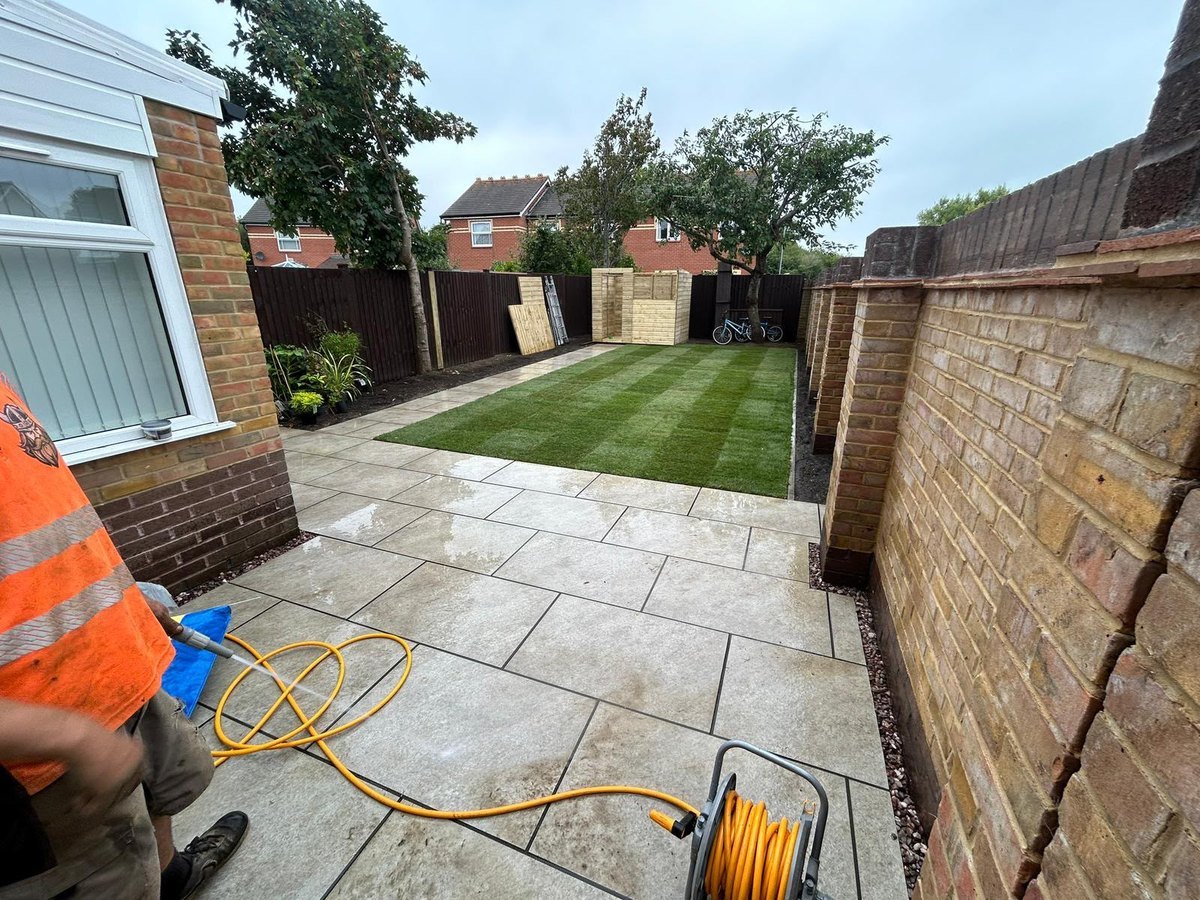
Testing what is already down. The first thing is a proper look at the existing slab. We check it for movement, tap it for hollow areas, read the cracks for shrinkage or settlement, and take levels to see how much build up would have to be added. That is half an hour on site and it decides the price.
Overlaying a sound concrete base. Where the concrete is solid, well drained and low enough, porcelain goes straight over it on a full mortar bed with a slurry primer, and the falls are corrected in the bed. No dig, no spoil, no muck away. It only works where the level leaves two courses clear of the DPC at the end.
Taking it out. Where the slab rocks, has settled or sits too high, it gets broken up and excavated, along with any old hardcore and made ground under it, and taken away by the load. Tree roots and buried footings turn up more often than people expect.
Rebuilding the base. MOT Type 1 back in and whacked in thin lifts to full compaction, carried past the edge of the paving, with a geotextile separator underneath on soft ground. Then a full wet mortar bed under every slab. Dabs are what the original was laid on and dabs are why it rocks.
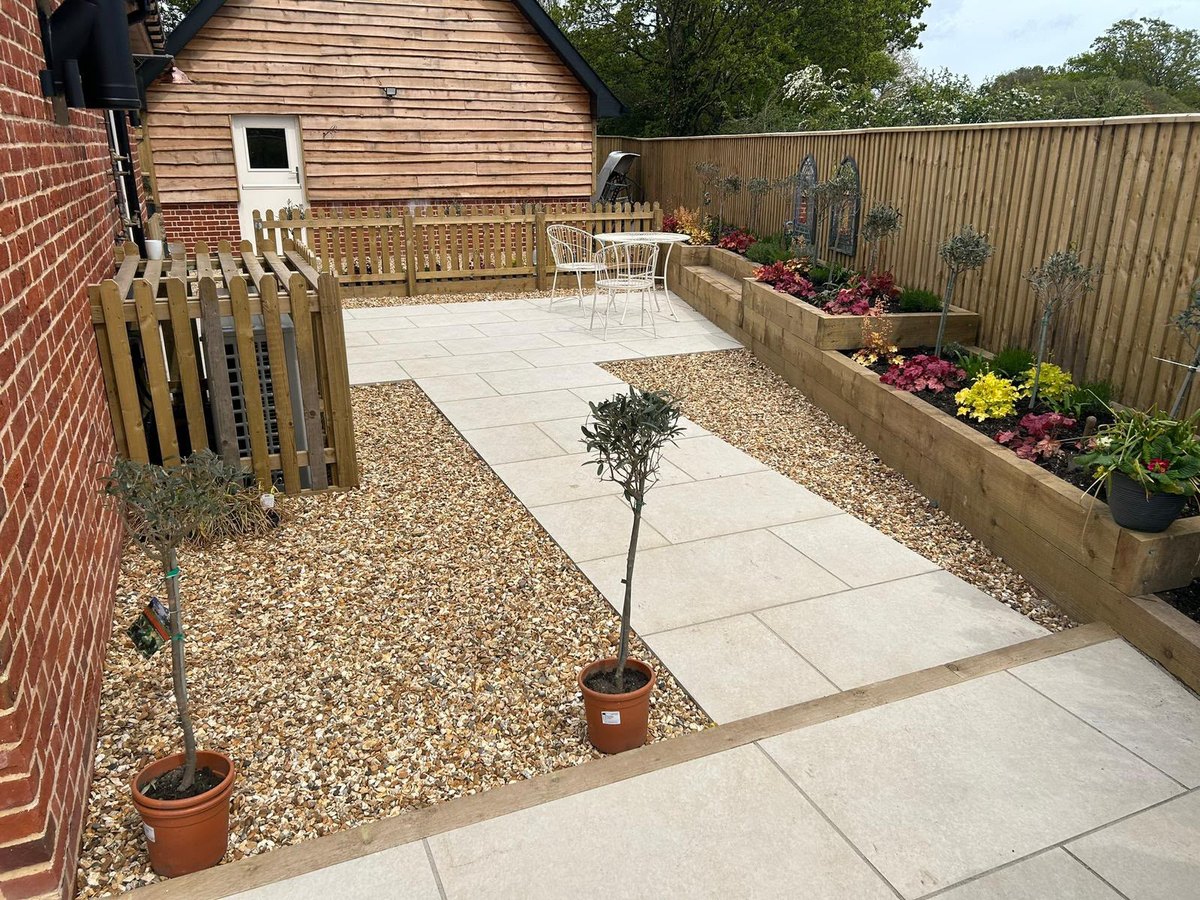
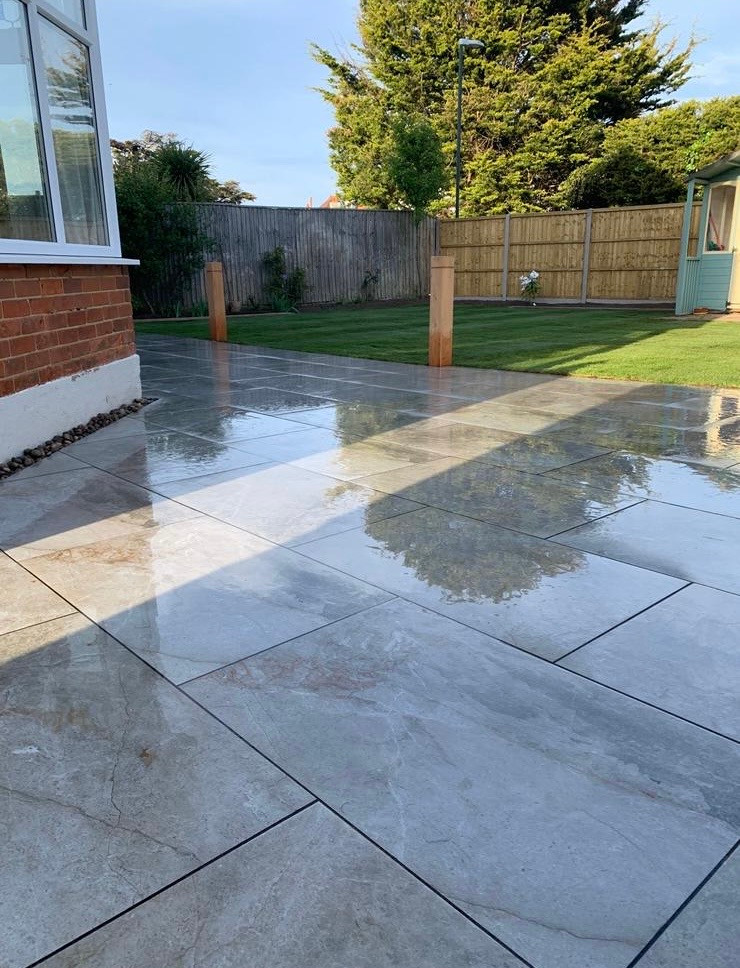
What goes on top. Porcelain is calibrated and consistent and needs no sealing, and a textured grade holds grip through a wet winter. Indian sandstone is riven and warmer and is bedded slab by slab. Limestone marks more easily, granite is the toughest, and travertine is for a sheltered corner.
Falls, the damp course and the door. Everything falls away from the house and finishes at least two courses below the DPC. On a 1970s house that is usually straightforward, and where a later extension has left a low threshold, a channel across the door with an outfall sorts it. Approved Document C covers why the level matters.
Where the water goes, and the edges. A channel to a gully with an outfall, a soakaway where the ground will take the runoff, or a permeable build up over open graded stone. Round the outside, a haunched edging or kerb into the lawn, a retaining edge and coping where the garden steps down, and steps with equal risers.
Jointing and repairs. Joints get a brush in compound worked wet and tooled off, or hand pointing on older stonework. Repairs are the same list every time: lifted slabs, a sunk bay, rocking paving, cracked stone, algae, efflorescence on new sandstone and staining. A patch is honest work when the base is sound and a waste of money when it is not.
How it runs
From your call to a written price
Same team from first visit to last, one person to ring, and no sub-contracting your work out to somebody you have never met. The quote is itemised, not a figure on the back of a card: excavation and muck away, the sub base, the falls and where water goes, edgings and steps, the slabs themselves, and jointing on separate lines, so you can compare it properly against anyone else's.
Nothing is left open or unusable overnight. The site is swept at the end of each day rather than the end of the job, and what comes out leaves with us. If something turns up once we start that nobody could have seen, you get a photograph and a price before we carry on.
Ground level paving in a back garden is normally permitted development and needs no planning permission, and building control only comes into it where a retaining structure is being built. The older part of the village sits in the Wool Conservation Area, where appearance is controlled, and Dorset Council holds the conservation area and listed building records.
Cost
What decides the price of a patio
No rate per square metre, because the slabs are the part you choose and the smallest part of the price.
Getting to it. A 1970s semi with a side gate and a hard standing, a terrace on the estate with a shared path, and an older cottage in the village centre are three different jobs. Everything comes in and goes out through the garden, often through a side gate or the house. A patio you can barrow to directly is a different job from one where every slab is carried. The work at height rules still apply to the dig and the machinery.
What is coming out before anything goes down. An old concrete slab, a raised bed, tree roots or made ground all have to be dug out and taken away, and that is priced by the load rather than by the metre. The dig is where a patio quote is won or lost.
Falls, levels and the damp course. A patio has to fall away from the house and finish at least two courses below the damp proof course, and getting that right often means steps, a retaining edge or a drainage channel. Laying a new patio up against a wall at the wrong level is the single most expensive mistake on this kind of job.
Comparing quotes? Ask how deep the dig goes and what sub base is specified, whether the slabs are laid on a full wet bed or on dabs, what the falls are and where the water goes, whether edgings and steps are included, and what the jointing compound is. Two quotes for the same job are usually two different jobs.
If it has become a hazard
A patio that has lifted, sunk or turned slippery
Ring rather than use the form. A slab that has lifted at one corner or a step that has dropped is a trip, and a north facing patio in winter can be genuinely dangerous. We can usually lift and re-lay the worst of it quickly, then look properly at whether the base under the rest has gone. A cracked concrete apron tilting back towards the house is worth a call before winter rather than after it. The phone is answered 24 hours for emergencies; scheduled work runs Monday to Friday, 8am to 6pm.
Worth knowing
The estate concrete is all failing at once
The bulk of Wool was built in one long run after the war, with the peak in the 1970s and early eighties, and the back gardens were finished to the standard of the day. That meant a poured concrete apron outside the back door, or a set of pressed paving squares bedded on a few dabs of sand. Both were fine for a couple of decades. Both are now the same age.
The failures arrive together and they look alike from house to house. The concrete cracks where it was never jointed, then tips back towards the building because the ground under it has settled unevenly. The paving squares rock, the sand washes out of the joints, moss fills the gaps and one corner drops. Neighbours often ring us within weeks of each other.
The useful part is that the answer is not the same for both. A concrete slab that is still flat and stable is a base somebody has already paid for, and porcelain laid over it on a full bed is quicker, cleaner and cheaper than digging it out. Paving on dabs is not a base at all and has to come up. So before you price a new patio here, get somebody to tell you which of the two you have.
Who you are dealing with
A local firm you can check
We cover Wool, East Burton, Bovington and the villages along the Frome, broadly BH20, under Dorset Council. You are dealing with Bournemouth Roofing & Building, the trading name of Bournemouth Roofing & Building Ltd, registered in England and Wales, company number 15471719, which you can look up in a minute. Thomas Hannen's business, and he is the one who comes out to price the job, not a salesman. A verified customer's 10 out of 10 on Checkatrade. The visit and the written quote are both free.
Questions
Wool questions we get asked
Can porcelain be laid over my existing concrete patio?
If the concrete is sound, stable and low enough to leave two courses clear of the damp course at the end, yes, on a full mortar bed with the slab primed. It saves the dig and the muck away. If it rocks or has settled, it has to come out.
How do I know whether the old concrete is still good?
Look at the cracks and listen to it. Fine shrinkage cracks in a slab that does not move are usually fine. A crack with a step in it, or a slab that gives underfoot, means the ground has gone and no amount of new paving fixes that.
Why do the paving squares in these gardens all rock?
Because they were bedded on dabs of sand rather than a full bed. The sand washes out, the voids fill with water and frost does the rest. It is a construction fault rather than wear, which is why re-laying the same way fails again.
Do you take the old patio away, or do I need a skip?
It leaves with us. Broken concrete and old paving go into a skip or a grab load booked before we start, and it appears on the quote as its own line rather than folded into a rate.
Will you do the patio in winter?
We work all year, but mortar will not go down onto frozen ground or into a hard frost, so a cold snap moves the laying rather than the digging. We would sooner shift a start date than bed slabs into a mix that will never gain strength.
Nearby, and next door
Patios near Wool
Patios nearby
Our other trades in Wool
Everything we do in Wareham Patios, all areas Every area we cover
Free quote
Find out whether your old slab can stay
Thomas comes out, tests the existing concrete, takes levels and prices both options in writing. The visit and the quote are free.