Exterior cleaning in Wool
Roofs, dry dash and render, gutters, drives and patios in Wool and BH20. Free site visit, free written itemised quote.
The site visit is free and so is the written itemised quote. Thomas Hannen prices every job himself.
Most of Wool is post-war housing with concrete tiled roofs, dry dash walls and block paved drives, and on all three of those the honest answer is the same: treat it, do not blast it. Dry dash in particular is loose stone stuck to a coat of render, and a pressure washer takes the stone off with the algae in patches that cannot be invisibly made good afterwards.
The calls come in for much the same handful of reasons. A roof has gone dark and the moss is coming down into the gutter and off the edge onto the path. The dry dash on the gable is grey and streaked and the house looks tired from the road. The driveway or the patio is green and slippery. A gutter is running over and staining the wall under it every time it rains. Or there is a date on it: a handover, a letting inspection, a viewing, or somebody coming to stay.
The site visit and the survey are free and so is the written itemised quote, and every surface gets its own line with the method written next to it. If something on your house needs a repair rather than a clean, you will hear that at the visit rather than after the deposit.
The work
Estate roofs, dry dash and a good deal of block paving
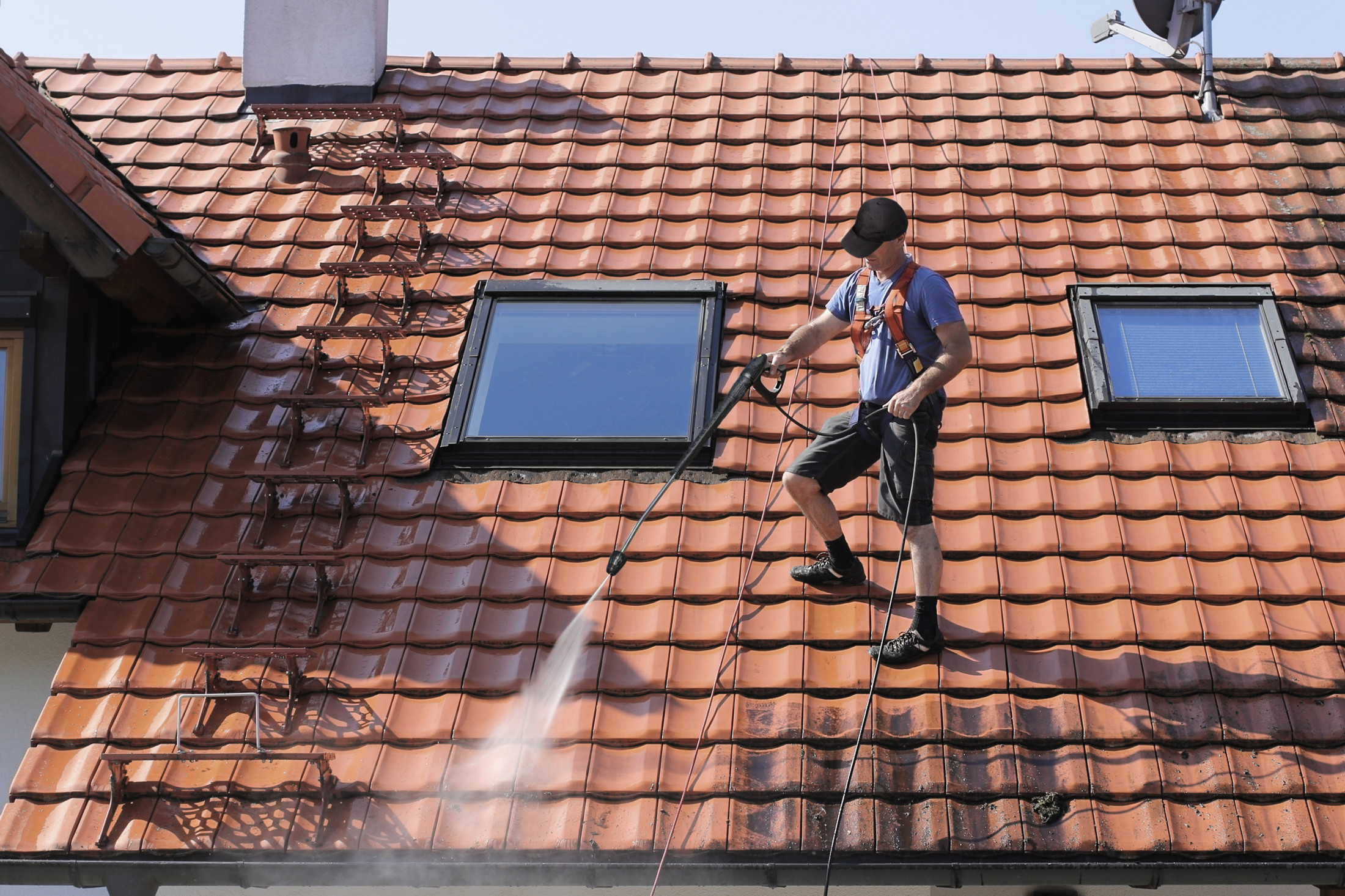
Concrete tile, and the ridge under it. Over half the village was built between 1945 and 1982, with the peak in the 1970s and early 1980s, so the standard covering is concrete interlocking tile, with clay plain tile and slate on the older houses down by the river and a little thatch. Moss beds into the channel and then packs the lap, and a packed lap makes water run sideways under the tile instead of down to the gutter. We work from the ridge down: the bulk comes away dry with a scrape and a stiff brush, and only then does anything wet go on, a soft wash and a biocide. On housing of this age the ridge tiles and the verges are usually still bedded in mortar, and mortar that has been up for forty odd years is often soft, cracked or already washed thin. A lance on a ridge finishes it off, which is how a clean turns into a roofing bill, so we check the bedding before anything is turned on and photograph what has already gone. Slate takes no jet wash at all.
Dry dash is the surface people ruin. Dry dash is pebbledash by another name: spar or gravel thrown onto a wet coat and left proud. There is a great deal of it here and it is the single most damaged surface in this trade, because it looks tough and is not. Pressure knocks the stone off in bare patches, and once a patch is bare no amount of touching up hides it. It gets a soft wash nozzle at low pressure and a biocide, and painted masonry and smooth render get the same. The older brickwork by the bridge has lime in the joints and is treated the same way as any old wall: brushed dry, then treated, never forced.
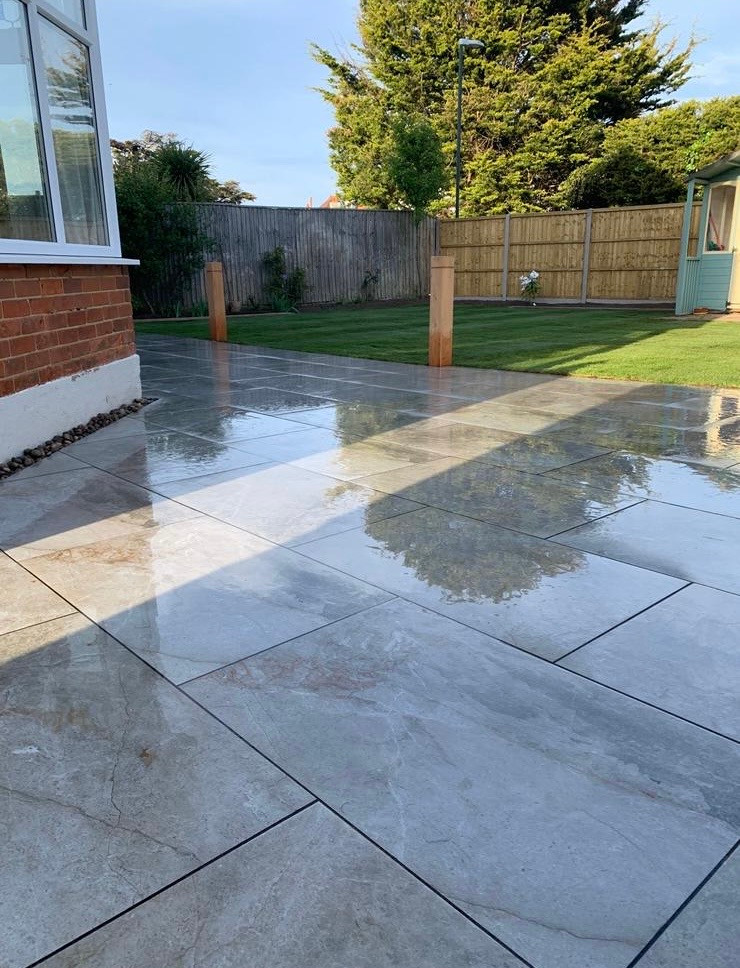
Block paving is everywhere here and it cleans up well, but it has to be re-sanded afterwards, because the wash pulls the kiln dried sand out of the joints along with the weed and blocks without full joints start to creep under the wheels. We use a rotary surface cleaner rather than a bare lance so the pressure is spread and the block faces stay on.
There is heath and pine on the edge of the village as well as trees through it, and pine needles are worse than leaves because they knit into a mat water runs straight over. Clearing is by hand or by vacuum, then every outlet and downpipe is flushed until it can be seen taking water, and any valley is cleared at the same time. Painted timber fascia and soffit get a soft wash and a brush, because pressure on old paint strips it. Drains and any gully near the work get covered, planting sheeted and watered down, and anything approved for the surface goes on at the strength printed on the label, which is what the biocides regime the HSE administers requires. Run off goes onto ground that will take it rather than across the drive into a road drain, and pollution prevention guidance applies to a house on an estate just as it does to a yard.
How it runs
From your call to a written price
Same team throughout, one person to ring, and an itemised quote with method, access, protection and the run off on separate lines. There is nothing to apply for to have a building cleaned, because cleaning is maintenance and not alteration. There is a conservation area over the older part of the village and nine listed entries in the parish, which matters for what comes after the wash rather than for the wash itself: repointing, or taking off a render that has blown, needs listed building consent first on a listed building. Dorset Council is the planning authority for this address.
Cost
What decides the price of a clean
No rate per square metre, because the same square metre can be twenty minutes or two. Access decides most of it: a semi or a terrace where the only way to the back is a side gate means everything is carried through, a two storey house on the estate is comfortable pole work, and a detached place with a drive you can pull onto is the quickest of the three. work at height rules decide when a tower replaces a pole. Ask each quote what method goes on each surface and where the run off is going.
If there is a date
A viewing, a visit or a deadline
Ring rather than use the form. Not emergency work, but usually work with a date on it. A lot of the work we do in Wool has a handover, a check out or an inspection attached to it, so tell us the date on the first call and we will say whether it can be done properly in the time. The phone is answered 24 hours for emergencies; scheduled work runs Monday to Friday, 8am to 6pm.
Worth knowing
Whole streets went up together, so they age together
More than half the housing in Wool was built between the war and the early 1980s, and the biggest single push came in the 1970s and early 80s while the camp at Bovington was growing. That is not a history lesson, it changes the job. It means street after street of identical roofs, laid the same year, at the same pitch, facing the same way, with the same mortar bedded ridges and verges and the same dry dash on the gables.
They do not fail at random. They arrive at the same condition at the same time, which is why a whole road can look fine one spring and uniformly green three years later, and why your neighbour's roof is a fair guide to the state of yours.
Two practical things follow. The first is that the age of the detail matters more than the age of the tile. A concrete tile of that vintage has plenty of life in it, but the mortar holding the ridge and the verge is at the end of its own, so on these houses a wash has to be planned around what the bedding will stand, and a clean quite often turns up a strip of verge or a couple of ridge tiles that need doing properly.
Better to find that with a camera than with a lance. The second is that uniformity is worth money to you: if three or four houses in a row book together, the set up is shared and the work goes quicker, and we are happy to price it that way. When you compare quotes, ask two questions. Will you pressure wash the dry dash, and what will you do about the ridge. The answers will sort the firms out for you.
Who you are dealing with
A local firm you can check
We cover Wool, Bovington, East Burton, Coombe Keynes and Winfrith Newburgh on BH20 and out to Wareham and the Lulworths, with Dorset Council as the local planning authority. Bournemouth Roofing & Building Ltd, registered in England and Wales, company number 15471719, which you can look up in a minute. Thomas Hannen's business, and he is the one who comes out to price the job, not a salesman. A verified customer's 10 out of 10 on Checkatrade. The visit and the written quote are both free.
Questions
Wool questions we get asked
Half our road wants it done. Does booking together help?
It helps the day work rather than the paperwork. 55.0% of Wool housing went up between 1945 and 1982, and the peak years were the 1970s and early 1980s at 18.2%, so a whole road often carries the same covering at the same stage. Setting up once and working along the row means far less moving of hose and sheeting. Each house is still surveyed and quoted on its own by Thomas Hannen.
Can a dry dash wall be washed without losing the pebbles?
Only at low pressure. Dry dash holds its stone in a thin bed of mortar and a lance takes that stone off in strips, which then has to be patched and never matches. We wet it, treat it and rinse it gently, and the biocide does the work over the weeks afterwards. On the older Wool frontages the dash has often been painted at some point, and a painted dash sheds its stone even more readily.
What if the wash uncovers a broken ridge or a bad verge?
We stop and show you before going any further. Moss holds a loose ridge tile in place more often than people expect, and on stock of this age around Wool the mortar bedding is usually first to go. If it turns up mid job we photograph it and price the repair separately rather than quietly washing over the top of it. Cleaning a roof that wants bedding work first is effort spent in the wrong order.
Is the conservation area an obstacle to getting this done?
Not for cleaning. The Wool Conservation Area controls what the place looks like, so a like for like wash is maintenance and needs nothing from Dorset Council. It bites if the clean leads on to a coating, a paint colour or a different roof covering, and there are nine listed entries here where even a repair wants care. We keep those two things apart on the quote so it is obvious which is which.
Which part of the job actually needs dry weather?
The treatment, not the wash. Rain within a few hours of a biocide going on dilutes it off the surface and the money is wasted, so we watch the forecast for the treating day rather than the washing day. Coming over to Wool is a run from base, so we would sooner move a date than turn up and put chemical on in drizzle. Gutter clearing and paving we will do in most weather.
Nearby, and next door
Exterior cleaning near Wool
Exterior cleaning nearby
Our other trades in Wool
Everything we do in Wareham Exterior cleaning, all areas Every area we cover
Free quote
Get a written price for Wool
Free site visit, free written itemised quote, and a straight answer on what your dry dash will take.