Flat Roofing in West Moors
Flat roof repairs, re-covering in EPDM, GRP fibreglass and felt, new decks, falls and outlets on bungalows, garages and sun lounges across West Moors.
The site visit is free and so is the written itemised quote. Thomas Hannen prices every job himself.
Under nearly every flat roof in West Moors there is a timber deck, and it is the deck rather than the covering on top of it that settles whether you are buying a repair or a new roof. We take a corner up, look at the boards and the joist ends, and price from what is actually there.
Where to start
Start underneath, not on top
Somebody has told you the felt has had it. Or a ceiling below the garage has gone soft and brown at one corner. Or there is a puddle up there in the middle of a dry week. All three point downwards rather than across. Rubber, fibreglass and felt all outlive the boards they are stuck to, so the question we come out to answer is what state the timber is in.
Which means getting on it. On a low bungalow roof that is quick work off a tower, and we are usually up, opened up and back down inside the hour. We take the covering back in one small patch where it will make good neatly, put a knee on the boarding to feel whether it gives, look along the joists from the hatch if there is one, and photograph all of it. Then you are holding the same information we are, before anyone mentions money. Neither the visit nor the written quote costs you a thing.
Layer by layer
What we find when a roof round here is opened up
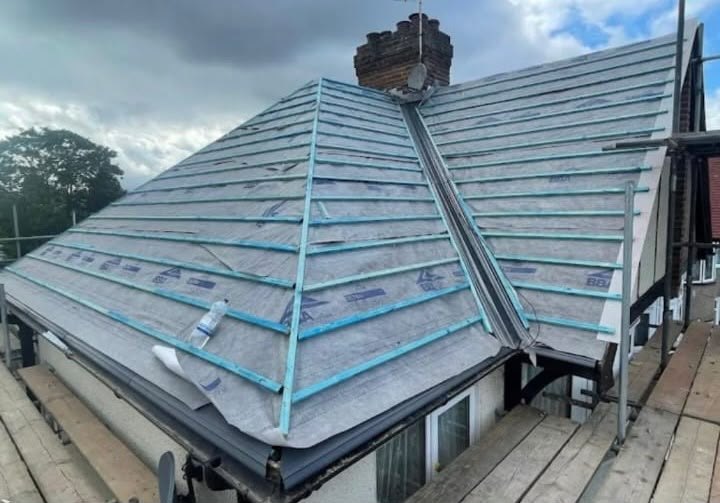
The joists. We start at the bottom. Bungalow flat roofs on this side of town are framed in light timber, and the ends resting on the wall plate soften first, because that is where a wet deck has been sitting on them. Every one gets prodded once the boarding is off. Most of the time the ends want packing or a fresh length sistered alongside, which is an hour. Where timber has gone spongy along its length we stop and tell you, because bonding a new covering onto a frame that is finished helps nobody.
The boarding. Chipboard was the cheap deck of its day and water destroys it, so once a corner crumbles between finger and thumb the sheet is done. Plywood survives longer but comes apart in layers, and you feel that flex under your heel before you see it. Either way it lifts out and OSB goes down in its place, screwed rather than nailed so it cannot work loose. Dry, firm boards we leave alone, and that single decision swings the quote further than any other.
The fall. Nothing here is truly flat, or it ought not to be. Firrings are tapered lengths of timber that sit along the joists and tilt the whole deck towards the outlet. Where a roof holds water, either firrings were never fitted or they run the wrong way across it. We re-cut them, or lay tapered insulation to do the same job, and we put the outlet at the genuine low point instead of wherever the last man found convenient. The hopper, gutter and downpipe below it get rodded through at the same time, because a blocked rainwater run will drown a covering that had years left in it.
The covering. Then it is a choice between four. EPDM comes off the roll as one piece of rubber, bonds down cold and puts no flame anywhere near a bungalow soffit, which is why it ends up on most garages and porch canopies. GRP is brushed on wet across fresh plywood and hardens into a single fibreglass skin with the trims formed as part of it. Built up felt, three layers with the mineral cap sheet torched on last, is still the toughest surface to walk about on. Single ply is hot air welded at every lap and earns its keep across a wide open span. Blisters, bubbles, splits and a lap that has peeled back are all patchable in any of them: we go back to material with life in it, weld or bond a new piece across, and dress the edge down flat.
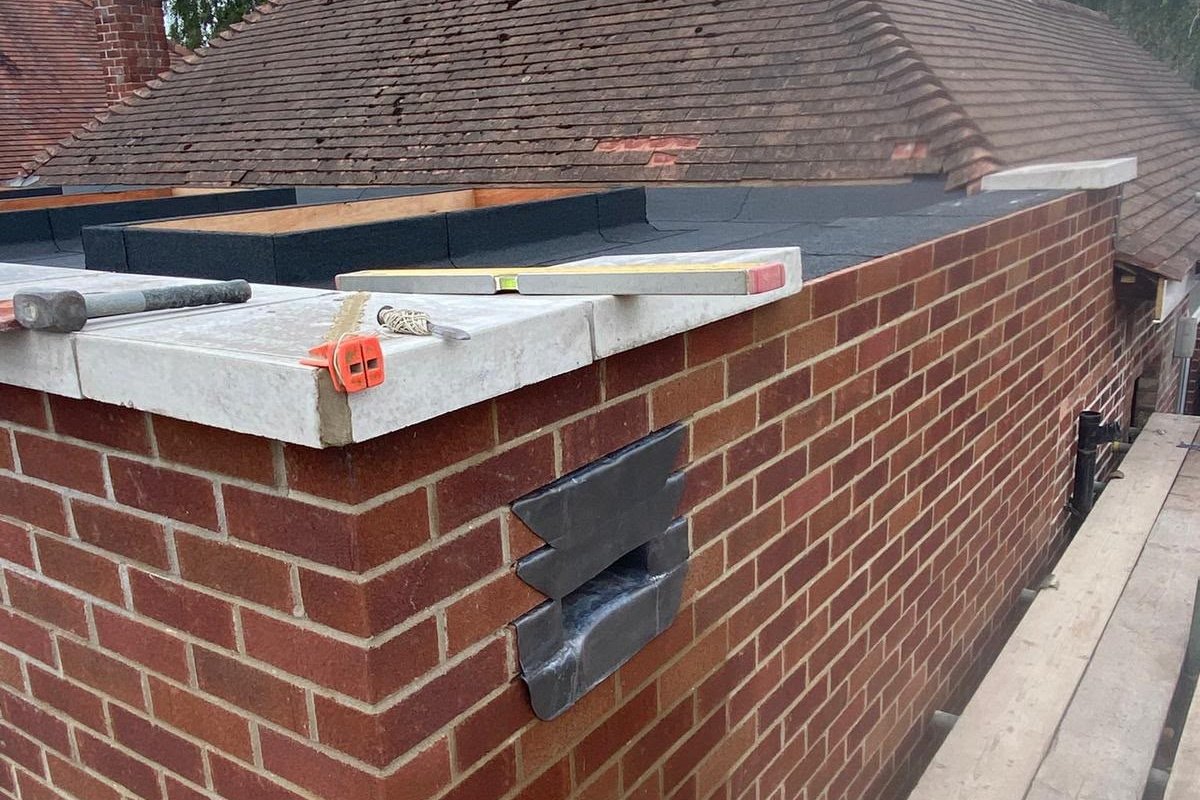
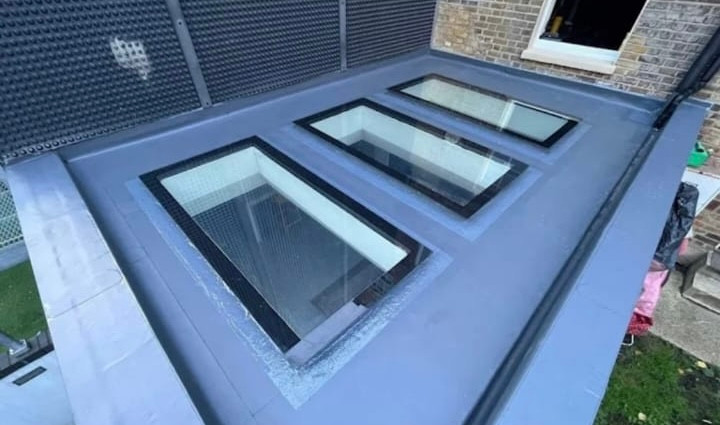
The insulation, and then the edges. If the covering is coming off anyway, that is the moment to settle warm roof against cold roof. Warm means PIR board above the deck with the vapour control layer beneath it, so the timber sits on the dry side of the dew point. Cold means insulation left between the joists with a ventilated gap over it, and when that gap gets blocked the condensation goes quietly into the boards where nobody will look for it. BS 6229 covers how the build should go together and Approved Document F the ventilation. The edges go on last and they are what keeps you dry: a cover flashing chased into the house wall or lead worked over an apron on an older detail, coping re-bedded on a parapet with a cavity tray behind it, a drip trim down every open side, and a kerb built up under any rooflight or lantern so the skylight stands above standing water rather than in it. Velux units, loft hatches, soil pipes and vent pipes each take a collar.
How it runs
From your call to a written price
Same team from first visit to last, one person to ring, and no sub-contracting your work out to somebody you have never met. The quote is itemised, not a figure on the back of a card: access, stripping the old covering, any new deck or firrings, the insulation, the membrane and each upstand, outlet and edge trim, and disposal on separate lines, so you can compare it properly against anyone else's.
Nothing is left open or unusable overnight. The site is swept at the end of each day rather than the end of the job, and what comes out leaves with us. If something turns up once we start that nobody could have seen, you get a photograph and a price before we carry on.
Re-covering a flat roof in what was there before is maintenance, and Planning Portal guidance sets out where that stops, which is at a change of roof line or appearance. There is no conservation area over West Moors and a single listed entry, so for almost every address here it is building control rather than planning that you would be dealing with, through Dorset Council.
Cost
What decides the price of a flat roof
No rate per square metre, because the square metres are the easy part and what is under the covering is what decides the job.
Getting to it. A sun lounge across the back of a bungalow, a detached garage down a side drive and a flat link between two pitched roofs are three different jobs before anything is unrolled. A garage or a single storey extension will often come off a tower, anything above a two storey wall wants a scaffold, and the platform has to stand while the deck is open rather than for an afternoon. The work at height rules are why it is a priced line rather than something folded into a rate.
The deck under the covering. A sound deck can be re-covered. Chipboard that has been wet for years, or ply that gives underfoot, has to come off and be replaced, and you cannot tell which you have from the ground or from a photograph. We lift a corner before quoting, because the deck is the single biggest swing in the price.
The falls, and where the water is meant to go. Most flat roofs that fail were never laid to a fall, or the fall runs at an outlet that has since been blocked or built over. Correcting it with firrings is more work than laying a membrane and it is the difference between a roof that lasts and one that ponds. Upstands, edge trims and each outlet are priced one at a time, because that is where the hours and the leaks both are.
Comparing quotes? Ask which system is being quoted and how many layers, whether the deck is being renewed or covered over, whether the falls are being corrected with firrings, how the upstands, outlets and edge trims are detailed, and whether the scaffold and the skip are in the price. Two quotes for the same job are usually two different jobs.
If it is coming through
Water through a flat roof
Ring rather than use the form. A flat roof that has split, blistered or lifted at an upstand puts water straight onto a ceiling, and once the deck is wet the damage carries on after the rain stops. The first visit is about getting it covered and dry, and we price the permanent job once we can see how much of the deck has gone. Get a bucket under it and pierce a bulging ceiling in one place over the bucket rather than waiting for it to drop. We are a few miles away, so an emergency cover is usually the same day. The phone is answered 24 hours for emergencies; scheduled work runs Monday to Friday, 8am to 6pm.
The local catch
Half the houses here are bungalows, and it shows in the falls
Bungalows make up about half the homes in West Moors, which is unusual even for this corner of Dorset, and their flat roofs share a habit. They are wide, they are shallow, and they were nearly all added afterwards: a sun lounge along the back, a garage joined on at the side, a flat link between two pitched roofs. A wide shallow roof has a long way to carry its water and generally one outlet to carry it to.
So the thing to ask about is the fall, not the felt. A quote that names the membrane but says nothing about firrings, tapered insulation or where the outlet is going to sit is a quote for a covering, not for a roof. The consolation is that the same low roof that ponds is also the easy one to reach, so putting a proper fall back in costs less here than it would over a two storey rear extension. Ask whoever quotes you to stand on the roof and show you which way the water will run when they have finished.
Who you are dealing with
A local firm you can check
We cover West Moors, Ferndown, Three Legged Cross, Ashley Heath and West Parley across BH22, out from Bournemouth. You are dealing with Bournemouth Roofing & Building, the trading name of Bournemouth Roofing & Building Ltd, registered in England and Wales, company number 15471719, which you can look up in a minute. Thomas Hannen's business, and he is the one who comes out to price the job, not a salesman. A verified customer's 10 out of 10 on Checkatrade. The visit and the written quote are both free.
Questions
Flat roof questions from West Moors
Can you tell what the deck is like without stripping the roof?
Not from the ground, and not from a photograph on a phone. We open one small area, usually beside an outlet or an upstand where water collects first, and that tells us the rest. It happens at the free visit, we make it good before we leave, and the pictures come to you with the price.
Will a tower do, or does it need a scaffold?
On most single storey roofs round here a tower is enough, which keeps the access line modest. Anything reached over a two storey wall wants a platform that stands for the whole job rather than an afternoon. Either way it is its own line on the quote and never folded into a rate.
Does a new flat roof have to be insulated?
Once most of the covering is being renewed the insulation standard is engaged, so building control comes into it. In practice that means a warm roof, with PIR above the deck. It also lifts the finished level, so the door threshold and the height of every upstand get checked before anything is ordered.
How long will you be on the roof?
A garage or a porch is normally a day or two. A sun lounge wanting new boards, new firrings and a rooflight kerb runs to three or four. Rain moves the dates rather than the price, because fibreglass will not cure and a bonded sheet will not stick to a damp deck.
Do I need planning permission?
Almost never for a like for like re-cover. There is no conservation area over West Moors and only a single listed entry in the whole parish, so for very nearly every address here it is building control you deal with rather than the planning department.
Nearby, and next door
Flat roofing near West Moors
Flat roofing nearby
Our other trades in West Moors
Everything we do in West Moors Flat roofing, all areas Every area we cover
Free quote
Get a written price for your West Moors flat roof
A free site visit, the deck and the falls checked, and an itemised quote you can compare.