Rendering in West Moors
Bungalow gables, plinths and dash across West Moors and the BH22 addresses, with the render stopped properly above the damp proof course.
The site visit is free and so is the written itemised quote. Thomas Hannen prices every job himself.
On a bungalow the whole rendered elevation is low, so the part that fails first is almost always the bottom of it. Where the render runs down to a path, a border or a bed of gravel it stays wet, and that is where the coat lets go.
Half the homes in West Moors are bungalows, which changes the job in ways that are easy to miss. There is far more wall per house at splashing height and far less of it out of reach. There are more windows and doors for the size of the elevation, so the beads and the reveals take a bigger share of the time than the open panels do.
People ring us about a bulge low down on a gable, a chalky finish that comes off on your hand, or dash that has started to shed. The free site visit is us tapping the whole wall, working out whether the failure is the render or the wall behind it, and putting the answer in a written itemised quote.
The work
Low walls, long gables and a lot of beads
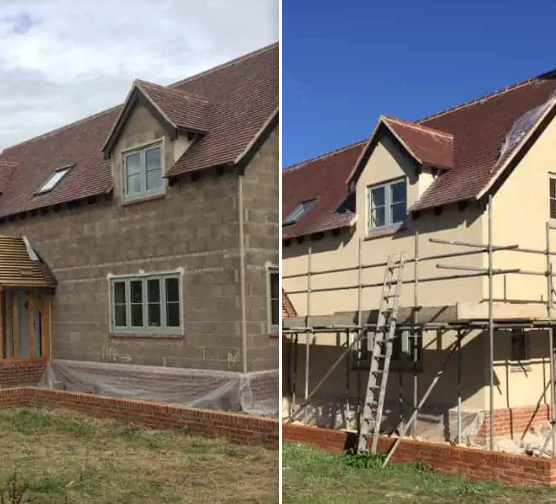
Sounding the elevation. We go round with a light hammer before quoting anything. Hollow render has already parted from the background and cannot be saved by a coating over it. The hollow areas are marked, photographed and measured, and it is that area, not the size of the bungalow, that moves the price.
Hacking off and preparing the background. Where a coat has gone we hack off to the blockwork or brick, clean down what is left, cut out loose or spalled material and let the wall dry. A primer or a slurry key goes on a dense or dusty background. Then the beads, and on a bungalow there are a lot of them: angle beads on the corners, stop beads at every reveal and against every frame, and a bellcast at the base to throw water clear.
Silicone thin coat. A mesh reinforced polymer basecoat with a flexible through-coloured topcoat scraped to a fine texture. It is the system we recommend most on the post-war cavity blockwork here: it copes with a little movement, sheds driven rain and stays breathable enough for a modern wall. Acrylic topcoats are the cheaper cousin and hold dirt sooner on a shaded elevation.
Monocouche. A single thick through-coloured coat, ruled off and scraped the following day. It suits a new blockwork extension or a garage that has to sit alongside the house, and it needs a properly flat, sound background to look right.
Sand and cement, dash and Tyrolean. The traditional two coat job still earns its place on plinths, garden and boundary walls, garage flanks and anything that gets knocked. Scratched, floated and then painted, dashed or given a Tyrolean finish. Many bungalows here already carry pebbledash, and where the backing is sound we can stabilise it, patch the bald areas and re-dash to match rather than take the lot off.
Cracking and staining. Fine crazing across a panel is shrinkage. A crack you can get a coin into, running out of a corner, is movement. Green and black streaking below a gutter is algae and wants a wash, not a new elevation. We will tell you which you have before anyone prices new work.
Render over external wall insulation. On a bungalow, EWI is unusually attractive, because there is so much wall for the floor area. The render then sits on a render carrier or a mesh basecoat on the board, and the thermal gain is only as good as the detailing at the sills, the eaves and the base.
How it runs
From your call to a written price
Same team from first visit to last, one person to ring, and no sub-contracting your work out to somebody you have never met. The quote is itemised, not a figure on the back of a card: access and scaffold, protection, preparation of the existing wall, the system and number of coats, beads and stop ends, and making good on separate lines, so you can compare it properly against anyone else's.
Nothing is left open or unusable overnight. The site is swept at the end of each day rather than the end of the job, and what comes out leaves with us. If something turns up once we start that nobody could have seen, you get a photograph and a price before we carry on.
Re-rendering a wall that is already rendered is maintenance. Rendering a wall that never was, or changing the finish, is a planning question and the Planning Portal explains where the line sits. West Moors has no conservation area and a single listed entry, so on an ordinary bungalow this is your choice. Renewing a full elevation does engage Part L and building control, because the wall is a thermal element.
Cost
What decides the price of a rendering job
No rate per square metre, because the square metres are the easy part; what is already on the wall decides the price.
Getting to it. A single storey gable off a tower, a chalet bungalow with a dormer to work round, and a garage flank tight to a boundary are three different platforms. A bungalow gable comes off a tower, a three storey elevation wants a scaffold, and the platform has to stand for the whole system rather than a day. The work at height rules are why it is a priced line rather than something folded into a rate.
What is already on the wall. Rendering over sound brick is one job. Hacking off blown sand and cement, or a pebbledash that has parted from the background, is another, and it is the part nobody can see from the road. We tap the whole elevation before quoting, because the hollow areas set the hours.
The system, and what the wall behind it needs. Silicone thin coat over insulation, monocouche through-coloured, or traditional sand and cement all price differently and behave differently. On a solid wall that has to breathe, a plastic-rich modern system traps moisture and moves the problem inside, so the right system is a wall decision rather than a colour decision.
Comparing quotes? Ask which system is being quoted and how many coats, whether the old render is being hacked off or overlaid, whether beads, bellcast and stop ends are included, whether the scaffold is in the price, and what happens to the existing sills and pipework. Two quotes for the same job are usually two different jobs.
If it has started to come away
Render that has blown or cracked open
Ring rather than use the form. A section that sounds hollow when you tap it, or a crack you can get a coin into, is letting water behind the render and the frost does the rest. We make the loose area safe, sheet it if the weather is against us, and price the elevation once we can see how far the blown area actually goes. A loose area low down where people walk past is the one we come and knock off first. The phone is answered 24 hours for emergencies; scheduled work runs Monday to Friday, 8am to 6pm.
Worth knowing
The bottom metre is where a bungalow loses its render
On a two storey house the render at ground level is a small share of the elevation. On a bungalow it is most of it. The consequence is that the splash zone, the band of wall the rain bounces back onto off a path, a patio, a gravel bed or a border, covers a much larger part of the finish, and it is wet far more often than the wall above it.
Two mistakes follow, and we see both weekly. The first is render carried straight down past the damp proof course into the ground. Below that line the coat is in permanent contact with wet soil, it draws moisture up behind itself, and the frost takes the bottom foot off in flakes. The second is no bellcast bead at the bottom edge, so water running down the face wraps round the arris and tracks back under the render instead of dropping off it.
Done properly, the render stops above the damp proof course on a bellcast bead, and the wall below is finished separately in a hard sand and cement plinth that can be repaired without touching the topcoat. It is a small line on a quote and it decides whether the elevation looks the same in ten years. If you are comparing prices, ask each firm where the render stops at the bottom and what bead goes there. It is the quickest way to tell who has actually looked at your bungalow.
Who you are dealing with
A local firm you can check
We cover West Moors, Ferndown, Three Legged Cross, Verwood and the BH22 addresses between them, under Dorset Council. You are dealing with Bournemouth Roofing & Building, the trading name of Bournemouth Roofing & Building Ltd, registered in England and Wales, company number 15471719, which you can look up in a minute. Thomas Hannen's business, and he is the one who comes out to price the job, not a salesman. A verified customer's 10 out of 10 on Checkatrade. The visit and the written quote are both free.
Questions
West Moors questions we get asked
Why does the render keep failing at the bottom of our bungalow?
Almost always because it has been taken too low. If the coat runs past the damp proof course into a path or a border it stays wet, draws moisture up behind itself and the frost lifts it. The repair is to cut it back above the line, put a bellcast bead on and finish the wall below separately.
Can you re-dash to match the rest of the road?
Yes, if the backing coat is still stuck. We tap the elevation, stabilise the sound backing, cut out and patch the bald areas, then throw the dash to match the aggregate that is already there. Where the backing has parted from the wall, re-dashing over it only hides the problem for a season.
Do you need a scaffold on a single storey?
Usually a tower or a light scaffold rather than a full one, which is one real advantage of a bungalow. It still has to stand for the whole system rather than a day, because the basecoat, the beads and the topcoat all go on from it and each wants drying time.
Is external wall insulation worth it on a bungalow?
It stacks up better here than on most house types, because a bungalow has a lot of external wall for the floor area inside it. The render then becomes the weather skin over the insulation board rather than over the wall, and the sills, eaves and base detailing is what decides whether it performs.
Nearby, and next door
Rendering near West Moors
Rendering nearby
Our other trades in West Moors
Everything we do in West Moors Rendering, all areas Every area we cover
Free quote
Get the bottom of the wall priced properly
Thomas sounds the whole elevation, shows you where the render should stop and what bead belongs there, and puts it in a free written itemised quote.