Rendering in Matchams, exposure and weather
On an open plot the forecast is part of the specification, and the fortnight you wait for settled weather is the cheapest thing you will buy.
The site visit is free and so is the written itemised quote. Thomas Hannen prices every job himself.
Last updated
Rendering at Matchams is the one outside trade the weather really beats. On an open plot, cracked or blown render is cut back and patched, or a whole elevation re-rendered in a silicone thin coat or monocouche with full mesh, and each coat needs settled weather to cure. So the honest start date is often a fortnight later than you would like, and it is the right one. For inside walls, see plastering in Matchams.
Render is a wet material that has to lose its water at a controlled rate. Too cold and it will not set. Too wet and it will not dry. Too much wind or sun on a fresh coat and the water leaves the surface faster than the body of it, and the face crazes.
Render only goes on above freezing and onto a dry wall. What it means is that on an exposed Matchams site the scaffold gets sheeted, the coats get planned around a forecast, not a diary, and we will tell you plainly when waiting a fortnight buys you a better wall. Everything else goes in a written itemised quote with the access, the preparation, each coat and the beads on their own lines. The visit and the quote are free.
The work
Render work on an open plot, and when it can be done
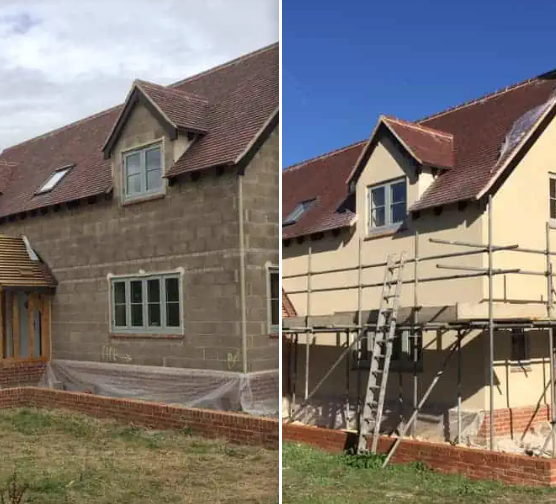
Tapping comes before quoting the elevation. A mallet goes over the whole of a Matchams wall with the hollow areas chalked. On an unsheltered building the failures cluster at the corners, reveals and the bottom of the wall, because that is where wind driven water works its way in.
Hacking off and preparing the background. Blown render on a Matchams house comes off to a firm edge, the brick or block behind is made good and given a key, and any friable face is brushed down and stabilised with a primer before a basecoat goes near it.
Silicone thin coat. A mesh reinforced basecoat, a primer and a silicone topcoat, scraped or floated. It is through-coloured, it stays breathable and it sheds water, which is what an exposed elevation needs. Full mesh across the face rather than only at the openings on a wall that takes the weather.
Monocouche and traditional sand and cement. Monocouche goes on in one build and is scraped back the following day. Traditional scratch and floating coats still suit outbuildings, stores and boundary walls out in Matchams and take a knock better than anything modern. Both want settled weather more than a thin coat system does.
Pebbledash and Tyrolean repairs. Cut back to a firm edge, floated out to thickness and re-dashed with matched aggregate. Worth knowing that a heavy dash on an exposed face holds dirt and growth, so on a wall with nothing in front of it a finer float finish stays presentable for longer.
Beads, bellcast and stop ends. Angle beads at every corner, stop beads at the reveals and a bellcast bead well clear of the ground. Corners and openings are exactly where an exposed elevation fails, so the beads are not a detail here, they are the job.
Cracking, delamination and staining. A crack at a reveal on a Matchams wall is a route for driven rain and gets cut out, meshed and made good. Where a coat has delaminated it comes off, because frost behind a parted render takes it off in sheets rather than in patches. Green algae on the shaded side is surface growth and washes down.
Render over external wall insulation. If a wall is coming back to the background anyway, insulation board or a render carrier fixed to the face and rendered over gives the thermal improvement in the same visit, which matters on a building that takes the wind from every side.
How it runs
Rendering an elevation that faces the weather
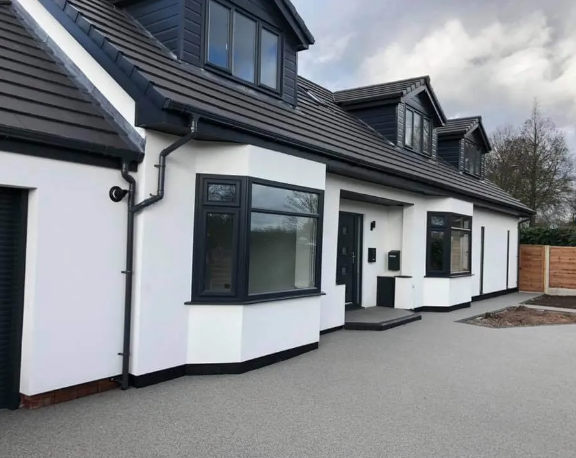
Thomas goes along each wall tapping the render with a knuckle or a trowel handle. Where it rings hollow it has lost its bond, and that sets the scope. His quote then shows the scaffold or tower, sheeting and masking, stripping and preparing the background, the system and its coats, the beads and stop ends, and the making good. Stripping and finishing are covered by the one quote.
A single storey Matchams wall is reached from a tower. Taller walls get scaffold, which stays until the last coat has cured. On an exposed plot we plan around the forecast, since render put on in driving rain or ahead of a hard frost does not last. Blockwork that crumbles under the old render, or a lintel that has cracked, is photographed and priced separately, and we wait for your go-ahead.
Putting the same kind of render back on is maintenance, not development. Matchams has no conservation area, so the finish and colour are for you to decide; only if your own house is on the Historic England list does listed building consent come into it. Being in the Green Belt changes nothing for a repair, and only matters for a new building. Adding insulation behind the render is a building control matter, and Approved Document L sets the Part L figure it must reach.
Cost
Blown render, mesh and a system that copes with wind
The size of the wall is the easy part. What is on it, and what it faces, set the price.
What is there now. Render still bonded to a Matchams wall can be patched and recoated. Hollow sand and cement, or pebbledash that has parted company with the blockwork, must come off first, and that hacking off is the part nobody sees from outside. Thomas taps the whole elevation before quoting.
Exposure. The south west faces in Matchams take wind-driven rain, dry out fast, then soak again. A rigid render crazes under that cycle. A basecoat with mesh bedded in it and a silicone topcoat copes better, and monocouche carries its colour right through, so a knock does not show a different shade.
Details that keep water out. A bellcast bead at the base, stop ends at openings and sills that throw water clear matter more on a wall that takes the weather.
The platform. Tower or scaffold, and for how long, since each coat must cure before the next. The work at height rules mean it is costed as an item.
Ask any rival quote what system they propose and in how many coats, whether they will hack off or render over, whether mesh and a bellcast bead are allowed for, and whether the scaffold is in.
If it has started to come away
Cracked or hollow render on an exposed wall
If a section of render sounds hollow when tapped, or a crack has opened wide enough to see into, water is getting behind it and the next frost will push it further. If pieces have fallen, keep people away from that wall.
Ring; do not use the form. We knock off what is loose, sheet the area if weather is on the way, and work out a price once we know how much of the wall has let go. On an open Matchams plot the face that takes the weather is usually the one that goes first. Rendering is scheduled Monday to Friday, 8am to 6pm. If the line goes unanswered, a call back follows as soon as we can make it.
Worth knowing
The weather window is part of the specification
Every render system has conditions it has to go on in, and they are tighter than most people expect. Cement based materials effectively stop gaining strength as the temperature drops towards freezing, so a coat put on into a cold snap sets slowly and weakly and a frost overnight can ruin it outright.
At the other end, strong sun or a drying wind pulls water out of the surface faster than out of the body of the coat, and that is what produces map cracking a few months later.
On an exposed Matchams plot both risks are bigger. There is nothing to slow the wind, nothing to shade the wall in the afternoon, and a wet week leaves the background saturated for longer than it would in a sheltered street. A basecoat that is still carrying water will not take a topcoat, and no amount of pressure from a diary changes that.
So the practical points are these. Expect the scaffold to be sheeted, which is a priced line, not an optional extra. Expect drying times between coats to be given rather than promised away. And treat any quote that offers to start next week whatever the forecast says with a bit of caution, because the render will still be there long after the convenience has been forgotten.
Who you are dealing with
Who renders your walls
Thomas Hannen runs the business and taps your walls and prices the render himself. Boscombe, where we are based, is about five and a half miles away. From there we render across Matchams, St Leonards, Ashley Heath and the lanes towards Ringwood, a stretch of BH24 that falls to Dorset Council.
Bournemouth Roofing & Building Ltd: registered in England and Wales, company number 15471719. A customer of ours left a verified 10 out of 10 on Checkatrade. Both the visit and the written, itemised quote are free, and there is no obligation. Before you book a visit in Matchams, you can read our customers' Google reviews, word for word, on our reviews page.
Planning at a glance
Do you need planning permission in Matchams?
Most repairs in Matchams need no application at all. What decides whether a change to the outside of your house does is who the council is, whether a conservation area or a listing applies, and whether the place sits in a protected landscape.
| Question | In Matchams |
|---|---|
| Who decides | Dorset Council is the planning authority for Matchams. Dorset Council's heritage pages set out what it controls. |
| Conservation area | None covers Matchams, so a like-for-like repair is ordinary maintenance. |
| Listed buildings | Nothing in Matchams is on the statutory list, so listed building consent does not come into it. |
| Protected landscape | No National Park or National Landscape covers Matchams. |
Questions
Questions about rendering in Matchams
Can render be applied in winter?
Yes, with care. It will not go on into a frost or onto a saturated wall, and it needs the temperature to stay up overnight as well as during the day. A sheeted scaffold buys a lot of working days, and we will say honestly when waiting is better.
What happens if it rains just after a coat goes on?
A fresh coat can be washed or marked, which is why the scaffold is sheeted before the material arrives, not after. If a downpour is coming we stop and cover; we do not push on and hope, because a rain damaged face has to come off.
Why does render crack in hot weather?
Because the surface dries faster than the body of the coat and shrinks against it. On an exposed elevation in sun and wind that happens quickly, so the wall is shaded, sometimes dampened down, and the coat is worked at a pace that suits the day.
How long between coats?
It depends on the system and the weather, but it is days rather than hours for a basecoat before a topcoat, and longer again for a traditional build. Anyone offering to do the whole thing in two days is skipping something that matters.
Do you need hard standing for a scaffold out here?
Not necessarily, but soft ground has to be boarded out so the scaffold stands level and stays that way through a wet week. That shows on the access line, not absorbed into the price.
Nearby, and next door
Rendering near Matchams
Nearby places we also cover for rendering, with straight-line distances from Matchams, and the other trades we offer in Matchams itself.
Rendering nearby
Our other trades in Matchams
Rendering guides
Silicone, cement or lime: which render? Cracked render: which cracks matter Listed building consent for repointing and re-renderingEverything we do in West Moors Rendering, all areas Every area we cover
Free quote
Get the elevation priced and the timing done honestly
Thomas comes out, taps the wall, works out the access on your ground and prices it in writing. The visit and the quote are free.