
Driveways in West Moors
Tarmac, resin bound, block paving and stone patios across West Moors and the BH22 roads. Free site visit, free written itemised quote.
The site visit is free and so is the written itemised quote. Thomas Hannen prices every job himself.
Last updated
Most West Moors drives were built at the same time to the same thin specification, so they are wearing out together. That thin base is usually the real problem: a trial hole decides whether an overlay will hold, and on most of them the base needs rebuilding first.
West Moors drives go grey and rut, back patios drop at a corner, and shared bays at flats break up. A tarmac or concrete drive that has gone grey and open, with ruts where the wheels sit and grass coming through at the edge. A patio outside the back door that has dropped at one corner and now holds water you have to step round. Or a shared parking area at a block of flats where the bays nearest the entrance have broken up and nobody is sure who is supposed to sort it.
What none of those tell you is what is underneath, and that is what decides whether you are spending on a surface or on a rebuild. The free site visit means opening a trial hole or lifting a block, seeing what the sub-base is and how deep it goes, and saying plainly which of the two you have. Then it goes into writing, itemised, with the method beside each line.
The work
The drives we dig up around West Moors
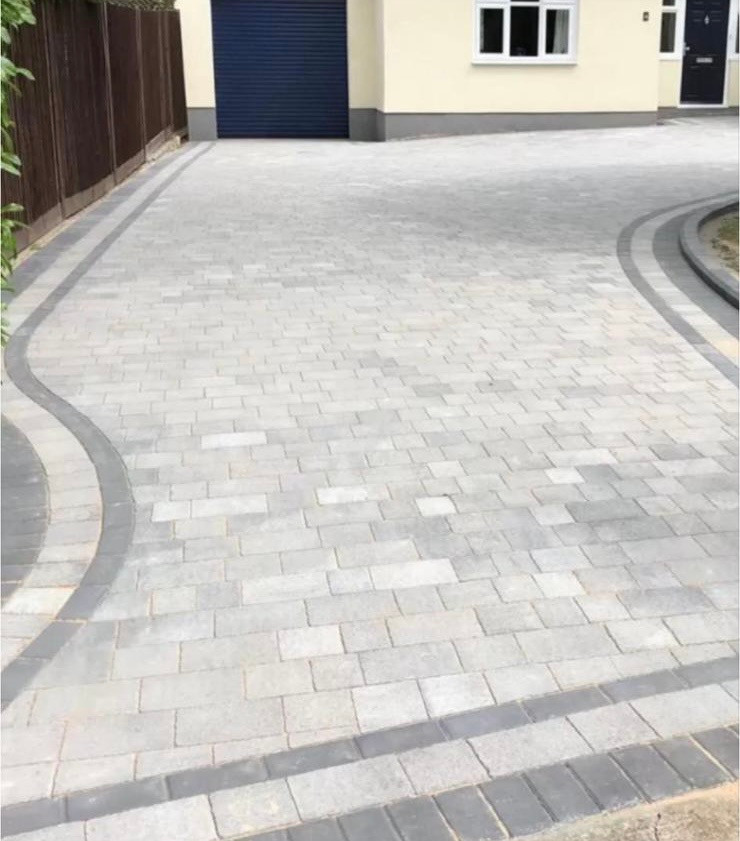
Tired tarmac and cracked concrete from the estate years. Getting on for two thirds of West Moors went up between 1945 and 1982, peaking in the late sixties and early seventies, so these drives are all much of an age and they fail together.
Thin tarmac over very little goes grey and loose once the binder has weathered out, then ruts under a parked car and crumbles at an edge that never had a restraint. Where the base underneath is genuinely sound we can overlay in tarmac or take resin bound over the top, which is the cheapest good result available. Where it is not, it comes out, we excavate to formation, lay a geotextile membrane and build a compacted sub-base to a depth that will actually hold a car. The other half of that generation is in-situ concrete, which goes as rocking panels with weed in every crack. Breaking it out is a machine job and the spoil is heavy, so muck away and disposal are their own lines.
Paving at a bungalow door. Old flags on five dabs of mortar, rocking and falling the wrong way, are the standard find. They come up, the base is rebuilt, and porcelain or sawn natural stone goes down on a full mortar bed with the fall running away from the house and the joints pointed; for the patio itself, see patios in West Moors. Half the houses in West Moors are bungalows, and a single storey house has very little room above ground level while still having to stay clear of the damp proof course, so we take a level against the threshold before anything is priced. Shared parking at the flats and retirement blocks wears differently again: the bays by the entrance go first, the bin store apron takes a hammering on collection days, and the falls are flat enough that water sits and stains. We will survey a court and price it in sections, so the whole thing is never shut at once.
Drainage is priced separately, and around West Moors infiltration is not the default answer. The ground is naturally wet, so a soakaway is sized from a percolation test rather than guessed at, and the design changes to a positive outfall where infiltration will not work. Otherwise it is a channel drain across a garage door, a silted gully dug out and re-connected, or a permeable build-up holding rainfall in open stone. Approved Document H is the standard it all answers to.
How it runs
Laying a new drive at a West Moors bungalow
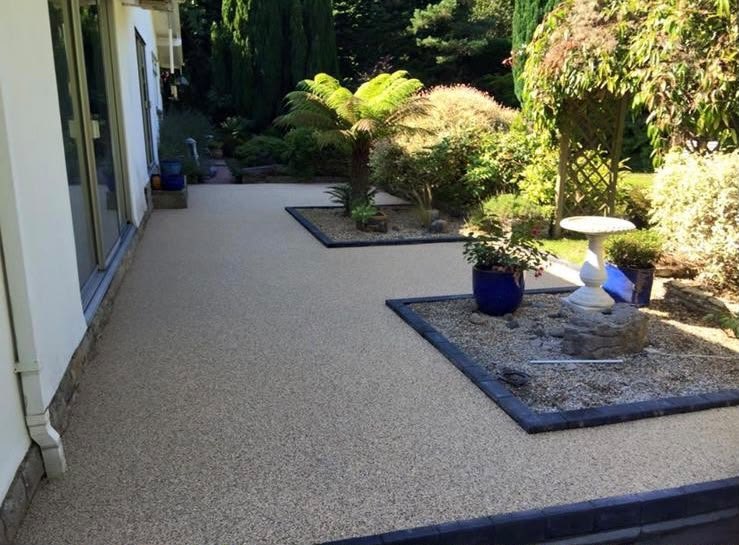
Thomas comes out, measures up and takes levels from the house and the pavement to see where water will run, then works the price out himself. His quote has excavation, muck away, sub-base, edgings, surface and drainage as separate lines.
Spoil goes in a grab lorry or skip, the pavement is swept each evening, and if an old soakaway or buried pipe turns up, you are shown it and given a figure before any extra goes on.
Most homes in West Moors are bungalows on their own plots, with room at the front for a drive and often a garage at the side, so a digger can usually get in. At retirement blocks and flats with a shared parking court, we work in sections so residents can still park.
Paving round a house is normally permitted development. The rule worth knowing is the front garden one, and the Planning Portal page on paving a front garden sets out where the line falls. That rule is for houses. Flats and retirement blocks have no permitted development rights for hard surfacing, so new paving on a shared parking court needs planning permission. Widening the crossing over the grass verge, which many of the original ones here need, is a separate approval covered in the dropped kerb guidance. West Moors has no conservation area, and Dorset Council is the planning and highway authority.
Cost
The ground under a West Moors drive sets its price
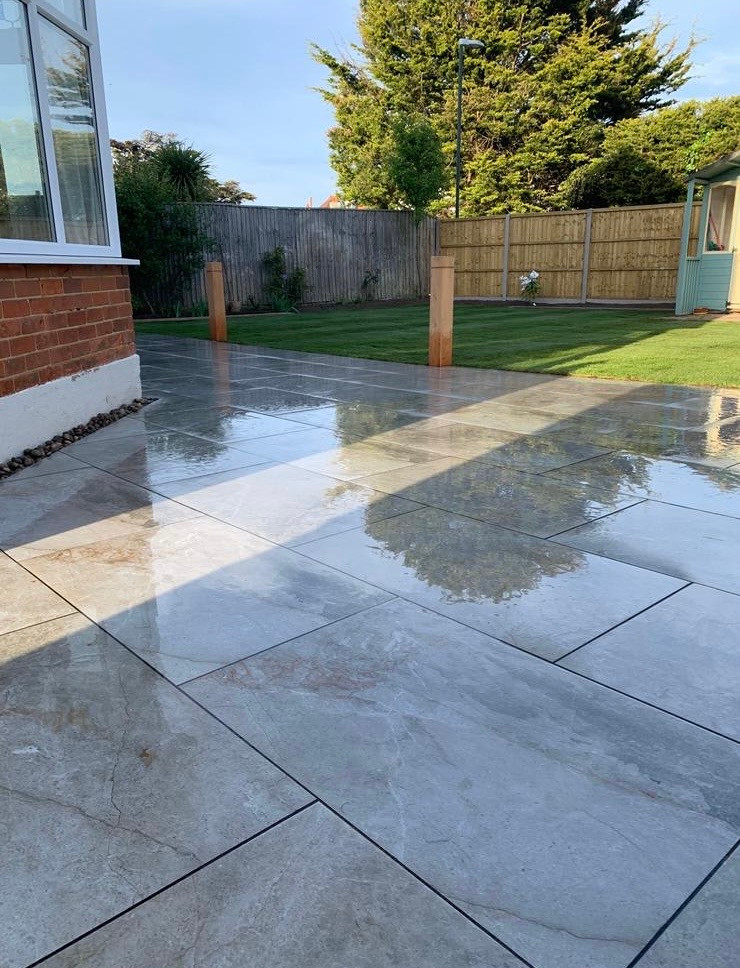
What goes under a drive decides more of the cost than the block, gravel or tarmac on top. The ground. Parts of West Moors sit on clay that shrinks in dry weather and swells when wet. On that, a drive needs a deeper dig and more compacted sub-base than on sandy soil, or it ruts where the wheels go. We dig a test hole if there is any doubt.
Where the rain goes. Surface water has to be dealt with on your own land, not run into the road. On clay a soakaway may barely drain, so the answer is often a permeable surface built to the government guidance on front gardens, or a channel drain to a proper outlet. Either is a real line on the quote.
The plot. A bungalow with a straight run to a detached garage, a corner plot with two frontages and a shared parking court at a block of flats each need their own approach before a spade goes in. Old concrete to break out, and how much spoil leaves, move the price a long way.
The crossing. Widening the dropped kerb is a council approval with its own fee and works, and it needs to be sorted before the drive is finished.
Ask any other quote how deep they are digging, what sub-base depth goes down, where the surface water ends up and who takes the spoil.
If it is urgent
A lifted slab or a drive holding water by the door
A lifted slab, a sunken bay by a doorway or a gully that has stopped taking water will not wait: somebody trips, or the water ends up against the house. Ring rather than using the form.
At the retirement blocks and flats it is often a bay that has dropped by a communal entrance, or an edge broken away where wheels keep mounting it. We make it safe first with a temporary repair or a barrier, then price the permanent work. Booked driveway work runs Monday to Friday, 8am to 6pm. If nobody answers, we phone back as soon as we can.
Worth knowing
A whole road built at once wears out at once, and you can use that
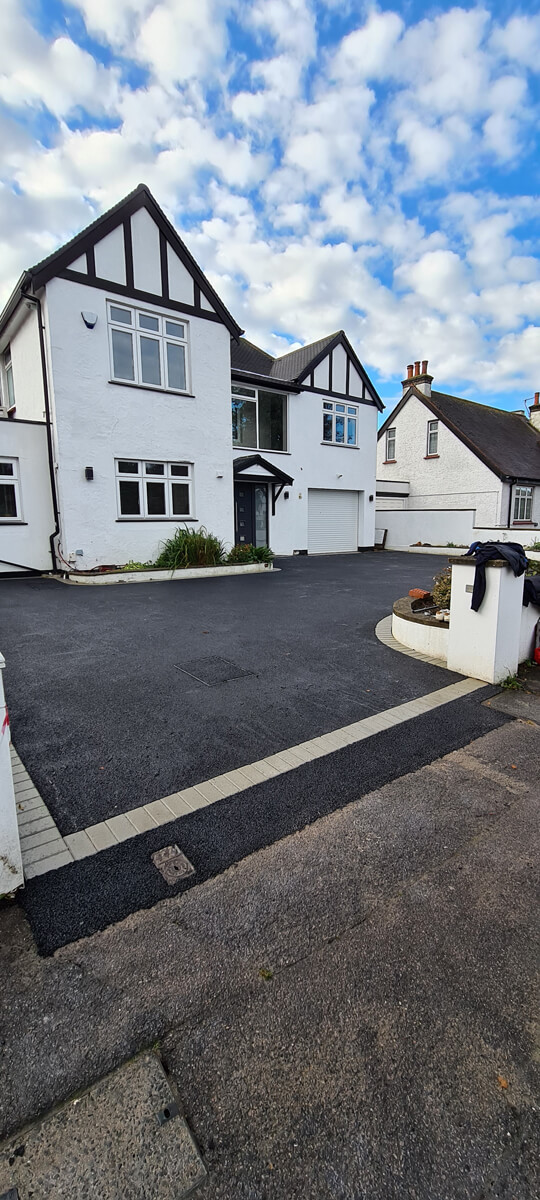
Most of West Moors went up inside a short run of years, which means the drives went in within a few years of each other, to the same build-up, and they are reaching the end of it together. If your neighbours are starting to get ruts and open edges, yours is on the same clock even if it still looks passable. The practical use of that is diagnosis.
When a whole road fails the same way at the same time, the cause is almost never the surface and almost always the base: too thin, never properly compacted, and laid without an edge restraint that could hold it. So before you accept a quote to resurface, get somebody to open a trial hole. An overlay onto a base that has given up looks perfect for a year and then cracks in exactly the pattern it inherited.
The other use of it is money. Because the drives in West Moors are the same age and the same size, two or three neighbours doing the work together share the machine, the delivery and the grab lorry, and the muck away stops being three separate charges. We are glad to price it that way and to set the days out so nobody loses their parking at the same time as next door.
It is also the moment to sort the crossing: the original ones on these roads were built for a smaller car and a single vehicle, and a lot of them are now too narrow for what people actually park. Widening it while the drive is open costs a fraction of coming back for it later.
Who you are dealing with
Driveways in West Moors, Ferndown and Three Legged Cross
We lay drives in West Moors, Three Legged Cross, Ferndown and out towards Verwood and St Leonards across the BH22 roads. The drive up from our Boscombe base is 7.1 miles, and Dorset Council handles planning and highways here.
The firm is Bournemouth Roofing & Building Ltd, number 15471719 on the register for England and Wales. Thomas Hannen owns it and measures up and prices each drive himself. A verified Checkatrade customer marked us 10 out of 10. The visit is free, as is the written quote with each item on it. Before you book a visit in West Moors, you can read our customers' Google reviews, word for word, on our reviews page.
Planning at a glance
Do you need planning permission in West Moors?
Most repairs in West Moors need no application at all. What decides whether a change to the outside of your house does is who the council is, whether a conservation area or a listing applies, and whether the place sits in a protected landscape.
| Question | In West Moors |
|---|---|
| Who decides | Dorset Council is the planning authority for West Moors. Dorset Council's heritage pages set out what it controls. |
| Conservation area | None covers West Moors, so a like-for-like repair is ordinary maintenance. |
| Listed buildings | Yes, West Moors has listed buildings. If yours is one, or stands in the grounds of one, work can need listed building consent. |
| Protected landscape | No National Park or National Landscape covers West Moors. |
Questions
Questions about driveways in West Moors
Why do so many drives here fail at once?
Because they were built at once. 64.6% of West Moors went up between 1945 and 1982, peaking in the late 1960s and early 1970s at 29.0%, so a whole road often carries the same thin base under the same tarmac. When one neighbour's surface breaks up, the rest are usually a season or two behind. Worth knowing before you patch, because a patch over a failed base moves again by the next winter.
Can you make room to turn on a bungalow frontage?
Often, because the frontages are generous. Bungalows are 50.9% of West Moors, and a single storey house on a wide plot usually has more width across the front than it has depth, which is exactly what a turning bay needs. The constraints are the manhole position, any tree you want kept, and the width of the existing crossing. We mark the bay out in paint on the old surface so you can see it before anyone digs.
Our garden is wet all winter. Will a soakaway cope?
Probably not unaided. West Moors sits on naturally wet ground, where an excavation can fill from the sides before it ever drains, and a permeable drive above that simply stores rain instead of losing it. The test is a percolation dig at the depth the crates would sit. If it fails, the answer is a wide shallow layer with a restricted outlet into an existing drain, not a deeper pit.
The kerb is dropped already. Is it wide enough?
Measure it before you commit to anything else. A crossing formed for one car in the 1970s is frequently narrower than the drive people are now planning, and mounting the standing kerb either side chips it and can be enforced by Dorset Council. Widening a crossing is a highways application dealt with separately from the drive. We build to the width you want and detail the transition so the extra can follow later.
Can two neighbours have theirs done at once?
Yes, and along a road of matching West Moors frontages it usually pays off. One dig, one grab lorry, one delivery of stone and one set up covers both plots, and the boundary between them comes out as a single straight line rather than two edges that never quite meet. Each quote is still written separately so nobody funds the other's ground. It only falls apart if the two drives need different depths.
Nearby, and next door
Driveways near West Moors
Nearby places we also cover for driveways, with straight-line distances from West Moors, and the other trades we offer in West Moors itself.
Driveways nearby
Our other trades in West Moors
Driveways and patios guides
Driveway planning permission and where water goes Sunken or ponding driveway: base or drainage Indian sandstone vs porcelain paving: an honest comparisonEverything we do in West Moors Driveways, all areas Every area we cover
Free quote
Get a written price for your West Moors drive or patio
A free site visit, a trial hole where it is needed, and an itemised written quote with the base, the surface and the drainage costed separately.