
Driveways and patios in Three Legged Cross
Estate block paving lifted and relaid on a corrected base, cracked garage aprons recast and patios that pond finally drained, across Three Legged Cross and BH21.
The site visit is free and so is the written itemised quote. Thomas Hannen prices every job himself.
Most of the block paving in Three Legged Cross went down with the estates, which puts a lot of it somewhere between twenty and forty years old. That is exactly the age at which the joints empty, the edging gives way and the wheel tracks start to dip. Nearly all of it can be lifted and relaid on a corrected base with the blocks you already own, and that is usually a far better buy than a new surface on the same tired ground.
Three things get us called out here. A drive that has spread sideways and dropped where the car stands, with weed in every joint. A concrete apron at a garage that has cracked and lifted, often over a root, so the door no longer clears it. And a back garden patio that holds water for two days after rain, because the ground it was laid on does not drain and nobody gave it anywhere to go.
None of those is a disaster and none needs a salesman. We come out, lift a block or dig a small hole, and tell you whether you are looking at a repair, a relay or a rebuild. The visit costs nothing, the written itemised quote costs nothing, and if the answer is that a re-sand and some new edging will see you right, that is what the quote will say.
The work
Estate drives, garage aprons and the gardens behind them
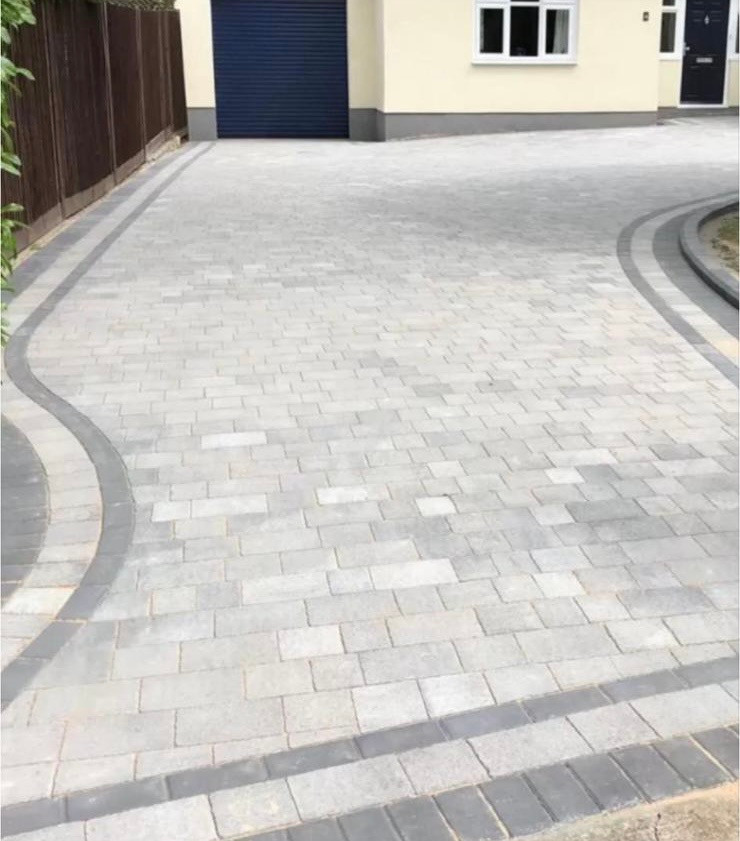
Relaying block paving. The single most common job in the village. The blocks rarely wear out. What fails is the kiln dried sand washing out of the jointing, which lets the blocks work loose, and the edge restraint giving way, which lets the whole field of paving creep outwards. Once it is loose, the wheel tracks start rutting and weed takes the open joints. We lift the blocks by hand and stack them, dig to a firm formation, rebuild a compacted sub-base, reset the edgings haunched in concrete, then screed and relay. The same blocks go back, turned where the sun has faded them.
Concrete drives and garage aprons. The older bungalows here mostly came with concrete, and after fifty years it cracks along the day joints and lifts where a root has found its way under. The awkward part is nearly always at the garage door, where the slab has risen and the door will not clear it, or dropped so water runs inside. That corner gets cut out, the ground beneath dealt with, and a new section cast to the right level with a channel drain across the threshold. Where the rest is sound we leave it and say so.
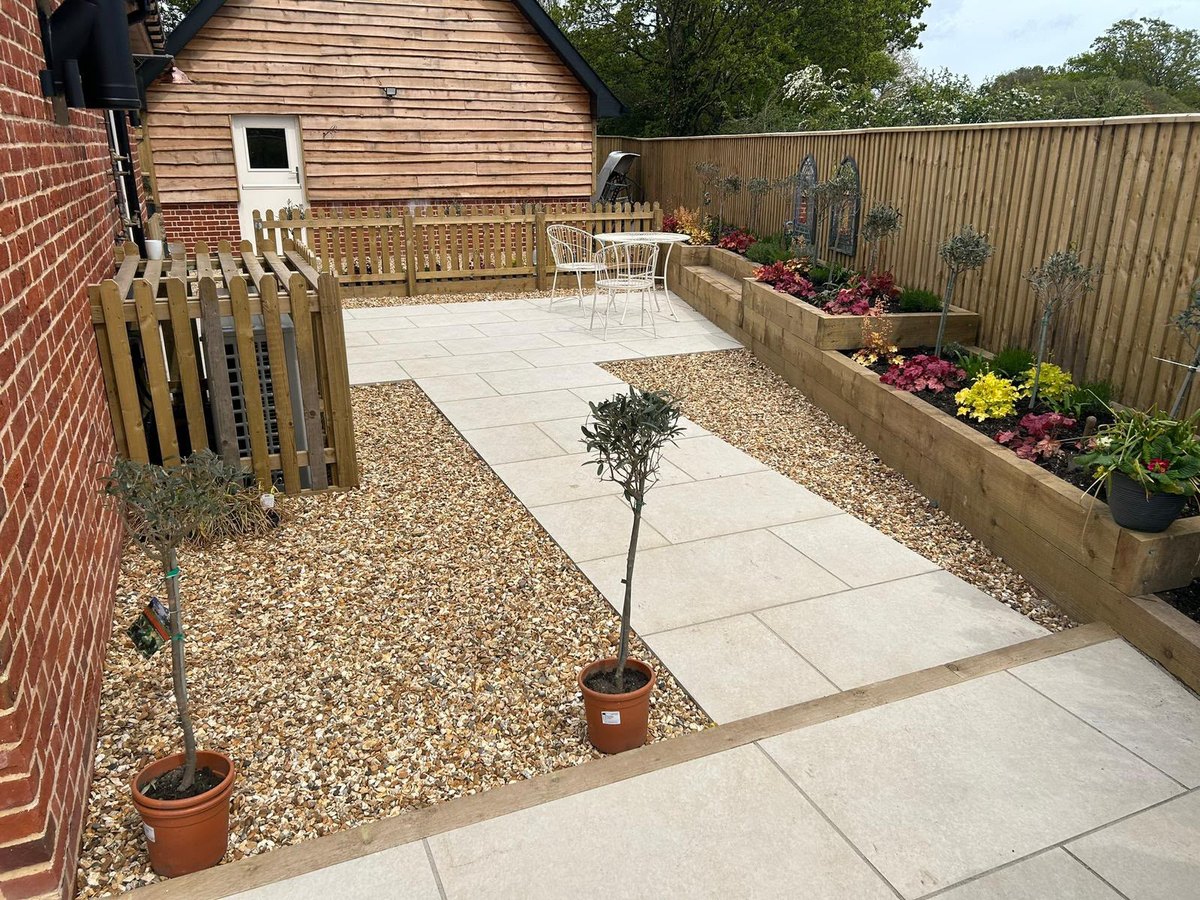
Extra parking usually follows something else changing: a garage converted, a second car, a grown up family. Two things decide it, whether the edging and the crossing already exist and where the extra water goes, since making more ground hard on soil that stays wet is not a free move. A new or wider vehicle crossing is a dropped kerb application to Dorset Council as highway authority. Plenty of these gardens are level, which sounds like an advantage and is not, because a flat patio on ground that holds water simply ponds, so we build a positive fall away from the house and pick up the low edge with a channel drain. Flags, natural stone or porcelain, go on a full mortar bed so the surface does not settle into hollows and start staining.
How it runs
From your call to a written price
One person to ring, and the quote itemised: excavation, muck away, sub base, edgings, surface and drainage on separate lines. Paving your own front garden is normally permitted development, and the test is water rather than area: any hard surface over five square metres has to be permeable or drain to a border, lawn or soakaway inside your own boundary, which is what the front garden paving rules set out. Send it into the road and it needs planning permission, and the highway authority takes an interest whether or not the planners do. Dorset Council covers both, and the crossing over the footway is its own application.
Cost
What decides the price of a driveway
No rate per square metre, because what is under it decides more than what goes on top. A drive a tipper can back straight onto is the cheap end, a house on a close where the lorry has to stand on a turning head is dearer, and a rear garden reached by barrow through a narrow side gate is dearer again. Ground conditions, the depth of the dig and how much spoil the grab lorry carries away are the real variables, and where a machine cannot get round the house every load goes by hand. On ground that stays wet, where the surface water goes is a design decision with a cost. Ask the depth of dig, the sub base and the drainage.
If it is urgent
A trip hazard, or a drive that floods
Ring rather than use the form. A lifted slab, a sunken bay by a doorway or a gully that has stopped taking water will not wait, because somebody falls or water ends up against the house. Say on the phone if water is standing where you walk, because on ground that stays wet a small hollow does not stay small for long. The phone is answered 24 hours for emergencies; scheduled work runs Monday to Friday, 8am to 6pm.
Worth knowing
The ground here does not take water away
Three Legged Cross sits on naturally wet ground, and that one fact should drive the whole design of a drive or a patio here rather than being an afterthought at the end. A soakaway is the default answer everywhere else in the country. Here it is a question, not an answer. A hole dug in August can look like it will swallow anything, and the same hole in February can be standing full of water before you have finished digging it, at which point it takes nothing at all and the drive it was meant to serve floods every time it rains hard.
So it gets proved rather than assumed: a trial hole and a percolation test, sized on what the ground actually accepts, and kept well away from the house so a full soakaway is never sitting against a foundation. Approved Document H is the standard that sits behind that, and it is why we would rather spend an hour with a spade at the survey than guess.
What that means in practice is usually good news, because the answer is often to stop trying to get rid of the water quickly. A permeable build up, where an open graded stone sub-base holds the water and lets it out slowly, is what planners mean by SuDS and it works on ground like this where a single deep hole does not. Keeping a lawn, a gravel border or a planted strip alongside the hard surface gives the run off somewhere to go, and it is cheaper than any drainage you can buy.
Where the ground genuinely will not take it, the honest answer is a positive outfall to an existing surface water drain, agreed before the job starts. What is not an option is sending it over your boundary or out onto the road, which is a complaint from a neighbour or the highway authority waiting to happen and is the one part of this that costs money twice.
Who you are dealing with
A local firm you can check
We cover Three Legged Cross, Verwood, West Moors, Ashley Heath and the BH21 addresses out towards Ringwood, with Dorset Council for planning and building control. Send the postcode if you want to be certain. Bournemouth Roofing & Building Ltd, registered in England and Wales, company number 15471719, which you can look up in a minute. Thomas Hannen's business, and he is the one who comes out to price the job, not a salesman. A verified customer's 10 out of 10 on Checkatrade. The visit and the written quote are both free.
Questions
Three Legged Cross questions we get asked
The block paving is uneven and full of weeds. Full relay?
Only if the base has gone. Weeds root in the joints of any block drive once the sand has washed out, and that is a re-sanding job rather than a rebuild. Uneven is a different signal: if the dips follow the wheel lines, the ground under them has consolidated and no amount of sand touches it. A lot of drives at Three Legged Cross went down in the seventies and early eighties with very little stone beneath them.
Can we re-sand it ourselves and leave it at that?
You can, and on a drive that is only weedy that is the right call. Brush the joints out, wash it down, let it dry properly, then work kiln dried sand in and vibrate it, or at least tamp it. What ruins a drive is jetting hard enough to blow the bedding out from under the blocks, which turns a flat surface into a rippled one. If it dips again inside a season, the trouble is underneath.
Should the new patio drain into the border by the wall?
No. The ground at Three Legged Cross is naturally wet and shrinks and swells on top of that, so sending run off from a paved area into a border tight against the building loads that corner with water it cannot shed. That is a foundation question, not a decorating one. We fall the paving away from the wall into a channel on the outer edge and take it to a drain or an infiltration point well out in the garden.
We want a car port over the new hardstanding. Any problem?
The paving is not the issue, the thing standing on it might be. Three Legged Cross falls inside the green belt, which makes no difference to resurfacing but starts to matter once you put up something with a roof. Check it with Dorset before the base goes in, because a car port wants foundations and drainage designed into the slab from the beginning rather than added under a drive that was never built for it.
How many days is a relay, start to finish?
A straightforward one runs to a few days: lift and stack the blocks, correct the base, relay, joint and compact. What stretches it is finding the base has to come out, or waiting on matching blocks to replace the ones that broke coming up. Three Legged Cross is nine miles from the yard, so these are full days on site, and you get told which morning the cars need to be off.
Nearby, and next door
Driveways and patios near Three Legged Cross
Driveways and patios nearby
Our other trades in Three Legged Cross
Everything we do in Verwood Driveways and patios, all areas Every area we cover
Free quote
Get a written price for your Three Legged Cross drive
Send the postcode and tell us what the paving is doing. We come out, lift a block to see the bed underneath, and put the price in writing with the days it will take.