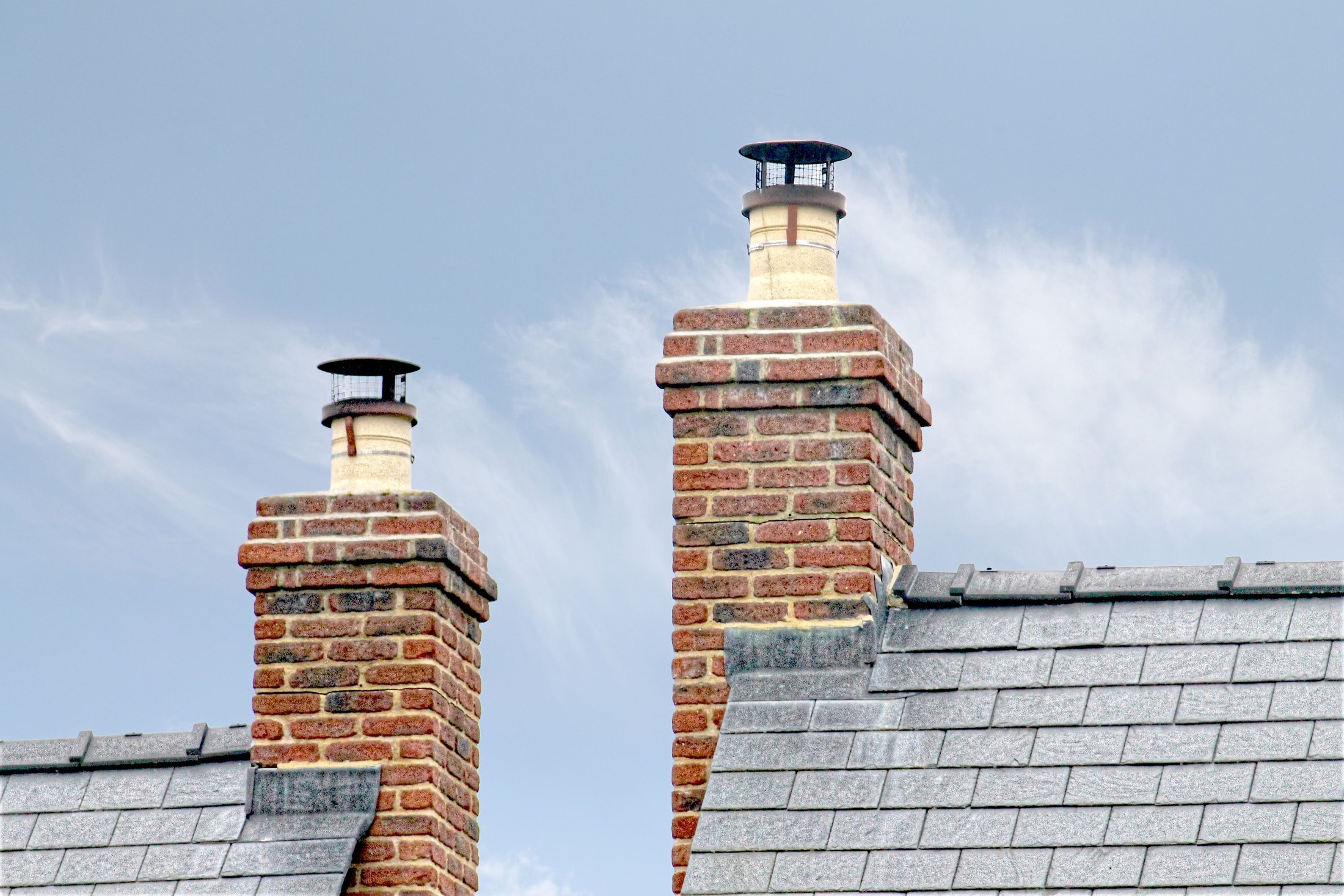
Roofing in Three Legged Cross
Eaves and felt repairs, dry ridge and verge, strip and re-cover, flat roofs, leadwork and gutter work across Three Legged Cross and BH21.
The site visit is free and so is the written itemised quote. Thomas Hannen prices every job himself.
On a concrete interlocking tile roof the tile is the last thing to fail. The felt underneath it and the mortar along its edges go long before the covering does, which is why so many houses in Three Legged Cross need a job that is nowhere near a new roof.
Almost everything here was built after the war, a large slice of it between the mid 1980s and the late 2000s, so the calls are predictable. Mortar on the drive and a ridge tile rocking. Water running down the wall under the gutter in heavy rain with a dry ceiling inside. Or a survey on a house purchase saying the roof covering is nearing the end of its life, and you want to know what that means in money.
We get on the roof, put our head in the loft, photograph what is there and tell you which of the three you have. Site visit and written quote both free.
The work
The eaves fail first and nothing shows inside
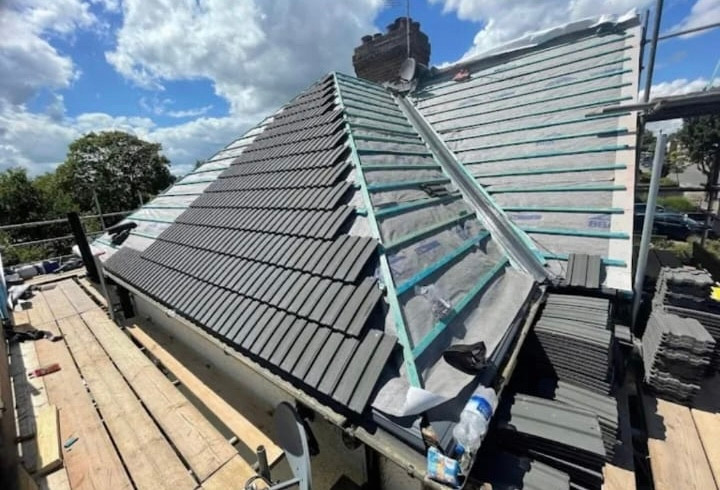
Eaves, felt and the gutter. The commonest job on the estates here and the one people ring about last, because it does not show inside. On roofs of this age, and four in ten went up between 1945 and 1982, the bitumen underlay was dressed over the fascia into the gutter with nothing holding it up. It sags, holds water in the fold, then splits along it. Rain then runs behind the gutter and down the wall plate and the rafter feet instead of into the downpipe, and by the time a ceiling stains the timber has been wet for years. Pine and birch debris off the heath fills the gutter as well, so clearing it out is what keeps that fold dry. The fix is to lift the bottom courses, cut the perished felt back, fit an eaves protection tray and re-lay. It is a repair, not a strip.
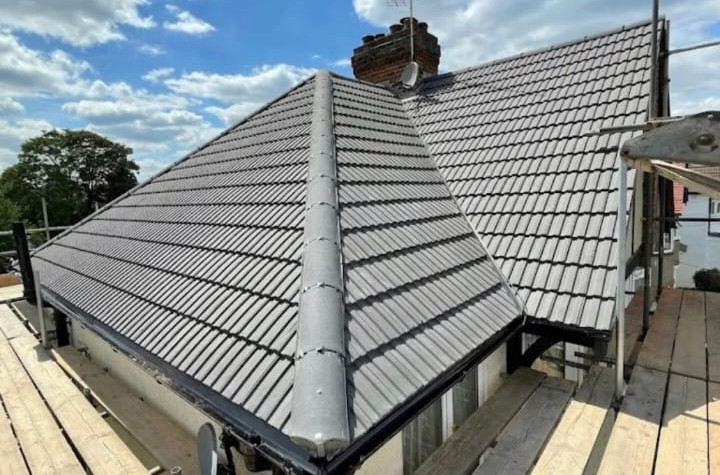
Edges, coverings and the loft. Bungalows, a quarter of the dwellings here, and hipped semis carry a lot of edge for their footprint, all of it bedded in mortar when the house went up. Once the bedding cracks the tiles rock and the next gale leaves slipped, cracked and missing tiles along that edge, so we strip it and convert to a dry fix system screwed onto a vented roll, the mechanical fixing BS 5534 expects. Nearly everything here is interlocking concrete tile, where the tile outlives the nail or clip holding it. Plain clay tile and natural slate are rare on estates of this age, and there is no stone slate here at all. Plenty of houses were built without a chimney, so the lead is more often an abutment or a valley where an extension meets the main slope than a stack, with soakers cut in where the tiles run into it. Watch for capping: plastic boards were nailed over original fascia and soffit timber on a lot of these houses, and if that timber was wet it is still wet, so we take a section off rather than guess. Roofs of this vintage had little eaves ventilation, and insulation has since been pushed into the eaves and blocked the airway, which shows as condensation under the felt. Vent trays are far cheaper with the roof open, and Approved Document L sets the standard a renovated roof should reach.
How it runs
From your call to a written price
You get an itemised quote, and a photograph and a price before we carry on if the strip turns up something nobody could have seen. There is no conservation area at Three Legged Cross and a single listed entry in the whole place, so on an ordinary house a like for like re-cover, a repair, new rainwater goods and rooflights all sit inside householder permitted development. No planning permission, no application and no building control sign-off, as long as nothing stands more than 150mm above the roof plane, and Planning Portal guidance sets out the limits. Dorset Council for planning and building control.
Cost
What decides the price of a roof
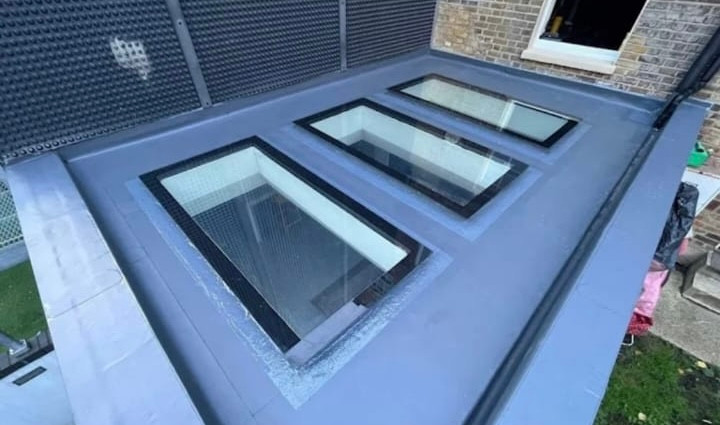
No rate per square metre. Estate roads here are wide and nearly every house has a drive, so a scaffold or a tower has somewhere to stand and a lorry can reach it. The exception is the terraced runs, where the platform has to cross more than one property and your neighbour needs telling before anything is booked. Because this is work at height work at height rules make the platform a priced line. When you compare quotes, ask whether battens and membrane are renewed or simply covered over, and who pays for the skip.
If it is leaking now
Water coming in today
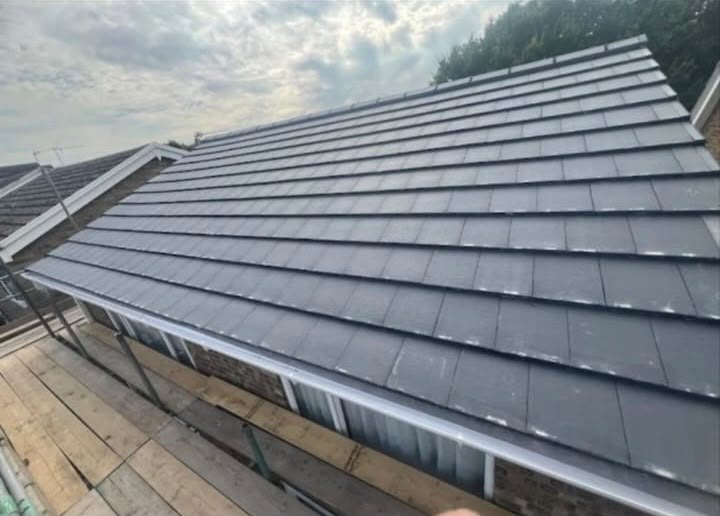
Ring rather than use the form. Water coming in goes to the front of the queue and the first visit makes it safe. Look behind the gutter as well as at the ceiling: water down the fascia while it rains means the felt has split where it laps in, which is how a roof here gets wet without marking one. The phone is answered 24 hours for emergencies; scheduled work runs Monday to Friday, 8am to 6pm.
Worth knowing
The designation here, and what it does not stop
Three Legged Cross sits inside the Green Belt, which sounds as though it ought to complicate a roof and does not. Re-covering, repairing, new gutters and fascias and a rooflight are all householder permitted development, and the designation takes none of that away.
Where it bites is anything new standing on open ground, so an outbuilding beyond the permitted development limits, a large extension or an annexe in the garden is where you meet it and where an application can genuinely be refused.
Which matters here because of the garages and workshops. Re-roofing the detached garage you already have is a repair and nothing more. Taking it down and putting up a bigger one with a new flat roof is a planning question first and a roofing question second, so get that answer from the council before you get a price from anyone.
Who you are dealing with
A local firm you can check
About nine miles from us, covering Three Legged Cross, Verwood and the BH21 addresses out towards West Moors, with Dorset Council for planning and building control. Bournemouth Roofing & Building Ltd, registered in England and Wales, company number 15471719, which you can look up in a minute. Thomas Hannen's business, and he is the one who comes out to price the job, not a salesman. A verified customer's 10 out of 10 on Checkatrade. The visit and the written quote are both free.
Questions
Three Legged Cross questions we get asked
Most houses here are fairly new. What actually fails on them?
The parts that were never going to outlast the tiles. Only about one home in twenty at Three Legged Cross predates 1919, four in ten went up between 1983 and 2008, and a third in the 1970s and early 1980s, so we are mostly on roofs where the covering is fine and the underfelt has gone brittle at the eaves. Felt, battens and edge fixings are the usual job.
Does anything here need a planning application before roof work?
Rarely, where roofs are concerned. There is a single listed entry in the whole area and no conservation area boundary, so appearance is not controlled and putting a roof back is maintenance rather than something to apply for. Green Belt policy sits over the area but bites on extensions and outbuildings, not repairs. Dorset Council is where it goes if you do need something, usually for a dormer.
Is a bungalow quicker to survey than a two storey house?
Quicker to see, not quicker to judge. A quarter of the homes at Three Legged Cross are bungalows, and from a ladder at eaves level the whole slope, the verge and the state of the felt can be read in one go. What takes the time is the loft, where the truss feet, the ventilation path and any staining round the chimney decide whether this is a repair or a strip.
Do you have to strip the roof to sort the verges?
No stripping is needed for verge work on its own. The tiles at the gable come off in a strip a course or two wide, the old bedding is cut back to sound material, and a dry verge or fresh bedding goes on before the same tiles return. Where a roof of that cohort has also lost the felt at the eaves, the two jobs get done on one visit.
What happens to the old tiles and the felt?
It leaves with us. Sound tiles are sorted and stacked in case they are wanted to make up another slope on the same house, while broken ones, perished felt and rotten batten go on the lorry, back to base around nine miles from here, and on for disposal. The drive and the borders get cleared and swept on the day the scaffold comes down, not a week later.
Nearby, and next door
Roofing near Three Legged Cross
Roofing nearby
Our other trades in Three Legged Cross
Roofing guides
Concrete vs clay roof tiles: which is right? Planning, building regs or listed building consent Storm damage to a roof: the first 24 hoursEverything we do in Verwood Roofing, all areas Every area we cover
Free quote
Get your Three Legged Cross roof priced properly
A free site visit, a look in the loft as well as on the roof, and a written itemised quote with the repair priced beside the re-cover.