
Bricklaying and repointing in Three Legged Cross
Gate piers, boundary and retaining walls, garages and workshops, and brick repairs on the house, across Three Legged Cross and BH21.
The site visit is free and so is the written itemised quote. Thomas Hannen prices every job himself.
Most brickwork jobs in Three Legged Cross are outside the house rather than on it: gate piers, boundary and retaining walls, garages, stores and workshops. Nearly all of them come down to the same two things, what is under the wall and what is on top of it, and both are cheaper to get right than to put right.
People ring us here about three situations. A brick pier or entrance wall that has been clipped by a vehicle or has slowly gone out of plumb. An outbuilding, a garage or a workshop that needs building, extending or making sound again. Or brickwork on the house itself that has started to shed its faces or crack, usually on the side that takes the wind and rain.
We come out and look before we say anything about price. That means digging a small hole to see what a leaning wall is actually standing on, scraping a joint to find out what the old mortar is, tapping for loose brick, and photographing the lot so you are looking at the same evidence we are. Then you get told plainly what needs doing, what does not, and in what order.
The work
The jobs we do here, and what they involve
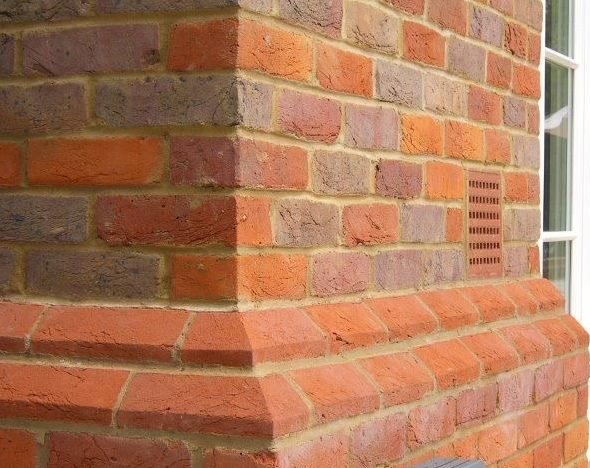
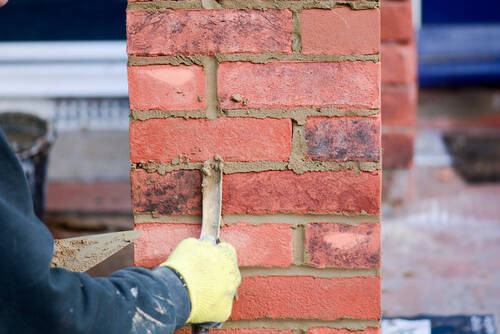
Gate piers and entrance walls. Plenty of the properties along the lanes here have a pair of brick piers at the drive, and they take a hard life: clipped by wing mirrors, carrying a heavy gate on one side only, and built years ago on a footing that was never much more than a scrape. A pier that has gone out of plumb does not come back. We take it down, dig a proper footing, rebuild it with the gate ironwork set into the brickwork as it goes up rather than bolted on afterwards, and cap it so water stays out of the middle of the pier.
Walls on ground that holds water. The ground round the village is sandy and holds water rather than draining away from it, and both matter under a wall. Sand does not grip the side of a trench, so a footing has to be dug wider and the hole worked safely rather than left open. On a gate pier the foundation is more than half the job, and a retaining wall holding a bank up needs weep holes and a drained backing or the water behind it will push it over. Coping gets re-bedded first, always, because an open wall top is what kills most garden walls here.
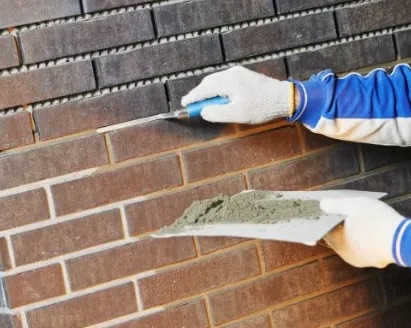
Four in ten houses here have gone up since 1983 and most of the rest are seventies, so the brickwork was pointed in a sand and cement mix that has usually lasted. What fails is local: the exposed gable, the run under an overflowing gutter, the bottom course where a border has been built up against the wall and over the damp proof course, which keeps it wet enough to start spalling at the first hard frost. Those bricks come out whole and go back matched for colour from a reclaimed batch with the same weathering on it, with a sample panel to look at before the rest follows, and the joints get raked back by hand. Galvanised wall ties from that era are reaching the end of their life, which shows as fine horizontal cracking at regular heights, and a rusting lintel over a window or a garage opening lifts the course above it. Both are repaired in place.
How it runs
From your call to a written price
The quote is itemised by elevation: access, raking out, the mix, brick replacement and disposal on separate lines. On permission: repairing and repointing like for like is maintenance and needs no application. There is no conservation area here and only one listed building in the village, so for practically every address the brick, the mortar and the joint are your choice, not a planning matter. What does need attention is building control, on the small jobs especially: a new opening in a wall, a beam over it, or a garage converted into a room. Where the work meets a shared wall, the Party Wall etc. Act 1996 gives your neighbour a formal notice period.
Cost
What decides the price of a brickwork job
No rate per square metre: the metre of wall tells you nothing until you know what the joints are like. A house on the lane with a wide verge, a bungalow behind a hedge and a workshop at the back of a paddock are three different jobs, and most of the work here is low enough for a tower. How long a platform stands matters as much as its size, and the work at height rules are why it is a priced line. On a pier or a retaining wall the footing moves the price more than the brickwork does. Ask what is being dug.
If something has moved
Loose brickwork, or a wall that has shifted
Ring rather than use the form. Anything overhead or leaning goes to the front of the queue: the first visit makes it safe, and we price the permanent repair once we can see how far the movement goes. A gate pier leaning towards a lane, where a vehicle or a child could be under it, comes first. The phone is answered 24 hours for emergencies; scheduled work runs Monday to Friday, 8am to 6pm.
Worth knowing
What you can build without asking, and what you cannot
Start with what needs nothing. Repairing, repointing or rebuilding an existing wall as it was is maintenance, whatever height it is. A new wall, gate or fence is permitted development up to two metres, or one metre where it fronts a road used by vehicles, and the Planning Portal sets out exactly where that line falls.
So the ordinary brickwork most people want here, a pier rebuilt, a boundary wall put back, a low front wall added, needs no application at all. That is worth saying plainly, because in a village surrounded by open land people tend to assume everything has to be asked for.
What is different here is that Three Legged Cross sits in the Green Belt, and Green Belt policy is about new building rather than repairs. Inside your own garden a modest outbuilding can still be permitted development if it meets the rules on size, height and where it sits relative to the house. Go past that, or put the building on land that is not part of the garden, a paddock or a field, and it is judged as new building in the Green Belt, where the starting position is that it is inappropriate unless it falls into a narrow set of exceptions.
The practical advice is simple: check the principle before you pay anyone for drawings, and see the other permissions you may need while you are at it. Building it in brick and block instead of timber does not change the planning answer either way, it only changes what it costs and how long it lasts, and we would rather you knew that before we quote it.
Who you are dealing with
A local firm you can check
We cover Three Legged Cross, Verwood, West Moors, Ashley Heath and Woodlands, across BH21 and BH31. The free site visit is the survey: we walk the job with you and dig where we need to, rather than pricing off a photograph.
Bournemouth Roofing & Building Ltd, registered in England and Wales, company number 15471719, which you can look up in a minute. Thomas Hannen's business, and he is the one who comes out to price the job, not a salesman. A verified customer's 10 out of 10 on Checkatrade. The visit and the written quote are both free.
Questions
Three Legged Cross questions we get asked
Is there any old brickwork here that needs lime?
Very little. Only 5.7% of Three Legged Cross predates 1919 and 41.0% of it went up between 1983 and 2008, so almost every wall we look at is a cavity built in cement with a bucket handle joint. Lime belongs on a solid wall that has to breathe through its mortar, and there are not many of those around here. Put it on a modern cavity wall and you have simply made the joint too soft.
Does Green Belt stop us putting up a new garden wall?
Not a repair or a rebuild on the same line, no. Green Belt policy is aimed at buildings and outbuildings rather than boundary walls, so it is largely beside the point for brickwork repairs around Three Legged Cross and becomes relevant once you extend or add something free standing. If the plan is a wall taller than what stood there, or a structure rather than a wall, it is worth a call to Dorset Council first.
How deep do footings go for a wall on this ground?
Deeper than most people expect, because the ground here is cohesive with a significant shrink swell rating and moves with the seasons. A garden wall on a shallow strip will crack in its first dry summer, usually diagonally near the ends where the wall is least restrained. We dig to firm undisturbed ground, keep the concrete below the zone that dries out, and build piers into anything beyond a short run instead of relying on the wall alone.
A quarter of the homes here are bungalows. Does that help?
It keeps the job off scaffold. Bungalows are 24.8% of the housing in Three Legged Cross, and on a single storey elevation the whole wall can be worked from a low tower, which is quicker and leaves nothing standing in the garden for a fortnight. It also puts the brickwork closer to the soil, so the pointing at the bottom of a bungalow wall is normally worse than the pointing up at eaves level.
A car has clipped our gate pier. Can it be rebuilt?
Yes. A pier that has been hit is usually cracked well below the visible damage, so patching the top of it puts good brick onto a broken base. We drop it to sound work, keep any cap or coping that survived, and rebuild in the same bond with a bar through the middle where the pier is tall or carrying a gate. Hinges and latches get set into the new work rather than bolted onto the face.
Nearby, and next door
Bricklaying and repointing near Three Legged Cross
Bricklaying and repointing nearby
Our other trades in Three Legged Cross
Everything we do in Verwood Bricklaying and repointing, all areas Every area we cover
Free quote
Get a written price for your brickwork here
Free site visit, free itemised quote, and an honest answer about what the ground under the wall is doing.