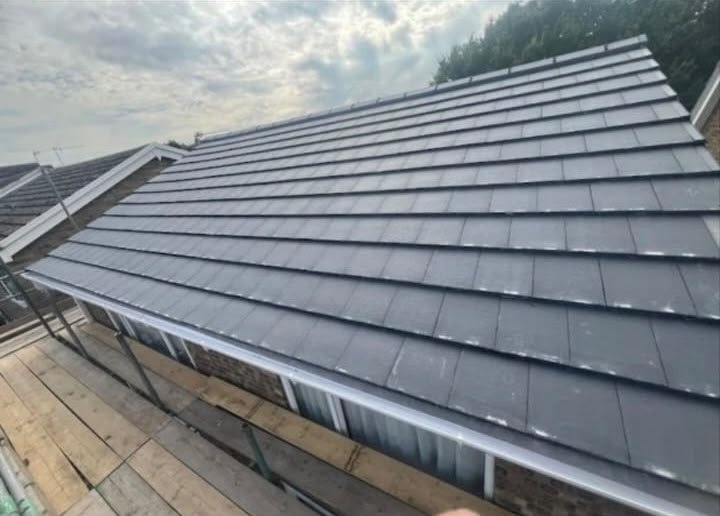
Fascia, soffit and guttering replacement in Three Legged Cross
Fascias, soffits, bargeboards and gutters renewed across Three Legged Cross, including the first generation of plastic roofline that is now coming to the end of it.
The site visit is free and so is the written itemised quote. Thomas Hannen prices every job himself.
Last updated
Fascia, soffit and guttering replacement in Three Legged Cross is often about a plastic roofline that has aged badly. Plastic does not rot, but it goes brittle, the fixings let go and the joints pop, and where it was capped over old timber the rot is still quietly going on behind it.
The usual reasons for a call are a gutter overflowing at one corner in heavy rain, a length that has dropped off its brackets after a gale, or a soffit that has gone chalky and started to sag away from the wall. On the older Three Legged Cross houses it is the more familiar picture: paint peeling and blown off a timber fascia with soft wood underneath. The free visit is about getting behind the plastic, not admiring it from the drive, because on a capped roofline the board that matters is the one you cannot see. We lift a section where we can, test the timber behind it, and put photographs and an itemised price in writing. If a brittle length has snapped and is hanging loose, or water is sheeting down the wall from a popped joint, ring 07435 839745 instead of booking a visit.
The work
From the fascia to the shoe
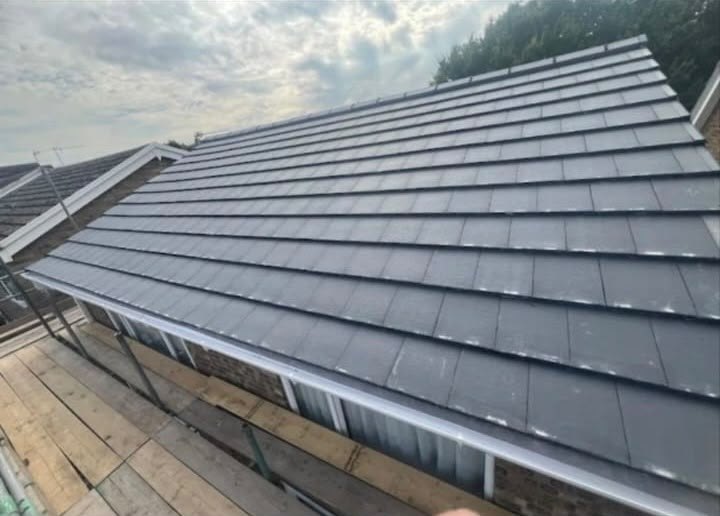
A plastic roofline reads differently. White boards do not rot, so the signs are different. Look along the fascia in bright light: a wavy line means it was nailed up tight with nowhere to move. Press the soffit where it meets the brickwork and see whether it flexes or crumbles.
Check the unions after a hot spell, because a joint with no room left in it will be sitting open. And if the plastic was simply capped across the original timber, none of that tells you anything about the fascia hiding behind it, which is the board your brackets are actually screwed to.
Taking it back to timber. Fascia, soffit and bargeboard come away, cover board included, and what is underneath gets tested, not assumed. New boards go back in uPVC, carried up to the verge on a gable. Rafter ends, the wall plate and the tilt fillet raising the bottom row of tiles all become visible, and anything soft is cut off and replaced with sound wood. A felt support tray goes in so the underlay finishes over the front edge and its water lands in the channel and not behind it. Tiles lifted are refixed to the pattern in BS 5534. Capping over is only fair where the timber is dry and firm, and we will tell you which you have.
The run, sized properly this time. Half round is the common section, ogee sits flat against a square edged fascia, and deepflow carries a great deal more, which is the honest answer where a long roof puts more through one length than it can shift and it is overflowing every autumn. Brackets, unions, outlets, hopper heads, downpipes and shoes all go back together, screwed and clipped so the length falls to the outlet. Cast iron is unusual on these Three Legged Cross roads, aluminium is worth a figure on a long exposed elevation, and any pipe finishing on a border rather than in a gully or a soakaway is what has left the green staining down your wall.
Ventilation, and the small repairs. New soffits are the cheapest chance you get at eaves ventilation, a soffit vent in the panel or an over fascia vent above it, keeping an air gap open over the loft insulation so February condensation is not written off as a roof leak. Most faults in Three Legged Cross are smaller than a replacement anyway: a leaking joint, a perished union, a bracket dragged out of a soft board, a snapped shoe, a blocked outlet packed with moss and debris off the tiles. Those are refixed, re-hung or swapped individually from a ladder. Wasps are seen to first, and a bird nest behind a soffit is closed up once it is empty.
How it runs
Replacing a roofline on a bungalow or a two storey house
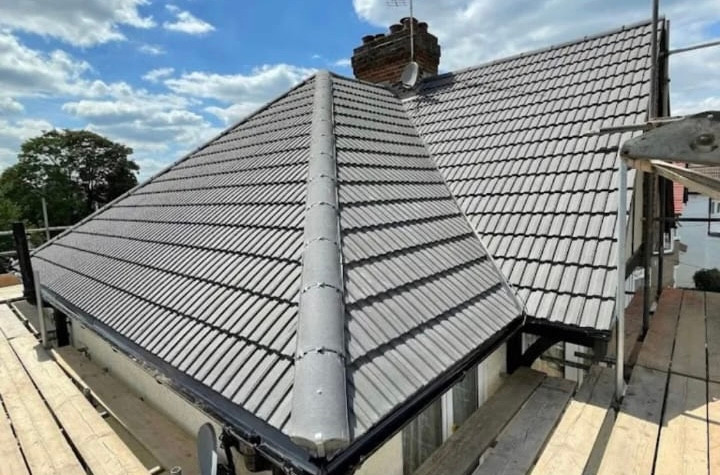
Thomas Hannen comes round, looks along each run from the ground and from a ladder, and puts the price together himself. On a Three Legged Cross house built in the seventies or eighties the boards are often the original softwood, painted over and over until the joints split and the paint holds the wet in.
His written quote breaks it down: the tower or scaffold, how many metres on each elevation, taking down the old timber and gutter, new fascia and soffit, bargeboards on the gables, the new guttering with its outlets and downpipes, and taking the waste away.
The whole run is stripped and fitted under one written quote. For a bungalow we work off a tower or low staging, and a two storey house gets a scaffold. Most Three Legged Cross plots have a drive, so the tower stands on your own ground and the van is off the road. Soft boards come off rather than being clad over, so we can see the rafter ends. If they are rotten, we show you a photo and put a price on splicing them before touching them. Old timber and plastic go away with us, and the paths are swept at the end of every day.
Swapping boards and gutters like for like is maintenance: no planning application, and building control is not involved. The colour and profile are up to you, since the village has no conservation area. Only on its one listed building would listed building consent come into it. Where the downpipes discharge matters on this ground, and Approved Document H covers where rainwater should go.
Cost
What moves the price of new fascias, soffits and gutters
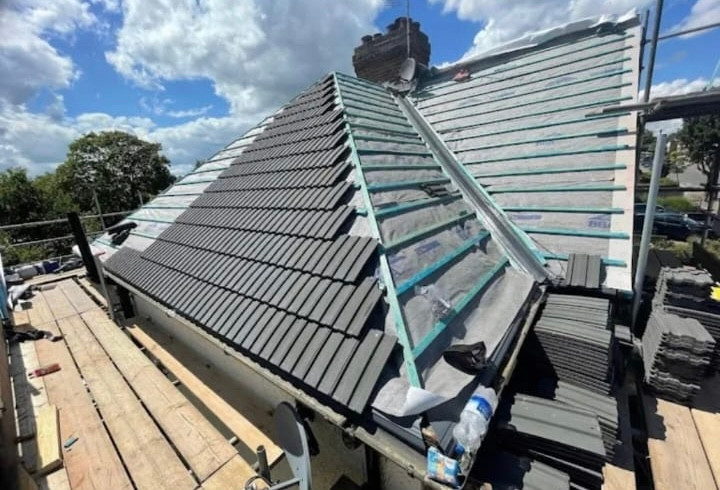
We do not price by the metre. Fascia round a bay takes far longer than the same length on a straight run.
Height, and what sits below. Three Legged Cross bungalows are the quick ones, done from a tower standing on the drive. A two storey semi or a terraced house needs scaffolding, and on a terrace the new boards have to meet next door's old ones neatly at the party line. A conservatory or a lean-to under the eaves means the platform is built around and over it. Access is a line on its own because of the work at height rules.
The timber behind. A soft fascia tells you water has been getting in. The rafter ends and wall plate behind it may be fine, or may need new timber scarfed on, and nobody can say which until the old board is off. Plastic cladding fitted over rotten wood just hides it.
Eaves ventilation. Plenty of roofs from this era have none. Vented soffit or an over fascia vent costs a little more and keeps the loft drier.
Where the water goes. The ground around Three Legged Cross is free-draining sand and gravel, so a soakaway set well clear of the wall usually works unless the water table is high. Running a pipe to one may be part of the job.
Questions for anyone else quoting: will they take the old boards off or clad over them, what do they do if the rafter ends are soft, and where will each downpipe end up?
If a section has come away
A gutter hanging loose or a fascia gone soft
Phone us, do not fill in the form. When a gutter drops off its brackets, a downpipe cracks or a fascia goes soft enough to push a finger through, every heavy shower pours down the wall and soaks the ground beside the footings, which is the last place you want it.
The first visit makes it safe: anything that could fall comes down, and the water is sent away from the house for now. Then we price the full run once we know how far the rot has spread. The working week for booked jobs is Monday to Friday, 8am to 6pm. If you cannot get through, we will phone you back as soon as we can.
Worth knowing
Your plastic roofline is not the last one you will buy
A lot of the roofline around Three Legged Cross went up in white plastic in the eighties and nineties, and it was sold on the idea that it would never need doing again. Most of it has done well, but it does age.
Sunlight takes the surface off, so it goes chalky and yellows on the elevations that get the most of it. Cold makes it brittle, which is when a bracket snaps or a clip lets go in a gale. And a lot of it was nailed rather than screwed and butted up tight at the unions, so there was nowhere for the run to expand and the joints have pushed themselves apart.
On a Three Legged Cross house the check is easy enough from the ground. Look along the fascia on a bright day: a rippled line means it was fixed too tight. Press the soffit with your thumb where it meets the wall, and if it flexes or crumbles it has had its day. Then look at the unions after a hot spell, because that is when a joint that has run out of room will be sitting open. And if the plastic was capped over the original timber, none of that tells you about the fascia underneath, which is the part we are actually interested in.
Who you are dealing with
Local roofline work under Dorset Council
We work across Three Legged Cross, Verwood and Woodlands, and on into West Moors and Ashley Heath, which is about nine miles from our Boscombe base. The council is Dorset Council. You are dealing with Bournemouth Roofing & Building Ltd, registered in England and Wales, company number 15471719. Before you book a visit in Three Legged Cross, you can read our customers' Google reviews, word for word, on our reviews page.
The firm belongs to Thomas Hannen, who looks at the roofline and prices every run himself. A verified Checkatrade customer marked us 10 out of 10. There is no charge for the visit, and none for the written quote with every line itemised.
Planning at a glance
Do you need planning permission in Three Legged Cross?
Most repairs in Three Legged Cross need no application at all. What decides whether a change to the outside of your house does is who the council is, whether a conservation area or a listing applies, and whether the place sits in a protected landscape.
| Question | In Three Legged Cross |
|---|---|
| Who decides | Dorset Council is the planning authority for Three Legged Cross. Dorset Council's heritage pages set out what it controls. |
| Conservation area | None covers Three Legged Cross, so a like-for-like repair is ordinary maintenance. |
| Listed buildings | Yes, there are listed buildings in and around Three Legged Cross. If yours is one, work can need listed building consent. |
| Protected landscape | No National Park or National Landscape covers Three Legged Cross. |
Questions
Questions about fascias and guttering in Three Legged Cross
Our plastic fascia is only thirty years old. Why has it failed?
Usually the fixings and the fitting rather than the plastic. Nailed instead of screwed, butted tight at the unions with nowhere to expand, or capped straight over timber that was already soft. The board itself is often the last part to give up.
How can I tell if there is rot behind the capping?
From the ground you mostly cannot, which is the honest answer. A stained soffit, a rippled fascia line or a gutter that has dropped are all hints. The certain way is to take a board off and look, and that is what the free site visit is for.
Is it worth changing the gutter profile?
Sometimes. If your run overflows in heavy rain every autumn and it is clear and hung to a fall, the run may simply be too small for the roof feeding it. Deepflow carries a lot more water than a standard half round, and it costs little more to fit while everything is off.
Do we need permission?
No, renewing fascias, soffits, bargeboards and gutters like for like is maintenance, so there is no application and nothing for building control to check, and there is no conservation area over Three Legged Cross.
Nearby, and next door
Fascias, soffits and guttering near Three Legged Cross
Nearby places we also cover for fascias, soffits and guttering, with straight-line distances from Three Legged Cross, and the other trades we offer in Three Legged Cross itself.
Fascias, soffits and guttering nearby
Our other trades in Three Legged Cross
Fascias, soffits and guttering guides
Gutter overflows in heavy rain but not light rainEverything we do in Verwood Fascias, soffits and guttering, all areas Every area we cover
Free quote
Get a price for your Three Legged Cross roofline
Tell us the address and what you have noticed. We will come out, get behind the boards and put an itemised price in writing. No charge, and no obligation.