Plastering in Three Legged Cross
A skim over sound plaster and a full replaster are days apart in price, so we knock every wall before we quote either.
The site visit is free and so is the written itemised quote. Thomas Hannen prices every job himself.
Most rooms in Three Legged Cross do not need replastering. They need the old surface taken back and a proper skim over plaster that is still perfectly sound. The visit is about telling those two apart, because the difference is a day against most of a week.
The calls come in three shapes. Somebody is redecorating and the walls will not take another coat: filler on filler, roller texture, and a ripple across every wall the low sun touches. A ceiling has cracked along its board joints or dropped a corner. Or a patch of wall has gone soft and hollow behind the paper, usually low down on an outside wall or beside a window.
What happens next is the same each time. We knock every wall and ceiling in the room, mark what is still bonded, and price the sound walls as a skim and the failed parts as a strip and rebuild, on the same written sheet so you can see which is which. The site visit and the itemised quote are free, and we are nine miles down the road.
The work
The mixer goes on the path, not the drive
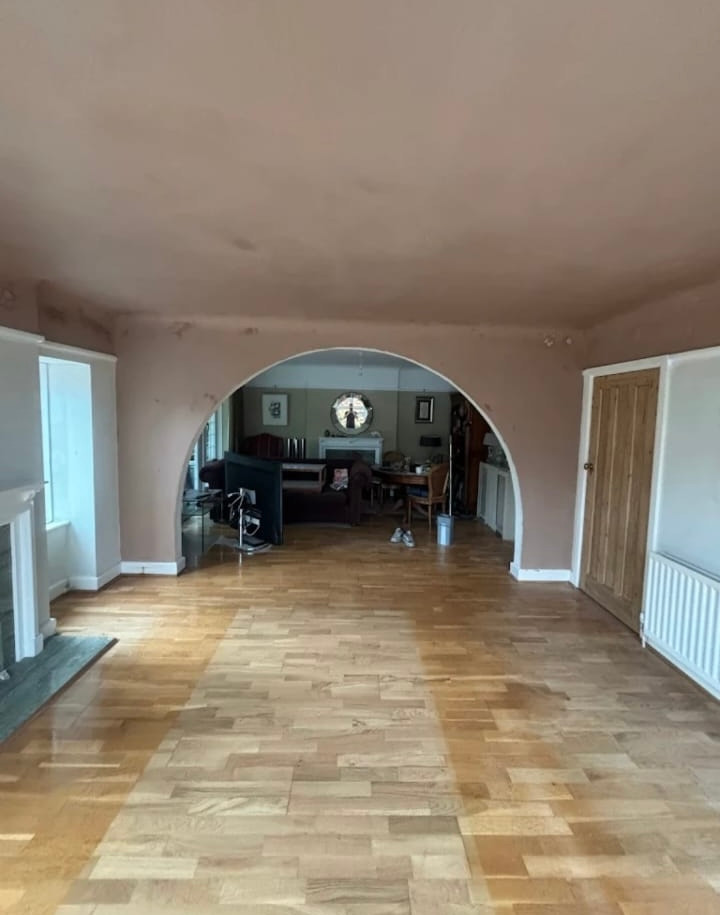
The mixer goes on the path, not the drive. About one home in five here is terraced, and that changes the practical side more than the plastering: the mixer goes on the path rather than the drive, every bag of waste comes back through the hall, and hacking off on a shared wall is felt next door, so we tell the neighbour when the noisy hours will be rather than leaving them to find out.
The biggest single block of housing here went up between the late sixties and the early eighties, and that plaster is usually still gripping. What has failed is the surface, under woodchip, textured paper and paint, so those rooms get two passes of finish coat trowelled flat. Roughly four homes in ten were built from the mid-eighties on, and those walls are dry lining instead: board stuck to blockwork on dabs, or screwed to a stud, joints taped, then a skim. A repair on one is a different movement. Cut the board back to a sound edge, fit a new piece the same thickness, tape and skim it out wide. An external corner takes an angle bead and a reveal a stop bead, bedded and run in. The hollow sound across the rest of it is how the wall was built rather than a defect. Where a patch has blown it comes off for a backing coat, browning or hardwall where the block pulls and bonding on a dense face.
A quarter of the homes here are bungalows, so their ceilings sit under a cold loft with nothing heated above them, and that is where sagging board and cracks along the board edges turn up first. Overboarding and skimming usually beats pulling a ceiling down, and anything textured from before the mid-1980s is tested before it is scraped. Outside, plenty of the older bungalows are pebbledashed or rendered in sand and cement that has now crazed and started to drum off, and the choice is a like-for-like patch or a strip back to the masonry and a modern system, a scratch coat and render coat under a silicone thin coat or a monocouche, with a bell cast bead keeping the render clear of the damp proof course.
How it runs
From your call to a written price
Same team from the first visit to the last, one person to ring, and nobody sub-contracted in. The quote is itemised line by line, from protection to disposal. There is no conservation area over Three Legged Cross and only one entry in the parish is listed, so on an ordinary house here the outside finish is your own decision, and Planning Portal guidance on external walls sets out where that stops. The green belt around the village bites on new buildings and extensions rather than on the finish of a wall you already have. Where render is stripped off most of an elevation, Approved Document L asks whether the wall should be insulated, and the one listed address would need listed building consent.
Cost
What decides the price
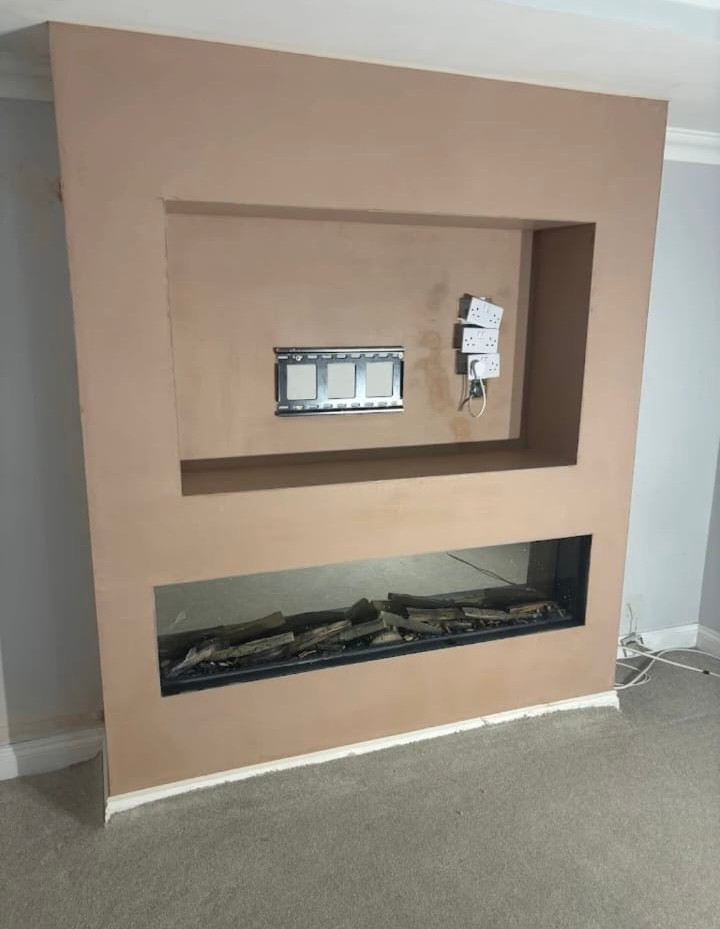
No rate per square metre, because two rooms the same size can be a day apart. A sound wall that only wants a skim is a different job from one where the backing coat has blown, and a dabbed wall is different again. Ceilings cost more than walls because everything is worked overhead. Round here access is usually a bungalow with a drive to stand a mixer on, a terraced house where the mixer goes on the path and every bag comes back through the hall, or a first floor flat where the boards and the waste both go up a shared stair. Outside, a tower does for low work and a gable wants a scaffold.
If it has come down
A ceiling cracking, or plaster blown off a wall
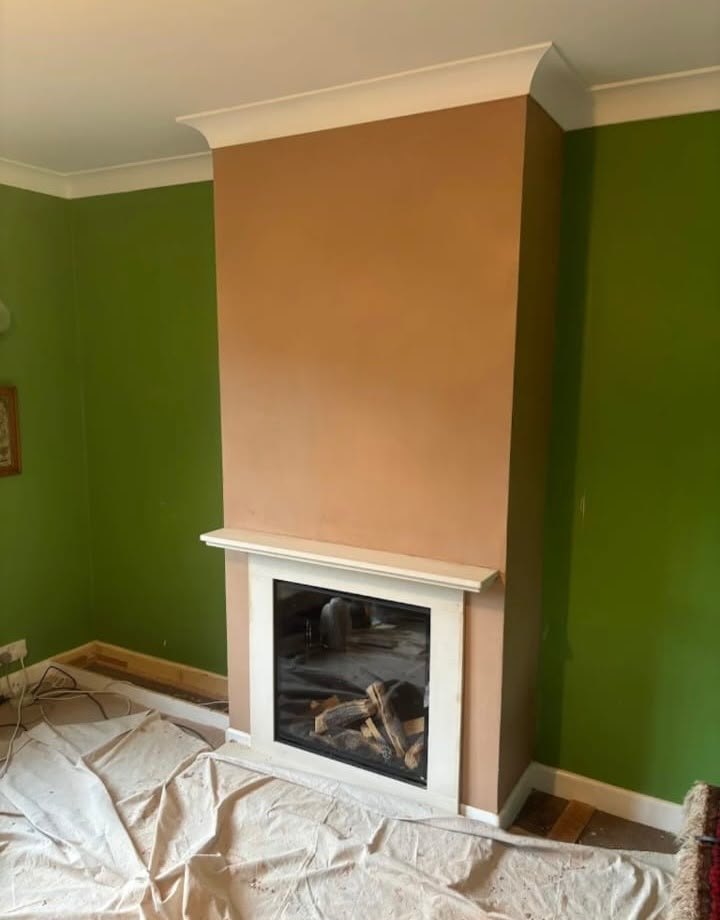
Ring rather than use the form. A ceiling that has cracked and dropped, plaster coming off in sheets, or a wet patch spreading across a wall all go to the front of the queue. We are about nine miles away, so a same-day look is normally possible. There is no point putting a finish on a wall that is still wet.
Worth knowing
Getting new plaster dry in a house that is sealed up tight
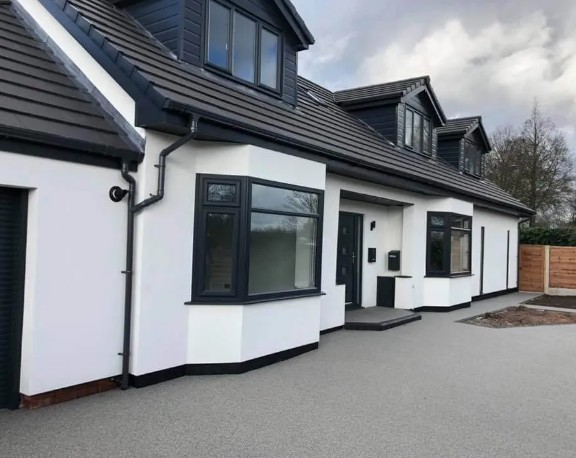
The newer half of this village dries plaster far more slowly than the older half, and it catches people out when they have already booked a decorator. A house built from the mid-eighties on has sealed units, no open chimney and trickle vents that are usually shut, so the water you have just put on the wall has nowhere to go.
Open the vents, run the extract fans, leave the internal doors ajar and keep a low steady background heat. What does not work is a fan heater aimed at one wall: that dries the face while the back is still wet, and you get crazing and hairline cracking across a finish that was fine an hour earlier. A dehumidifier is useful in the room, not pointed at the plaster.
The older bungalows and houses behave the other way. Their outside walls are colder, so a fresh skim dries unevenly and the darkest patch is nearly always the outside corner or the wall behind a wardrobe. Wait for the whole wall to go one even pale colour before anything goes on it, then a watered-down mist coat first so the paint grips.
A skim over sound plaster can be ready in days. A wall taken back to the block and rebuilt with a backing coat wants considerably longer, and in winter longer again. We give you the expected drying time in writing with the quote so you can book the decorator once rather than twice.
Who you are dealing with
A local firm you can check
About nine miles from us, covering Three Legged Cross, Verwood, West Moors and the BH21 addresses along the old railway line, with Dorset Council for planning and building control. Bournemouth Roofing & Building Ltd, registered in England and Wales, company number 15471719, which you can look up in a minute. Thomas Hannen's business, and he is the one who comes out to price the job, not a salesman. A verified customer's 10 out of 10 on Checkatrade. The visit and the written quote are both free.
Questions
Three Legged Cross questions we get asked
Three Legged Cross is mostly modern. Are the walls dry lined?
A lot of them are. Over four in ten homes here went up between 1983 and 2008, and by then plasterboard was being dabbed onto blockwork rather than floated on wet, so the board sits on adhesive with an air gap behind it. That gap is why the wall drums when you tap it, and why a heavy picture fixing pulls straight back out unless it reaches the block behind the board.
Is anything in Three Legged Cross protected from being re-rendered?
On the outside of an ordinary house, more or less nothing is. Three Legged Cross has no conservation area and a single listed entry, so there is no appearance control over an unlisted home and a change of render or colour is normally your own affair. Green belt sits over the area, but that bites on extensions and outbuildings rather than on recoating a wall that is already there. Worth a call to Dorset Council if you are unsure.
What is involved in taking a textured bungalow ceiling off?
Either over-boarding it or taking the whole ceiling down, and on a bungalow over-boarding is usually the sensible one. A quarter of Three Legged Cross is bungalows, and those ceilings sit directly under the loft with no floor above them, so an extra layer of board changes nothing anyone will notice and keeps the old finish sealed in place. Where a ceiling has already sagged it comes down instead, and the joists get checked.
The joints on our ceiling have cracked in straight lines. Why?
Those are the board joints opening up, not the plaster failing. On the newer Three Legged Cross stock the ceiling is plasterboard with scrim tape over each joint, and where the tape was skimped or the boards were fixed too tight the joint moves with the seasons and telegraphs a straight line through the paint. Filling it does not last. Cutting the tape out, re-taping and skimming the whole ceiling does.
What does the free quote actually list for a full house?
Room by room and surface by surface, with preparation shown separately from the finish. On a dry lined house, which most of Three Legged Cross is, that means the joint work, the beading on external angles, and whether a wall is being over-boarded or patched, each as its own line. Thomas Hannen writes it after seeing the rooms rather than off a floor plan, and there is no charge for the visit or the quote.
Nearby, and next door
Plastering and rendering near Three Legged Cross
Plastering and rendering nearby
Our other trades in Three Legged Cross
Everything we do in Verwood Plastering and rendering, all areas Every area we cover
Free quote
Get a straight answer on your Three Legged Cross walls
A free site visit, every wall and ceiling sounded rather than glanced at, and an itemised written quote with the drying time on it.