
Driveways and patios in Longham
Block paving, resin, tarmac and patios across Longham and BH22, with the sub-base and the drainage priced openly rather than hidden in a rate.
The site visit is free and so is the written itemised quote. Thomas Hannen prices every job himself.
The surface is the cheap part of putting a Longham drive right. What it costs is decided by what is under it and where the water is allowed to go. Most of the ones we are called to were laid with the house and have simply run out of road.
The calls come in three shapes. A concrete drive that went down with the estate has cracked across the bays and now lifts at the joints. Block paving from a later re-lay has sunk in the wheel tracks, gone green and grown weed through the joints. Or there is standing water where a car parks, and it has started creeping towards a doorway that sits barely above the paving.
We are only a few miles away, so somebody comes out, digs a trial hole where the wheels actually sit, and takes levels off the threshold. You get a written itemised quote with the dig, the sub-base, the edgings, the drainage and the surface priced apart.
The work
Bungalow frontages, old concrete and paving that has dropped
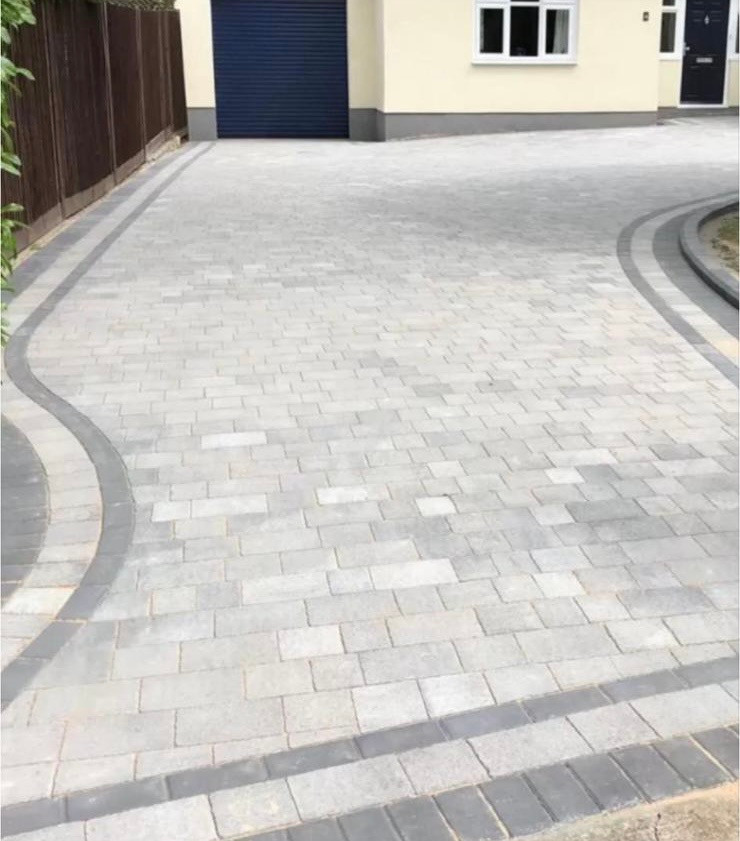
The original concrete, and what to do with it. Six in ten homes here went up between 1945 and 1982, with the peak in the late sixties and early seventies, and a lot of the drives are the ones laid when the houses went up, in bays with joints between them. They fail in a pattern: the joints open, a corner lifts where a root has got under it, and the surface crazes and holds staining. Concrete is not a bad base and sometimes a new surface can go over it. But if the slab is rocking it comes out, and breaking it up weighs a great deal and costs more to take away than soil does. That is a line on the quote, not a footnote.
Levels at the door, which is a bungalow problem. Longham is bungalow country, better than a third of the housing, and on a bungalow the floor inside sits close to the ground outside. Over the years each new surface has gone on top of the last until the paving is level with, or above, the damp proof course. Then the wall inside goes damp and everyone blames the weather. The finished level comes down two brick courses below the damp course, or a channel drain and a gravel margin go in along the wall so nothing bridges up to the threshold. We measure that before we talk about surfaces.
The plots here are generous at the front, so a drive can usually be built to let you come out forwards rather than reverse into the road, and so two cars pass without one sitting on the border. Where the frontage has never been opened up, the dropped kerb is an application of its own to Dorset Council on the highway side, and it takes longer to come through than the drive takes to build. The ground holds water, so where the fall goes is settled at the survey rather than assumed.
Where the sub-base was thin, a car finds it out: sunken bays and rutting under one wheel, kiln dried sand washed out of the jointing, and blocks creeping outwards because the edge restraint stops at the gate and the rest of the perimeter is lawn. A lift, a re-lay to the right falls, a re-sand and a properly haunched kerb deals with most of it. If the base was never deep enough, relaying the top just buys a season. Patios behind these houses are usually reached through a side gate, so before we price a slab we measure the gate.
How it runs
From your call to a written price
One person to ring, and an itemised quote: excavation, muck away, sub base, edgings, the surface and the drainage on separate lines. Relaying a drive or a patio in the same place is maintenance and needs nothing. New hard surfacing at the front over five square metres draining onto the road needs planning permission, and the Planning Portal sets out where that line sits. Use a permeable surface, or keep the fall on your own land, and it stays permitted development, though on ground this wet somewhere for the water to go is a design question rather than an assumption. No conservation area covers Longham and the listed entries near here are few.
Cost
What decides the price of a driveway
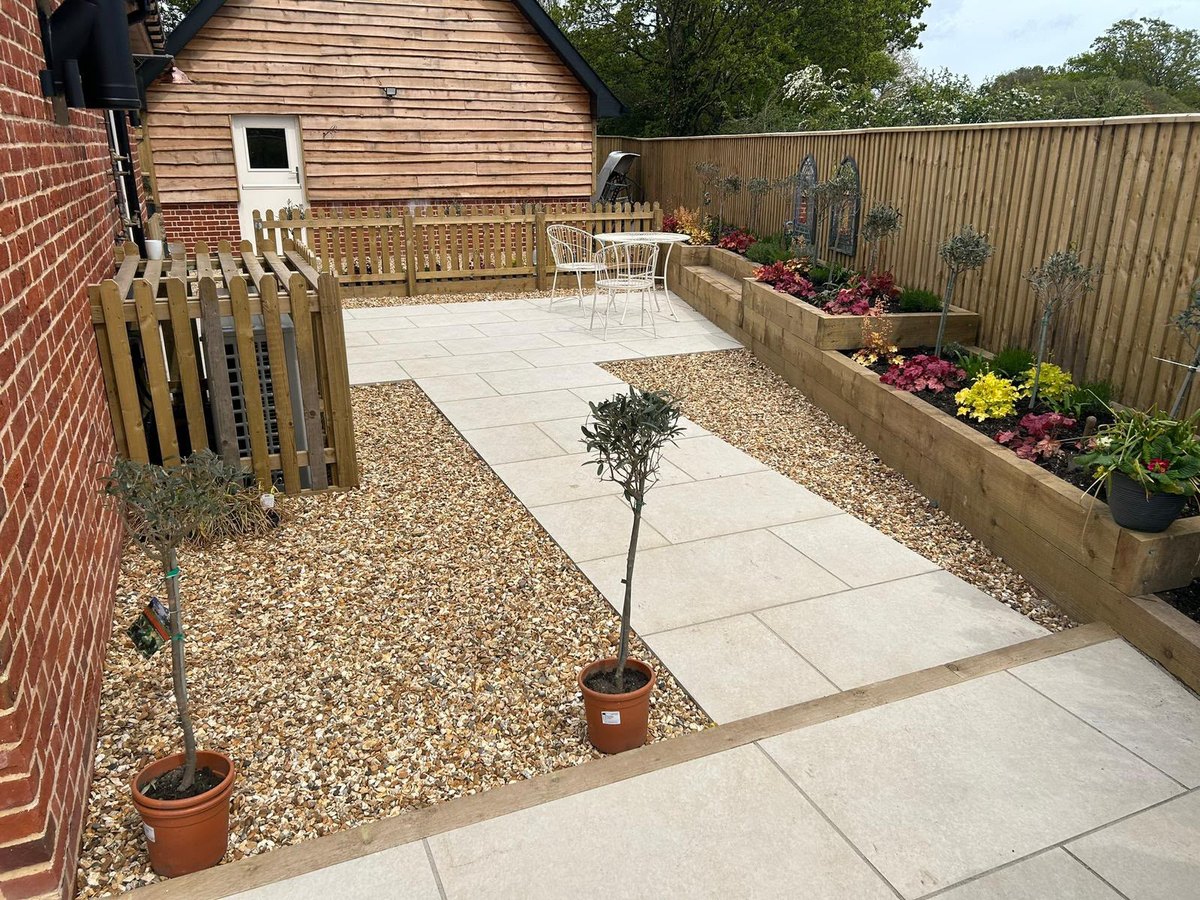
No rate per square metre. What is under it decides more of the cost than what goes on top. A bungalow with an open frontage, a detached house on a close with a shared turning head, and a back garden reached only through a side gate are three different jobs. The ground holds water, so where the fall goes is settled at the survey rather than assumed. Ask any quote how deep the dig is, what sub base goes in, where the water goes, and who takes the spoil.
If it is urgent
A trip hazard, or a drive that floods
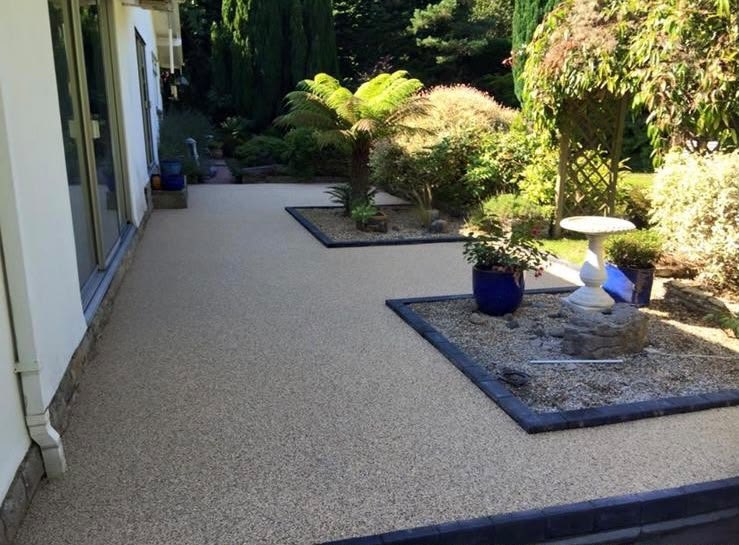
Ring rather than use the form. A lifted slab, a sunken bay by a doorway or a gully that has stopped taking water will not wait. The first visit is about making it safe and getting the water going somewhere. Around here it is most often a bay dropped away right outside a bungalow door. The phone is answered 24 hours for emergencies; scheduled work runs Monday to Friday, 8am to 6pm.
Worth knowing
Wet ground, and why a soakaway is not the automatic answer here
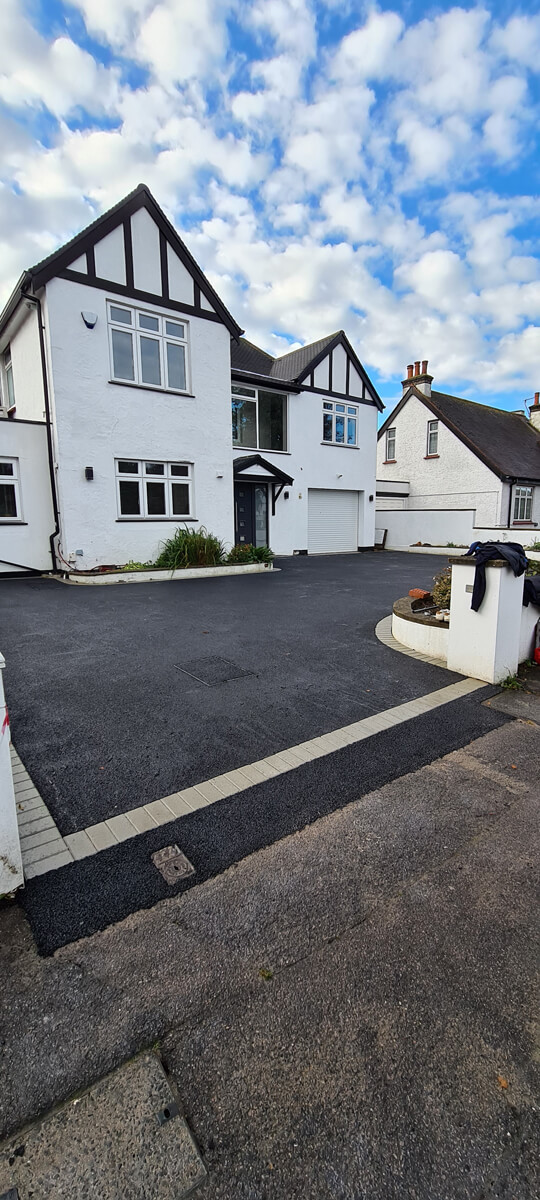
The default drainage design on a new drive is to soak the water away on your own land, and on the low ground around here that is the design most likely to fail. Ground that holds water does not take a storm from an extra parking bay as well as a dry sandy plot does, and a soakaway that cannot empty between downpours simply fills up and backs out at the surface, usually at the lowest point, which is often a doorway. Approved Document H is the document that governs it, and the honest way to size one is a percolation test dug in the wet half of the year rather than an assumption made in July.
What that changes for you is the order of the decisions. Before choosing between block paving, resin and tarmac, we work out where the water is lawfully going: into your own ground if it will genuinely take it, into a surface water drain if there is one and the owner agrees, or held in a deep permeable sub-base that releases slowly, which is the approach the SuDS guidance pushes everyone towards.
What it must never join is the foul drain, and it is not allowed to run out onto the road. If the test says the ground will not take it, we tell you before you have paid for a surface that depends on it.
Who you are dealing with
A local firm you can check
Longham is one of the shortest runs we make, and we cover it along with BH22, up to Ferndown and across to West Parley and Wimborne. Bournemouth Roofing & Building Ltd, registered in England and Wales, company number 15471719, which you can look up in a minute. Thomas Hannen's business, and he is the one who comes out to price the job, not a salesman. A verified customer's 10 out of 10 on Checkatrade. The visit and the written quote are both free.
Questions
Longham questions we get asked
Bungalow drives here are wide. Does that change the base?
Mainly the area, not the build up. Bungalows are 36.3% of the homes in Longham, so the frontage is wide and shallow and the drive tends to be one open square rather than a strip down the side. That means more edge per car and a lot of surface with nothing obvious to fall to, so drainage has to be designed as channels across it rather than one gully in a corner.
The drives on our road are all going at once. Why?
Because they went in at the same time. Longham is 60.0% post war stock built between 1945 and 1982, most of it in the late 1960s and early 1970s, and the drives were laid with the houses. They have had the same rain, the same frost and roughly the same number of cars, so the edge restraint and the joint sand give out within a season or two of each other along a whole street.
Where does the water go if the front garden all becomes drive?
Onto your own land, never the road, and that decides the design. Turning a soft front into a hard one removes the sponge, and on Ferndown ground already slow to take water there is nowhere for the extra to sit. So we either keep a planted border for it to soak into, use permeable blocks over a stone reservoir, or fall the surface back to a channel and a piped outlet.
Do you have to lift the whole drive to fix a sunken area?
No. A dip in block paving is nearly always a soft spot in the base beneath it or a washed out joint above a drain run, and both of those are local problems. We lift the blocks over a slightly bigger area than the dip, dig out what has failed, rebuild and relay the same blocks. The colour sits a shade off for one winter and then settles. Redoing everything for that is waste.
How do you stop the new drive sinking where the cars stand?
By building the base for the load rather than for the look. Wheel tracks and the turning point take far more punishment than the rest, so the stone goes in as compacted layers and gets whacked between each one, not tipped and levelled in a single pass. On these wide frontages it also means getting the falls right across the whole square, because water standing in the base is what softens it.
Nearby, and next door
Driveways and patios near Longham
Driveways and patios nearby
Our other trades in Longham
Everything we do in Ferndown Driveways and patios, all areas Every area we cover
Free quote
Get a price for a drive or patio in Longham
Tell us the address and what the drive is doing. We will come and look at the ground, then put an itemised price in writing. Both cost nothing.