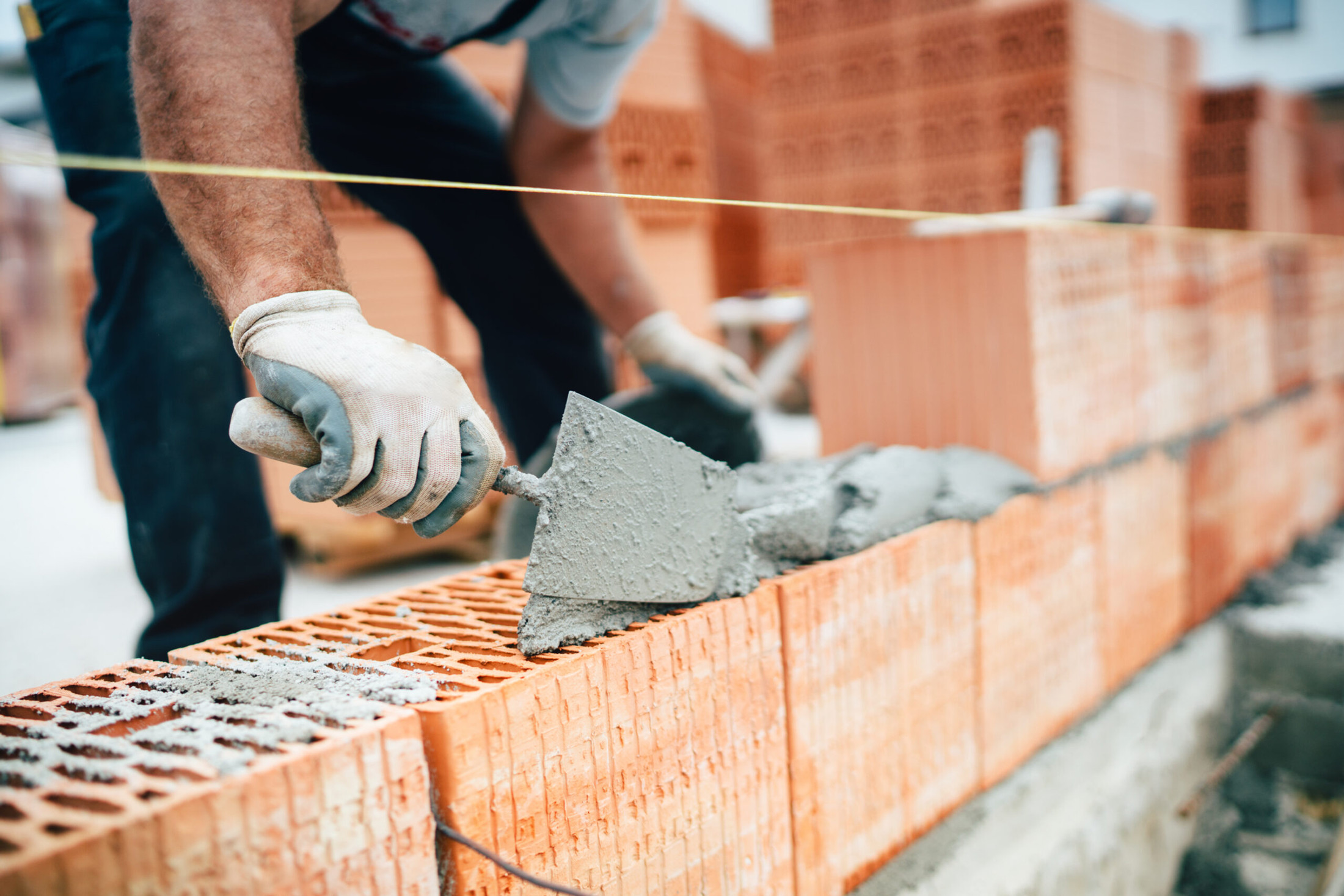
Bricklaying and repointing in Longham
Cavity brickwork, cracked joints and tired garden walls, sorted properly. We are four miles away, the visit is free and the quote is itemised.
The site visit is free and so is the written itemised quote. Thomas Hannen prices every job himself.
If the brickwork on a Longham house has a fine horizontal crack running along the same mortar joint right across an elevation, that is almost always the wall ties rusting, not the house moving. It is repaired from outside, and nobody has to come indoors.
Most calls here start with a crack somebody has finally stopped ignoring. Sometimes it is that flat horizontal line along a joint, often worst on the gable that takes the weather. Sometimes it is brick faces flaking off near the bottom of the wall, where a drive or a patio has been laid up over the damp proof course.
Sometimes it is a garden wall or a garage that has started to lean. The useful thing to know is that all three have a specific cause you can point at, so the first job is working out which one you have rather than pricing a rebuild. We come out, take photographs, and tell you plainly whether it is a morning's work or something bigger.
The work
The jobs we do on Longham brickwork
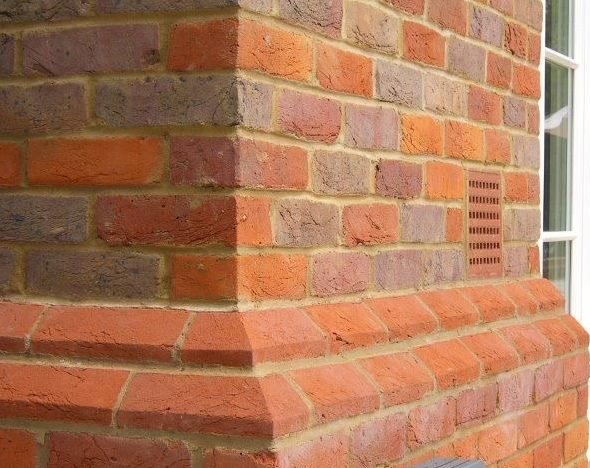
Wall tie replacement. Six in ten homes here went up between 1945 and 1982, and cavity houses of that age were built with mild steel ties. As they rust they swell, and because the tie sits in a bed joint the swelling lifts the outer leaf a fraction at a time. You see it as a hairline crack repeating along the same joint every sixth or ninth course, worst on the exposed gable, sometimes with the wall bowed out a touch below the eaves. The repair is remedial ties drilled through the outer leaf into the blockwork inner leaf on a set pattern, then the holes made good in a matched mortar.
Brick of this era went up in a gauged sand and cement mix, and it goes back the same way rather than in lime, because these are not solid walls. Most were finished with a bucket handle joint, some with a weather struck one, and we match whichever you have. Rake to depth, blow out, point back. A skim of fresh mortar smeared over a tired joint looks fine for two summers and then falls out.
Faces blowing off the bottom two or three courses is nearly always a damp proof course problem. A drive, a patio or a raised bed has ended up above the DPC, the wall wicks water behind the face, and the first hard frost takes the front off. Cutting out and replacing the spalling with a matched brick is the easy half. Getting the levels back down so it does not happen again is the half that matters, and on ground that shrinks and swells like this it is structural as much as damp, so we say so even when it is somebody else's paving.
Stepped cracks up from the corner of a window usually mean the lintel has had enough, or a steel rusting inside the wall. We cut out and replace, then rebuild the brickwork over the opening. Widening an opening for bifolds or a bigger garage door brings a structural calculation and building control. Then there are low boundary walls to the road, brick piers, coping, twisted gate piers, and the single skin garage walls that came with these houses. If you are building a new wall rather than repairing one, Planning Portal guidance on garden walls tells you the height you can go to without planning permission, and the Party Wall etc. Act 1996 covers anything sitting on the line with a neighbour. Matching an existing brick from the seventies takes sourcing rather than luck, so we bring samples to you before we order.
How it runs
From your call to a written price
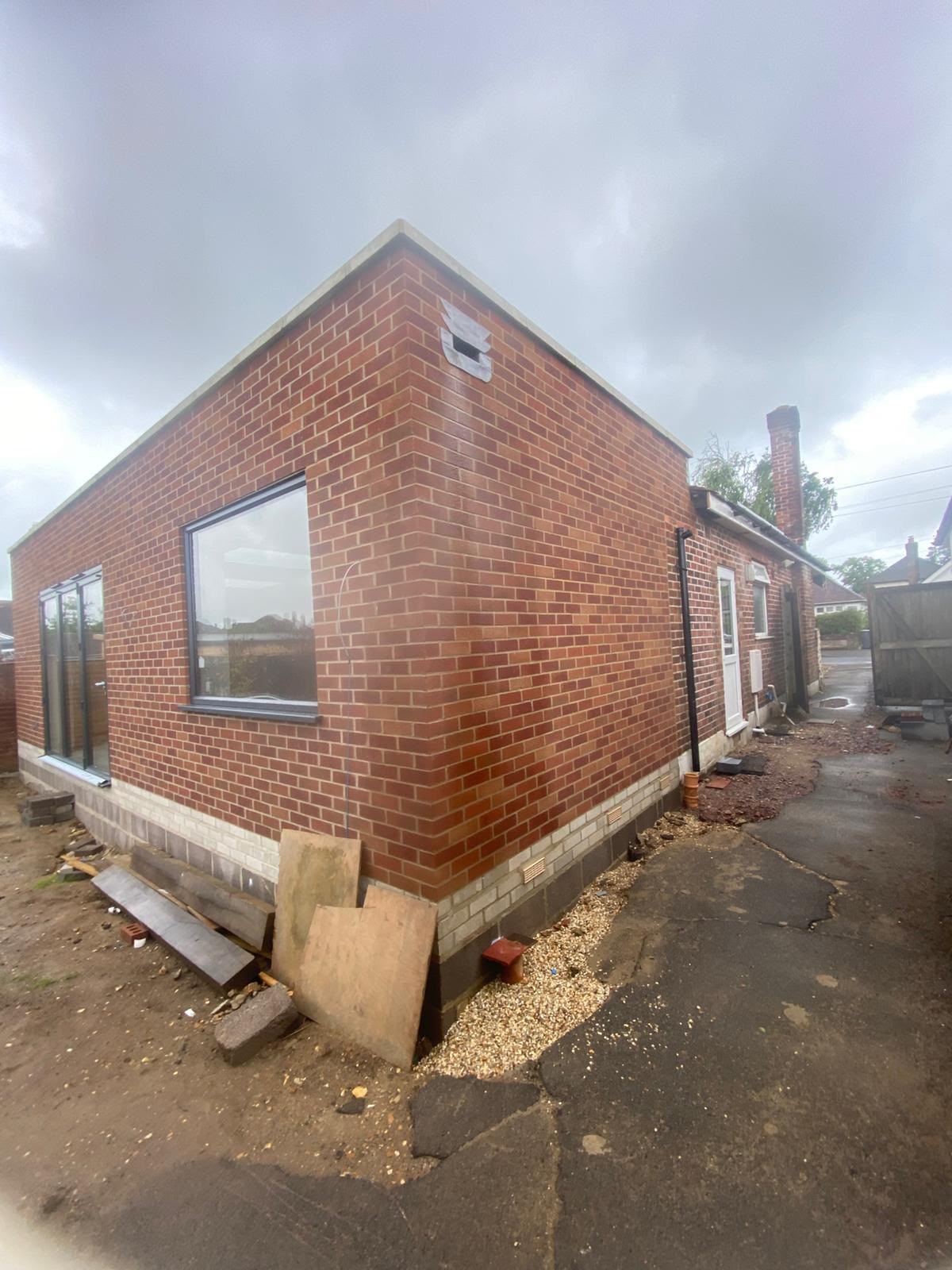
Same team from the first visit to the last, one person to ring, and the quote itemised: access, raking out, the mortar mix, the area of each elevation, any brick replacement and disposal on separate lines. If something turns up once we start that nobody could have seen, you get a photograph and a price before we carry on. No conservation area covers Longham and there are only 13 listed entries in the area, so for most addresses here repointing, tie replacement and brick repair need no application at all. Building control comes into it when a wall is load bearing or an opening is being altered, and Planning Portal guidance on external walls is the plain English version of where that line sits.
Cost
What decides the price of a brickwork job
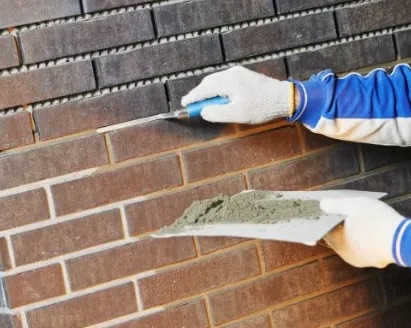
No rate per square metre: the metre of wall tells you nothing until you see the joints. A low front wall, a bungalow gable and a two storey rear elevation over a narrow side passage are three different jobs. How long the platform stands matters as much as its size, and the work at height rules are why it is a priced line. Raking by hand is slow, so joint depth and spalled faces decide the hours, and matching a mortar or sourcing a brick takes trial panels. Ask how deep joints are raked, by hand or disc, and whether the scaffold is in.
If something has moved
Loose brickwork, or a wall that has shifted
Ring rather than use the form. Anything overhead or leaning goes to the front of the queue. Longham is under five miles from us, so if a garden wall alongside the road or a garage flank has visibly moved, say so when you ring and it gets looked at first. The first visit is about making it safe. The phone is answered 24 hours for emergencies; scheduled work runs Monday to Friday, 8am to 6pm.
Worth knowing
Longham brickwork mostly went up in one go, and it ages together
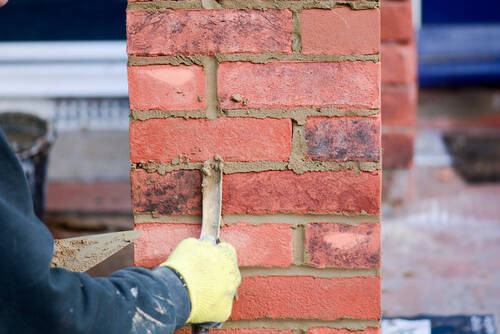
Six out of ten homes around here were built between the war and the early eighties, with the biggest single push in the late sixties and early seventies. That matters more than it sounds. Those houses were built by the same handful of firms, to the same details, with the same materials, within a few years of each other. So they do not fail one at a time and at random.
They fail together, in the same places, at roughly the same age: the ties on the exposed gable, the pointing on the weather side, the lintel over the garage opening, the coping on the front wall. If a neighbour two doors down has had ties done, that is genuinely useful information about your own wall, and it is worth asking.
What it changes for you is scope and timing. Patching one crack on a wall whose ties are on the way out is money spent twice, because you will have the scaffold back within a couple of years. It is nearly always cheaper to have the whole elevation looked at once, do the ties and the pointing on the same visit, and use the access you are already paying for.
It also means that if a run of neighbours are in the same position there is a real saving in getting the work priced together, because scaffold and set up are a big part of a small job. We are happy to quote several houses at once and price them separately so nobody is tied to anybody else.
Who you are dealing with
A local firm you can check
We cover Longham, Ferndown, West Parley, Hampreston, Wimborne and Bearwood, and BH22 and the roads either side of the Stour. Bournemouth Roofing & Building Ltd, registered in England and Wales, company number 15471719, which you can look up in a minute. Thomas Hannen's business, and he is the one who comes out to price the job, not a salesman. A verified customer's 10 out of 10 on Checkatrade. The visit and the written quote are both free.
Questions
Longham questions we get asked
Horizontal cracks every few courses. Ties or movement?
Horizontal and evenly spaced means ties. Cavity ties corrode, swell to several times their original thickness and jack the outer leaf up a fraction at every tie position, which is why the crack follows one bed joint at a regular spacing right along the wall. Ground movement gives you diagonal stepped cracking, wider at one end than the other. 60.0% of Longham was built between 1945 and 1982, peaking in the late 1960s and early 1970s, so ties are the usual answer here.
Why does a bungalow need more pointing than a house?
Because there is more outside wall for the same amount of inside. Bungalows make up 36.3% of Longham dwellings, the largest share of any type in the settlement, and spreading one floor area across a single storey gives you a longer perimeter, more external corners and more window reveals to weather. Every one of those edges is where driven rain finds a way in first. The consolation is that most of it is reachable without a full scaffold.
The ground stays wet here. Does that reach our footings?
It does. Longham sits on naturally wet cohesive ground rated significant for shrink and swell, so soil that is saturated all winter and bakes out in a hot summer changes volume, and anything on a shallow footing rides up and down with it. A downpipe emptying against the house, or a soakaway set too close in, makes that local swing sharper still. We trace where the water goes before repairing the crack, or the same crack reappears.
Can you replace just the few blown bricks under our sills?
That is a straightforward repair. Spalled bricks are cut out one at a time and replaced with matched ones turned so a sound face shows, then the surrounding joints are made good so it does not read as a patch. Under a sill the real cause is usually a failed cill or a missing drip putting water where it should not be, so that gets dealt with too. Longham is a short run from us, so a handful of bricks is worth the visit.
Does Green Belt affect an extension in Ferndown South?
It bears on new building, not on mending what is there. Longham lies in Green Belt, where extensions and outbuildings are weighed on scale and on whether they are disproportionate to the original house, while repointing, rebuilding a wall on its line and structural brick repairs fall outside all of that. Dorset Council is the planning authority. If the plan is something new rather than something mended, settle the planning position before we price brickwork.
Nearby, and next door
Bricklaying and repointing near Longham
Bricklaying and repointing nearby
Our other trades in Longham
Everything we do in Ferndown Bricklaying and repointing, all areas Every area we cover
Free quote
Find out what that crack actually is
A free site visit in Longham, photographs of what we find behind the brick, and an itemised written quote you can compare.