
Driveways and patios in Bearwood
Estate drives relaid on a base that will hold a car, patios that fall away from the house, and a written price before anything is lifted.
The site visit is free and so is the written itemised quote. Thomas Hannen prices every job himself.
If your blocks were laid when the house was built, they are not worn out. They have run out of base. Relaying the same blocks on a proper build up is nearly always cheaper than a new surface, and on a Bearwood drive it is the first thing we check.
The calls we get from this side of BH11 are usually one of three. The drive has dropped into a saucer where the car stands and rain sits in it. The blocks have crept sideways into the grass, so the pattern has opened up and there is a finger wide gap along the edge.
Or the back is the problem: a small paved yard that greened over, tipped towards the kitchen wall and now holds water at the door. We come and look at it in person, put a level across it, and take a few blocks up so we can see the depth of what is underneath. That half hour decides whether you are buying a repair or a rebuild, and you get told which before anyone writes a number down.
The work
Estate block paving, thirty-odd years on
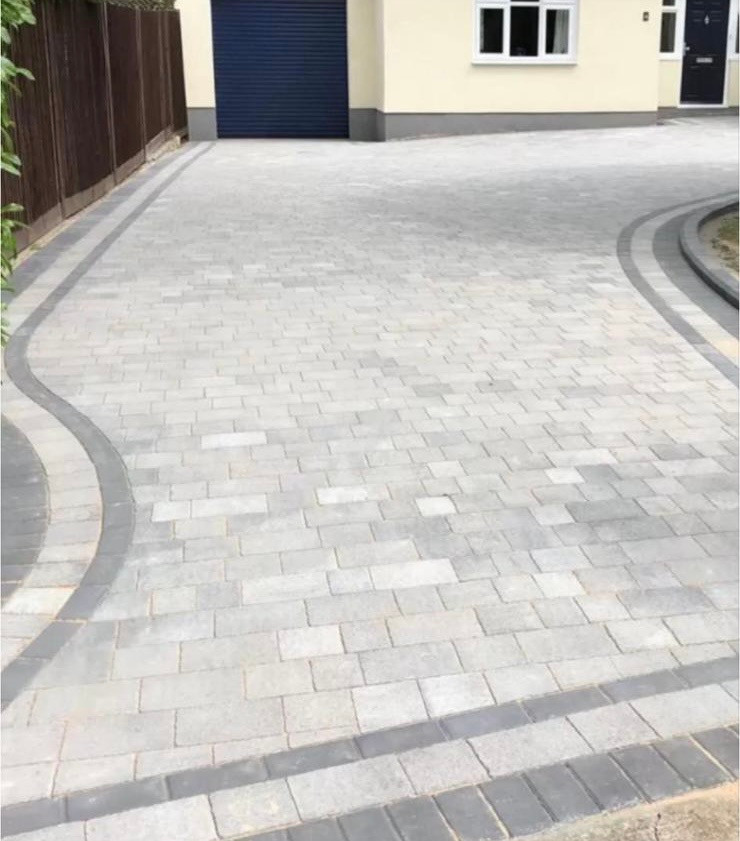
Relaying the original drive. Almost everything here was built in one go in the 1980s, and the developer's drives went down fast: a shallow bed of scalpings, blocks on top, edges only where the plot needed them. They lasted a long time and now they are giving up all at once, in the same two places, with rutting under the wheels and blocks tipping in. We lift them by hand, stack what is reusable, dig out the tired material with a small machine, cut back to a firm formation and rebuild the sub-base in two compacted layers over a geotextile membrane. Roughly nine in ten of the original blocks go back down, and the rest we make up from a matching range.
Edges, which is what actually failed. On the terraced rows the frontages ran into open lawn with nothing holding the paving in. Blocks only stay tight because they push against each other, so the moment one side has nothing to push against, the whole field of them walks. New work gets a concrete edge restraint or a kerb bedded and haunched along every open side, with a planting border kept back off it rather than soil piled against it.
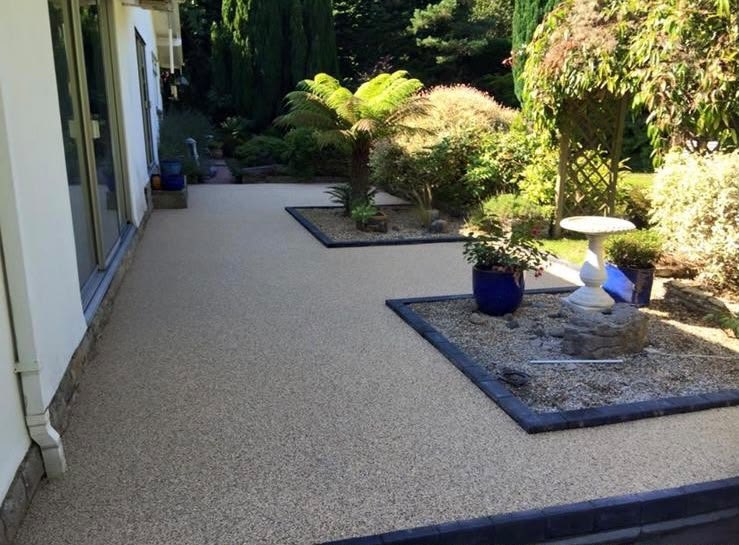
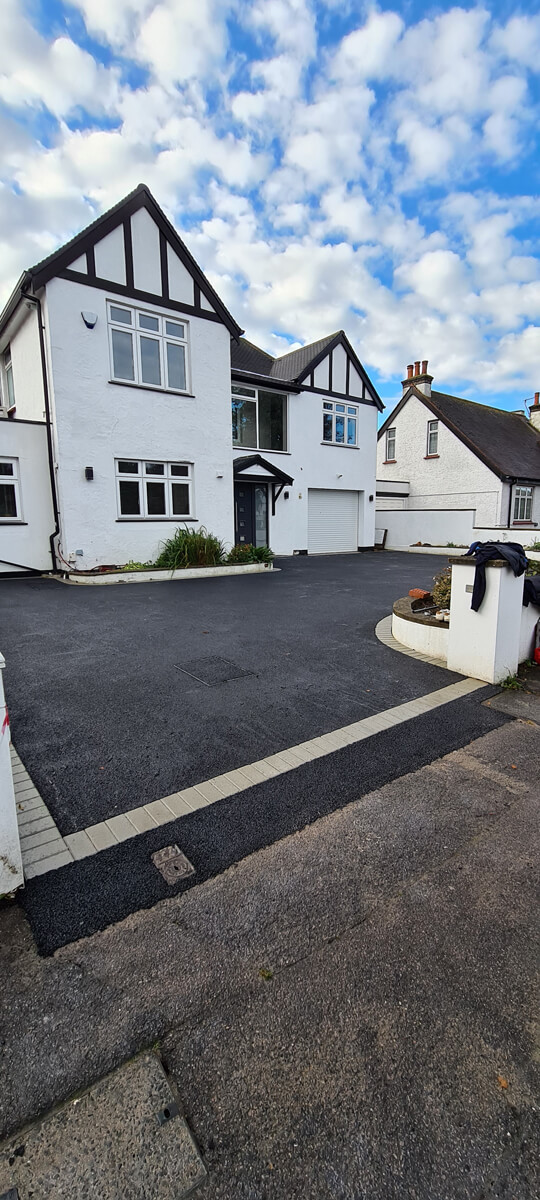
Parking two cars where the builder allowed for one is the other job on this estate. Tandem drives and a strip of front lawn taken in are the usual answers, and either way the drainage changes, which is where the surface gets chosen: permeable block, resin bound over a sound base, or tarmac where you want it plain and quick. Widening often means a wider vehicle crossing as well, which is a separate job with the council rather than something we can pave up to.
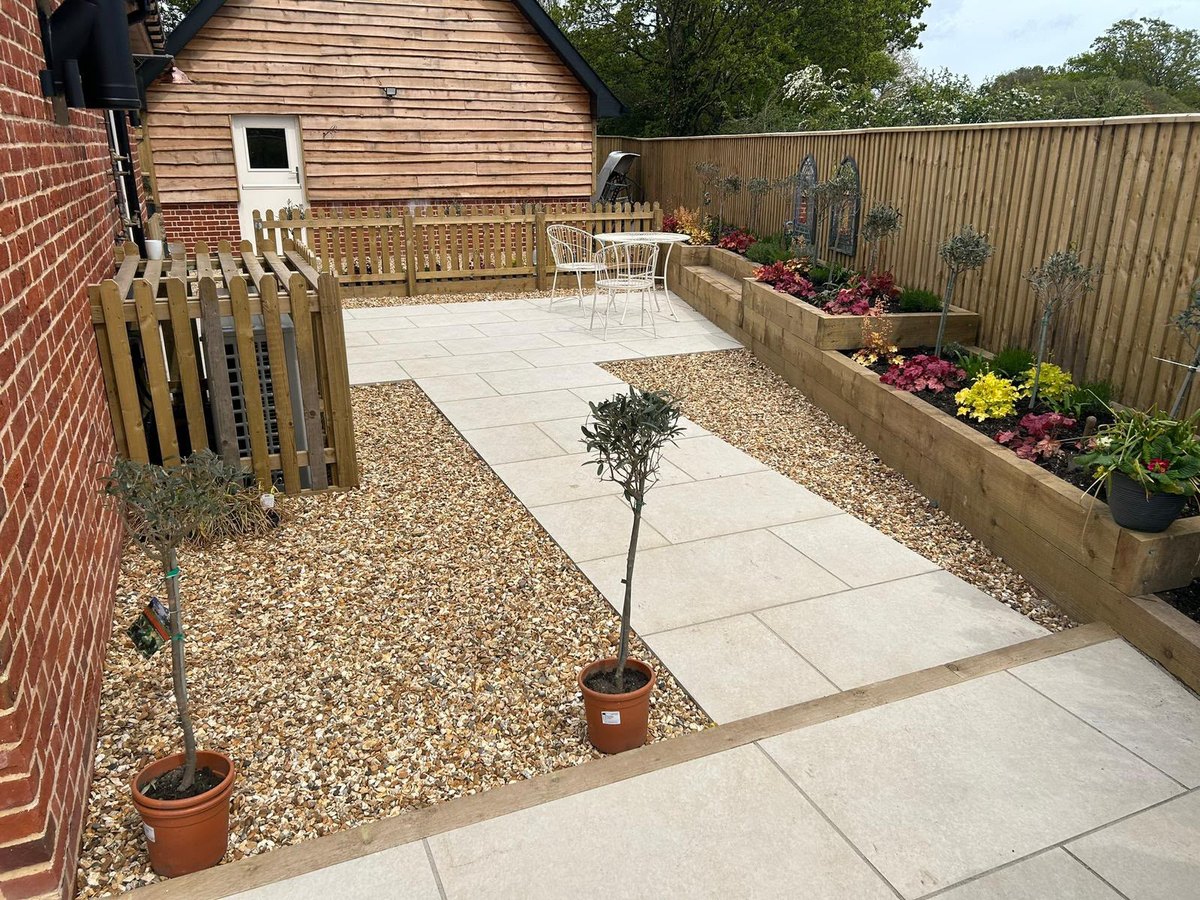
Rear gardens on this estate are short, so the patio is usually the whole of it and it sits hard against the house. Two faults turn up constantly: the level has crept up to or above the damp proof course, and the fall runs back towards the wall instead of away from it. Both are fixable without losing the space, by dropping the finished level or taking one step down and running a channel drain along the threshold. Weed in the joints or one settled corner by the gate is an afternoon with kiln dried sand, and we will say so rather than quote you a drive.
How it runs
From your call to a written price
Bournemouth, Christchurch and Poole are both the planning authority and the highway authority here, so it is one council for the whole of it. Paving the front stays permitted development while the rain stays on your land, which means a permeable surface or a fall into a soakaway or a border. Take more than five square metres of hard surfacing straight out to the road and you need planning permission, as Planning Portal guidance on paving a front garden explains. A new or widened vehicle crossing is applied for separately, and it is worth starting that before the paving is booked. The quote comes itemised line by line, and the same team is on it start to finish.
Cost
What decides the price of a driveway
Most drives here are open to the estate road, which keeps the muck away simple and the deliveries cheap, and that is a real saving against a job where every barrow goes through a side gate. What is left is the part you never see. The developer's shallow scalpings are why so many of these drives rutted, so the dig depth and the new sub base are where the money should go rather than into the surface. Ask any quote how deep it digs, what goes in underneath, where the surface water ends up, and whether the edgings are haunched.
If it is urgent
A trip hazard, or a drive that floods
If water is standing against the wall of the house rather than out on the drive, ring the same day and leave it where it is until we have seen it. Lifted slabs and a gully that has stopped taking water are the other two worth a call rather than the form. We are four miles up the road, which makes Bearwood one of the quickest calls we get.
The one local thing
The ground moves here, so the water matters more than the surface
The ground under Bearwood is cohesive and it shrinks and swells with the seasons. It gives up moisture and pulls in through a dry summer, then takes it back over winter. Under a lawn nobody notices.
Under a new drive it becomes your problem, because a drive is a large sheet that keeps rain off one patch of ground and pours it onto another, right beside a house whose foundations are not deep. Get that wrong and you are not looking at a puddle, you are looking at movement in the fabric of the building.
So three things get decided at the site visit rather than on the day. Where the water goes: Approved Document H expects a soakaway to sit well clear of the building, five metres out as a rule, and on ground like this it also expects a percolation test rather than an assumption.
Whether infiltration works at all: where it does not, the water needs a positive outfall to a surface water drain, and it may never lawfully go into the foul system. And the trees. The estate was planted when it was built, and those trees have been drinking out of that ground for decades. Taking a mature one out to make room for parking can let the clay swell back over several years, which is a slower and more expensive problem than the paving it made way for. If that is on your list, say so at the survey and we will talk about it before anything is dug.
Who you are dealing with
A local firm you can check
We cover Bearwood and BH11, over to Kinson, Merley and Broadstone, and we are about four miles up the road. Bournemouth Roofing & Building Ltd, registered in England and Wales, company number 15471719, which you can look up in a minute. Thomas Hannen's business, and he is the one who comes out to price the job, not a salesman. A verified customer's 10 out of 10 on Checkatrade. The visit and the written quote are both free.
Questions
Bearwood questions we get asked
Every house in Bearwood is modern. Does that change the patio?
It changes the level detail. Nothing in Bearwood predates 1919 and better than a third of it went up in the 1980s, so the walls have a proper damp course and you are not fighting a solid wall cottage with its floor at garden height. Paving can come up to two courses below the door, with the drop used for a channel. What it does not change is the fall, which still has to run water away from the house.
The only way to the back is through the house. Now what?
Then it all goes by barrow along a boarded run, or over the fence where a neighbour agrees. Terraces are 28.9% of Bearwood, so this comes up regularly and it is a planning problem rather than a stopper. We sheet the floor, work in smaller batches and mix outside so nothing sets indoors. It costs time rather than making the job impossible, and that time shows as its own line on the quote.
Bearwood ground drains freely. Does a soakaway work here?
Usually it does, and that keeps the design straightforward. The ground at Bearwood is free draining, so a properly sized soakaway on your own land is normally the right answer and the drive stays inside permitted development. A test hole still gets opened, because builder's backfill round an eighties estate house behaves nothing like the natural ground a few feet away. An hour with a pit and a stopwatch settles the stone depth.
Who signs off a new opening onto a Bearwood road?
Bournemouth, Christchurch and Poole council do, as highway authority, and the application is made by the householder rather than by us. They set the width, the construction and whether the footway can be crossed at all, given sightlines and whatever street furniture is in the way. We build to that specification and time our work around the date they give. Paving up to a kerb that never gets dropped is money spent on a garden path.
Is there anything worth checking before we call anyone out?
Three things. Stand at the pavement and see whether the edge course still runs straight, because a bowed edge means the restraint has gone and the surface will keep spreading. Then look at where water is sitting an hour after rain. Then push a screwdriver into a joint: in it goes easily, the sand has washed out. Most Bearwood drives are eighties work, and those three checks say whether it is a relay or a rebuild.
Nearby, and next door
Driveways and patios near Bearwood
Driveways and patios nearby
Our other trades in Bearwood
Everything we do in Broadstone Driveways and patios, all areas Every area we cover
Free quote
Find out what your drive actually needs
A free visit in Bearwood, a few blocks lifted so we can see the base, and an itemised written quote.