Driveways in Parkstone
Front parking and new drives on a hillside suburb, with the levels, the drainage and the kerb worked out before the surface is chosen.
The site visit is free and so is the written itemised quote. Thomas Hannen prices every job himself.
Last updated
We lay driveways in Parkstone in block paving, resin, tarmac and concrete, and on a lot of these streets the fall of the ground decides the job before the surface does. We work out where the rainwater will run, how the car gets on and off the road, and what is holding the front garden up, then price it in writing. For back gardens, see patios in Parkstone.
Parkstone drive work usually starts with a slope, a sunken track or a shared frontage. A front garden that the owner wants to park on, on a road where the house sits above or below the pavement. A drive that has sunk in the wheel tracks and now holds a puddle by the garage door. And a shared frontage at a converted house or a small block, where the surface has broken up and nobody is sure whose job it is.
We come out, take levels off the house and the pavement, open a small hole to see what is under the old surface, and tell you what it needs. If a repair is the honest answer, you get a price for the repair. The visit and the written itemised quote are free.
The work
Drives on a hill, old concrete and shared frontages
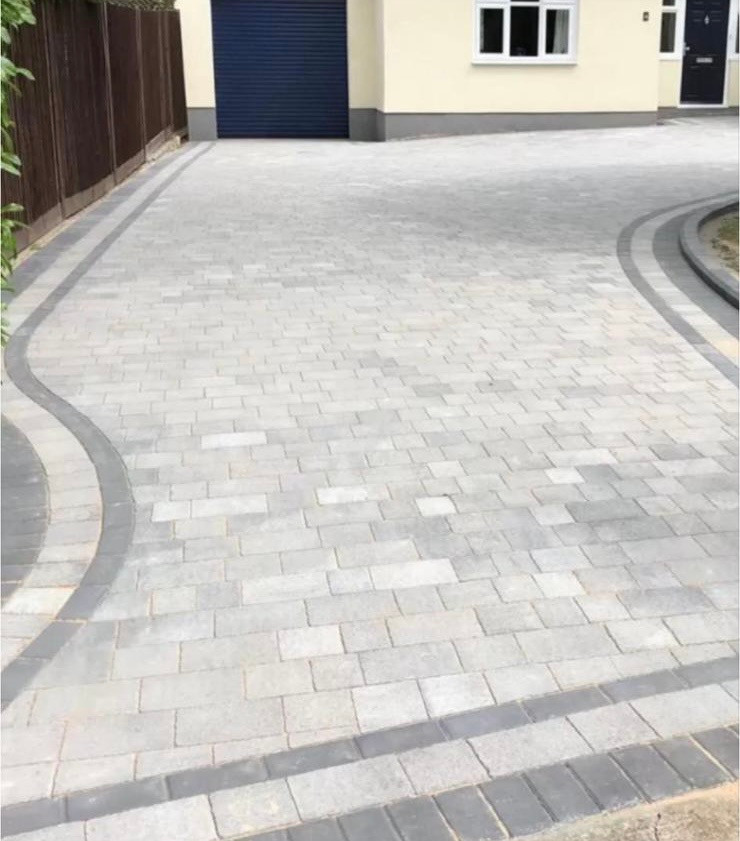
New parking in a front garden. On the older terraces and villas the front garden is often the only place a car will ever go. The paving is the quick part.
The crossing is the slow part, because a new or wider dropped kerb is an application to BCP Council as highway authority, and the footway is rebuilt to their specification. Where the garden sits above the pavement, the bay is cut in and a retaining wall built either side. Where it sits below, the drive is built up and ramped, and the gradient at the crossing has to suit a car that does not ground out.
Taking out a failed drive. The inter-war and post-war semis further up the hill in Parkstone were often given two concrete strips or a thin tarmac, laid onto whatever was there. They fail the same way: a crack along each wheel track, rutting where the car turns in, and a sunken patch where water has stood. If the old slab is flat and solid, resin bound can go over it with almost no dig. If it rocks, it comes out. The formation is cut back to firm ground, a geotextile membrane goes down, and the sub-base goes in compacted layers to a depth that suits the ground and the load.
Block paving. Still the most forgiving surface on a Parkstone slope, because a block that has settled can be lifted and relaid without cutting a scar through the drive. It needs a firm edge restraint haunched in concrete, or the blocks creep sideways and downhill. Joints are filled with kiln dried sand and topped up after the first few weeks as it settles in. Permeable block, with open joints and a free draining base, is the easiest way to keep the water on your own land.
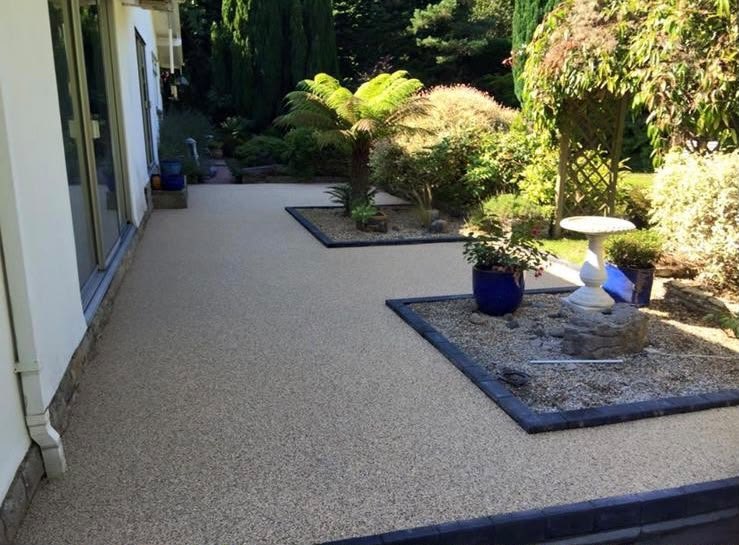
Resin bound, tarmac and concrete. Resin bound is porous, quiet in colour and fine on a moderate slope, but it needs a sound, dry base and is laid in one go. Tarmac is quick and takes a turning wheel well. Pattern imprinted concrete is hard wearing but cannot be patched invisibly, and it is not permeable, so the drainage has to be designed in. Loose gravel we would talk you out of on any real gradient, because it washes and walks downhill onto the pavement.
Shared forecourts at flats. Parkstone has a lot of flats, many in big houses split up and some in small purpose-built blocks, and the frontage is usually shared. We price that as one job laid to one fall, with bays set out and a channel drain across the entrance, in a form the freeholder can send out under section 20 where the leaseholders pay. Flats have no permitted development rights for paving, so a new hard surface there needs planning.
Repairs. A sunken bay, a lifted kerb, blocks rocking by the gate, weed through open joints, a gully that has stopped taking water, or a drive that has spread at the edges. These are usually a day or two, and we will say so rather than sell you a new drive.
How it runs
From your call to a written price
One person to ring from the first visit to the last. The quote is itemised, not a figure on the back of a card: excavation, muck away, the sub base, edgings, the surface itself and the drainage on separate lines, so you can compare it properly against anyone else's.
Nothing is left open or unusable overnight. The site is swept at the end of each day rather than the end of the job, and what comes out leaves with us. If something turns up once we start that nobody could have seen, you get a photograph and a price before we carry on.
Paving a front garden in Parkstone is permitted development for a house if the surface is permeable or the water drains onto your own ground, and needs planning if more than five square metres of sealed surface runs to the road. A dropped kerb is a separate highway application. Inside Ashley Cross conservation area, taking down a front wall or piers can need consent too, and the council keeps the list.
Cost
What decides the price of a driveway
No rate per square metre, because what is under it decides more of the cost than what goes on top.
Getting to it. A terraced house near Ashley Cross with no side access, a semi on a slope in Upper Parkstone and a converted villa with a shared frontage differ a great deal before a machine arrives. Everything arrives and everything leaves by the same route. A drive you can back a lorry onto is cheaper to build than one where every barrow goes through a side gate.
The sub base. The part you never see is the part that decides whether the surface is still flat in ten years. Ground conditions, how deep it has to be dug and how much muck goes away are the real variables.
Water, and where it is allowed to go. Surface water has to be dealt with on the property rather than run into the road, which means a permeable surface or somewhere for it to soak away. That is a design decision with a cost, not an afterthought.
Comparing quotes? Ask how deep the dig is and what sub base is going in, where the surface water is going, whether the edgings are haunched, and who takes the spoil away.
If it is urgent
A trip hazard, or a drive that floods
Ring rather than use the form. A lifted slab, a sunken bay by a doorway or a gully that has stopped taking water are the ones that will not wait, because somebody falls or water ends up against the house.
The first visit is about making it safe and getting the water going somewhere, and we quote the permanent work once the ground can be opened up. On a drive that falls towards the house, water standing at the garage door or against the front wall is the one to ring about first, before it finds the damp course. Scheduled work runs Monday to Friday, 8am to 6pm. For anything urgent, ring rather than use the form, and if we cannot pick up we ring you back as soon as we can.
The one local thing
Building a drive on a Parkstone slope
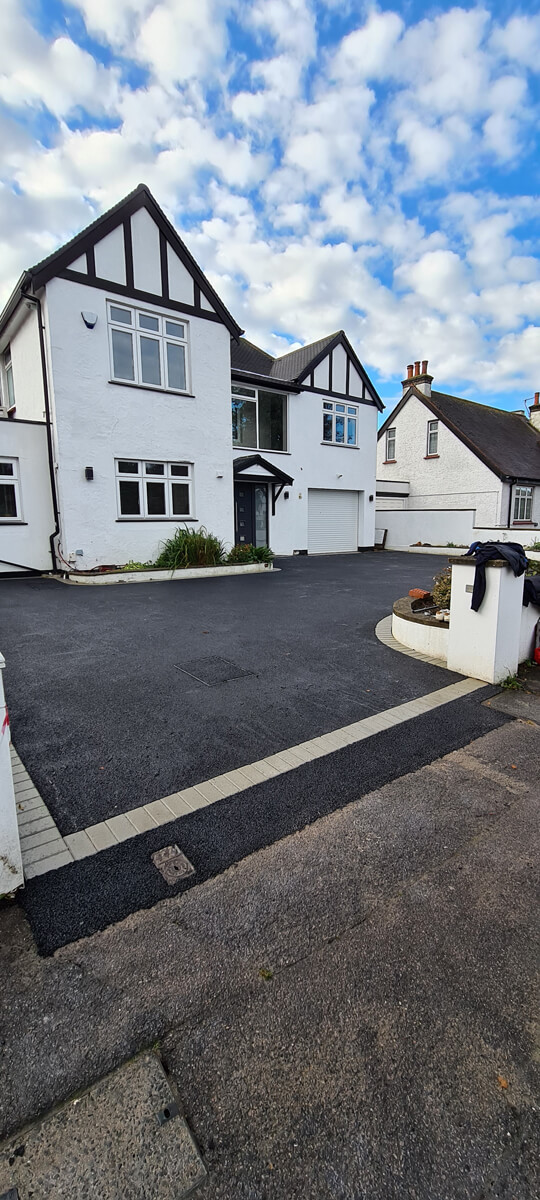
Parkstone is built on a hill. The ground climbs from Lower Parkstone and the harbour edge up to Ashley Road and Constitution Hill, and plenty of front gardens sit well above or below the pavement. That changes the water, the bank and the surface on a drive. The first is water.
A Parkstone drive that falls towards the house brings every storm to the front door, so it needs a channel drain across the bottom with a proper outfall, and the surface must finish below the damp course. A drive that falls to the road cannot just dump its water on the footway, which is where a permeable build or a soakaway comes in.
The second is the bank. Cutting a parking bay into a raised Parkstone front garden means holding the soil back with a retaining wall, and that wall is structure, not edging, so it is designed for the load of the ground and a car behind it. If the dig comes close to next door's foundations, the Party Wall Act excavation rules can mean serving notice first. The third is the surface. On a real gradient we steer you to block paving or a textured resin that holds a tyre in the wet, and away from gravel and smooth concrete. We take levels on the first visit so the quote already allows for all of this.
Who you are dealing with
A local firm you can check
We lay drives across Parkstone, from Heatherlands and the streets off Ashley Road down to Ashley Cross, Whitecliff and Penn Hill, in BH12 and BH14, from our base in Boscombe, 4.6 miles east. BCP Council is both the planning and the highway authority, which matters for the kerb.
You are dealing with Bournemouth Roofing & Building, the trading name of Bournemouth Roofing & Building Ltd, registered in England and Wales, company number 15471719, which you can look up in a minute. Thomas Hannen's business, and he is the one who comes out to price the job, not a salesman. A verified customer's 10 out of 10 on Checkatrade. The visit and the written quote are both free. Before you book a visit in Parkstone, you can read our customers' Google reviews, word for word, on our reviews page.
Planning at a glance
Do you need planning permission in Parkstone?
Most repairs in Parkstone need no application at all. What decides whether a change to the outside of your house does is who the council is, whether a conservation area or a listing applies, and whether the place sits in a protected landscape.
| Question | In Parkstone |
|---|---|
| Who decides | BCP Council is the planning authority for Parkstone. BCP Council's heritage pages set out what it controls. |
| Conservation area | Yes: Ashley Cross Conservation Area. Check whether your street is inside the boundary before changing anything visible. |
| Listed buildings | Yes, there are listed buildings in and around Parkstone. If yours is one, work can need listed building consent. |
| Protected landscape | No National Park or National Landscape covers Parkstone. |
Questions
Questions about driveways in Parkstone
How long does a new drive take?
A resin or block paved drive on an ordinary frontage is usually about a week from dig to finish. Retaining walls on a sloping garden add time. The dropped kerb can take longer to approve than the drive takes to build, so we start that paperwork first.
Can you lay resin over my old concrete drive?
If the concrete is flat, sound and not cracked right through, yes, and it saves most of the dig. If it rocks, has sunk or is broken up, resin will crack along the same lines, so it comes out and the base is rebuilt.
Our front garden is higher than the road. Can we still park on it?
Usually, by cutting the bay down to a level a car can use and building a retaining wall either side. It costs more than paving a flat garden because of the dig and the walls, and we price both on the quote so you can see why.
Where does the rainwater go on a sloping drive?
Into a channel drain at the low end with an outfall, into a permeable surface over a stone base, or a mix of both. What it must not do is run to the house or out across the pavement.
Will you leave a mess on the road?
Spoil goes into a grab lorry or a permitted skip, and the road and footway are swept at the end of every day. On a narrow street we book the collection to arrive as the dig finishes.
Nearby, and next door
Driveways near Parkstone
Nearby places we also cover for driveways, with straight-line distances from Parkstone, and the other trades we offer in Parkstone itself.
Driveways nearby
Our other trades in Parkstone
Driveways and patios guides
Driveway planning permission and where water goes Sunken or ponding driveway: base or drainage Indian sandstone vs porcelain paving: an honest comparisonEverything we do in Parkstone Driveways, all areas Every area we cover
Free quote
Get the levels taken before you choose a surface
Thomas comes out, measures the fall of the garden, looks under the old drive and prices the whole job in writing. The visit and the quote are free.