Flat roofing in Cranborne
Flat roof repairs, re-covers and warm roof rebuilds around Cranborne, in EPDM rubber, GRP fibreglass, torch on felt and lead. We look under the covering first.
The site visit is free and so is the written itemised quote. Thomas Hannen prices every job himself.
Last updated
Most leaking flat roofs around Cranborne are failing at an edge, an upstand or an outlet rather than everywhere at once. What decides a repair against a full re-cover is the state of the deck, so we open it and look before pricing.
Cranborne flat roofs tend to give themselves away before they fail. Water marks a ceiling under a back extension. The felt on a garage tears or turns brittle and starts to curl at a corner. Or a pool sits up there for a week after rain and turns green.
Whichever it is, it wants someone on the roof, not standing in the garden guessing. We cut a small inspection opening at the worst spot, photograph the deck and whatever insulation is under it, and show you before we write anything down. The quote then lists what is being replaced and what is staying, line by line. If the mark under the back extension has become a drip, ring 07435 839745 and tell us which room.
The work
Garages, garden rooms and the small flats on older houses
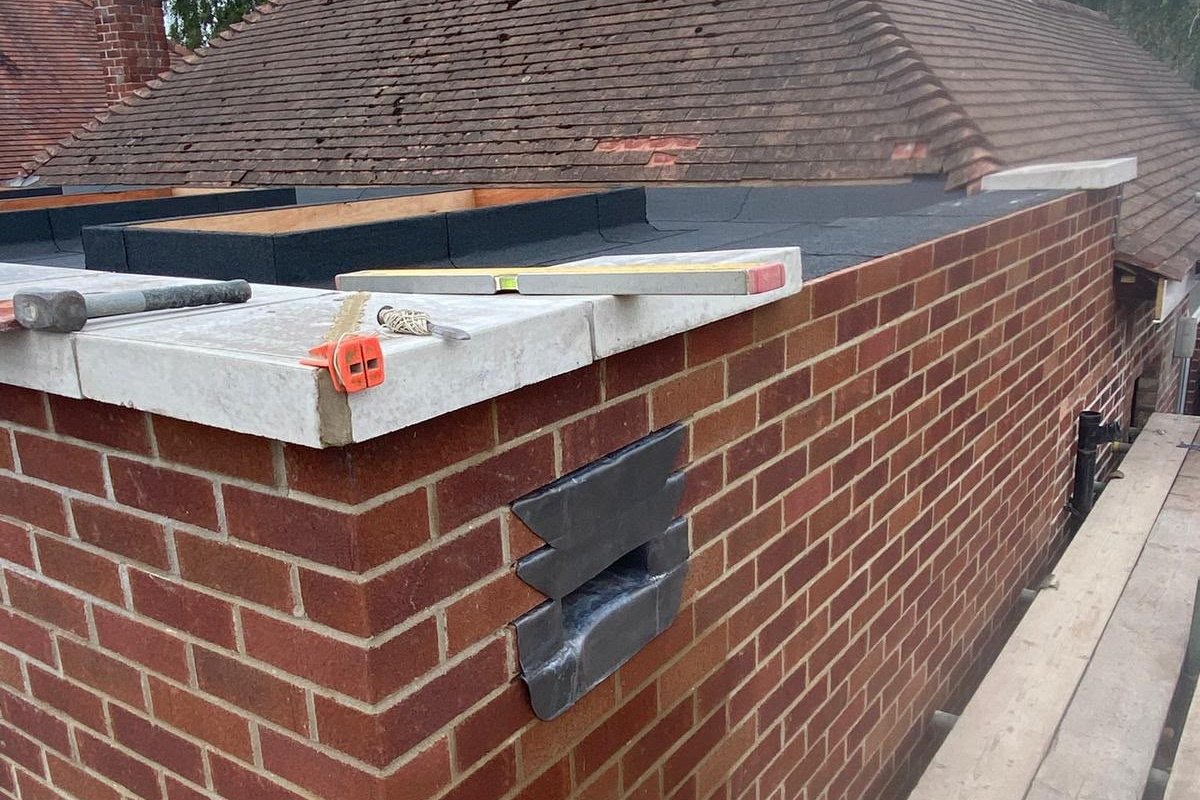
Garages, garden rooms and the roof over an old bay. Village work in Cranborne is mostly small flat roofs attached to something older: a garage put up in the seventies, a garden room across the back, a porch, a boot room, and the little lead or felt roof capping a bay window.
The coverings in Cranborne are torch on felt, built up felt in three layers under a mineral cap sheet, tired GRP fibreglass, and now and then a genuine lead flat that has split along a bay. We strip a section and look at the deck first. Dry plywood or OSB can be re-covered as it stands. Chipboard decking that has drawn water is done for and new boards go down on the joists before anything else. Then it is EPDM rubber, fibreglass or a new torch on system, and single ply on anything with a long clear run.
Standing water and where it should be going. Ponding is the fault to look for first. Water that stays on a roof works into every lap and seam, and one hard frost opens them up. Usually the fall was never laid, the firrings have been cut too shallow, or the rainwater outlet has silted up under leaves from the trees around Cranborne. We reset the falls with firrings or tapered insulation so the roof drains at an outlet rather than in the middle, which is what BS 6229:2025 on flat roofs asks for, and we check the gutter, hopper and downpipe take it away cleanly.
The details that fail. The middle of a covering rarely gives trouble. The edge trim, the drip, the apron against a wall, the kerb around a rooflight and the laps are where water gets in. Felt goes as a blister, a bubble or a split. Single ply lifts at a failed seam. Fibreglass cracks at a hard internal angle. Failed material comes out first. The upstand is carried up behind the covering rather than stopped at deck level, and each lap is welded or bonded, so nothing is left relying on a repair over a repair.
Openings, abutments and the build up. Every rooflight, lantern, Velux, hatch and soil and vent pipe needs a kerb and a collar, not sealant. Where the roof meets brick or flint we chase in a cover flashing in lead, cut so it can move without splitting. On a parapet we look at the coping and whether a cavity tray sits behind it. Most of the older flat roofs in Cranborne are cold roofs, insulation between the joists with a still void above, and that void is where condensation and interstitial damp rot the deck out of sight. A warm roof turns that around. The insulation is laid over the boards on a vapour control layer, the void goes altogether, and the joists spend the winter dry.
How it runs
How a flat roof gets stripped, laid and signed off
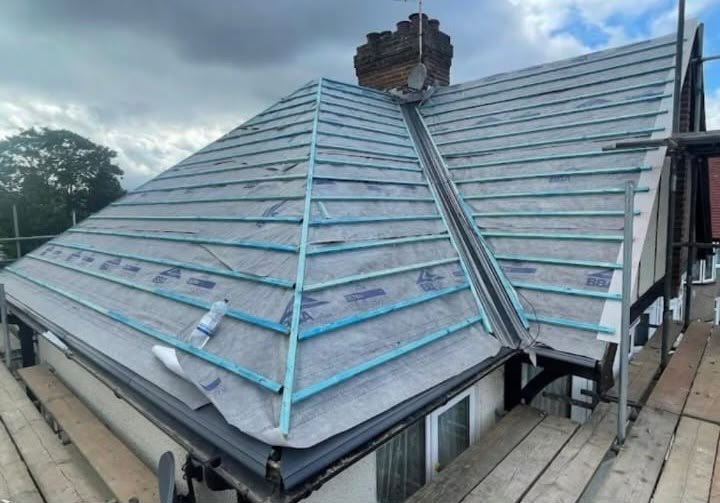
Thomas comes up from Boscombe to Cranborne, climbs onto the flat roof, and lifts the felt at an edge to see the deck. He also looks at the ceiling underneath for tide marks. He sets the price himself. Stripping and relaying are both in it.
You get the figure itemised. Access. Taking off the old covering. A new deck or firrings where they are needed. Insulation and membrane. Every upstand, outlet and edge trim on its own. Taking the waste away.
In and around Cranborne, flat roofs sit on garages at the end of gravel drives, on back extensions, and on lean to additions against old outbuildings. A tower in the garden reaches most of them, and the skip goes wherever the drive allows. When the house itself is the only route, we sheet your floors and carry the old felt out by hand. The deck is always covered before we leave, and we sweep up daily. Should the rot run past the corner Thomas lifted, he shows you a photo and the extra figure before we touch it.
Re-covering like for like counts as maintenance under permitted development, with no planning application, which Planning Portal guidance on roofs explains. Renewing over half of the roof makes it a thermal element, so the insulation must reach Approved Document L, and we tell Dorset Council through a building notice or full plans. On a listed building, speak to the council before the covering changes.
Cost
Why two flat roofs the same size price differently
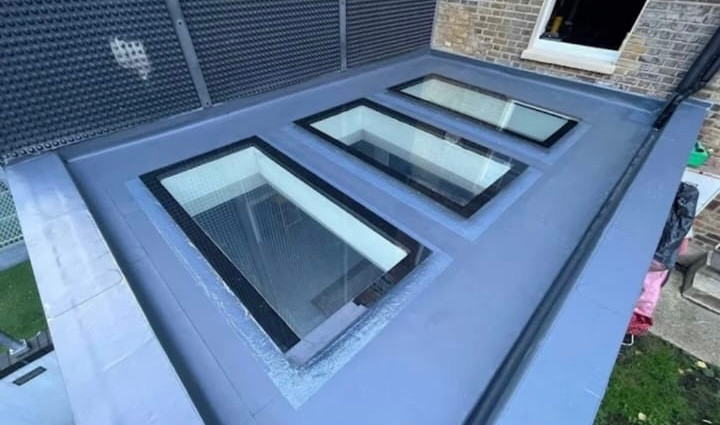
Measure two flat roofs of equal size in Cranborne and their prices can still be far apart. The covering is quick. The rest is not.
The deck. Old garage roofs were often decked in chipboard. Once water gets in, it swells, sags and crumbles. Ply that springs under your boot is no better. Thomas lifts a corner before quoting, because a new deck changes the figure more than anything else.
The fall. A flat roof needs a slope you can barely see. Many older ones were laid level, or drain towards a corner where a later wall now stops the water. Firrings put the fall back. That takes time, and it stops the new membrane sitting in a puddle. Each upstand, edge trim and each of the outlets is costed individually.
Getting up there. A garage by a gravel drive needs only a tower. A roof under a bedroom window needs a scaffold that stays up for as long as the deck is open. The work at height rules say which, and the skip is listed apart.
Insulation. A full re-cover means insulating to current standard, so a warm deck is part of the price from the start.
Hold any other quote up to ours: which system and how many layers, a new deck or an overlay, and firrings to correct the falls or not.
If it is coming through
A flat roof that has split or lifted at the edge
If water is running through, a bucket first, then move anything that would be ruined. A split, a burst blister, or felt peeled off an upstand drops rain straight onto the ceiling below, and the wet deck carries on rotting in dry weather.
We get it covered on the first visit, with a patch or a sheet weighed down with timber, and we find out how far the wet has spread through the deck. The proper repair is priced once the deck is opened and we know what is sound. Planned jobs are Monday to Friday, 8am to 6pm. Water through a ceiling is worth a phone call, not the form, and a missed call is always returned as soon as we are able.
Worth knowing
Listed and conservation rules reach the small roofs too
Cranborne has its own conservation area, and there are a good many listed entries in and around the village, Cranborne Manor House among them. For flat roofing that has two practical consequences. The first is appearance. Putting like back for like is maintenance and needs nothing.
Changing what a roof looks like where it can be seen from the street or the green, adding a lantern or a run of rooflights, or fitting a bright trim in place of a dark one is a planning conversation, and it is far cheaper to have it before the order goes in.
The second is consent. If the building is listed, or your flat roof is on something attached to a listed building, changing the material or the look of the roof needs listed building consent, which is separate from planning permission. It is worth asking the council even about repairs, because the test is whether the work affects the building's character. Where an old lead flat is being replaced on a listed building, expect to be asked to put lead back rather than a modern membrane. For an ordinary house in Cranborne none of this bites, and the only real decision is which covering suits the roof.
Who you are dealing with
Your flat roof, priced by the man who owns the firm
Cranborne lies 13.9 miles from our Boscombe base. Our flat roof work covers the village, Boveridge, Alderholt and the BH21 lanes between them, and any building notice for a re-cover goes to Dorset Council.
The company is Bournemouth Roofing & Building Ltd, registered in England and Wales, company number 15471719, and Companies House will show you its record. Thomas Hannen owns it. He comes to walk the roof and he writes the price. On Checkatrade, one customer whose job was verified scored us 10 out of 10. The visit is free of charge, as is the itemised written quote. Before you book a visit in Cranborne, you can read our customers' Google reviews, word for word, on our reviews page.
Planning at a glance
Do you need planning permission in Cranborne?
Most repairs in Cranborne need no application at all. What decides whether a change to the outside of your house does is who the council is, whether a conservation area or a listing applies, and whether the place sits in a protected landscape.
| Question | In Cranborne |
|---|---|
| Who decides | Dorset Council is the planning authority for Cranborne. Dorset Council's heritage pages set out what it controls. |
| Conservation area | Yes: Cranborne Conservation Area. Check whether your street is inside the boundary before changing anything visible. |
| Listed buildings | Yes, there are listed buildings in and around Cranborne. If yours is one, work can need listed building consent. |
| Protected landscape | Inside the Cranborne Chase & West Wiltshire Downs National Landscape (formerly AONB), so anything visible from outside gets more attention. |
Questions
Questions about flat roofs in Cranborne
Do you have to take the whole roof off?
Only if the deck has gone. A split upstand, a lifted trim or a blocked outlet over sound boards is a repair, and we will price it as one. Where the boards move under your foot, a new covering on top will not last and we will tell you that instead of taking the work.
How long are you on site?
A garage or garden room roof is normally two working days from strip out to finished covering. Add rebuilt falls, a new rooflight or a full warm roof build up and it takes longer. The number of days is written on the quote.
Can you match a lead flat on an old house?
Yes. A bay top or a small flat in lead is replaced in lead, cut and dressed so it can move with the weather instead of splitting. On a listed building that is usually what will be expected anyway, and we will say so before you spend money on a membrane that will not be allowed.
Where do the skip and the van go in the village?
We sort that out on the site visit. The lanes in Cranborne are narrow, so we agree in advance where materials land and where the waste sits, and everything leaves with us rather than staying by the gate. The site is swept at the end of each day.
Nearby, and next door
Flat roofing near Cranborne
Nearby places we also cover for flat roofing, with straight-line distances from Cranborne, and the other trades we offer in Cranborne itself.
Flat roofing nearby
Our other trades in Cranborne
Flat roofing guides
GRP, EPDM or felt: which flat roof covering? Snow on a flat roof or a conservatory Warm roof or cold roof: which do you need?Everything we do in Verwood Flat roofing, all areas Every area we cover
Free quote
Get a price for your Cranborne flat roof
Free site visit, free itemised written quote, and an honest answer about whether the deck needs replacing at all.