Flat roofing in Thorney Hill
Flat roofs on extensions, garages, outbuildings and garden rooms around Thorney Hill and the BH23 addresses on the forest edge.
The site visit is free and so is the written itemised quote. Thomas Hannen prices every job himself.
The flat roofs up here fail from the outside in. A trim works loose in a gale, the wind gets under the covering, and the middle of the roof is still perfectly good when the corner has gone.
Thorney Hill sits high and open, with detached houses on big plots and a good deal of older property mixed in. The flat roofing follows that: extensions, garages, garden rooms, stores and the odd stable or field shelter. People ring after a windy night when something is flapping, or when a ceiling has started to mark and nobody can say where the water got in. We come out, walk the roof, check the perimeter fixings and the falls, look at the deck, and put photographs and a written itemised price in front of you.
The work
What we get called out to around the hill
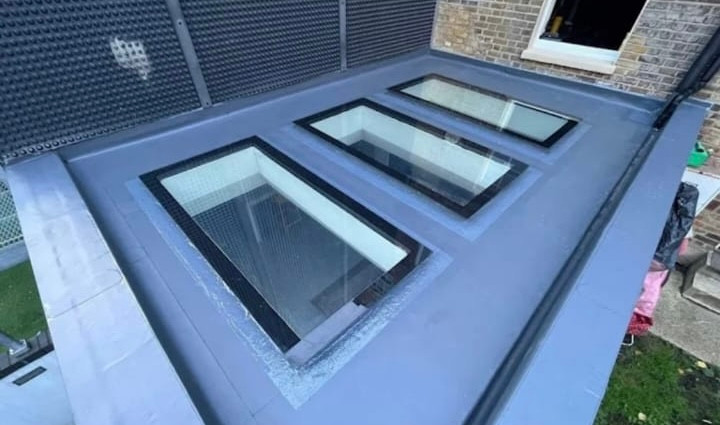
Extensions and garden rooms. The usual re-cover. EPDM rubber where the shape is a plain rectangle, laid as one sheet with bonded seams. GRP fibreglass where there are kerbs, a step in the level or a corner to work round, because it is laid wet and forms its upstands and edge trim in one piece. Single ply, welded at the laps, on anything with real area to it.
Garages, stores and outbuildings. Detached buildings weather from every side with nothing warming them, so felt built up in three layers with a mineral cap sheet over it goes hard and splits sooner here than the same covering tucked against a house. A modern torch on system on a dry deck is a solid answer on a big plain span. Whatever goes down, the boards decide it: plywood, OSB or chipboard on joists, and wet chipboard is finished.
Fixed down, not just laid down. On an exposed site the specification is as much about how the covering is held as what it is made of. A fully bonded membrane relies on the adhesive and on a sound deck under it. A mechanically fixed single ply relies on fixings at set centres, closer at the perimeter and corners than in the middle, because that is where uplift works hardest. Ballast is not an option on most light domestic decks. Getting this right is why an edge trim that has worked loose is a fault worth attending to rather than something cosmetic.
Falls, insulation and condensation. Firrings set the falls across the joists, and without them you get ponding and standing water sitting over every lap and seam. Tapered insulation corrects a fall from above. A warm roof takes PIR over the deck with a vapour control layer sealed underneath, holding the timber on the warm side of the dew point throughout. A cold roof holds the insulation between the joists and must be ventilated, or condensation and interstitial damp spoil the decking with no rain involved. BS 6229 is the reference for both.
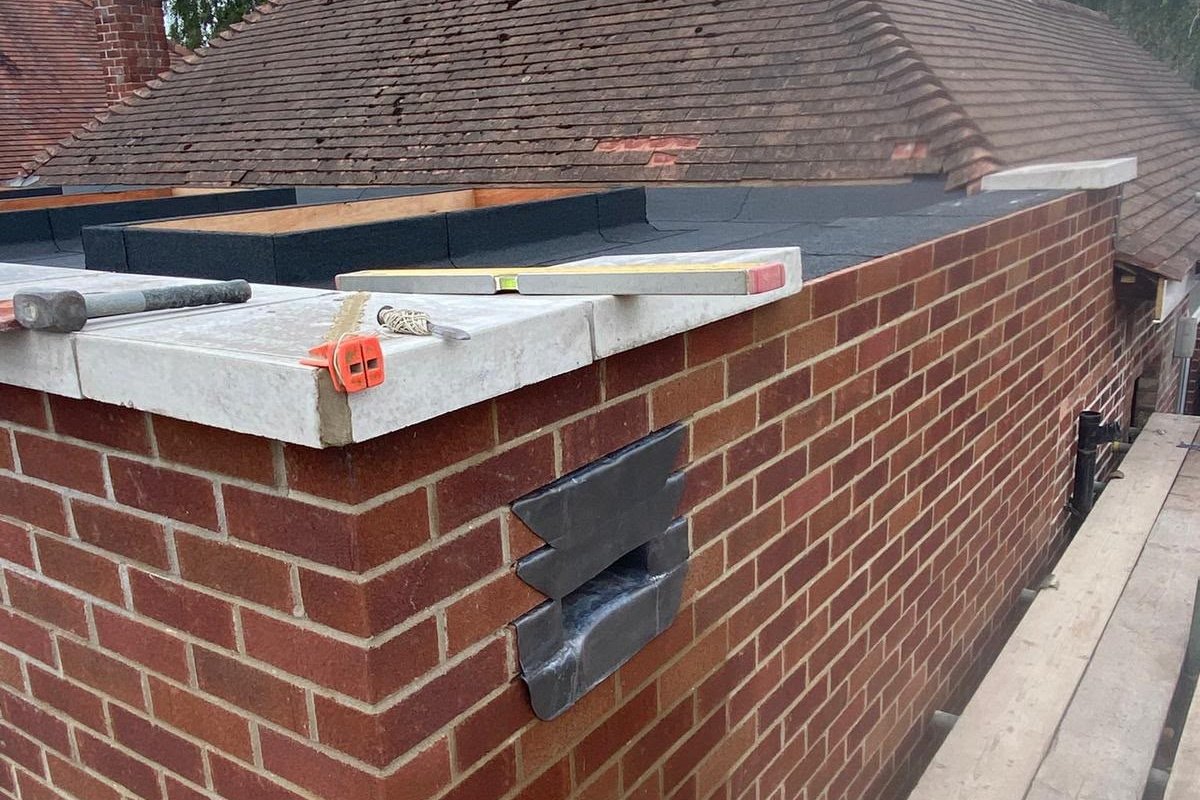
Junctions, openings and rainwater. At an abutment the brick is chased out and a lead cover flashing dressed into it, not sealed with mastic, and a parapet has its coping and cavity tray checked. At the perimeter it is the edge trim, the drip and the apron. A rooflight, a lantern or a Velux sits on a formed kerb, and so does any soil pipe or vent pipe. Then the gutter, its hopper, the rainwater outlet and the downpipe. The everyday repairs are blisters, bubbles, a split or crack, and a lifted or failed seam.
How it runs
From your call to a written price
Same team from first visit to last, one person to ring, and no sub-contracting your work out to somebody you have never met. The quote is itemised, not a figure on the back of a card: access, stripping the old covering, any new deck or firrings, the insulation, the membrane and each upstand, outlet and edge trim, and disposal on separate lines, so you can compare it properly against anyone else's.
Nothing is left open or unusable overnight. The site is swept at the end of each day rather than the end of the job, and what comes out leaves with us. If something turns up once we start that nobody could have seen, you get a photograph and a price before we carry on.
A like for like re-cover is maintenance, so there is no planning permission to get, but this is National Park land, permitted development is narrower here than elsewhere and anything visible gets a design look, which National Park heritage and conservation guidance explains. No conservation area covers Thorney Hill itself and very little of the housing is listed. Building control is the other half of it. Renewing a covering over most of a roof counts as renovating a thermal element, so it needs notifying, and Part L, in Approved Document L, sets what the insulation has to do.
Cost
What decides the price of a flat roof
No rate per square metre, because the square metres are the easy part and what is under the covering is what decides the job.
Getting to it. A detached garage on an open drive, an extension on a forest edge house and a stable or field shelter are three different jobs, whatever they add up to in square metres. A garage or a single storey extension will often come off a tower, anything above a two storey wall wants a scaffold, and the platform has to stand while the deck is open rather than for an afternoon. The work at height rules are why it is a priced line rather than something folded into a rate.
The deck under the covering. A sound deck can be re-covered. Chipboard that has been wet for years, or ply that gives underfoot, has to come off and be replaced, and you cannot tell which you have from the ground or from a photograph. We lift a corner before quoting, because the deck is the single biggest swing in the price.
The falls, and where the water is meant to go. Most flat roofs that fail were never laid to a fall, or the fall runs at an outlet that has since been blocked or built over. Correcting it with firrings is more work than laying a membrane and it is the difference between a roof that lasts and one that ponds. Upstands, edge trims and each outlet are priced one at a time, because that is where the hours and the leaks both are.
Comparing quotes? Ask which system is being quoted and how many layers, whether the deck is being renewed or covered over, whether the falls are being corrected with firrings, how the upstands, outlets and edge trims are detailed, and whether the scaffold and the skip are in the price. Two quotes for the same job are usually two different jobs.
If it is coming through
Water through a flat roof
Ring rather than use the form. A flat roof that has split, blistered or lifted at an upstand puts water straight onto a ceiling, and once the deck is wet the damage carries on after the rain stops. The first visit is about getting it covered and dry, and we price the permanent job once we can see how much of the deck has gone. Thorney Hill is a short run for us, so an emergency cover after a gale is usually the same day or the next. The phone is answered 24 hours for emergencies; scheduled work runs Monday to Friday, 8am to 6pm.
Worth knowing
After a gale, look at the corners before the middle
The exposed side of nearly everything up here faces south west, and there is very little in the way. Wind does not press a flat roof down, it lifts it, and the suction is strongest at the corners and along the perimeter rather than in the field of the roof. That is why a covering can be sound everywhere you can see and already loose where you cannot.
So after a rough night, the useful check is the edge. Walk round and look along the trim for a section that has lifted, a corner turned up, or a fixing that has pulled. If something is flapping it wants dealing with quickly, because a membrane that has been worked loose keeps tearing at the seams every time the wind gets up. A temporary weight on it is not a fix and can make the tear worse. Ring instead, and we will get it covered and fixed down before pricing anything permanent.
Who you are dealing with
A local firm you can check
We cover Thorney Hill, Bransgore, Burley Street and the BH23 addresses along the forest edge, with the New Forest National Park Authority as the planning authority. You are dealing with Bournemouth Roofing & Building, the trading name of Bournemouth Roofing & Building Ltd, registered in England and Wales, company number 15471719, which you can look up in a minute. Thomas Hannen's business, and he is the one who comes out to price the job, not a salesman. A verified customer's 10 out of 10 on Checkatrade. The visit and the written quote are both free.
Questions
Thorney Hill questions we get asked
A corner has lifted. Can it be re-fixed rather than replaced?
Usually. The trim comes off, the perimeter is re-fixed at proper centres, the covering is re-bonded or welded back and the trim goes on again. That is a morning. It only becomes a re-cover if the membrane has torn back far enough to have wet the deck.
Which system copes best up here?
It is less about the material than the fixing. A properly bonded EPDM on a sound deck, a GRP laid wet and locked to the boards, or a mechanically fixed single ply with the right pattern at the corners all cope. A covering fixed only at the edges and left loose in the middle does not.
Do you need a survey, or will photographs do?
Photographs help, but they cannot tell us whether a deck is soft or an upstand is high enough. The free site visit takes half an hour, and everything found is photographed and priced in writing after it.
How long will the work take?
A garage roof is usually a day. An extension with fresh boards, new falls, insulation and trims runs to three working days where the deck all changes. The quote gives you the run of days.
Nearby, and next door
Flat roofing near Thorney Hill
Flat roofing nearby
Our other trades in Thorney Hill
Everything we do in New Milton Flat roofing, all areas Every area we cover
Free quote
Get a price for your Thorney Hill flat roof
Tell us the address and what you have noticed. We will check the perimeter and the deck, then put an itemised price in writing.