
Driveways and patios in Thorney Hill
Long drives that have rutted, hardstandings for a caravan or trailer, and bungalow patios relaid at the right level, across Thorney Hill and the BH23 forest edge.
The site visit is free and so is the written itemised quote. Thomas Hannen prices every job himself.
Drives around Thorney Hill are long, they are used by heavier vehicles than a hatchback, and they sit on ground that stays wet for months at a time. That combination is what wears them out. The fix is nearly always more depth and better drainage under the same surface you already have, rather than a smarter surface laid on the same tired base.
Three jobs come up here again and again. A gravel or tarmac drive that has worn into ruts and holds standing water halfway along it. A rear patio at a bungalow, laid in concrete flags when the house was built, that has settled, gone green and now sits too high against the wall. And a hardstanding wanted for a caravan, a trailer or a second vehicle, on a plot with plenty of room but nowhere obvious for the water to go.
All three are straightforward once somebody has actually dug a hole and looked. We come out, open the ground in a corner, and tell you what you are dealing with before you commit to anything. The visit is free and so is the written itemised quote.
The work
Long drives, big plots and 1970s bungalows
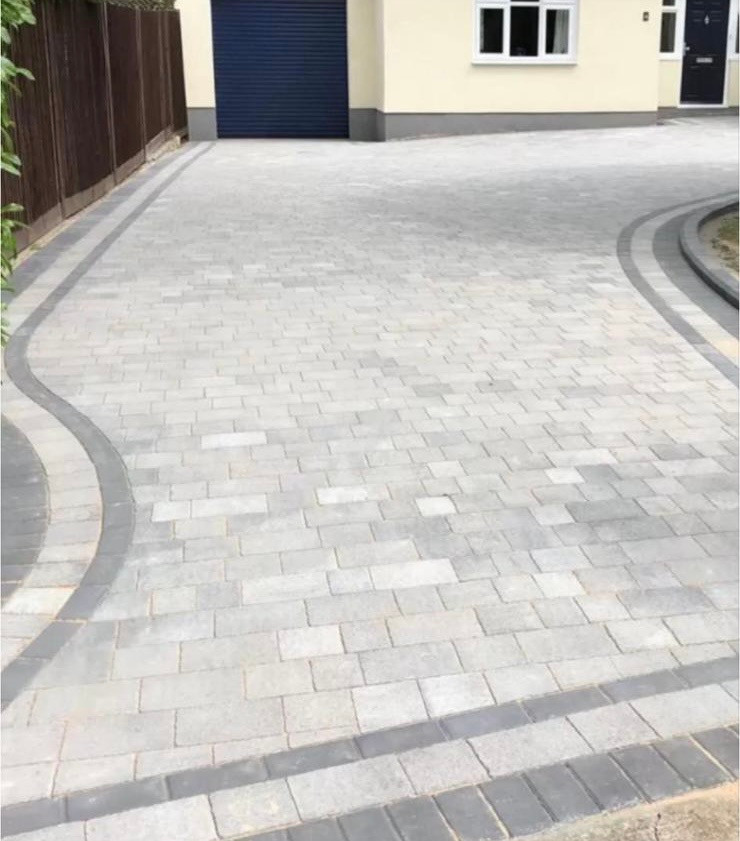
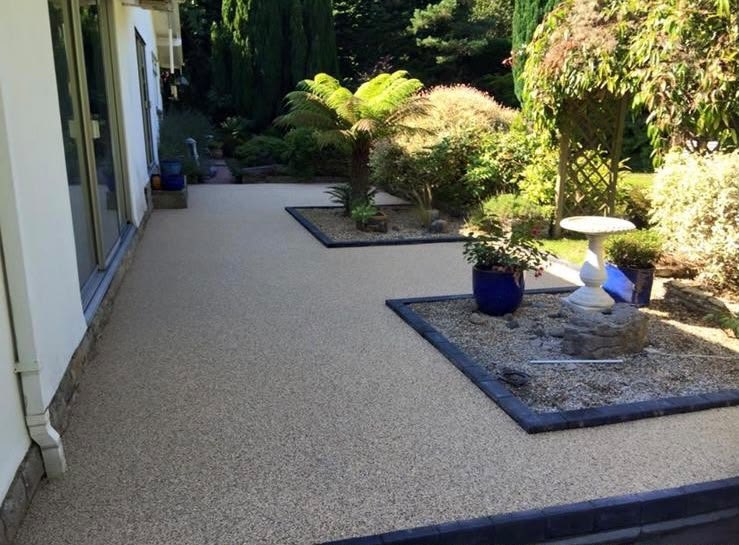
Drives that have rutted. Four in ten homes here are detached and a fifth are bungalows, which in practice means long drives on generous plots, often gravel or tarmac laid decades ago on very little. They fail in the wheel tracks first: the stone thins, the ground beneath softens, and once water sits in the rut it takes the base apart from below. Topping up the gravel treats the symptom. We strip back to a firm formation, lay a geotextile membrane so ground and stone stay separate, and build a compacted sub-base with the depth the traffic actually needs, then finish in gravel, tarmac, resin or block. On a drive that carries a horsebox or a builder's tipper, the extra depth in the base is the cheapest part of the job.
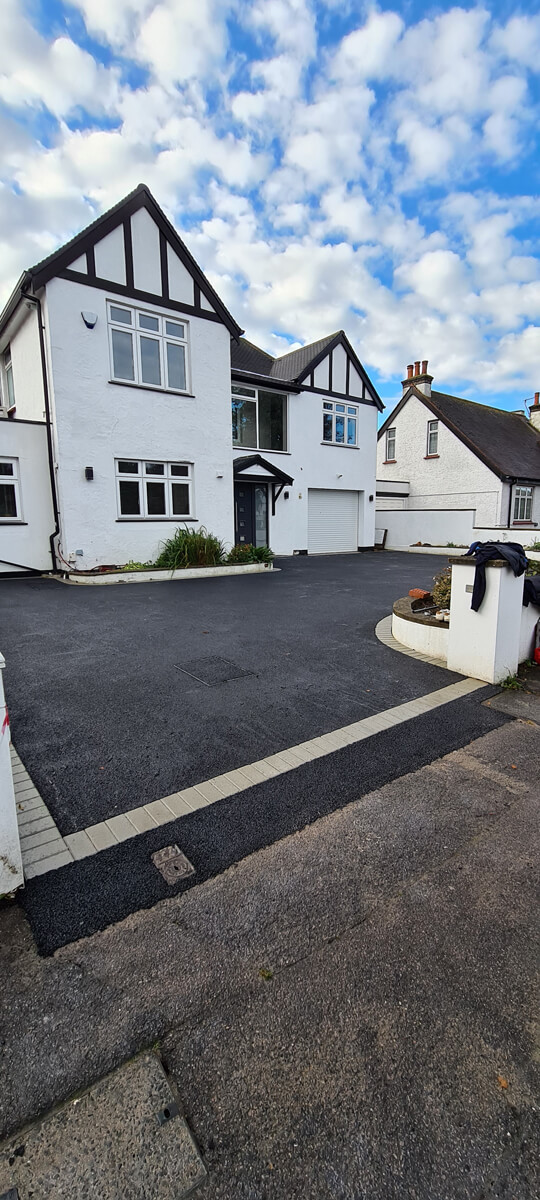
The last few metres to the road. On plots set well back, the entrance takes all the turning loads and gets all the mud. It is worth building the apron properly even when the rest stays gravel: a bound surface for the first stretch, a haunched kerb to hold it, and a fall that sends water back onto your land rather than out onto the carriageway. A new opening or a widened one is a dropped kerb application to Hampshire County Council as highway authority, and they set the construction for the crossing itself.
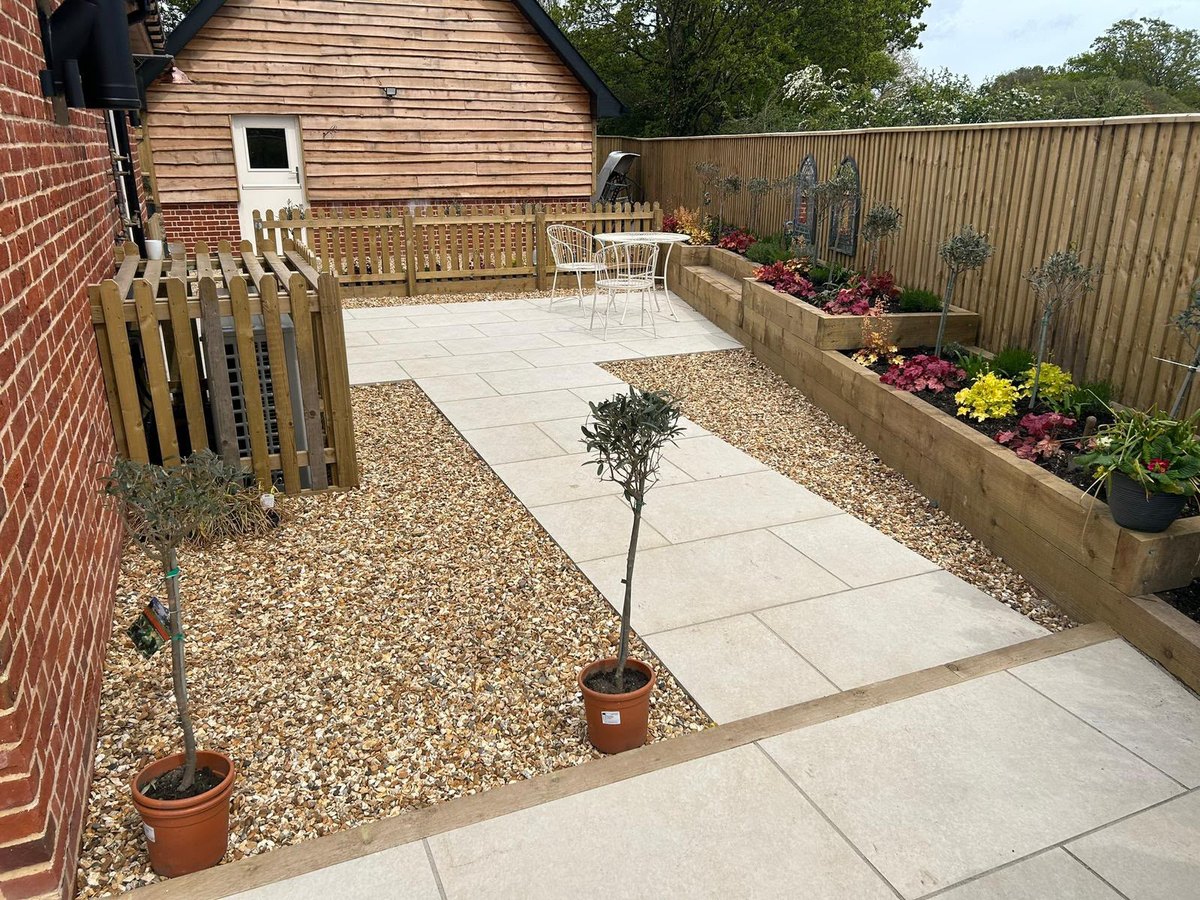
Bungalow patios and the level at the back door. Four in ten homes here went up between the war and the early eighties, and the original rear patios are concrete flags on sand, laid flat or falling gently the wrong way. The ground has settled, the jointing has opened and taken weed and green staining, and the paving has crept up the brickwork with each repair. We take it up, correct the base and relay in stone, porcelain on a full mortar bed or block, with the level back below the damp proof course and the fall away from the house. Where block goes back down, the joints are filled with kiln dried sand, and a re-sand a year on is maintenance rather than a fault. This ground holds water, so a soakaway is a percolation test rather than an assumption, and a patio laid flat ponds rather than drains.
Hardstanding for a caravan, boat or trailer is common here because the plots allow it, and a standing that takes a static load all winter is a different build from a car bay: more depth, a wider spread of load, and a surface that will not deform under a jockey wheel. Reinforced concrete, a heavy duty block or a cellular grid filled with gravel all work, and the grid stays green and stays permeable.
How it runs
From your call to a written price
One person to ring, and the quote itemised: excavation, muck away, sub base, edgings, surface and drainage on separate lines. Paving your own front garden is normally permitted development, and the condition is water rather than area: any hard surface over five square metres has to be permeable or drain to a border, lawn or soakaway inside your own boundary, which is what the front garden paving rules set out. Run it into the road and it needs planning permission. The planning authority here is the New Forest National Park Authority rather than a district council, and the highway authority is Hampshire County Council, so an entrance can involve both.
Cost
What decides the price of a driveway
No rate per square metre, because what is under it decides more than what goes on top. A plot where a grab lorry can turn on the drive itself is the cheap end, a house set well back where the machine shuttles up and down all day is dearer, and a frontage where the wagon stands on the road is dearer again. Ground conditions, the depth of the dig and how much spoil goes away for disposal are the real variables, and a back garden reached only by barrow through a side gate takes longer than the same area out front. On ground that holds water, where it is sent is a design decision with a cost. Ask the depth of dig, the sub base and the drainage.
If it is urgent
A trip hazard, or a drive that floods
Ring rather than use the form. A lifted slab, a sunken bay by a doorway or a gully that has stopped taking water will not wait, because somebody falls or water ends up against the house. If water has started standing where you walk, say so, because on this ground a small dip turns into a soft hole in one wet month. The phone is answered 24 hours for emergencies; scheduled work runs Monday to Friday, 8am to 6pm.
Worth knowing
You are inside the National Park, and the verge is not yours
Thorney Hill sits inside the New Forest National Park, which changes two practical things about a driveway. The first is who decides. Planning here goes to the park authority rather than to a district council, and its interest is in what the place looks like from the road. That is not a reason to expect a fight over a drive, because paving your own frontage is usually permitted development anyway, but it is a good reason to choose the plainer answer where the work is visible.
Gravel, self binding gravel and a gravel grid all read as rural, and they are permeable, which quietly answers the drainage rule at the same time. A wide sweep of bright block paving right on the road frontage is the one that attracts comment. The park authority keeps an interactive property map, and it is worth looking your own address up before you order anything, because designations here sit on individual properties rather than on whole streets.
The second thing is the verge. On a good many of these lanes the grass between your boundary and the tarmac is open forest rather than part of your garden, and it may be grazed. You cannot simply gravel across it, park on it, or widen an entrance into it, and the crossing has to be formed under the highway authority instead.
It matters in a plainer way too: where animals have the run of the verges, a standing needs to be long enough to get the whole car off the road and the gates need room to swing without anybody reversing back out to open them. We look at all of that from the road at the survey, and whatever applies goes in the written quote rather than turning up as a problem in week one.
Who you are dealing with
A local firm you can check
We cover Thorney Hill, Bransgore, Burley, Sopley, Hinton and the BH23 addresses along the forest edge, with the New Forest National Park Authority for planning and Hampshire County Council for the highway. Send the postcode if you want to be certain.
Bournemouth Roofing & Building Ltd, registered in England and Wales, company number 15471719, which you can look up in a minute. Thomas Hannen's business, and he is the one who comes out to price the job, not a salesman. A verified customer's 10 out of 10 on Checkatrade. The visit and the written quote are both free.
Questions
Thorney Hill questions we get asked
Does being inside the National Park change what we can do?
It changes who decides and how closely it gets looked at. Thorney Hill sits under the New Forest National Park authority rather than a district council, permitted development rights are tighter inside the park, and a new hard surface at the front is worth checking rather than assuming. The park will also have a view on appearance, since plots here are visible from the open ground. Resurfacing what already exists, like for like, is the simple case.
What surface takes a horsebox without rutting?
One with the depth underneath it, not a particular finish on top. A horsebox puts several times the axle load of a car through two narrow lines, so the sub-base has to be deeper and compacted in layers, and on the naturally wet ground at Thorney Hill it needs a geotextile as well so the stone does not vanish into the subsoil. Above that, bound gravel or a heavy duty block both work. Thin tarmac does not.
The drive is long and we reverse out. Any options?
Build a turning head instead of widening the whole run. Four in ten homes at Thorney Hill are detached and the drives are long, so the useful change is a hard bay two thirds of the way down where a car can swing round, with the rest kept to single width. It moves far less ground than widening the lot, and it is the part that actually stops you backing out onto the road.
Can a long drive be built in sections over time?
It can, and on a run that length it often makes sense. Drainage has to be settled first, because a section built to the wrong fall comes up again when the next one goes in beside it. Thomas sets the whole entrance out on one visit and prices it in stages, so on the longer Thorney Hill approaches the turning area and the apron at the house can be done now and the middle later.
How can I tell if it is the surface or the base?
Push a screwdriver into an open joint or a crack and see how far it travels. If it stops on something hard within a hand's depth, there is a base under there and the surface may be all that needs doing. If it keeps going into soft ground, the surface is holding itself up and no amount of resurfacing will help. On the wet ground around Thorney Hill it is generally the second.
Nearby, and next door
Driveways and patios near Thorney Hill
Driveways and patios nearby
Our other trades in Thorney Hill
Everything we do in New Milton Driveways and patios, all areas Every area we cover
Free quote
Get a written price for your Thorney Hill drive or patio
Send the postcode and tell us what the drive is doing. We come out, open the ground to see what is under it, and put the price in writing with the days it will take.