Driveways and patios in Sopley
Drives, front paths, steps and terraces across Sopley and BH23. We dig a trial hole and take levels before anybody talks about a surface.
The site visit is free and so is the written itemised quote. Thomas Hannen prices every job himself.
Too little stone underneath and nothing holding the edge is what we find on most Sopley drives, and they are nearly all still the original one. The tarmac itself is rarely the problem. The fix is a proper dig and a compacted sub-base, not another layer over the top.
People here tend to ring about one of three things. A drive has gone soft and rutted where the car sits, the edges have crumbled into the lawn and puddles hang about for days after rain. A front path or a step has lifted enough to catch a foot, usually at the threshold where it matters most. Or a back garden needs a proper terrace instead of the slabs somebody laid over the old ones years ago, which now sit far too close to the damp proof course.
We come and look, dig a trial hole where the wheels actually stand so we can see what is underneath, and take levels off the door and the road. Then you get an itemised written quote with the excavation, the muck away, the sub-base, the edgings, the drainage and the surface each on their own line.
The work
Estate drives, front paths and terraces that crept up the wall
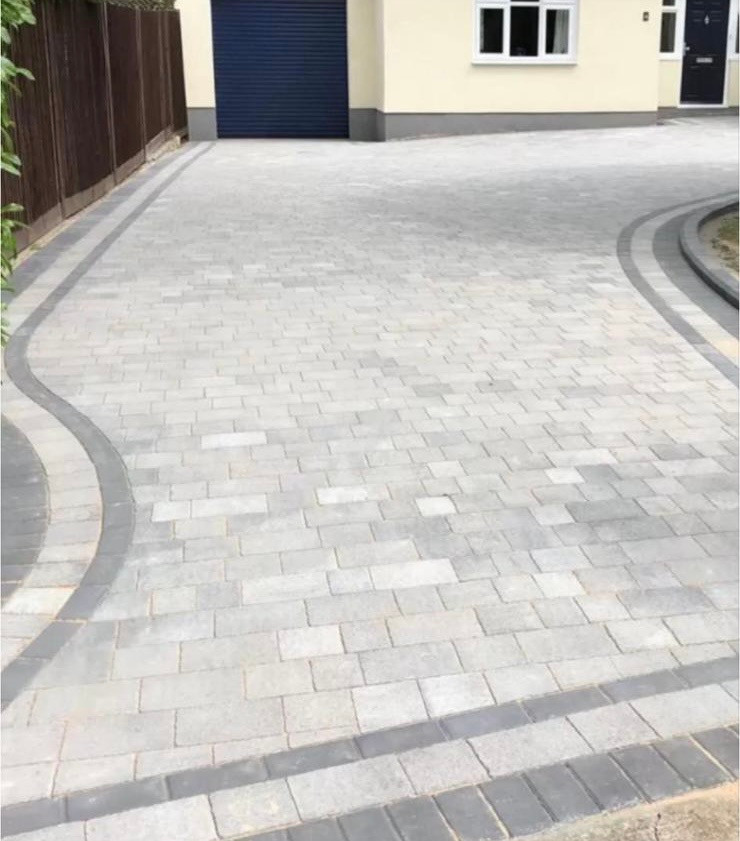
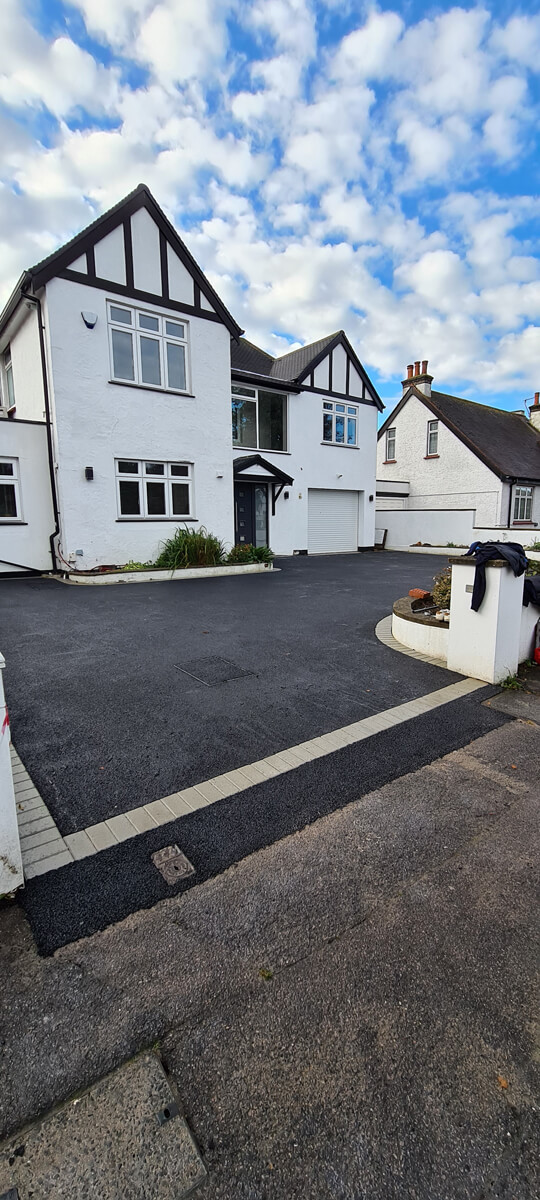
Worn out tarmac drives. Three quarters of the housing around Sopley went up between the war and the early 1980s, and a great many drives are still the ones laid with the house. What you see now is crazing across the middle, rutting in the wheel tracks, an edge that has lost its kerb with grass creeping in, and ponding where the fall has flattened out. Laying new tarmac over that buys a couple of winters at most. We excavate to a firm formation, put a geotextile membrane down where the ground is soft, build a compacted sub-base to a depth that suits the traffic, then surface it in tarmac, block paving or resin. The edge gets a haunched restraint on both sides so it cannot spread again.
Front paths, steps and the bit by the door. Concrete flags on sand are the standard path here and they lift as soon as the ground under them moves. A relay with the base corrected costs far less than a new path and it usually sorts the trip at the same time. Where the step at the front door has settled, the riser heights need evening up rather than one step being packed, and the top surface wants a fall away from the threshold so water is not sitting against the door in a downpour.
Paired drives and the line between two houses. Nearly half the homes here are terraced, and a lot of that post-war housing was built with two drives side by side and no edge between them, so one neighbour's settlement becomes both neighbours' puddle. We take levels across the whole width before pricing, set a proper edge restraint on the boundary, and make sure water crosses onto a border or a channel drain rather than onto next door. Where both households want the work, doing the two halves in one visit saves a second mobilisation.
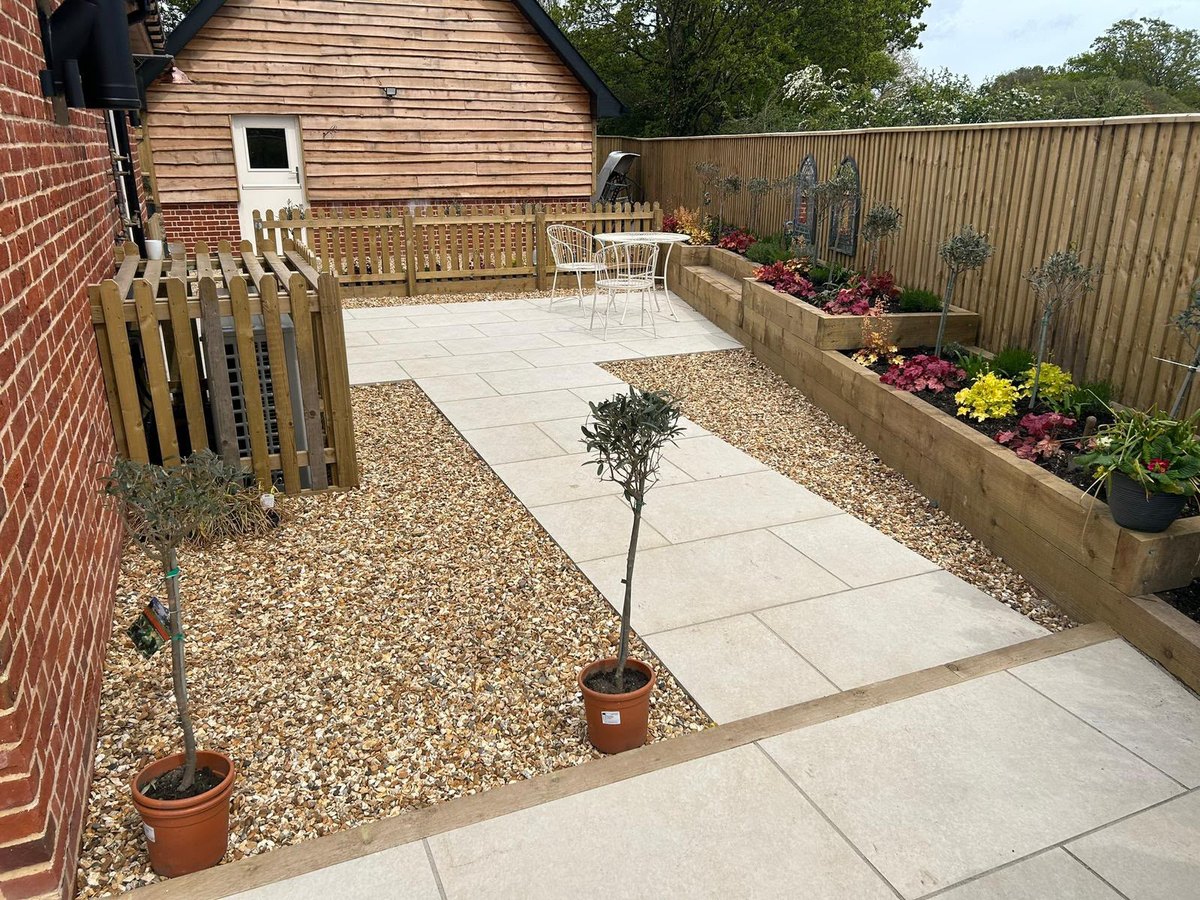
Patios that have crept up the wall. Where a terrace has been relaid over the old one more than once, the finished level ends up above the damp proof course and the wall starts showing it. The right job is to break out, reset the level with a gravel margin along the house, and lay on a full mortar bed with the jointing chosen for the width of the joint. Natural stone, porcelain and concrete slab all behave once the falls take water away from the building. The most exposed elevation here faces south west, and that is the corner where splash back shows first.
Much of the ground in this parish is cohesive and moves with the seasons, shrinking in a dry summer and swelling again in winter. That makes the position of a soakaway a structural question and not just a drainage one, so it stays well away from foundations, and where infiltration will not work we design a positive outfall instead. Approved Document H covers what is acceptable, and a permeable surface often removes the argument altogether.
How it runs
From your call to a written price
One person to ring, and the quote itemised: excavation, muck away, sub base, edgings, surface and drainage on separate lines. New hard surfacing at the front over five square metres needs planning permission if it sheds onto the road, while a permeable build-up or a fall onto your own ground keeps it permitted development, and Planning Portal sets out that test. Planning is New Forest District Council, though the National Park boundary is close enough that the National Park Authority's property map is worth checking before anyone prices a boundary wall. Sopley has its own conservation area, so appearance and materials at the front are a planning matter. A new opening also needs dropped kerb consent.
Cost
What decides the price of a driveway
No rate per square metre, because what is under it decides more than what goes on top. A cottage in the old part of the village with no frontage at all, a post-war semi with a paired drive and a side gate, and a house down a shared track are three different jobs before a barrow moves. Ground conditions, the depth of the dig and how much muck goes away are the real variables. On ground that swells and shrinks, where the water is sent is a design decision. Ask the depth of dig, the sub base and the drainage.
If it is urgent
A trip hazard, or a drive that floods
Ring rather than use the form. A lifted slab, a sunken bay by a doorway or a gully that has stopped taking water will not wait, because somebody falls or water ends up against the house. We are under six miles away, so a drive settled enough to send water back at the house gets looked at quickly. The phone is answered 24 hours for emergencies; scheduled work runs Monday to Friday, 8am to 6pm.
Worth knowing
The drives here are all the same age, and they are failing together
Housebuilding around Sopley was heavily concentrated in a short period, with nearly half of everything standing now put up in the 1970s and early 1980s. That matters more than it sounds. Those drives went in within a few years of each other, to the same specification, and they are reaching the end of it at the same time.
If three houses in a row are suddenly talking about their driveways, nothing odd is happening: the build-up under all of them has simply run out of life at once. It also means the fault is usually predictable before we arrive. Thin stone, no membrane, an edge that was never haunched, and a fall that was fine until the surface settled.
The useful thing to take from it is that a neighbour's price is a poor guide to yours, even on an identical plot. What decides the cost is how deep we have to dig before we reach something worth building on, and how much spoil that puts in a lorry. One house may need a modest dig, and the one next door may hit soft ground that needs a geotextile membrane and another hundred millimetres of stone.
That is also why we dig a trial hole on the site visit rather than quoting from a photograph. If you and a neighbour are both thinking about it, say so when you ring: sharing the excavator, the muck away and the delivery of stone across two drives on the same week takes real money off both.
Who you are dealing with
A local firm you can check
We cover Sopley and BH23, out through Winkton, Burton, Ripley and Bransgore. Bournemouth Roofing & Building Ltd, registered in England and Wales, company number 15471719, which you can look up in a minute. Thomas Hannen's business, and he is the one who comes out to price the job, not a salesman. A verified customer's 10 out of 10 on Checkatrade. The visit and the written quote are both free.
Questions
Sopley questions we get asked
Does conservation area status reach as far as the front path?
It reaches the appearance of whatever can be seen from the street, and in the Sopley conservation area the front surface is part of that. Replacing like for like is maintenance and needs nothing from anybody. Swapping a gravel or brick frontage for a different material is a change, and on a terrace where the frontages read as one run it is the change most likely to be questioned. New Forest will confirm the position in writing.
There is no side access. How does the muck come out?
Out through the front and straight into a grab lorry, rather than heaped on the pavement. Almost half of Sopley is terraced, so back gardens here are reached down a shared alley or not at all, and that single fact decides whether the job runs on a micro digger, a barrow line or hand dig. We settle it on the visit, because it moves the labour far more than the choice of paving does.
The whole close was built together. Are we all due the same work?
Three quarters of Sopley went up between the mid forties and the early eighties, the heaviest run of it in the seventies and early eighties, so drives and paths on those closes do tend to go within a few years of each other. What fails first is the edging and the joint against the threshold, not the middle of the surface. That is why the edges and the drainage get priced apart from a full relay.
Rain runs off the drive towards the house. Is that serious?
On ground that shrinks and swells it is more than a nuisance. Water arriving at the same spot beside a foundation alters how much the soil under that corner moves through the year, which is a structural matter rather than a damp one. We regrade so the fall carries water to a channel at the low end and out to a drain, and keep any infiltration well clear of the building. Most Sopley plots have room for that.
Is there a wrong month to lay block paving?
Frost is the one to plan around. Bedding sand and jointing material do not behave in a hard frost, and a surface jointed in freezing weather can lose its lock and need doing again. Rain matters less than people expect, since the dig and the sub-base carry on regardless. Sopley is close enough to the yard that a jointing day can be pushed back two days and picked up again rather than forced through.
Nearby, and next door
Driveways and patios near Sopley
Driveways and patios nearby
Our other trades in Sopley
Everything we do in Christchurch Driveways and patios, all areas Every area we cover
Free quote
Get a price for a drive or patio in Sopley
Tell us the address and what the drive or the paving is doing now. We will come and look, then put an itemised price in writing. Both cost nothing.