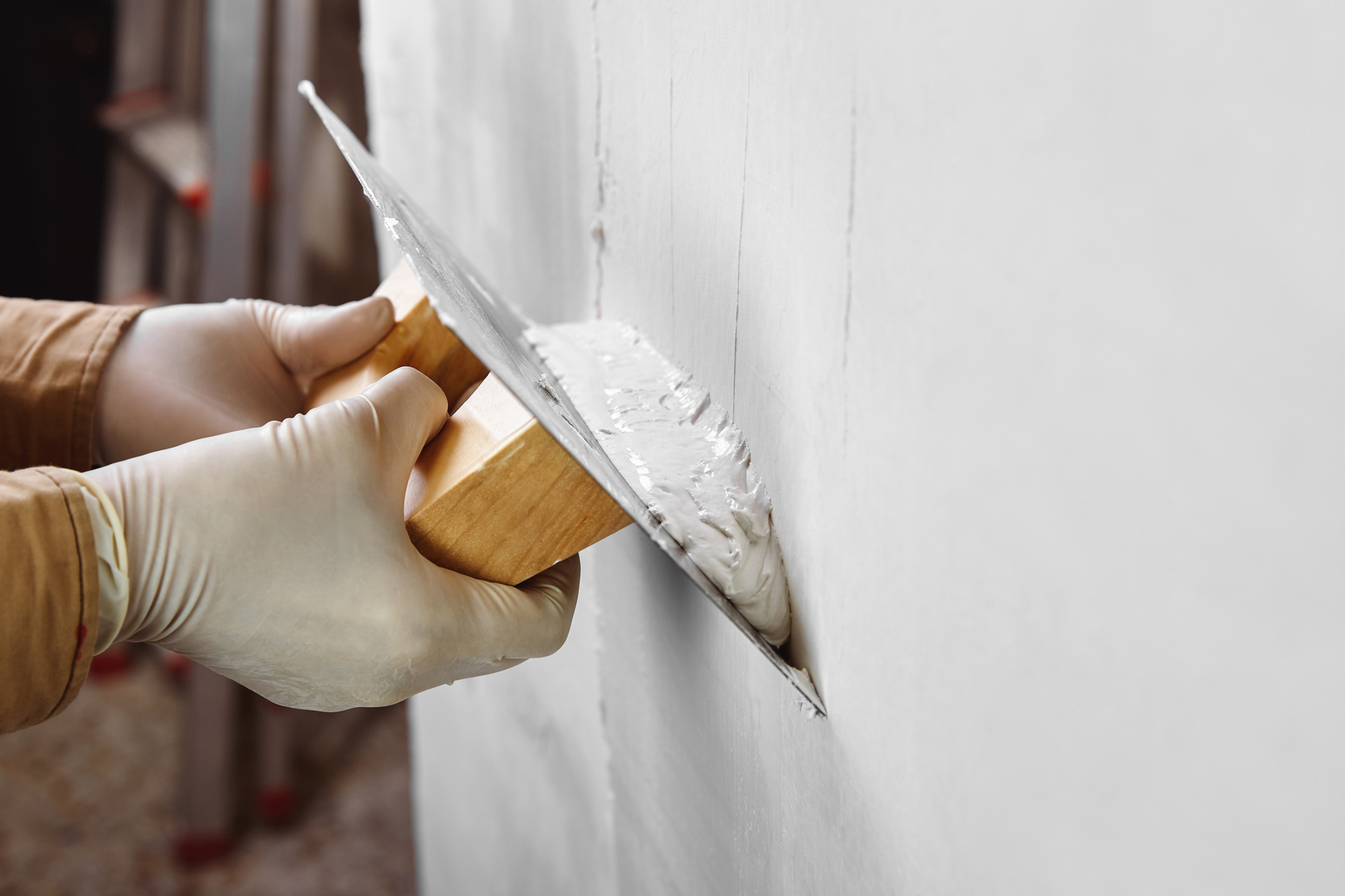
Plastering in Sopley
Ceilings, re-skims, hollow walls taken back to the block, lime work in the village cottages and external render across Sopley, Winkton and BH23.
The site visit is free and so is the written itemised quote. Thomas Hannen prices every job himself.
Most plastering calls from Sopley are one of two jobs: a tired ceiling that wants overboarding and skimming, or a wall that has gone hollow and needs taking back before anything new goes on it. We tell you which one you have got before you commit to either.
People ring when the room is already in pieces. The paper is off and the wall underneath is patchy and soft. The bathroom above has leaked and the ceiling below has gone brown and started to sag. A stud wall has come out and left a scar across two ceilings and a floor. Or the textured ceilings have simply had their day and the room cannot be decorated round them.
None of that needs a survey to describe, but all of it needs someone to tap the surface and look behind it. What is behind a wall in a 1970s house is not what is behind a wall in a cottage by the church, and the two take different materials. We are under six miles away, so coming out to look costs you nothing and settles the argument.
The work
Filler along a straight crack is a six month fix
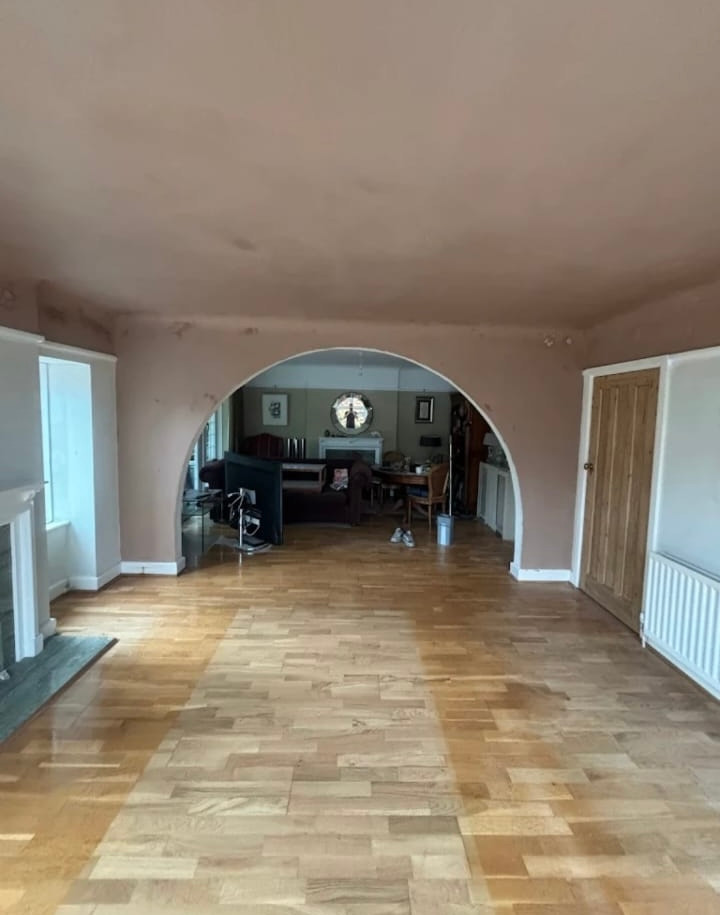
Filler along a straight crack is a six month fix. Three quarters of the housing here went up between 1945 and 1982, with the peak in the seventies and early eighties, and on those houses the ceilings are plasterboard with a thin skim or a textured coating over the top. They crack in straight lines along the board joints as the house moves, and filler along a crack like that is a six month fix. We scrim and skim the whole ceiling instead, or overboard it where the old board has sagged between the joists, and it goes flat and stays flat.
Houses of this vintage went up with a browning or hardwall backing coat on blockwork downstairs and board upstairs. Where a wall has been wet, or where a fixing has been hammered about, the backing loses its grip on the block and the whole patch sounds hollow when you tap it. That comes off back to the block, gets a new backing coat and a fresh finish coat, rather than a skim laid over a wall that is already letting go.
A shower tray, a failed seal or a slipped overflow shows up as a stained, soft patch on the ceiling below. We take out what is wet rather than skim over it, let it dry, then patch or re-board and skim so the repair does not read as a rectangle through the paint. Nearly half the homes here are terraced, so the mixer and the waste both come back through the house, and hacking off on a shared wall is felt next door, which is worth telling the neighbour rather than leaving them to find out.
Garage conversions and knock-throughs. There are a lot of integral garages on the estates around here and they nearly all become a room in the end. That is dry lining rather than wet plaster: insulated plasterboard on dabs or on a stud, tape and joint or a full skim over the board, and a proper angle bead on every corner and reveal so the new opening looks like it was always there.
Down by the church and along the lane there are cob and brick cottages with solid walls and lath ceilings, twenty-six listed entries among them. Those want lime plaster and a breathable finish, not gypsum. A cottage wall that was skimmed hard ten years ago and now has a damp shadow at skirting level is usually telling you the wall cannot dry through its own face. Outside, the exposed elevation faces southwest, so the wind and driven rain work at the openings and the edges rather than the middle of a wall, and that is where pebbledash and render crack or go hollow. Those get patched into the existing where the rest is sound, or taken back and rebuilt with a scratch coat, a mesh reinforced basecoat, a bell cast bead and a silicone thin coat. Thin coat systems suit blockwork; a solid old wall takes lime render instead.
How it runs
From your call to a written price
Same team from the first visit to the last coat, one person to ring, and no sub-contracting your house out to somebody you have never met. The quote is itemised: prep, anything hacked off, the backing coat, the beads, the skim, making good, and disposal on separate lines. Planning and building control here sit with New Forest District Council, the old core of the village is a conservation area, and the National Park boundary runs close by, so if you are changing an external finish rather than repairing it, check the address on the National Park Authority's property map and ask the council whether permission is needed. Re-rendering a whole elevation also brings Approved Document L and building control into it.
Cost
What decides the price of a plastering job
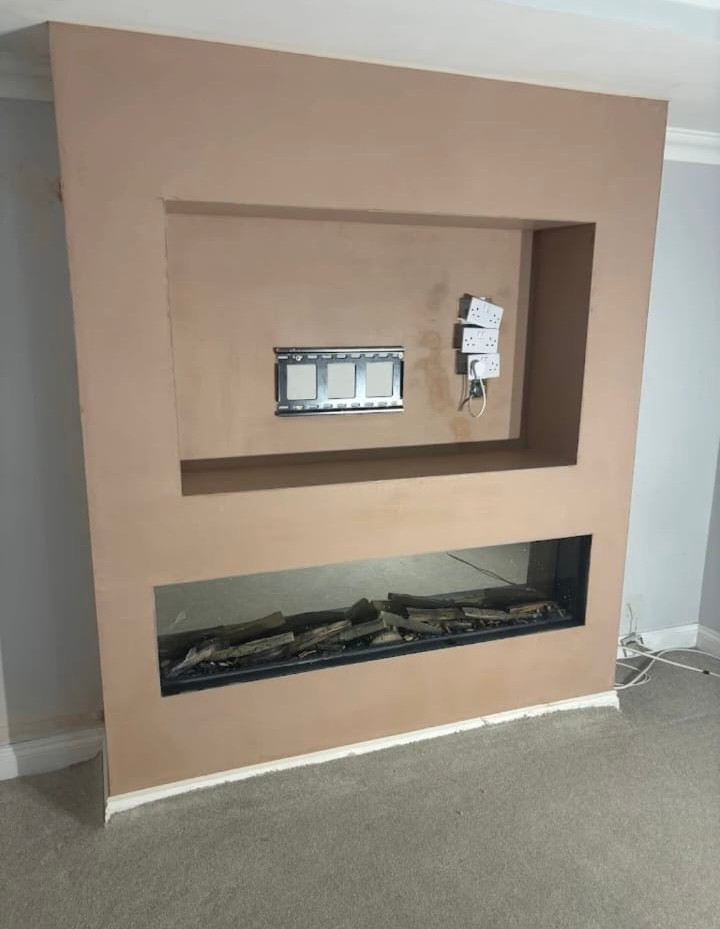
No rate per square metre, because what sits behind the surface decides it. A seventies terrace with browning on block, a converted garage lined out on studs, and a cob cottage on lath and lime are three different jobs before anyone lifts a trowel. We tap the old surface before quoting, because anything hollow is already blown. Reveals, chimney breasts and staircases are where the hours go, since each is a bead cut, fixed and floated true. External render wants a tower or a scaffold, and each coat has to take up before the next, so the weather sets the programme.
If it has come down
Plaster blown or a ceiling down today
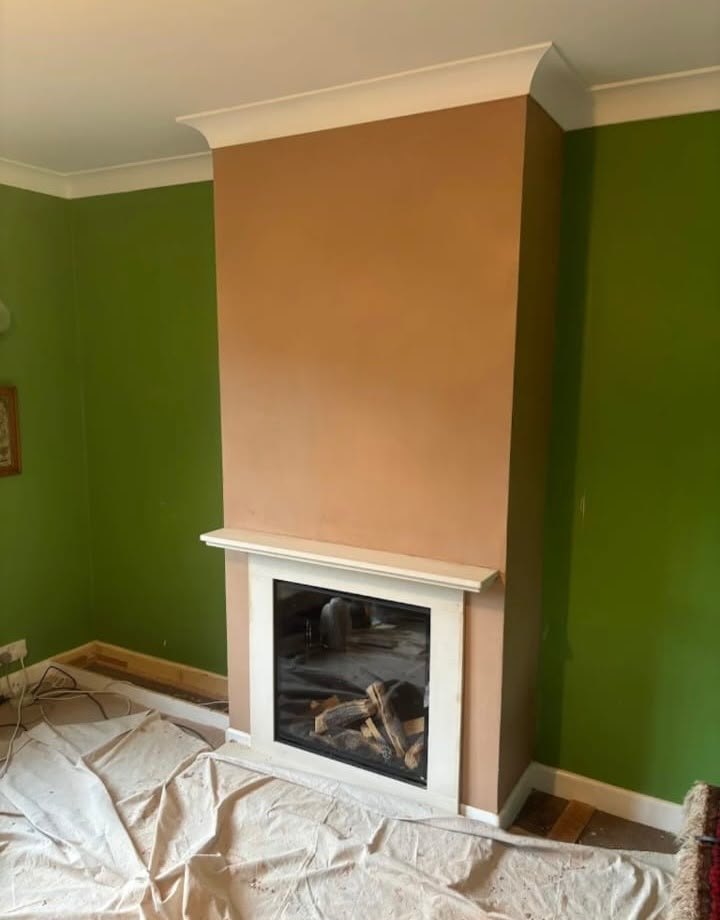
Ring rather than use the form. A ceiling that has started to sag, or plaster blown off a wall after a leak, goes to the front of the queue. Keep out of the room and get anything you value out from under it. Sopley is a short run for us, so a ceiling that has let go in the morning can usually be looked at the same day.
Worth knowing
The artex question, and why the ceilings crack in lines
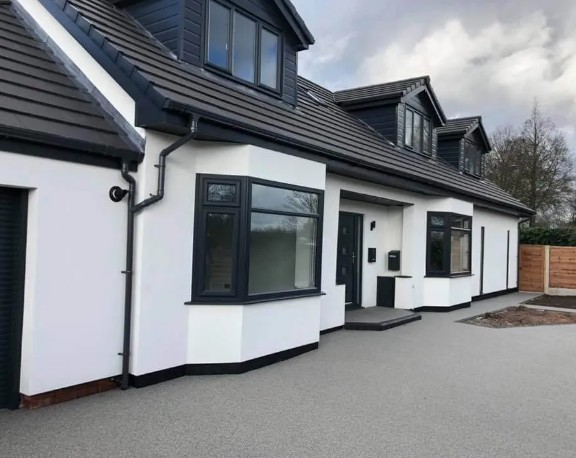
Roughly three quarters of the housing around Sopley went up between the mid 1940s and the early 1980s, and the peak of it was the 1970s. That gives a lot of these houses the same interior: plasterboard ceilings, a textured coating over them, and a backing coat on blockwork below. So the same two questions come up here far more often than anywhere else we work.
The first is artex. Textured coatings applied before 2000 can contain asbestos fibres in the mix, which is why nothing gets sanded, scraped dry or attacked with a wallpaper steamer. The safe and usually cheaper answer is to overboard it: 9.5mm plasterboard screwed through the old ceiling into the joists, scrimmed and skimmed flat, which costs you about a centimetre of ceiling height and leaves the coating sealed where it is.
Removal is the other route and it belongs with a licensed contractor, not a plasterer with a scraper. The second question is the cracking. Straight cracks that follow the board joints are the boards moving, not the house failing, and they come back through filler every time. Scrim tape and a skim across the whole ceiling is what actually ends it.
Who you are dealing with
A local firm you can check
We cover Sopley and the BH23 addresses around it, out through Winkton, Burton, Bransgore, Ripley and Neacroft, with planning and building control under New Forest District Council. Bournemouth Roofing & Building Ltd, registered in England and Wales, company number 15471719, which you can look up in a minute. Thomas Hannen's business, and he is the one who comes out to price the job, not a salesman. A verified customer's 10 out of 10 on Checkatrade. The visit and the written quote are both free.
Questions
Sopley questions we get asked
Sopley is a conservation area. Does that cover the render?
It covers how the outside of the building looks, yes. Sopley has its own conservation area, so putting back the same render in the same finish counts as maintenance, while going from a smooth finish to pebbledash, or from off-white to a strong colour, is a change of appearance and is worth putting to the New Forest authority first. Indoors the conservation area does not reach, so a re-skim is entirely your decision.
We are mid-terrace. Will the neighbours feel the ceiling coming down?
They will certainly hear it. Close to half of Sopley is terraced, so the party wall carries the noise of a ceiling being pulled down and there is no way round that beyond warning them and keeping to normal hours. We do the noisy stripping in one hit rather than spreading it across several days. Where a party wall is being hacked back I check both faces before starting, so nothing pops through on their side.
Which Sopley elevation should we do first if funds are tight?
The south west face. That is the exposed elevation in Sopley, so it takes the driven rain and it is where the render cracks open, where the finish goes chalky first and where damp shows on the inside face. The sheltered sides will usually sit a season or two without getting any worse. I price elevations separately for that reason rather than assuming the whole outside has to be done in one go.
What does an itemised quote for a 1970s house cover?
Every surface separately, with the make-good shown rather than buried in a single figure. Three quarters of Sopley went up between 1945 and 1982, most of that in the seventies, and on that stock the extras are predictable: taking off and refitting a textured ceiling, easing a door that will not close over new plaster, and beading round metal window reveals. Thomas Hannen writes those in before you commit, and the visit costs nothing.
Do we need anything cleared before converting the loft here?
For the nutrient rule, yes, if it becomes a bedroom. Sopley drains into the River Avon catchment and that only engages where a scheme adds overnight accommodation, so a new loft bedroom is caught while re-skimming the landing is not. The conservation area also means a new rooflight or dormer on a visible face gets looked at. Plastering is the last trade in, so get both cleared while the structure is still on paper.
Nearby, and next door
Plastering and rendering near Sopley
Plastering and rendering nearby
Our other trades in Sopley
Everything we do in Christchurch Plastering and rendering, all areas Every area we cover
Free quote
Find out what your ceilings and walls actually need
We will tap the room through, tell you what can be skimmed and what has to come off, and put a free written itemised price behind it.