
Bricklaying and repointing in Sopley
Repointing, wall ties, sills and lintels, chimney stacks and boundary walls, on Avon valley cottages and the estates built around them.
The site visit is free and so is the written itemised quote. Thomas Hannen prices every job himself.
Pointing that has gone grey and crumbly on a Sopley house is nearly always a mortar that was mixed too strong for the brick, not a wall in any structural trouble. It is raked back to sound material and put back softer, and the wall starts shedding water again instead of holding it.
Three things bring people here to the phone. Joints you can pick out with a screwdriver on the elevation that takes the weather, so rain sits in the wall instead of running off it. A crack running dead level along the front, in the same place every few courses, which is a different problem altogether and worth naming early. Or a boundary wall down one of the lanes that has gone bowed after a wet winter, lost its coping, or been caught by a wing mirror.
We come out, look at the whole elevation rather than the square metre that shows, and tell you plainly which of those you have. Sometimes the answer is a couple of days of cutting out and pointing. Sometimes it is ties, which is a smaller job than most people fear once it is diagnosed. And sometimes it is a wall to leave alone and watch for a winter, which we would rather say at the survey than halfway through.
The work
The brickwork we get called to in Sopley
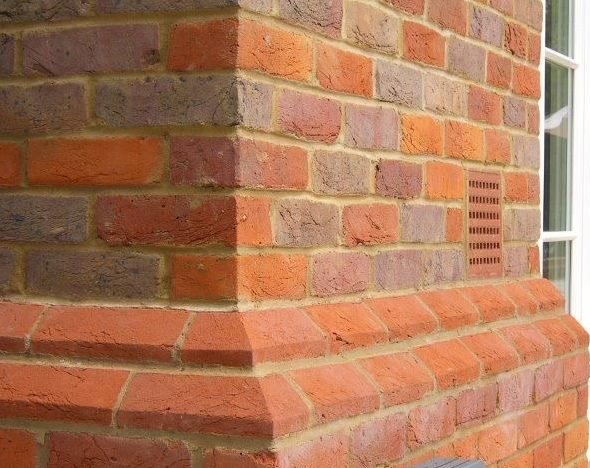
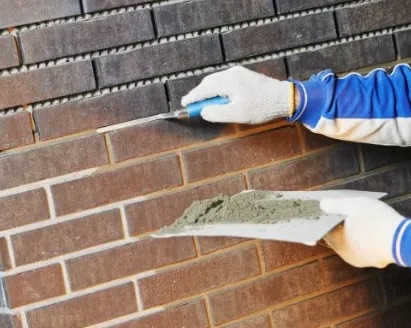
Repointing cavity brickwork. Three quarters of the houses in and around the village went up between the war and the early 1980s, with the peak in the 1970s, which means a facing brick outer leaf, a cavity behind it and a cement and sand mortar in the joints. That mortar fails from the face inwards. The first sign is a joint you can rub out with a thumbnail, then the arris of the brick starts losing its edge where water sits. We rake out to at least twice the width of the joint, back to something solid, then point in a mix knocked up to match what is already there, usually cement, lime and sand rather than neat cement. The profile goes back the way the house was built, which on this stock is normally a bucket handle or a weather struck finish rather than flush.
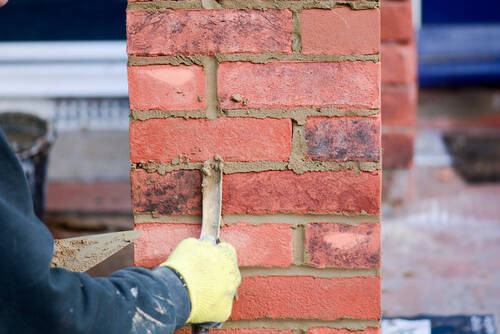
The crack that runs sideways. Worth knowing the difference before you panic. A crack that steps down diagonally through the mortar joints is movement. A crack that runs dead level, repeating every fifth or sixth course on one elevation, is nearly always wall tie corrosion: the tie rusts, swells and jacks the brickwork apart. On a house of this age it is common and it is fixable. We cut out the failed ties, install remedial ties on a set pattern, replace any brick that has been split, and make the pointing good so the repair is not a stripe across the front.
Nearer the church and the river the fabric changes. Soft red brick, some flint, a solid wall with no cavity and often no damp proof course under it. On that sort of period wall the joint is the sacrificial part and it wants a lime mortar, usually an NHL, so the wall dries out through the mortar rather than through the brick face. Point a soft wall in something hard and the faces spall off at the first sharp frost while the pointing still looks perfect.
A cracked concrete sill, a soldier course that has dropped, or brickwork bulging over a window where the lintel bearing has moved all get propped, cut out and rebuilt on the original line in brick sourced to match. Along the lanes it is roots, vehicles and water standing on an open top that do most of the damage, and once a length of garden wall is bowed the honest answer is to take that section down and rebuild it off the same footing, with the coping reset so the top sheds water. A stack takes weather from four sides, so its joints go first and then the flaunching cracks and feeds water down inside.
New brickwork and blockwork is the other half of the week: extensions, garden rooms, a new pier, an opening formed with a lintel over it, a garage in blockwork behind a facing leaf. New cavity work goes up in stretcher bond with the wall ties, cavity trays and the damp proof course carried through, the foundation dug to depth, and the structural parts signed off by building control. In a conservation area the brick and the bond are worth agreeing before anything is ordered.
How it runs
From your call to a written price
The quote is itemised by elevation: access, raking out, the mix, brick replacement and disposal on separate lines. On permission: repointing and repairing like for like on an unlisted building is repair, so there is no planning permission and no building control in it. Two things change that here. Sopley has its own conservation area, so covering a brick elevation in render, cladding or tile is an application, and the National Park Authority's interactive property map will tell you whether your address sits inside the boundary. On the twenty six listed entries in the village, the church among them, even a change of mortar counts as an alteration, and National Park heritage and conservation guidance sets out how the Park handles it.
Cost
What decides the price of a brickwork job
No rate per square metre: the metre of wall tells you nothing until you know what the joints are like. Terraces are close to half the stock here, and a cottage tight to the lane, a semi with an open side path and an end terrace where every bag goes through the house are three different jobs. How long a platform stands matters as much as its size, and the work at height rules are why it is a priced line rather than an optional extra. Ask the rake depth, the mix, and whether the scaffold is in.
If something has moved
Loose brickwork, or a wall that has shifted
Ring rather than use the form. Anything overhead or leaning goes to the front of the queue: the first visit makes it safe, and we price the permanent repair once we can see how far the movement goes. Sopley is under six miles out, so a stack with movement in it usually gets looked at the same day. The phone is answered 24 hours for emergencies; scheduled work runs Monday to Friday, 8am to 6pm.
The one local thing
Every wall in the road was built the same year
Around three quarters of the housing here went up between the war and the early 1980s, and the busiest stretch by some way was the 1970s. Walls built within a couple of years of each other, in the same mortar, with the same ties, by the same gang, tend to fail within a couple of years of each other too.
That is why the useful thing to do when a neighbour has their front elevation pointed is to have a look at your own. Not because anybody wants the work, but because the same weather has been on both walls for the same length of time. It is also why we will say honestly that a wall has a few winters left in it, if that is what we find.
The second consequence is that a good half of the homes here are terraced, and a terrace reads from the road as one wall rather than four. Point one house in a different sand or finish the joints to a different profile and it shows from the far side of the street for good, so we make up a sample panel, let it dry properly and get you to look at the colour before we point the whole elevation.
If two or three neighbours want it done together the scaffold goes up once and is split between you, which is the one real saving on this kind of job. And where the work means cutting into a shared wall, taking a footing deeper or rebuilding a wall that stands astride the boundary, the Party Wall etc. Act 1996 applies and your neighbour needs written notice first. Repointing your own face of your own wall does not.
Who you are dealing with
A local firm you can check
We cover Sopley, Bransgore, Thorney Hill, Winkton, Burton and the rest of BH23, and the travel is a line on the quote rather than something buried in the rate. Bournemouth Roofing & Building Ltd, registered in England and Wales, company number 15471719, which you can look up in a minute. Thomas Hannen's business, and he is the one who comes out to price the job, not a salesman. A verified customer's 10 out of 10 on Checkatrade. The visit and the written quote are both free.
Questions
Sopley questions we get asked
Sopley is a conservation area. What still counts as maintenance?
Putting back what was there. A joint raked out and refilled in the same mortar, the same colour and the same profile is repair and needs no application. Rendering over brick, swapping to a different brick or a different covering, or striking the joints proud where they were flush, is a change of appearance, and that is what the designation exists to control. New Forest District would want to see any of that first.
Nearly half the village is terraced. Does that change anything?
It changes the seam. Terraced houses make up 48.3% of the dwellings in Sopley, so most frontages run continuously into next door and a repoint stopping at your boundary shows as a vertical line in a slightly different colour. We match the joint profile to the neighbouring houses rather than only to your own wall, and we agree access over the adjoining path well before the scaffold arrives rather than on the morning it turns up.
The houses here all went up together. Do they fail together?
Largely, yes. 75.4% of Sopley was built between 1945 and 1982 with the peak in the 1970s and early 1980s at 46.6%, so the same ties, the same mortar and the same detailing have had the same weather for the same length of time. When one house on a row shows soft bed joints or a rusting tie, the ones either side are usually a season behind it rather than sound.
You are only a few miles away. How soon can you look?
Sopley is under six miles from the yard, so it is normally a matter of days rather than weeks, and if something has come loose over a path or a doorway we get out sooner than that. Thomas does the visit himself, walks the elevations, and writes it up afterwards as separate itemised lines. He prices the job, so there is nobody else to go back to when you have a question about it.
Do the Avon nutrient rules affect a chimney rebuild?
They do not. That regime is aimed at schemes adding overnight accommodation in the River Avon catchment, so it engages on a new dwelling or a loft conversion with a bedroom in it and leaves repairs alone. Taking a stack down and rebuilding it, repointing an elevation or standing a garden wall back up adds nothing the rules are measuring. You are not applying for anything in order to have a stack rebuilt.
Nearby, and next door
Bricklaying and repointing near Sopley
Bricklaying and repointing nearby
Our other trades in Sopley
Everything we do in Christchurch Bricklaying and repointing, all areas Every area we cover
Free quote
Get the wall looked at before the winter
Tell us what the brickwork is doing and we will come and look at it. A free site visit and a written itemised quote, with the mortar mix and the method written down.