Bricklaying in Bransgore
Repointing, brick replacement, chimneys, garden walls and new brickwork in Bransgore and the villages around it.
The site visit is free and so is the written itemised quote. Thomas Hannen prices every job himself.
Last updated
The bricks in a Bransgore wall are usually sound. It is the mortar joints between them that have gone, which is why so much failing brickwork here does not need rebuilding at all. Putting joints back is a fraction of the work and a fraction of the cost.
What goes wrong around Bransgore is usually soft joints, a level crack or a leaning garden wall. The joints on one elevation have gone soft and sandy, and a screwdriver goes into them without much effort. A line of cracking has appeared across the front of a seventies house, running level along a bed joint rather than stepping up through the bricks. Or a garden wall has started to lean after a wet winter and nobody can say whether it is about to go over.
Those are three different problems with three different answers, and you cannot tell them apart from the drive. We come out, get up close to the wall, and say which one you have got. If the honest answer is that it will keep for another two or three years, you will get that too. The site visit and the written quote are both free, so finding out costs you nothing.
The work
What Bransgore brickwork tends to need
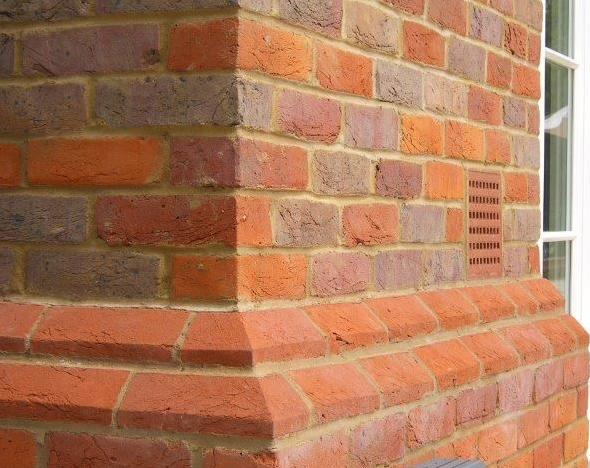
Joints, and the mortar they actually want. Half of Bransgore went up between the middle sixties and the early eighties, in a cement mortar that was often harder than the facing brick it was holding.
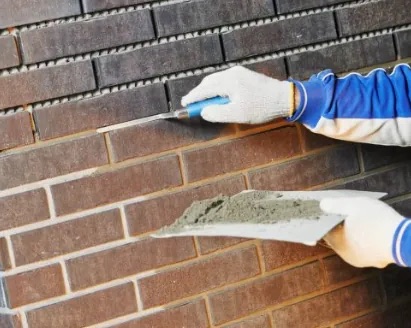
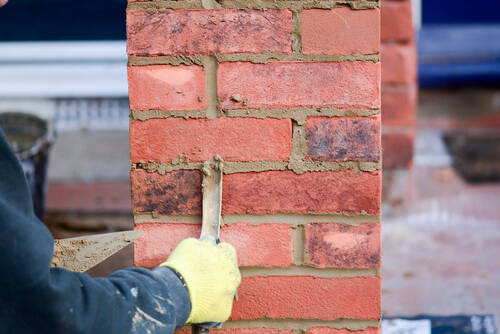
Where that is the case the joints have shrunk back, hairline gaps have opened along the top of each bed joint, and driven rain is getting behind the face. We rake out by hand to about twice the joint width, wash the wall down, and point back in a mix matched to what is there, finished flush, bucket handle or weather struck so it sheds water instead of holding it. Close to a fifth of Bransgore is older than that, and those cottages are solid wall in soft red brick, wanting a breathable lime mortar, usually an NHL with a coarse local sand. A hard cement joint on soft brick simply moves the damage into the brick face.
Wall ties, and spalled brick. A cavity wall built here in the seventies has galvanised ties in it, and fifty years is about their working life. As they corrode they swell and that lifts the outer skin along a bed joint, and the tell is horizontal cracking at regular spacing up an elevation, most often on the south west face that takes the weather. It is a proper repair with replacement ties installed through the outer skin, not a pointing job, and pointing over it only hides it for a season. Once a brick face has blown, frost takes another layer off it every winter, so we cut the failed units out and replace them with a reclaimed or handmade brick of the right period rather than the nearest thing on the merchant's rack. On the first two courses above the damp proof course, where splashback keeps the wall wet, that is often all that is wrong.
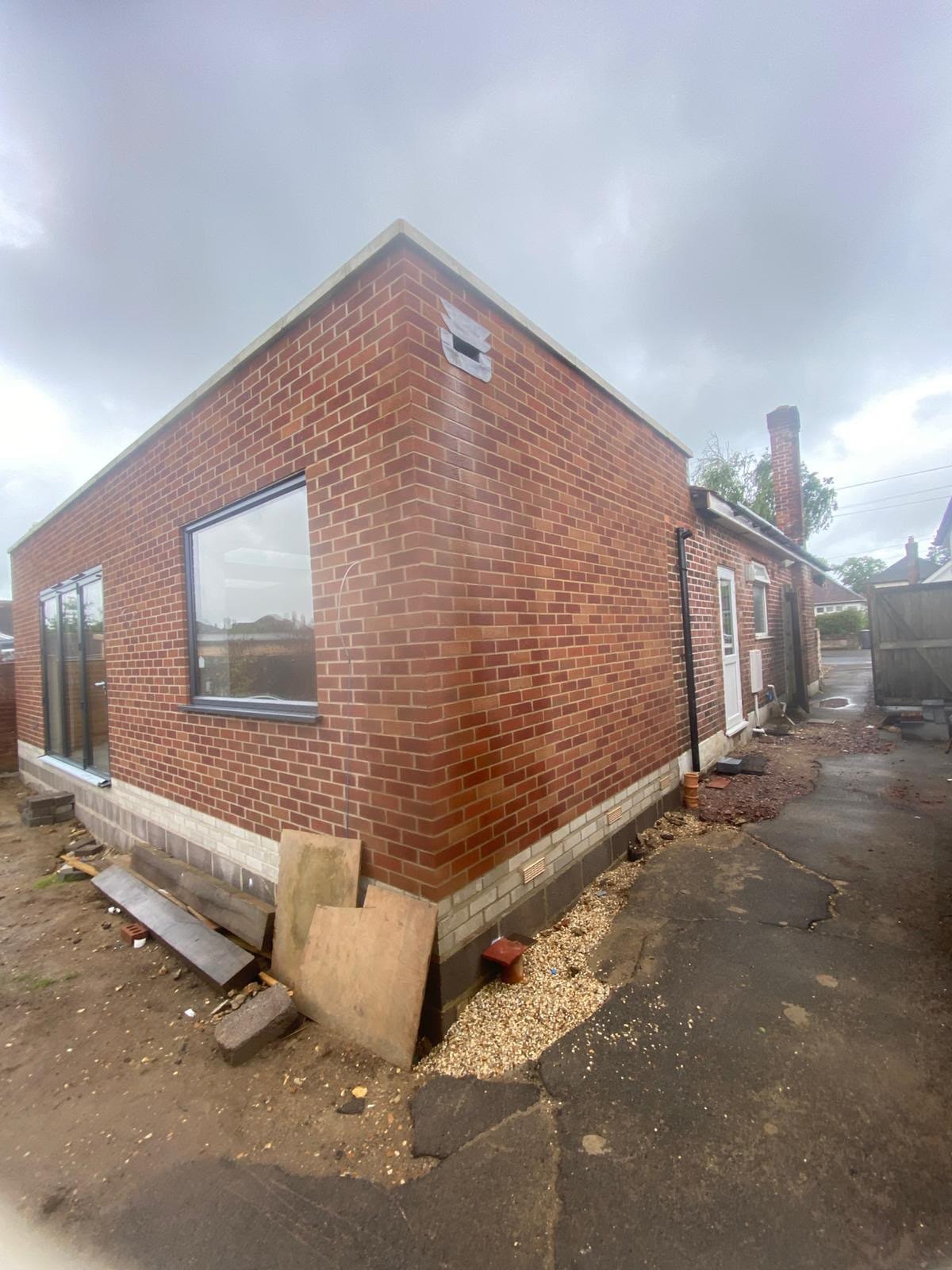
Plots in Bransgore are long and four in ten houses are detached, so there is a lot of free-standing brickwork about: boundary walls, a pair of gate piers either side of the drive, low retaining walls where the garden steps down. Free-standing walls weather from both sides at once, which is why they are usually the first brickwork on a property to lean or bow. A stack is the most weathered brickwork on any house, and the flaunching around the pots normally fails before anything else. New work is extensions and garden rooms in blockwork with a facing skin laid in stretcher bond to match the house, and cutting a new lintel in over a widened opening.
How it runs
Repairing brickwork that sits on moving clay
Thomas comes out, looks at the wall, and asks when a crack appeared and whether it opens and closes with the seasons. That question matters in Bransgore. The village sits on clay that shrinks in a dry summer and swells in a wet winter, so a stepped crack by a corner or a downpipe can be movement rather than old mortar.
If it is, repointing over it is wasted money, and he will say so. The written quote splits out scaffold or other access, raking out, the mortar and its mix, each elevation by area, any bricks to be replaced, and taking the rubble away. One company sees it through.
Most garden walls and bungalow gables need no platform. A chimney stack or a two storey gable gets a scaffold. Drives and borders are sheeted, mortar is mixed on boards, and the rubble leaves with us. Should the brickwork prove worse once the joints are open, you are shown photos and an added price before another brick comes out.
Like for like brick repair is maintenance, so at almost any address in the village no application is needed. Change the look of the outside and the Planning Portal sets out where permission begins. A new boundary wall has its own height limits under the guidance on garden walls, and a shared wall brings in the Party Wall etc. Act 1996. Bransgore has no conservation area, but a listed building needs consent from New Forest District Council.
Cost
What a brickwork repair costs depends on the crack
Whether the wall is still moving. A crack that has been stable for years can be raked out, stitched with helical bars if needed, and repointed. A crack that grows each summer means the ground is still moving, often because a tree or a leaking drain is drying or wetting the clay. That needs the cause sorted before the brickwork, and it changes the job completely.
Which wall you have. Most houses in Bransgore are cavity walls built in hard, even brick with a cement mortar. The older cottages are solid brick in a softer mortar, often lime. Matching the brick and the mix on a cottage takes longer, and a hard cement mortar on soft brick makes the faces spall in frost.
How much is actually wrong. The joint depth, the number of spalled bricks to cut out and replace, and whether a wall tie has corroded all set the hours. Raking by hand is slow. A disc is quicker but can widen the joint.
Getting to it. A garden wall needs nothing. A chimney or a gable needs a scaffold, and how long it stands is why the work at height rules make access a priced line.
Ask any other quote whether the cause of the crack has been looked at, what mix is going in, and how many bricks are being replaced.
If something has moved
A wall that is leaning or a crack that has opened
If a boundary wall is leaning over a path or a drive, keep people and cars away from it. If a chimney has loose bricks, keep out of the garden below.
A crack that has opened suddenly after a very dry spell is worth a photograph with a coin beside it, so the next visit can see whether it has changed. Then telephone rather than using the form, because a moving wall should not sit in an inbox. Brickwork is scheduled Monday to Friday, 8am to 6pm, and any call we cannot take is returned as soon as we are free. The first job on site is making it safe, propping a wall or taking down a loose top course. The permanent repair is priced after that.
Worth knowing
Where your rainwater lands matters more here than you would think
The ground under most of Bransgore is cohesive, and cohesive ground shrinks and swells with the seasons. It takes water up over winter and gives it back in a dry summer, and the level moves a little every time it does. Houses mostly cope, because their foundations were taken deep enough to sit below that movement.
What does not cope is everything built without a real footing: garden walls, gate piers, porch and conservatory bases, the low retaining wall around a raised bed. Those are the ones that come back with a stepped crack every few years however carefully they were pointed.
So before we rebuild anything free-standing here, we look at where the water is going. A downpipe discharging beside a wall, a silted gully, or a soakaway sited too close to a footing keeps one patch of ground soaked all winter while the ground a metre away dries out, and it is that difference across a short distance that moves brickwork. Approved Document H sets out where surface water is meant to end up.
Getting the rainwater away first, then rebuilding on a footing taken down past the seasonal movement, is the difference between a wall that stays put and one you pay for twice.
Who you are dealing with
Who you are handing your brickwork to
You deal with Thomas Hannen. It is his business, and he looks at the brickwork and prices it himself. Bransgore sits 5.6 miles from his Boscombe base, and he takes on walls anywhere in the village as well as at Thorney Hill, Sopley and along the BH23 roads towards Christchurch.
New Forest District Council covers planning and building control here. The company behind the name is Bournemouth Roofing & Building Ltd, registered in England and Wales with number 15471719, which is public on Companies House. On Checkatrade, the review from a verified customer reads 10 out of 10. Nothing is charged for the visit or for the written, itemised quote. Before you book a visit in Bransgore, you can read our customers' Google reviews, word for word, on our reviews page.
Planning at a glance
Do you need planning permission in Bransgore?
Most repairs in Bransgore need no application at all. What decides whether a change to the outside of your house does is who the council is, whether a conservation area or a listing applies, and whether the place sits in a protected landscape.
| Question | In Bransgore |
|---|---|
| Who decides | New Forest District Council is the planning authority for Bransgore. The National Park boundary runs close by, and the Park's property map shows which side an address falls. |
| Conservation area | None covers Bransgore, so a like-for-like repair is ordinary maintenance. |
| Listed buildings | Yes, there are listed buildings in and around Bransgore. If yours is one, work can need listed building consent. |
| Protected landscape | No National Park or National Landscape covers Bransgore. |
Questions
Questions about bricklaying in Bransgore
The garden floods every winter. Is that why the wall moved?
The flooding is very likely the cause. The ground at Bransgore has impeded drainage, so surface water sits on it instead of soaking away, and a footing standing in water through the winter loses support around its edges. Add a soil that swells when saturated and shrinks back in summer, and you get seasonal movement that opens a stepped crack and closes it again. The repair starts with getting water away from the wall, not with the brickwork.
Why is my detached house cracking where the extension joins?
Because the two halves sit on different footings and move at different rates. Detached houses are 41.3% of Bransgore, and most have picked up a conservatory, a porch or a rear extension at some point, built off a shallower foundation than the original. On ground that holds water the newer part rises and falls further. A straight vertical crack on the joint line is normally that, and it is repaired with a movement joint rather than filled solid.
Should the chimney be done at the same time as the walls?
If the scaffold is going up anyway, yes, because the stack is the most exposed brickwork on the house and it is the expensive part to reach twice. Around Bransgore the prevailing weather arrives from the west and hits the stack before it hits anything else, so cracked flaunching and open joints show on that face first. We price the stack as its own line so you can see the figure and decide.
Who owns the wall between me and the field behind?
The deeds say, and it is worth checking before anyone lifts a trowel. Around Bransgore a lot of plots back onto paddock and farmland, and the boundary is often a hedge with a short brick return only at the road end. Look for a T mark on the title plan pointing into the owner's land. Where a wall is genuinely shared we will not start until both owners have agreed the scope in writing.
How many days does a single elevation usually run to?
Two to four working days on an average semi or detached frontage, plus the scaffold going up and coming down either side of that. The variables are joint depth, how hard the old cement has gone and the weather. On the wetter plots around Bransgore we lose more time to a face that will not dry enough to accept mortar than to anything else. The written quote gives a day count so you can plan parking around it.
Nearby, and next door
Bricklaying near Bransgore
Nearby places we also cover for bricklaying, with straight-line distances from Bransgore, and the other trades we offer in Bransgore itself.
Bricklaying nearby
Our other trades in Bransgore
Brickwork and repointing guides
Lime or cement mortar: which do you need? Single storey extension: planning and building regs Subsidence cracks: which ones matterEverything we do in Highcliffe Bricklaying, all areas Every area we cover
Free quote
Get your Bransgore brickwork looked at properly
Tell us which wall is worrying you. We come out, get close to it, and put what it needs in writing.