
Bricklaying at Thorney Hill
Repointing, cracked and spalled brickwork, chimney stacks and garden walls, priced off a free visit and written down line by line.
The site visit is free and so is the written itemised quote. Thomas Hannen prices every job himself.
Last updated
The work
Brickwork in Thorney Hill: the weather side is where the work is
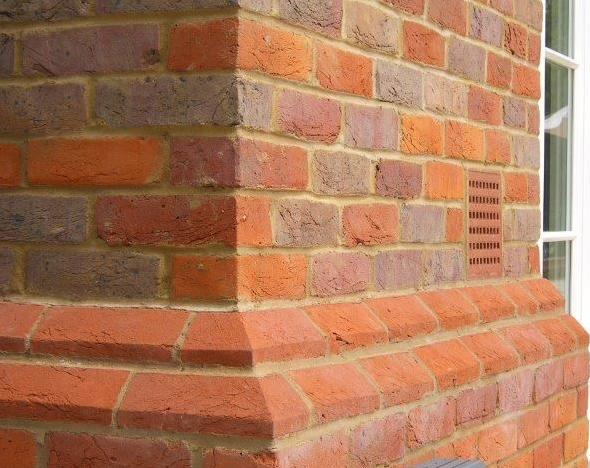
On most houses at Thorney Hill only one or two elevations actually need repointing, and it is nearly always the ones facing the open forest and the weather. We rake out the joints that have gone, match the mortar to what is already on the wall, and leave the sheltered elevations alone, not sell you the whole house.
A brick wall at Thorney Hill is due for work when any of these shows. Joints on a gable that have eroded back behind the face of the brick, so the wall looks pitted and dark after rain. A damp patch inside an outside wall that decorating will not fix. Or a garden wall, a pier or a stack that has started to move and is now obviously out of line.
We come and look at the wall, in daylight, and tell you which of those you have. A good deal of what gets called damp out in Thorney Hill is rain getting through an eroded joint or a cracked lintel bearing, and the fix is a day of brickwork rather than anything dramatic. You get a straight account of what needs doing now, what will keep, and an itemised written price for the work. The site visit and the quote cost nothing.
The work
Brickwork jobs at Thorney Hill
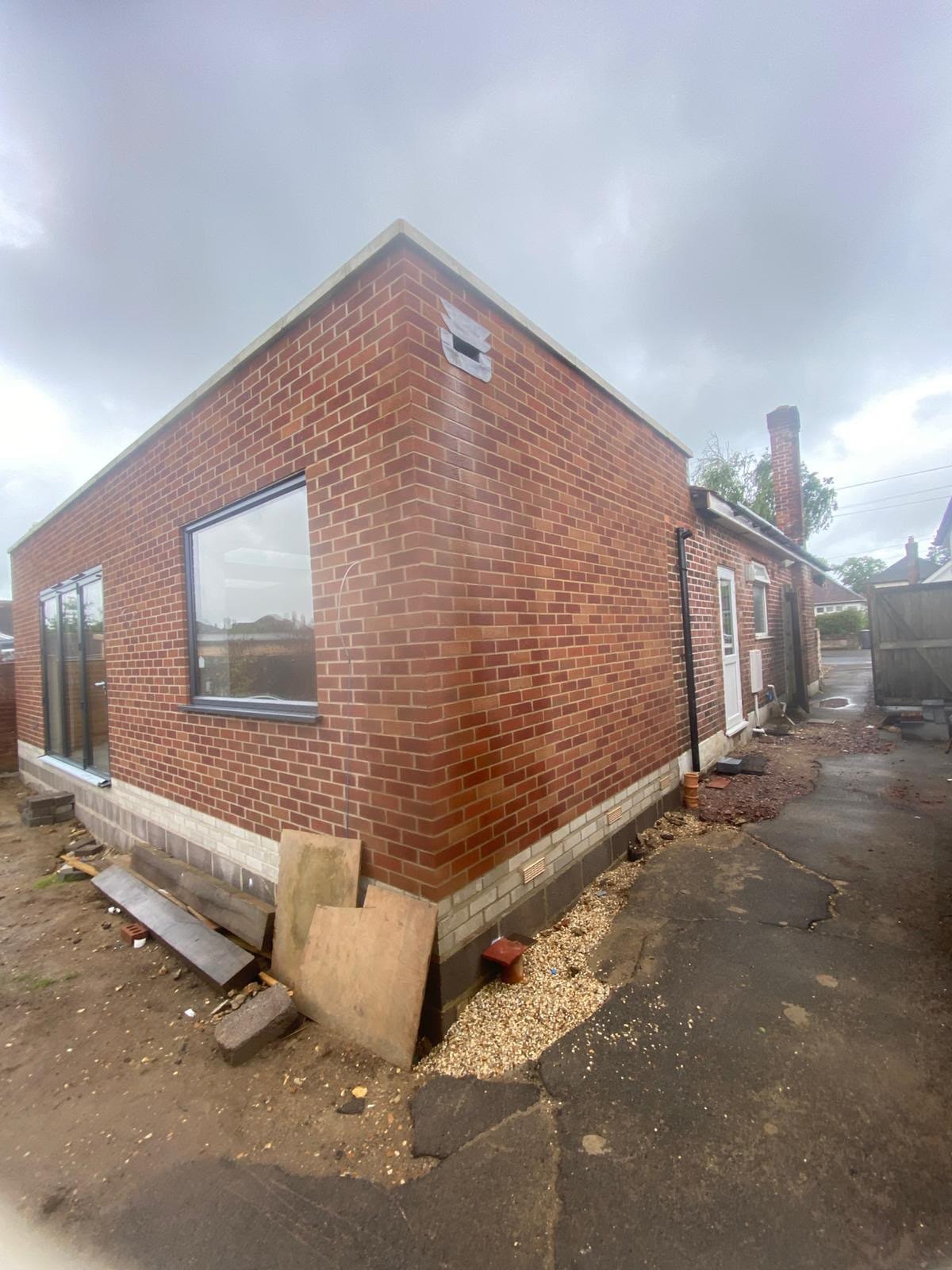
The weather elevations on the newer houses. A lot of the housing around the green and the lanes off it went up between the sixties and the early eighties, in cavity brickwork with a sand and cement joint.
That mortar has a working life, and on the exposed side, which here faces south west, it is usually spent first: the joint goes back a few millimetres, the face of the brick starts to fret, and rain sits in the wall instead of running off it. We cut and rake the failed joints out, repoint to match the profile already there, and finish the elevation as a whole so it does not read as a patch.
Cracks that are wall ties rather than mortar. On cavity walls of that generation, a crack that runs horizontally and repeats every few courses is not a pointing problem. It is the ties in the cavity rusting and jacking the outer leaf apart, and repointing over it hides it for a year. We look for the pattern, cut out and replace the damaged bricks, and set out plainly what the wall needs so you can decide with the facts in front of you.
More than a fifth of the stock in Thorney Hill predates 1919, and those brick cottages and the outbuildings behind them are a different animal: soft handmade brick in a solid wall, no cavity, built to dry out through a breathable lime joint. Those get raked by hand and repointed in an NHL lime mix with the sand matched for colour, and you see a sample panel before we go further. Cement on a period wall like that pushes the water into the brick face and takes it off after the first hard frost.
Stacks here take the full run of the wind off the heath. Flaunching cracks, the top courses go soft, and eventually the stack leans. We rebuild from a sound course up, reuse the brick where it is worth reusing, and re-flaunch properly. It is work at height under work at height rules, and the platform is a line in the quote. Boundaries that face onto the lanes and the forest take knocks, and their coping and gate piers are usually the first to go, so we rebuild bowed lengths, put back brick on edge coping, rebuild a gate pier on a proper footing and get a damp proof course in at the base. New work runs the same way: an extension or garage skin in stretcher bond with blockwork behind, a lintel over each opening and a foundation sized for ground that shrinks and swells, all through building control.
How it runs
Rebuilding a wall or chimney stack on clay ground
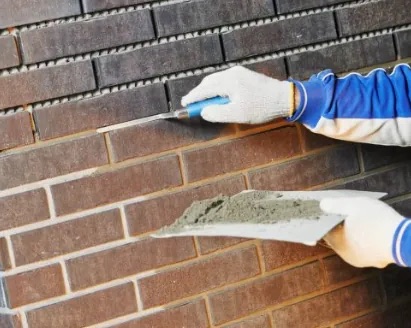
Tell us which wall: a chimney stack that has taken a gale, a boundary wall a vehicle has clipped on a narrow lane, a garden wall with a crack running through it, or an older brick cottage that needs making good. Thomas comes out, looks at the brick, the joints and the ground, and prices it himself. You deal with one company throughout.
Each elevation gets its own lines on the quote: scaffold or tower, raking out, the mortar, the count of bricks to replace, any rebuild or new footing, and taking the waste away. Plots in Thorney Hill generally have room for a scaffold and a mixer on the drive, and we match bricks from reclaim where a cottage needs it. The site is cleared each evening. Where a crack runs through a wall we look at the ground, because this is clay that shrinks and swells, and a wall near a tree or a leaking drain can move. If the foundation proves to be the problem, a photograph and a rebuild price reach you first.
Planning here is the National Park Authority, whose interactive property map covers each address. With no conservation area in Thorney Hill and only a handful of listed buildings, repair is simply maintenance. Building a new garden wall, or raising one, is limited in height by the Planning Portal rules on garden walls. Structural work goes through New Forest District Council building control, and building on the line between you and a neighbour means serving notice under the Party Wall etc. Act 1996.
Cost
What decides a brickwork price on forest clay
The metre of wall tells you little until you know what the joints, the bricks and the ground beneath are doing.
What kind of wall. Detached houses are the largest share here, so a full height gable, an old cottage wall tight to the lane, and a garden wall worked from the ground are three different set ups. Work at height rules put the scaffold on its own line.
The ground under it. Clay shrinks in a dry summer and swells in a wet winter. A crack that opens and closes with the seasons may need its cause dealt with, a tree or a leaking drain, before the wall is rebuilt, and that changes the job. Where rainwater ends up beside a foundation matters, as Approved Document H makes clear.
Matching bricks. Post-war houses used standard bricks that can often still be found. Older cottages need reclaimed bricks sorted by colour and size, which takes time.
The mortar. Lime on old soft brick, and a cement and lime mix on modern work, each matched in colour.
When comparing, find out the raking depth and the tool, and whether scaffold and any footing work are in the figure.
If something has moved
A stack or wall that has moved or come down
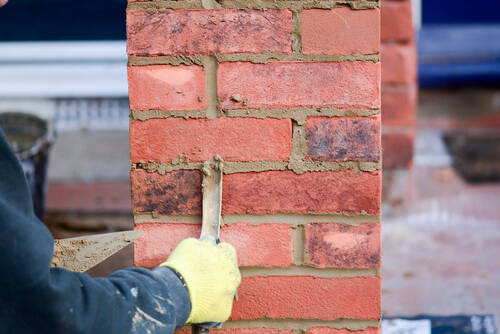
If brickwork is leaning or loose above head height, phone us; do not use the form. A chimney stack loosened by a gale, a boundary wall knocked by a vehicle, or a garden wall leaning over a path is made safe first, with loose bricks taken down, the area fenced and props set if needed.
The lasting repair is priced when we know how much has moved, and why it moved. Scheduled work is Monday to Friday, 8am to 6pm. For anything like this, ring, and if nobody answers you will get a call back as soon as we can.
The one local thing
The wind comes off the forest from the south west, and it sets the job
The exposed side of almost every building here faces south west, into the open ground, and driven rain does its damage at the edges, not in the middle of a wall.
That is why the pointing fails first around window and door reveals, under sills, at the corners of a gable and on the top few courses of a stack or a parapet, while the sheltered elevations of the same house can still be sound after fifty years. It is also why patch pointing on that side rarely holds: water finds the next weak joint along and you are back where you started next winter.
In practice, repoint the weather elevation as a whole and in one go, and be more careful about the mix and the weathering of the joint there than anywhere else, because a joint left proud or slack on that face will hold water instead of shedding it.
And if a room on that side of the house is damp, get the brickwork looked at before you start on the inside, because a wall that is taking rain through an open joint will make the same wet patch come back through whatever you put over it. We would rather tell you that on a free visit than take money for pointing a wall that is not the problem.
Who you are dealing with
Bricklayers for Thorney Hill, Bransgore and Burley
We are based in Boscombe, 6.8 miles off, and do brickwork across Thorney Hill, Bransgore, Burley and the BH23 villages either side of the forest. The National Park Authority decides planning, and New Forest District Council checks structural work.
The firm is Bournemouth Roofing & Building Ltd, registered in England and Wales, company number 15471719. Its owner is Thomas Hannen; he inspects the wall and prices the work himself. A customer verified by Checkatrade rated us 10 out of 10. The site visit is free, as is the written quote with every item set out. Before you book a visit in Thorney Hill, you can read our customers' Google reviews, word for word, on our reviews page.
Planning at a glance
Do you need planning permission in Thorney Hill?
Most repairs in Thorney Hill need no application at all. What decides whether a change to the outside of your house does is who the council is, whether a conservation area or a listing applies, and whether the place sits in a protected landscape.
| Question | In Thorney Hill |
|---|---|
| Who decides | New Forest National Park Authority is the planning authority for Thorney Hill. New Forest National Park Authority's heritage pages set out what it controls. |
| Conservation area | None covers Thorney Hill, so a like-for-like repair is ordinary maintenance. |
| Listed buildings | Yes, there are listed buildings in and around Thorney Hill. If yours is one, work can need listed building consent. |
| Protected landscape | Inside the New Forest National Park, where design is looked at more closely and permitted development rights are narrower. |
Questions
Questions about bricklaying in Thorney Hill
We are in the National Park. Who decides on brickwork?
The New Forest National Park Authority, not the district council, because Thorney Hill sits inside the Park boundary and the Authority is the planning authority for it. On a like for like repoint to an unlisted house that makes no practical difference, since repair is not development. Where it matters is anything changing what the building looks like from outside, and there the Park applies tighter design expectations than you would meet just beyond the boundary.
Most houses here are detached. Does that make access easier?
Access is rarely the problem here. Detached houses are 39.7% of the stock in Thorney Hill, the largest single type, so we can normally get a tower or a scaffold right round a building without asking a neighbour for permission or standing on someone else's path. It also means all four elevations weather differently, so they can be priced and done one at a time, not committed to as a single job.
The garden slopes towards the house. Is that a wall problem?
It becomes one. Thorney Hill is on cohesive ground with a significant shrink swell rating, so water ponding against a foundation instead of running away changes how the ground beneath it behaves through the year. That shows as cracking which opens in a dry summer and closes again over winter, usually at a corner. Getting the levels and the surface water away from the wall does more good than any amount of fresh mortar.
Why is the south west side always the worst?
That is the exposed face here, and driven rain works at the edges instead of the middle of a wall. Water arrives almost horizontally, so it gets under the cills, into the reveals around the windows and behind the verge and top course, which is where the joints go first. The middle of the same elevation can still be perfectly sound. We price the weathered parts of a wall rather than defaulting to all of it.
How many days would a stack rebuild run to?
Two or three on site for a single stack once the access is up, and the access is what sets the date rather than the brickwork. We drop it to sound work below the flaunching, keep the pot where it is sound, rebuild in the same bond with a mortar matched to what is there, and re-flaunch. Nothing is left open overnight. In Thorney Hill the roofing and the brickwork are the same firm, so one scaffold covers both.
Nearby, and next door
Bricklaying near Thorney Hill
Nearby places we also cover for bricklaying, with straight-line distances from Thorney Hill, and the other trades we offer in Thorney Hill itself.
Bricklaying nearby
Our other trades in Thorney Hill
Brickwork and repointing guides
Lime or cement mortar: which do you need? Single storey extension: planning and building regs Subsidence cracks: which ones matterEverything we do in New Milton Bricklaying, all areas Every area we cover
Free quote
Get a written price for your brickwork at Thorney Hill
Tell us what the wall is doing and we will come and look at it. Free visit, free itemised quote, and no chasing afterwards.