Driveways and patios in Bransgore
Drives, patios and paths across Bransgore, Thorney Hill and Sopley, priced off what is under the surface rather than off a photograph of the top of it.
The site visit is free and so is the written itemised quote. Thomas Hannen prices every job himself.
If a Bransgore drive has dipped where the car stands, or the patio slabs rock when you walk on them, the surface is almost never the fault. It is the sub-base underneath, and that is the thing we come and look at before anybody talks about paving.
Three calls come in from here more than any others. A tarmac drive that went down when the house was built has gone soft and started rutting where the wheels sit. A concrete flag path has lifted at a joint and somebody has caught a foot on it. Or the back patio has settled at one corner and rainwater now stands against the wall of the house instead of running away from it.
All three come back to the ground. On a free site visit we open a small hole in a corner of the drive and tell you whether what is down there can be kept or has to come out. That answer moves the cost far more than the choice between block paving and resin does, so it is worth twenty minutes with a spade before anything is written down.
The work
What Bransgore frontages usually need doing
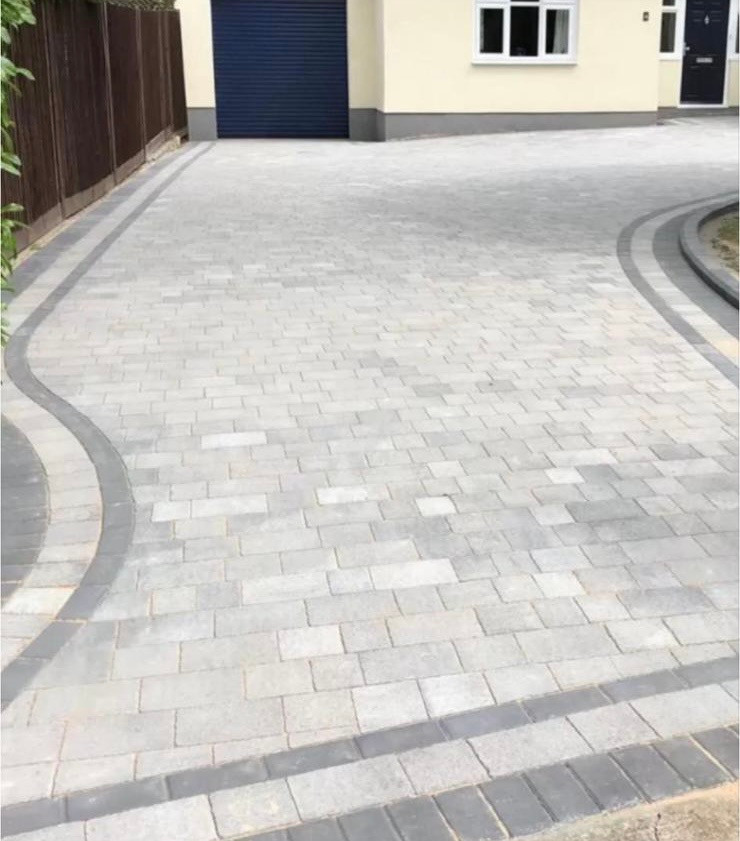
Drives as old as the house. Half of Bransgore was built between the mid sixties and the early eighties, and plenty of those detached houses and bungalows still have the original surface: tarmac laid straight onto the dug ground, or concrete flags bedded on sand. Tarmac of that age goes porous, then ruts where the car sits and breaks up along any edge nothing is holding. We excavate to firm formation, roll out a geotextile membrane so the stone cannot work down into the soil, and compact the sub-base in layers rather than tipping it in one deep lift. What goes on top is then a free choice.
The wide frontages here suit block, and on a front drive the sensible move is usually the permeable version, because the ground under Bransgore drains poorly and the water has to stay on your land. Blocks hold each other in place, so the edge restraint is the part that matters: a kerb or a block-on-edge border haunched in concrete, not bedded against a lawn and hoped for. Joints get kiln dried sand and a top up once they have settled. Weed through the joints and blocks creeping outwards at the sides is the restraint gone rather than the paving.
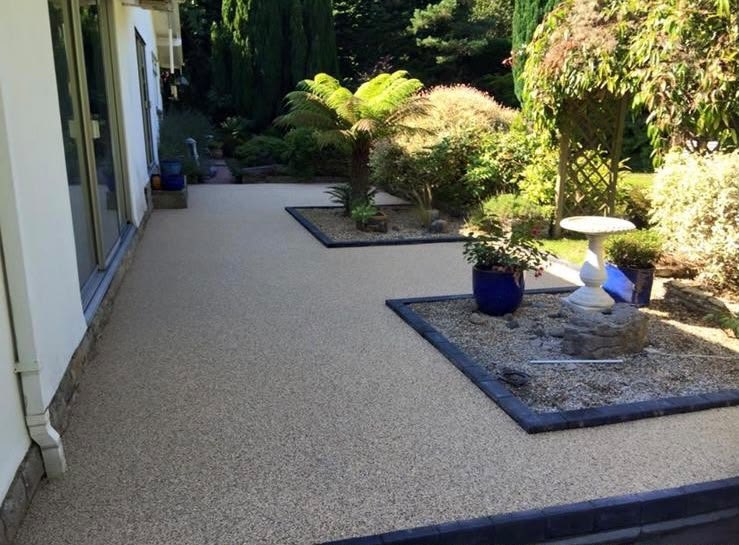
Resin bound gravel goes over a sound base and leaves no jointing to empty, which suits the longer drives out towards Thorney Hill. Tarmac is still the quickest way to cover a big area and takes a turning circle well. Concrete belongs where a horsebox or a tractor uses the entrance. Each wants a different depth underneath, decided at the survey.
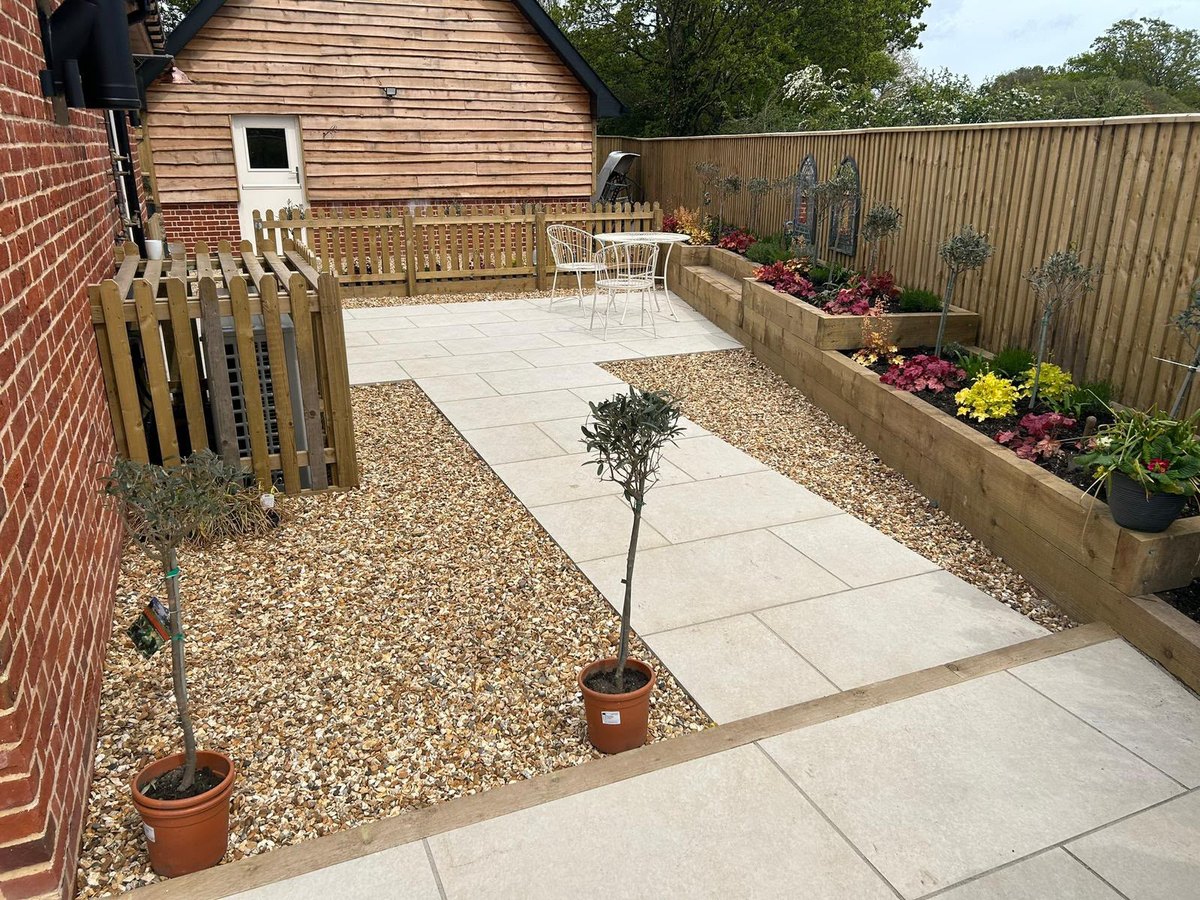
Patios, and the level they sit at. The bungalows here nearly all have a patio off the rear, and the ones we get called to were bedded on five dabs of mortar with a void in the middle. Slabs, natural stone and porcelain all want a full mortar bed and a fall away from the house, but the level matters more than the material: the finished surface has to stay two brick courses below the damp proof course, and where the ground will not allow that we build a step down or run a channel drain across the threshold instead. Ponding, a cracked bay, a gully that has stopped taking water and a soakaway that never worked are all jobs on their own, and the spoil is priced honestly, a grab lorry where one can stand on the lane and a skip where it cannot.
How it runs
From your call to a written price
Nothing in Bransgore sits in a conservation area, so on an ordinary house the paving itself is rarely a planning matter. A new front surface over five square metres only needs planning permission where it is impermeable and sheds to the road, and Planning Portal sets out where that line falls. Keep the water inside your own boundary, with a permeable surface or a border to soak into, and it stays permitted development. Thirteen entries in the parish are listed, and there the frontage is part of what is protected. New Forest District Council are the planners, while dropping the kerb is a separate application to Hampshire County Council as highway authority, and the Planning Portal explains what a dropped kerb involves.
Cost
What decides the price of a driveway
Getting to it. A detached house with a wide frontage onto the lane, a bungalow whose side gate is barely wider than a barrow, and a cottage on a shared track are three different jobs before a slab is lifted. Then the ground, which drains badly here, so the dig often goes deeper than standard and the spoil is heavier and wetter than it looks on paper. Where the surface water is allowed to go is a design decision with a cost. Ask any quote for the dig depth, the sub base, the drainage and who takes the spoil away.
If it is urgent
A trip hazard, or a drive that floods
Bransgore is about eight miles from us and on the round most weeks, so a lifted flag or a blocked gully here is usually seen within a day or two. Ring rather than use the form for either, because somebody falls or the water starts standing against the house. The first visit makes it safe and gets the water moving, and the permanent work is priced once the ground can be opened up.
Worth knowing
On this ground, where the drive sends its water is a structural question
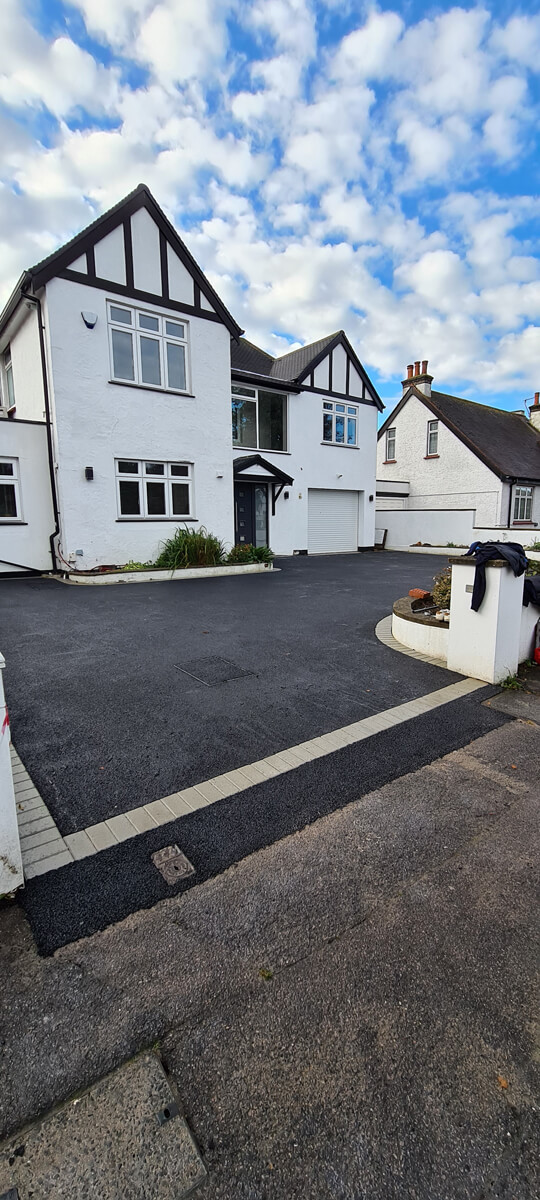
The soil under most of Bransgore is cohesive and shrinks and swells with the seasons. It takes up water in winter and gives it back in summer, and the ground moves a little each time it does. That is why a drive laid on a shallow bed dips in the wheel tracks after a couple of winters, and why a patio laid tight against the house can put water exactly where you least want it, which is down beside the foundation.
So the drainage design is not the last line of the quote here, it is the first decision. Where a soakaway is proposed it wants a percolation test rather than an assumption, because Approved Document H expects the ground to be shown to take the water, and clay like this often will not.
If it will not, the answer is a positive outfall to a surface water drain or a ditch, agreed before the machine arrives. It is also why we keep any soakaway well away from the house and finish the paving with a fall running off the building rather than towards it. None of that is expensive to build in at the start. All of it is expensive to add later.
Who you are dealing with
A local firm you can check
We cover Bransgore, Thorney Hill, Sopley and the BH23 addresses out towards Hinton, with New Forest District Council for planning and Hampshire County Council for anything on the highway. Bournemouth Roofing & Building Ltd, registered in England and Wales, company number 15471719, which you can look up in a minute. Thomas Hannen's business, and he is the one who comes out to price the job, not a salesman. A verified customer's 10 out of 10 on Checkatrade. The visit and the written quote are both free.
Questions
Bransgore questions we get asked
Why does water sit on the surface for days after rain?
Because drainage at Bransgore is impeded rather than free. Water gets into the top of the ground, meets a layer it cannot pass through and backs up. A drive built on that without thought behaves the same way: the stone layer fills, the bedding stays saturated and the blocks start to shift under load. So we build with a drainage layer that has an outlet, rather than one that simply stores water it has no way of losing.
So is a soakaway pointless on a Bransgore plot?
Not pointless, but never assumed. A percolation test goes in at the spot where it would sit, because impeded ground varies inside a single garden and one corner can drain while another does nothing at all. Where the test fails, the design shifts to a positive outfall or to a tank with a controlled release. Building a crate into ground that cannot empty it moves the puddle underground and shortens the life of everything above it.
Our 1970s drive has broken up. Is the base salvageable?
Sometimes the stone is, and it is worth a look before more gets ordered. Bransgore is largely postwar stock, 51.4% of it built between 1945 and 1982, and drives of that age went down on a shallow layer of whatever was cheap at the time. If that layer is clean and thick enough it can be scarified, topped up and recompacted. Full of clay pumped up from below, which happens on this ground, and it comes out.
We keep hearing about the River Avon rules. Do they apply?
They do not bite on paving. Bransgore falls in the River Avon catchment, and the nutrient requirement is triggered by schemes adding overnight accommodation, so it bears on a new dwelling or an annexe and not on a drive or a patio. It gets quoted at people far more broadly than it actually applies. Surface water is the real constraint on a front garden here, and that is a question of where the run off ends up.
What keeps weeds out of the joints on wet ground?
Dry joints. Seed lands on every surface, but it only roots where the jointing material stays damp and holds a little silt, which is exactly what happens on impeded Bransgore ground when a drive drains slowly. Kiln dried sand topped up properly, or a polymeric jointing mortar over a surface that genuinely sheds water, keeps them out far longer than spraying ever will. Getting the fall right does more than any weedkiller.
Nearby, and next door
Driveways and patios near Bransgore
Driveways and patios nearby
Our other trades in Bransgore
Everything we do in Highcliffe Driveways and patios, all areas Every area we cover
Free quote
Get a price for your Bransgore drive or patio
Tell us the address and what you have noticed. We come out, look at the ground and the access, and put it in writing line by line. The visit and the quote both cost nothing.