Insulation in Sopley
Loft top-ups under trussed roofs, cavities checked before they are filled, and the ventilation put right at the same time.
The site visit is free and so is the written itemised quote. Thomas Hannen prices every job himself.
On most houses in Sopley the two jobs worth doing are the loft and the cavity, in that order, and both start with finding out what is already in there. We survey both on a free visit and put the depth, the method and the ventilation work on a written quote before you commit to anything.
People usually ring for one of three reasons. The upstairs rooms are cold and the heating bill has stopped making sense. There is black mould coming back on a bedroom wall faster than it can be washed off. Or somebody has been up in the loft for the Christmas boxes and found the old layer squashed flat under the boards and stopping short of the walls.
None of that is solved by ordering more material. What it needs is somebody up there with a rule and a torch: how deep the existing layer really is once it is lifted, whether the eaves are still open or were closed up when the roof was felted, what the trusses will let you get to, where the tank and the pipe runs sit, and whether the cavity in the walls has ever been touched. Everything after that goes on paper, itemised, so you can compare it properly against anyone else.
The work
Not one truss in that roof can be cut
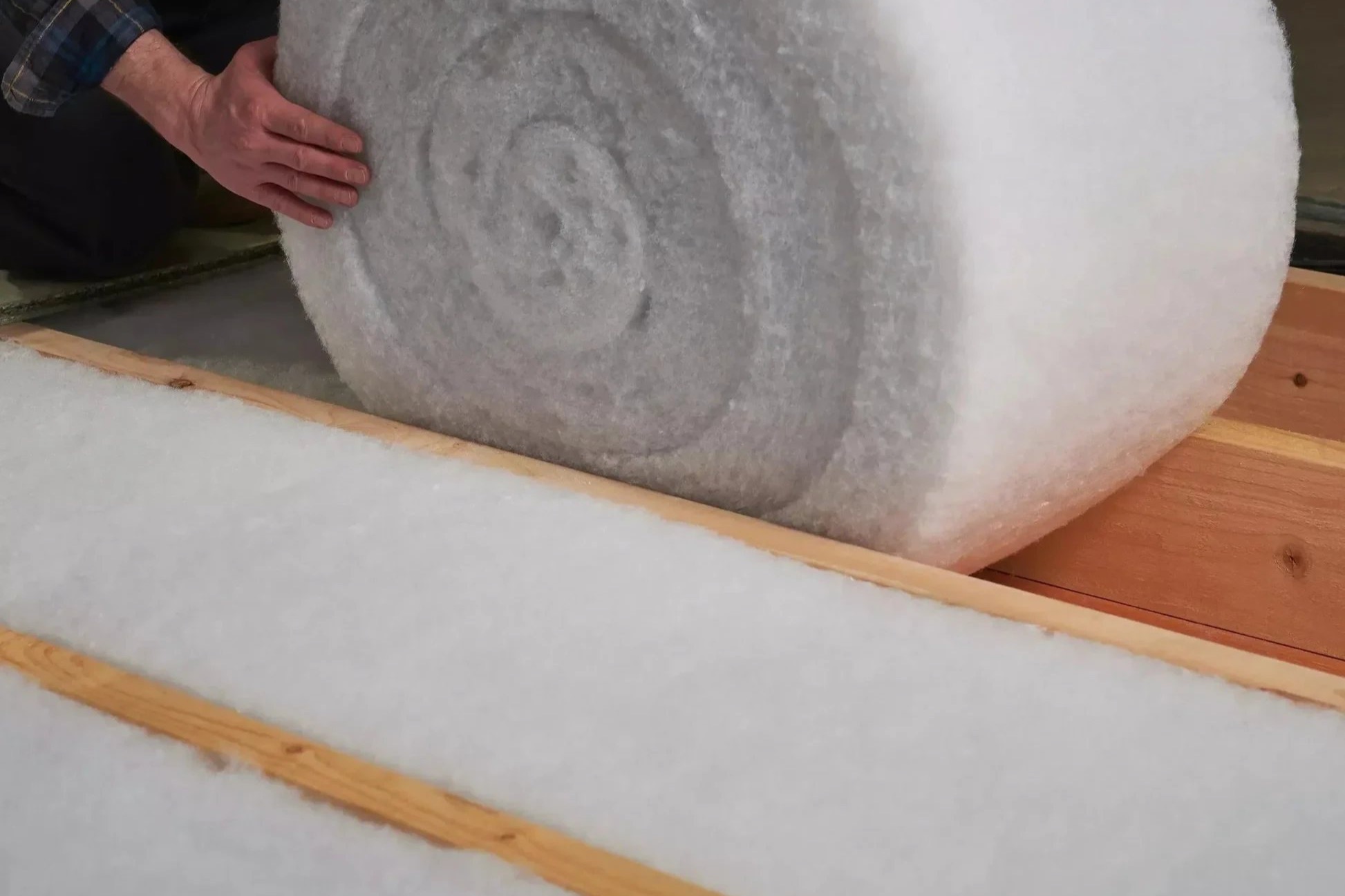
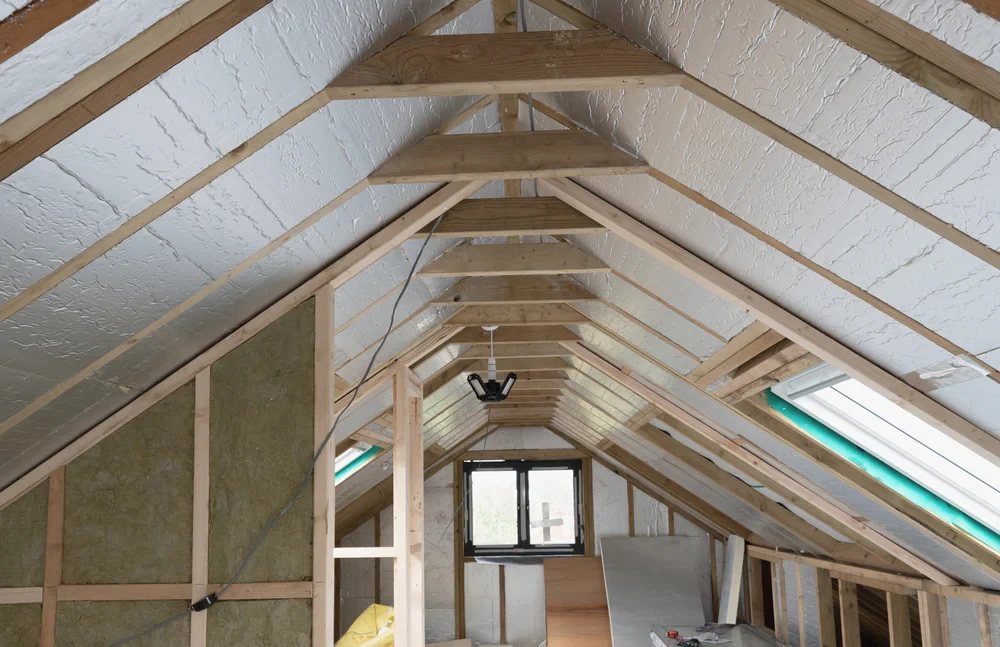
Lofts under a trussed roof. Three quarters of the housing here went up between 1945 and 1982, with the peak in the 1970s and early eighties, and that means most of the lofts are trussed: thin timbers in a W pattern every couple of feet, none of which can be cut, and just enough room to work in if you know where to put your feet. Those roofs were finished with a thin quilt laid one way between the joists, and it has been walked on and stored on ever since. We keep what is sound, take out what has been compressed beyond use, and bring the whole space up to depth with mineral wool laid between and over, the second layer running across the timbers so no truss carries cold straight through the ceiling.
Where your loft actually stops. Terraced houses are nearly half the stock here, and in a run of them the wall between one loft and the next does not always carry on up to the underside of the roof. Sometimes it does, sometimes it stops at ceiling height with a fire barrier above it. Either way the top of that wall is a cold path if nothing is done to it, and it is the edge that gets skipped because it does not look like the outside of the house. We insulate up to it properly and we do not cut, squash or work past a fire barrier to save ourselves a job.
Houses of this age were built with a cavity and a good many round here still have nothing in it, which makes the walls the biggest single thing left to do once the loft is right. It is a borescope job before it is a quote: what the cavity measures, whether anybody filled it in an earlier scheme, and whether that fill has settled and left the top of the wall bare. Where an old fill has bridged and is carrying damp across, more material is the wrong answer and we will tell you so rather than sell it.
A lot of these houses have picked up a rear extension, and the join is where the heat goes: a flat roof deck with an inch of board in it, and a cold bridge where the new wall meets the old one. If that roof is being recovered anyway, a warm roof with rigid board above the deck is the right build-up and far cheaper done while the covering is off.
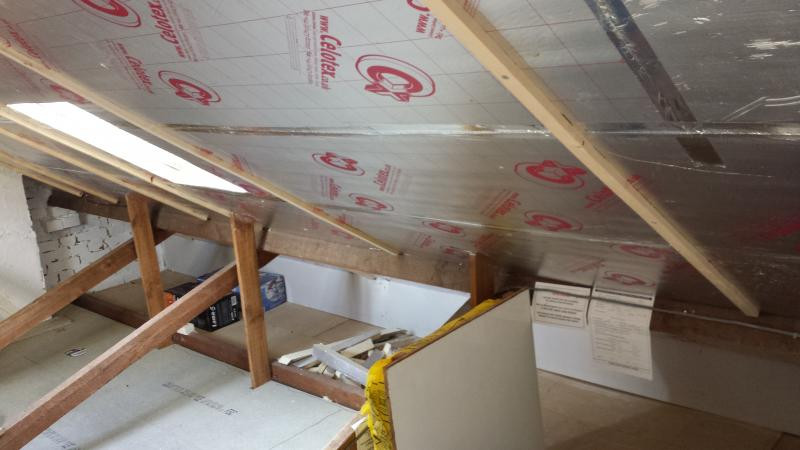
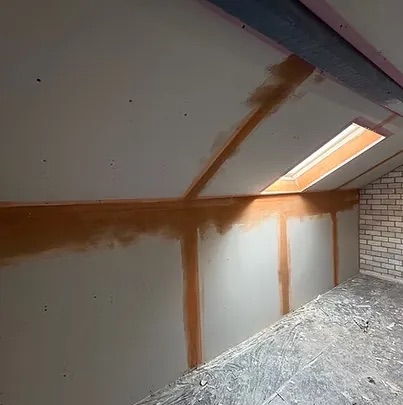
At the village end, inside the Sopley conservation area, there are houses with solid walls and no cavity to fill, where an internal lining has to be vapour open and finished in lime rather than sealed up tight, and there are converted attics with no loft left to work in. Those are rigid board jobs: PIR such as Celotex between the rafters with a clear air gap kept above it, a foil faced board fixed under the rafters, or a multi-layer quilt like TLX where a sloping ceiling has no depth to give away. Dormer cheeks and the voids behind the knee walls are done at the same time. Add an insulated hatch, covers over the downlighters, lagging on the tank, and vent trays at the eaves.
How it runs
From your call to a written price
Insulating a loft or lining a wall on the inside is an improvement rather than development, so no planning permission is needed and it sits inside permitted development. The Planning Portal sets out where that stops. Building control comes in once a thermal element is renovated or the loft becomes a room, and the Building Regulations then set the standard the finished work has to reach. New Forest District Council is the planning and building control authority for this address. Sopley has a conservation area of its own and twenty-six listed entries in and around it, and the National Park Authority publishes its property map, which will show you what sits over your address before you spend anything on drawings.
Cost
What decides the price of an insulation job
No rate per square metre. A terrace with a small hatch on the landing and a trussed roof over it, a bungalow with one wide open loft, and a cottage where the roof pinches down almost to head height at the wall plate are three different days before a roll is opened. Old material that has to be bagged and taken away is a cost before anything new goes down. Approved Document L sets what the finished work has to reach. Ask any quote what depth is going down and whether the eaves are being kept clear.
If it is urgent
Damp, condensation or a room you cannot heat
Ring rather than use the form. A loft dripping with condensation, mould that keeps coming back, or a room that will not hold heat gets looked at quickly. Sopley is a few miles up the road from us, so we can usually get to it in the same week you ring. If water is running down the inside of the roof we will tell you what to open up meanwhile.
Worth knowing
The conservation area, and what it actually stops
The village has a conservation area of its own, and it is worth understanding what that does before you assume it blocks the work. It controls the outside face of the building and how the place looks. It has nothing to say about a loft, an internal wall lining, a floor, a draughtproofed hatch or a cavity fill, because none of those change anything anybody can see from the lane. Almost everything we do in Sopley falls on that side of the line and needs no permission at all.
Where it does bite is anything that alters the outside. External wall insulation is the obvious one, because it thickens the walls, changes the finish and moves every reveal and eaves detail on the house, and on a designated street that is a full planning conversation rather than a technical decision.
Rooflights and dormers on a loft conversion are the other, and inside the National Park permitted development rights are narrower than they are elsewhere, so the honest advice is to check your address on the Authority's map first. Being in it is rarely the end of a scheme. It usually just means the work goes on the inside, which for most of these houses is where the heat was being lost anyway.
Who you are dealing with
A local firm you can check
We cover Sopley, Bransgore, Thorney Hill, Burley and the Ringwood East side on BH23 and down into Christchurch, and here it is the New Forest National Park Authority that deals with planning. Bournemouth Roofing & Building Ltd, registered in England and Wales, company number 15471719, which you can look up in a minute. Thomas Hannen's business, and he is the one who comes out to price the job, not a salesman. A verified customer's 10 out of 10 on Checkatrade. The visit and the written quote are both free.
Questions
Sopley questions we get asked
Nearly half the houses here are terraced. Does that matter?
It does, at the party wall. Terraces are 48.3% of Sopley, and in a terrace the wall between you and next door usually carries on up into the roof void, sometimes with an open gap along the top of it. Warm air rises into that gap and goes. So the job is not just the flat ceiling: the head of the party wall gets sealed and the quilt runs up to it on both sides.
Would external wall insulation get past the conservation area?
Not easily on a front elevation. The Sopley designation controls appearance, and cladding a wall changes the face of the building, the depth of the window reveals and the line of the eaves all at once. New Forest District would want a full application and would very likely refuse it on a visible frontage. A rear elevation nobody sees is a different conversation, and internal lining avoids the argument.
Most of the village went up in the seventies. What fails?
The original loft depth, first. Sopley is 75.4% post war stock with 46.6% dating from the 1970s and early 1980s, and the standard then was a thin layer laid one way between the joists with nothing over the top. It settles, it gets walked on, and it leaves a cold strip above every joist. Running a second layer across the joists rather than between them is what corrects it.
You are only a few miles away. How soon can you look?
Sopley is under six miles from the yard, so usually within a few days and sooner if we are already out that side. Thomas does the visit and prices it himself instead of sending somebody to measure and phoning a figure through afterwards. The visit is free and so is the written itemised quote. If water is coming in, say so when you ring and we work round it.
Why does the south west corner feel colder than the rest?
Because that is the elevation the weather comes from here, and wind does two things at once. It drives rain into the wall so the masonry sits wet and conducts more heat away, and it pushes air through every gap at the eaves and around the openings on that face. The middle of a wall is rarely the problem. Edges, reveals and the wall to ceiling junction are, so that is where we seal.
Nearby, and next door
Insulation near Sopley
Insulation nearby
Our other trades in Sopley
Everything we do in Christchurch Insulation, all areas Every area we cover
Free quote
Start with the loft and the cavity
A free site visit in Sopley, a borescope in the wall and a rule in the loft, and a written itemised quote you can hold against anyone else's.