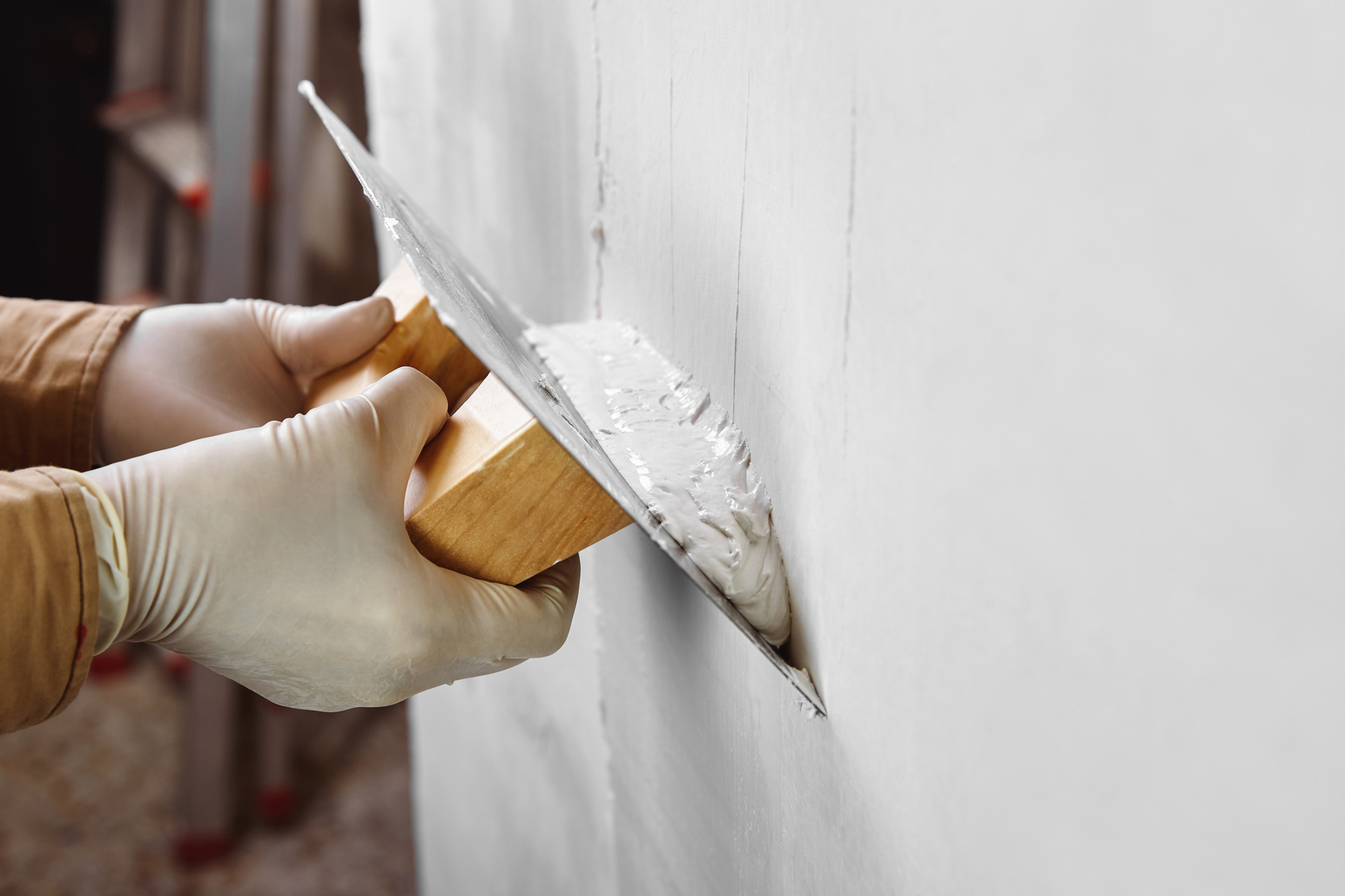
Plastering in Merritown
Replastering wet walls, skimming, ceiling repairs and external render around Merritown and BH23, with the drying time priced honestly rather than skipped.
The site visit is free and so is the written itemised quote. Thomas Hannen prices every job himself.
Plastering is the last job on a wall at Merritown that has been wet, not the first. Replastering over a wall that is still drying is money spent twice. So the useful thing we can tell you on the first visit is whether it is ready and what it wants when it is.
Merritown sits low, with a high surface water risk across it and the Moors River about a kilometre off, so a fair share of the calls out here start with water: a tide mark above the skirting, plaster blowing along the bottom of a wall, or salts blooming through paint that was fine last year. The rest are the ordinary run of the trade, ceilings that have cracked or started to bow and rooms that want skimming before a decorator comes in.
The survey is a knuckle on every wall and ceiling and, where water has been involved, a look at where it came from before anything else. You get a written price with the drying, the stripping and the finish kept on separate lines. The site visit and the quote are free, and we are only about five miles away past the airport.
The work
Nothing goes back on until the wall is dry
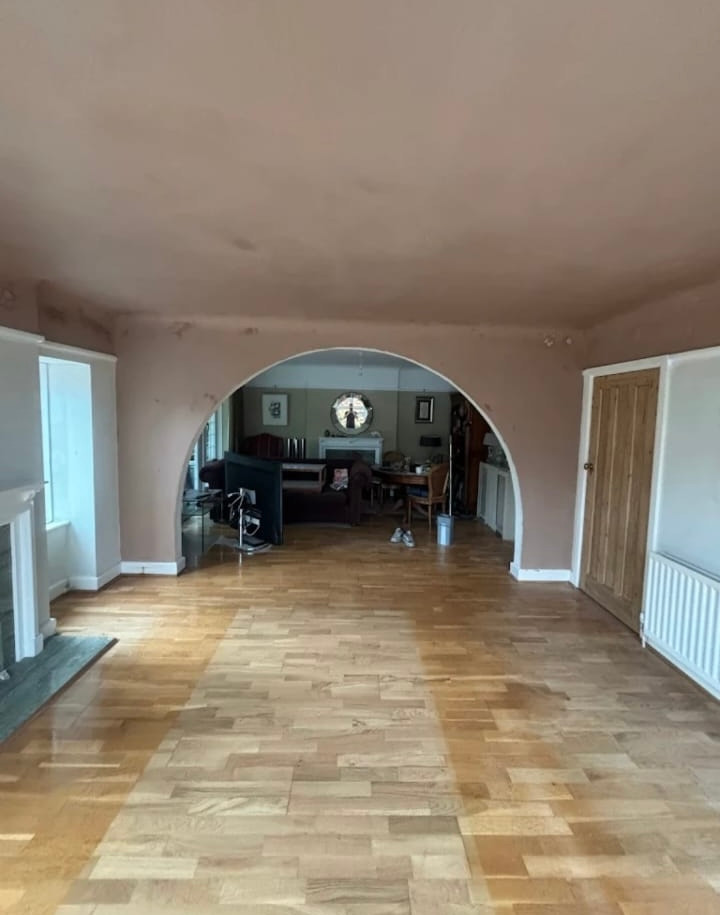
Nothing goes back until the wall is dry. The order matters more than the material. First find where the water came in, because a finish coat over a live leak or a bridged damp proof course fails exactly where it did before. The ground does not help: Merritown sits in flood zone 2 with a high surface water band and the Moors under a kilometre away. Then the loose plaster comes off, and it comes off well above the tide mark rather than level with it, because the damage runs higher than the stain. Then the wall dries, and that takes as long as it takes. Only after that does a backing coat go on, bonding on a dense face and browning or hardwall on something thirstier, floated out and ruled level.
A wall that has been wet a long time carries salts up through the plaster, and salts pull moisture out of the air for years afterwards, so a skim straight over it stays cold and blows again. The options are a sacrificial coat expected to come off, a renovating backing coat that holds the salts back, or on a solid wall a breathable lime plaster. Where a ground floor has been wet once, assume it can happen again: board on stud or on dot and dab, finished in tape and joint with an angle bead at every corner, fixed above a plinth rather than tight to the floor, the bottom board run horizontally, so only one strip has to come off next time.
The base of an external wall is where most of the trouble round here starts. Render run down over the damp proof course bridges it and feeds water into the wall behind, and a path built up over the years does the same. The fix is to cut the render back and finish it on a bell cast bead with a visible gap above the damp course. A failed elevation goes back as a thin coat system rather than the old pebbledash. We will talk you out of replastering before the wall has dried, and out of PVA sold as a damp cure.
How it runs
From your call to a written price
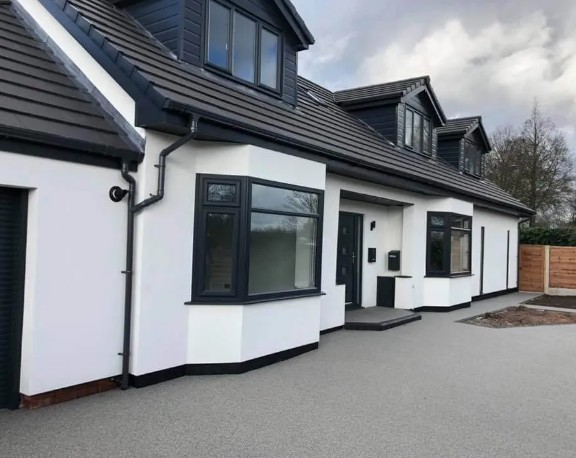
The quote is itemised rather than one figure on the back of a card, the old plaster leaves with us rather than sitting in bags on your drive, and anything uncovered behind the old finish stops the job for a photograph and a price. There is no conservation area over Merritown and only a handful of listed entries in the parish, so on an ordinary house the outside finish is your choice and re-rendering an elevation in a similar material needs no planning permission, with Planning Portal guidance on external walls setting out where that stops. The council keeps the list if you want to check your own address. Renewing render across most of an elevation is where Approved Document L asks whether the wall should be insulated while it is open.
Cost
What decides the price
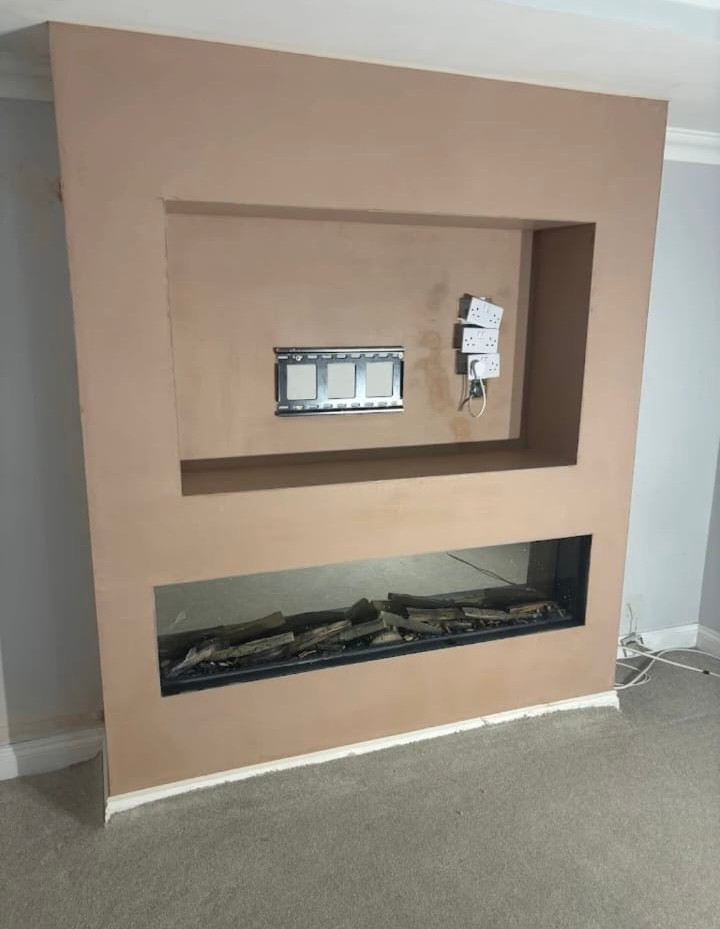
No rate per square metre. What is behind the finish decides it: a sound wall wants a skim, a blown one comes off back to the masonry and brings a backing coat into the job. Drying time on a wall that has been wet is its own line, because nothing goes on until it is ready. Around Merritown access is usually a house on the lane where the van gets onto the drive, or a ground floor room where the furniture has to come out first. Ask whether it is a skim or a full replaster, how long it wants before a mist coat and decorating, and who takes the waste.
If it has come down
A ceiling down, or plaster coming off the wall
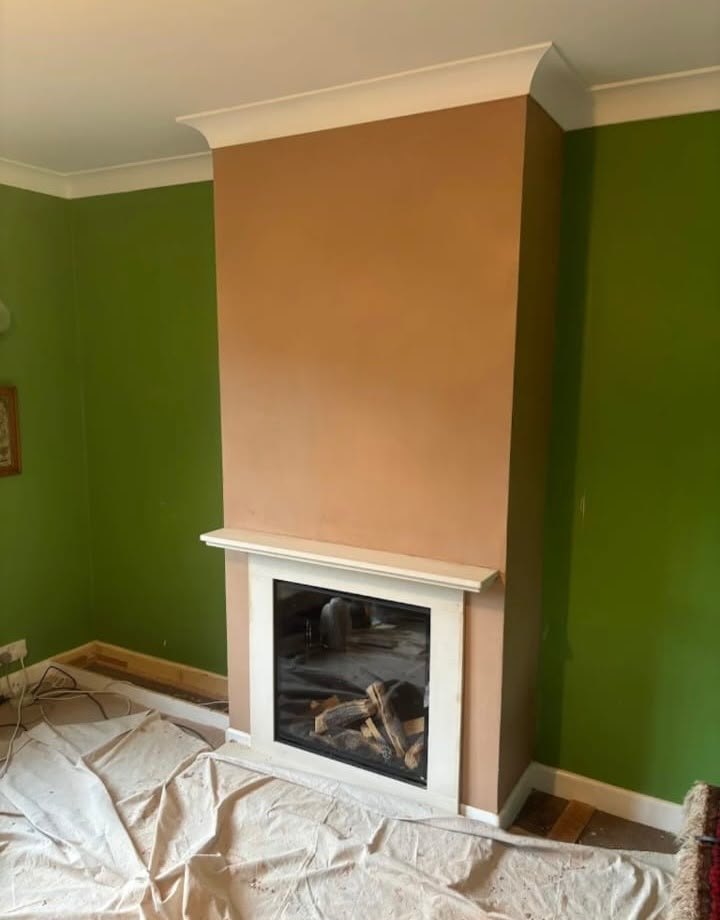
Ring rather than use the form. A ceiling that has cracked and dropped, plaster coming off in sheets, or a wet patch spreading across a wall goes to the front of the queue. Merritown is about five miles from us past the airport, so a same-day look is usually possible, and if water is still coming in we would rather see it while it is happening than after it has dried.
Worth knowing
Low ground, and what that means for the walls
Parts of Merritown fall inside flood zone 2, the surface water risk across the area is rated high, and the Moors River runs about a kilometre away. Risk is drawn address by address rather than village by village, so the government flood risk service is worth two minutes on your own postcode before you spend anything on a wall.
What matters for plastering is not the map, though. It is that a wall which has taken water once behaves differently forever afterwards: it holds salts, it dries slowly from the middle out, and it will show through a new finish coat months after everything looked fine.
So the practical advice is to slow down and change the specification rather than to rush the same job back in. Give the wall real drying time before any plaster goes near it, and expect that to be measured in months rather than weeks on a thick masonry wall. Strip well above the tide mark, because the damage always runs higher than the stain.
Then think about the rebuild as something that might have to come off again: a bottom board run horizontally on a dry lining system, or a sacrificial coat you accept will be replaced, costs very little extra now and turns a repeat into a small job. Tanking and pumps are a different trade and we will say so rather than sell you plaster as a cure for water.
Who you are dealing with
A local firm you can check
About five miles from us, covering Merritown, Hurn, Parley and the BH23 addresses around the airport, with Bournemouth, Christchurch and Poole Council for planning and building control. Bournemouth Roofing & Building Ltd, registered in England and Wales, company number 15471719, which you can look up in a minute. Thomas Hannen's business, and he is the one who comes out to price the job, not a salesman. A verified customer's 10 out of 10 on Checkatrade. The visit and the written quote are both free.
Questions
Merritown questions we get asked
We are in flood zone 2. Does that affect replastering?
It affects what goes back on the wall rather than whether the work can happen. Merritown sits in flood zone 2 with a high surface water band, and the Moors runs about a kilometre away, so the bottom of a ground floor wall can take water from below or from a saturated surface. Where that risk is live we leave the lower section in a cement based backing that survives a soaking instead of gypsum.
Water came in last winter. When can the walls be redone?
Not until the wall itself has dried, which after standing water means months rather than weeks. Skimming over a wall that is still holding moisture traps it, and the finish blows again inside a year. So we open the bottom up, take off whatever has gone, and leave it exposed to dry properly. Given how much surface water gathers around Hurn, it is worth sorting the drainage outside while that is happening.
What render suits a wall that faces the weather here?
Something that flexes. The exposed face here looks south west and sits about seven kilometres from the coast, so it gets driven rain repeatedly rather than an occasional soaking. A silicone topcoat over a mesh reinforced base coat handles that cycle without cracking. Sand and cement on the same wall goes hard, splits at a corner, and then feeds water in behind itself, which leaves you worse off than bare masonry would.
Access here is a lane. Where does the van go?
On the property, normally. Most houses around Hurn have room off the lane, and we would far rather stand on the drive than block a single track for a week. If a scaffold is going up for render we need a clear run alongside the elevation and somewhere the boards can be dropped off. That gets walked through with you on the visit so nothing turns up on the day that cannot get in.
Do we need council permission for external render here?
On a normal house, no. There is no conservation area over Merritown and only three listed entries in the area, so recoating a wall is maintenance and the colour is up to you. Bournemouth, Christchurch and Poole Council is the planning authority if you want that in writing. If the house happens to be one of the three, or you are changing the material rather than renewing it, that conversation comes first.
Nearby, and next door
Plastering and rendering near Merritown
Plastering and rendering nearby
Our other trades in Merritown
Everything we do in Ferndown Plastering and rendering, all areas Every area we cover
Free quote
Get a written price for plastering in Merritown
A free site visit, an honest answer on whether the wall is ready, and an itemised written quote.